How Much Do Independent Stylists Earn After Paying Salon Lease? [2026 Math]
 Scott Farmer
·
September 19, 2026
·
13 min read
Quick Answer: An independent suite stylist in the US takes home about $2,800 to $9,000 a month after rent, product, and tax set-aside. Three numbers set your spot in that range: weekly rent, average ticket, and weekly client count. At a $95 ticket, 25 clients a week, and $350 rent, take-home lands near $5,400 a month.
Last updated: October 7, 2026.
Gross revenue looks great on a suite renter’s bank statement. Then you subtract rent. Then product. Then taxes. I learned that the hard way my first year on my own, when the April tax bill was bigger than what was in my account.
The number that was left made me sit down in the styling chair and stare at the wall for ten minutes.
Not because the number was terrible. It was fine. But it was a lot less than the figure I had been treating as my income for the whole month. That gap between gross and real take-home is where most independent stylists get blindsided.
I am Scott Farmer, Licensed Master Cosmetologist with over 30 years behind the chair and more than 15,000 clients. I ran my own salon, worked as an independent at every model you can name, and today I rent a salon suite in Venice, FL. I have been on a commission split where the salon took 45%. I have been a booth renter writing a rent check every week, and I have rented a suite for the past 15 years. At every stage, the question was the same: what do I take home?
During my years as an Artistic Director at Toni and Guy, I watched dozens of talented stylists make the jump to independent. The ones who ran the math before they signed the lease thrived. The ones who guessed got crushed in month three.
This post gives you the formula I use and the real numbers at three different price points. No motivational talk. Just math you can verify with your own numbers today.
How Much Does an Independent Stylist Earn After Paying Salon Lease?

The short answer is less than you think and more than commission, if you have the volume to fill the chair.
According to the BLS Occupational Outlook Handbook (SOC 39-5012), the median hourly wage for hairdressers, hairstylists, and cosmetologists was $17.21 in May 2025. Independent stylists who run the math on their lease costs earn above that median, but only when they account for every deduction, not just rent.
Here is the reality. When you rent a suite or a chair, your gross revenue is everything the client pays. If you charge $95 for a cut and color and serve 25 clients in a week, your gross weekly revenue is $2,375. Multiply by 4.33 (the average number of weeks in a month) and you gross about $10,284 a month.
That number is not your income. It is revenue. The distance between revenue and take-home is where most independent stylists get confused, get stressed, or get into debt.
Your actual take-home after lease is what remains after four deductions hit: rent, product costs, business expenses, and taxes. Most stylists subtract rent and stop. That is the mistake.
Why the BLS $17.21 Is Not a Booth Renter’s Number
That $17.21 comes from the Pay tab of the same BLS Occupational Outlook Handbook page, and tips are counted in that figure. Then comes the line most salary articles skip. The wage data “does not include pay for self-employed workers.” On the same handbook page, BLS reports that 48% of hairdressers, hairstylists, and cosmetologists are self-employed.
Half the trade is missing from the wage data
Read those two facts together. Close to half the trade is missing from the $17.21, and every booth renter and suite stylist sits in that missing half. The $17.21 describes W-2 employees and says nothing about what a renter keeps. BLS projects 7% job growth for the field from 2025 to 2035, which means more of us will land in that unmeasured group each year.
Gross minus rent is not take-home either
The trap has a second side, because gross bookings minus rent is not take-home either. I made that mistake in my first year on my own. Here is the overhead that leaves a renter’s gross before a single dollar becomes personal income:
- Rent, plus utilities when the lease does not include them
- Color and back bar
- Card processing fees
- Booking software
- Liability insurance
- Continuing education
- Self-employment tax at 15.3% (IRS)
- Unpaid admin hours: ordering, cleaning, texting clients
- Cancellations and no-shows
- The benefits an employer would have covered: health insurance, paid time off, half your payroll tax
One more number for context. A Booksy income guide published September 14, 2026 models pre-tax net for booth renters and suite operators at $62,600 to $97,400 a year. That is a modeled estimate, not a BLS measurement, so treat it as a rough band and run your own figures.
Two tools do that work. The booth rent vs commission calculator handles self-employment tax and the federal bracket for you, and the stylist hourly rate calculator shows your after-expense hourly figure, the number the BLS page cannot give you. Use the calculator to compare booth rent and commission. Its estimate uses a different tax method from the simple 28% set-aside in my formula below.
The Formula: After-Rent Take-Home in 5 Numbers
Here is the formula I run at the beginning of every month. It takes 90 seconds on a phone calculator.
Real Monthly Take-Home Formula:

Step 1: GROSS = Weekly avg ticket x Weekly clients x 4.33
Step 2: RENT = Weekly rent x 4.33
Step 3: PRODUCT = GROSS x 0.10 (adjust 0.08 to 0.12 based on your service mix)
Step 4: EXPENSES = Insurance + software + education + supplies (monthly total)
Step 5: TAX SET-ASIDE = (GROSS - RENT - PRODUCT - EXPENSES) x 0.28
Step 6: TAKE-HOME = GROSS - RENT - PRODUCT - EXPENSES - TAX SET-ASIDE

Worked example. Say you book 28 clients a week at a $105 average ticket and pay $375 a week in rent:
- Weekly average ticket: $105
- Weekly clients: 28
- Weekly rent: $375
Step 1: GROSS = $105 x 28 x 4.33 = $12,731/month
Step 2: RENT = $375 x 4.33 = $1,624/month
Step 3: PRODUCT = $12,731 x 0.10 = $1,273/month
Step 4: EXPENSES = $280/month (insurance $85, software $65, education $50, supplies $80)
Step 5: TAX SET-ASIDE = ($12,731 – $1,624 – $1,273 – $280) x 0.28 = $2,675/month
Step 6: TAKE-HOME = $12,731 – $1,624 – $1,273 – $280 – $2,675 = $6,879/month
That is a 54% take-home rate on gross revenue. Compare that to a 50/50 commission split where your share is $6,366 on the same gross (before your W-2 taxes come out), with no control over your schedule, your prices, or your brand.
The difference compounds. Over 12 months, the independent path nets about $6,156 more in this scenario. Over 5 years, that gap is over $30,000.
Watch the 5-number math in 48 seconds
This video uses an AI version of me, made from my own likeness and voice. The numbers are an example, not tax advice.
Run your own five numbers: Booth Rent vs Commission Calculator
Read the transcript
In a salon suite, your tax bill is bigger than your rent. Here’s the math nobody shows you. 25 clients a week. $95 ticket. That’s about $10,300 a month. Rent’s $350 a week, so you think you’ve got $8,700. But product takes 10%. Insurance, your booking app, the little stuff, another $280. And 28% of what’s left should be set aside for taxes. So what’s really yours? $5,370. That’s about $3,400 a month you thought you had and didn’t. I learned this my first year on my own. April came, the tax bill was bigger than my account, and part of it went on a credit card. Run your own five numbers before you sign anything. The calculator’s free. Link’s on the blog. Plan your life on the small number. Not the big one.
What Does a Salon Lease Cost in 2026?
Salon lease costs vary depending on where you are and what you are renting. Here is what I see across the stylists I work with:
| Lease Type | Weekly Range | Monthly Range | What You Get |
|---|---|---|---|
| Booth rental (basic) | $150 to $350 | $650 to $1,516 | A chair, station, shared backbar, shared reception |
| Booth rental (premium) | $300 to $500 | $1,299 to $2,165 | Above plus towel service, wifi, some products |
| Salon suite (standard) | $250 to $500 | $1,083 to $2,165 | Private room, your own key, utilities included |
| Salon suite (premium metro) | $450 to $800 | $1,949 to $3,464 | Private room in high-traffic area, build-out provided |
The golden rule I learned from running my own salon: your rent should never exceed 15% of your gross monthly revenue. If you gross $8,000 a month, your rent ceiling is $1,200. Go above that and your margins collapse.
In the worked example above, $1,624 in rent on $12,731 gross works out to 12.8%, a comfortable margin. In a slow month at $7,000 gross, that same rent jumps to 23.2% of revenue, which is the danger zone.
How Does Suite Income Compare to Staying on Commission?
This is the question I hear more than any other. “Should I leave commission?”
The answer is math, not feelings. Here is a side-by-side at the same gross revenue:
| Category | Commission (50/50) | Suite Stylist |
|---|---|---|
| Gross monthly revenue | $10,284 | $10,284 |
| Commission or rent deduction | $5,142 (50%) | $1,516 (rent) |
| Product costs | $0 (salon covers) | $1,028 (10%) |
| Business expenses | $0 (salon covers) | $280 |
| Tax set-aside | $1,440 (W-2 withholding) | $2,089 (self-employment) |
| Monthly take-home | $3,702 | $5,371 |
The suite stylist takes home $1,669 more per month in this scenario. That is $20,028 more per year on the exact same client volume and pricing.

But notice the hidden cost on the commission side: the salon provides products, equipment, insurance, software, reception, and marketing. On the suite side, every one of those is your responsibility. If you undercount those expenses, the gap shrinks fast.
When does the commission math beat going independent?
The breakeven point where suite income beats commission depends on your volume. If your weekly client count drops below 15 to 18 clients (depending on ticket and rent), commission can pay more because the fixed overhead of a suite eats into a smaller revenue base. The same holds when your client count stays below 15 at a sub-$80 average ticket and your commission salon covers all product, insurance, and marketing. The crossover point for most stylists is around $5,000 to $6,000 a month in gross revenue.
Use the Booth Rent vs Commission Calculator to run your specific scenario.
How long until a new suite stylist hits break-even?
Most hit monthly break-even in 3 to 6 weeks if they bring an existing book. Starting from zero, expect 8 to 14 weeks. Your break-even client count is your total monthly costs divided by your average ticket. At $5,500 a month in costs and a $95 ticket, you need 58 clients a month (about 14 per week) just to cover expenses. See the Break-Even Calculator to run your numbers.
Can I move to a suite without losing my clients?
Most stylists retain 75% to 90% of their book when they move, especially if they stay within a 15-minute drive of the old location. The clients who leave were convenience clients, not loyalty clients. Start telling your book 6 to 8 weeks before the move and offer to text them your new address directly.
What Does the Math Look Like at Different Average Tickets?
This is where the real conversation starts. Your average ticket is the single biggest lever on your take-home.
All examples below assume 25 clients per week, $350/week rent, $280/month expenses, 10% product cost, and 28% tax set-aside on net profit.
| Average Ticket | Monthly Gross | After Rent | After Product | After Expenses | After Tax | Take-Home | Take-Home % |
|---|---|---|---|---|---|---|---|
| $65 | $7,036 | $5,521 | $4,817 | $4,537 | $3,267 | $3,267 | 46.4% |
| $85 | $9,200 | $7,685 | $6,765 | $6,485 | $4,669 | $4,669 | 50.8% |
| $95 | $10,284 | $8,769 | $7,741 | $7,461 | $5,372 | $5,372 | 52.2% |
| $115 | $12,447 | $10,932 | $9,688 | $9,408 | $6,774 | $6,774 | 54.4% |
| $135 | $14,614 | $13,099 | $11,638 | $11,358 | $8,178 | $8,178 | 56.0% |
The pattern is clear. Below a $75 average ticket with $350 weekly rent, independent math gets tight. Above $95, it starts compounding in your favor. Every $10 increase in your average ticket adds about $700 in monthly take-home at 25 clients per week.
That is why pricing is the first conversation I have with every independent stylist, not marketing.
The Mistake Most Stylists Make Before They Sign the Lease
The mistake is simple: they calculate gross minus rent and call the rest profit.
I did this myself in my first year as an independent, back in my booth-rental days, when I took gross, subtracted rent, and treated the rest as mine. I spent like it.
Then April came, and the self-employment tax plus income tax bill was more than I had in the account. Part of it went on a credit card, which meant I paid interest on my own tax bill for more than a year. Run your own version of that month through the stylist hourly rate calculator before April finds you.
The fix is the formula above. Subtract product. Subtract expenses. Subtract 28% to 30% of what is left for taxes. What is left is real.
I now tell every stylist I work with: open a separate bank account. Every week, move 30% of your profit (what is left after rent, product and expenses) into that account and do not touch it until tax time. What stays in your operating account is your real budget. If that number does not cover your life, your pricing is wrong.

Slow weeks come for every independent stylist. Build a cash reserve equal to three months of fixed overhead (rent, insurance, software) so a week where you only fill 18 chairs does not turn into a cash flow problem. If your fixed costs are $2,200 a month, keep $6,600 untouched in your business account. That buys you time to adjust your marketing, raise prices, or change your schedule instead of panicking.
The Self-Employment Tax Gap Nobody Mentions
When you work on commission with a W-2, your employer pays half of your Social Security and Medicare taxes. That is 7.65% of your income that you never see deducted.
When you go independent, you pay both halves. That is 15.3% on 92.35% of your net self-employment earnings, up to the 2026 Social Security wage base of $184,500 (the 2.9% Medicare part has no cap), per IRS Publication 334 (verify the current year figures with your accountant). On top of your income tax.
On $80,000 of net profit, the self-employment tax alone is about $11,304. That is about $942 a month that you must set aside. A commission stylist earning the same gross never sees this bill because their salon paid half.
This is not a reason to avoid going independent. It is a reason to price correctly. Most independent stylists need to charge 8% to 12% more than they would on commission just to break even after the tax gap.
While you price for the tax gap, price for retirement too, because nobody is funding it for you. I tell stylists to put 15% of gross into a Solo 401(k) or SEP IRA. A stylist saving $11,250 a year from age 30 at 7% average returns builds about $711,000 by age 55 (returns are not guaranteed), and the full plan is in our guide to booth renter retirement savings.

Frequently Asked Questions
How much should a suite stylist charge per hour to cover rent?
Calculate your total monthly costs (rent + product + expenses + tax set-aside), divide by the number of billable hours you work per month. If your costs are $5,500 and you work 120 billable hours, your floor rate is $45.83/hour. Anything below that and you are losing money. I recommend pricing at least 30% above your floor to build margin for slow weeks.
What percentage of revenue should go to rent?
Keep rent at or below 15% of your gross monthly revenue. If you gross $8,000, your rent ceiling is $1,200/month. If rent exceeds 20% of gross for two consecutive months, your pricing or volume needs to change.
Is it better to rent a booth or a suite?
It depends on your revenue level. Below $6,000/month gross, a booth at $200 to $300/week may save enough to matter. Above $8,000/month, a suite gives you a private space, your own brand, and the ability to set your own retail. The math comparison is straightforward with the Booth Rent vs Commission Calculator.
How much do independent stylists make a year?
Based on the numbers I see, independent suite stylists in the US take home $34,000 to $108,000 per year after all deductions. The range is wide because average ticket and client count vary so much. A stylist charging $65 with 20 clients per week lives in a different financial universe than one charging $135 with 30 clients per week.
What hidden costs do new suite stylists miss?
The five most common: liability insurance ($600 to $1,200/year), booking software ($300 to $900/year), continuing education ($500 to $2,000/year), product backbar replenishment (8% to 12% of gross, not just retail inventory), and the quarterly tax payments most stylists only discover when April arrives. Budget $200 to $400/month on top of rent for these items.
Should I raise my prices when I move to a suite?
Yes. Moving to a suite is the single best time to raise prices because clients expect it. You are upgrading their experience with a private space, dedicated attention, and a premium environment. A $10 to $20 increase per service is standard practice and most clients absorb it without pushback.
What Is Your Next Step to Running the Independent Stylist Math?
Going independent is a math decision. When the math works, it is the best move you can make for your income and your freedom. When the math does not work, it is the fastest way to burn through your savings and end up back on commission feeling defeated.
Run your numbers first. Not your feelings.
Start here: Use the free Salon Profit Calculator to see exactly where your money is going and whether independent math works at your current pricing. It takes 5 minutes.
Go deeper: The $17 Salon Owner Starter Pack includes the Budget Template, Pricing Guide, and Price Increase Scripts PRO so you can set your rates with confidence before signing any lease.
Get the full system: HSP Pro gives you the AI Profit Analyst, weekly group coaching with a 30-year master cosmetologist, and a private community of salon owners running the same math you are.
Found this useful? Tell Google you want to see more from Hair Salon Pro in your search results and AI answers.
Free Download
Get the Salon Profit Calculator
See exactly where your salon is losing money in under 5 minutes.
Download Free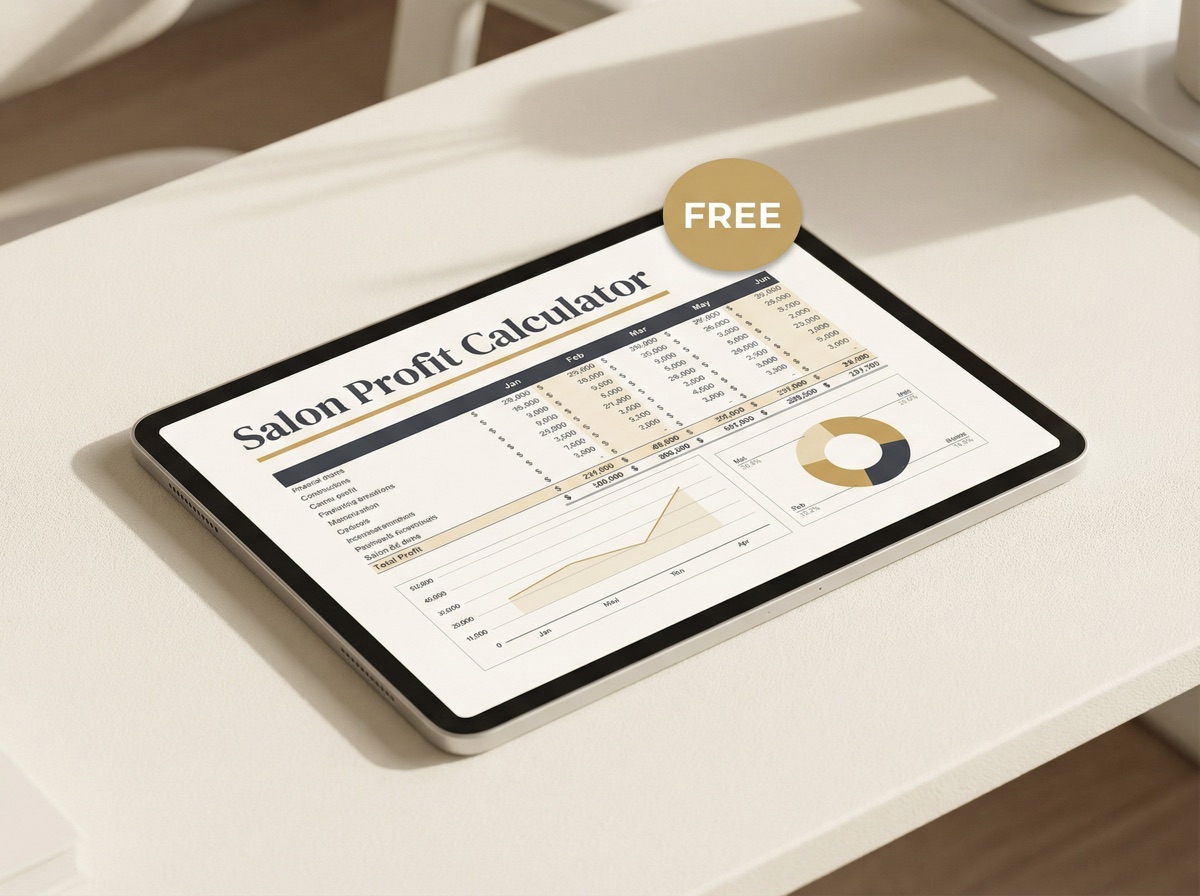
Written by Scott Farmer
Licensed Master Cosmetologist (GA & FL), former Toni & Guy Artistic Director, and founder of Hair Salon Pro. 30+ years behind the chair. 15,000+ clients. Building the business tools cosmetology school never taught. Currently behind the chair at scottfsalon.com in Venice, FL.