Stylist Retirement Savings Self-Employed: The Complete Guide for Booth Renters and Suite Owners
 Scott Farmer
·
April 26, 2026
·
13 min read
Scott Farmer
·
April 26, 2026
·
13 min read
Quick Answer: How do self-employed stylists save for retirement?
Booth renters and suite owners get no employer 401(k), but you can open three accounts with high limits: a SEP IRA up to $70,000 a year, a Solo 401(k) up to $70,000 to $77,500, and a Roth IRA at $7,000 to $8,000. Open one this week at Fidelity, Vanguard, or Schwab. Saving $500 a month from age 25 grows to $606,438.
Nobody sat me down and explained this when I got my license. Additionally, thirty years behind the chair, thousands of clients, and not one instructor, not one salon owner, not one industry mentor ever said: “Hey, you’re self-employed now. That means YOU are responsible for your own retirement.”
I figured it out late. However, a lot of stylists do.
If you’re a booth renter, suite owner, or independent contractor, you are running a small business. As a result, the IRS sees you that way. Your clients see you as the expert. But when it comes to stylist retirement savings as a self-employed professional, most of us are flying blind.
This guide fixes that. In practice, real account types, real 2025 contribution limits, and the math that shows exactly what you’re leaving on the table every year you wait.
TL;DR: Self-employed stylists can access three retirement accounts: SEP IRA (up to $70,000/year), Solo 401(k) (up to $70,000-$77,500), and Roth IRA ($7,000-$8,000). That said, most booth renters and suite owners use none of them. $500/month at age 25 turns into $606,438 by retirement. Open an account this week at Fidelity, Vanguard, or Schwab. Run a free Salon Profit Calculator to find the extra dollars to fund it.
Why Self-Employed Stylist Retirement Savings Work Differently Than W-2

If you work as a W-2 employee at a commission salon, your employer might offer a 401(k) with a company match. For example, you contribute pre-tax dollars, they add free money on top, and the whole thing is automatic.
Booth renters and suite owners get none of that. According to the Bureau of Labor Statistics, the median annual wage for hairdressers and cosmetologists already trails most other professions. Without employer-sponsored retirement benefits on top of lower wages, the gap widens every year.
You’re a 1099 contractor or a sole proprietor. No automatic 401(k). No employer match. Overall, no payroll deductions. Just you, your income, and a pile of quarterly tax estimates.
The upside? Because of this, you actually have access to retirement accounts with higher contribution limits than most employees can touch. The problem is nobody tells you they exist.
W-2 Stylist vs. Self-Employed Stylist: What Changes
| Situation | Retirement Access | Employer Match? | Max Contribution (2025) |
|---|---|---|---|
| W-2 at commission salon | Employer 401(k) if offered | Possibly | $23,500 employee limit |
| Booth renter (1099/self-employed) | SEP IRA, Solo 401(k), Roth IRA | No | Up to $70,000 (Solo 401k) |
| Suite owner (self-employed) | SEP IRA, Solo 401(k), Roth IRA | No | Up to $70,000 (Solo 401k) |
| LLC salon owner with employees | SEP IRA, Simple IRA, 401(k) | You set it | Varies by plan |
The numbers aren’t a typo. Ultimately, a self-employed stylist with a solid income year can shelter far more from taxes than a W-2 employee in the same income bracket. Most stylists never do it because nobody showed them how.
The 3 Retirement Savings Accounts for Self-Employed Stylists
You don’t need to pick all three. But you need to understand all three so you can pick the right one for your situation.
SEP IRA: The Simple One
SEP stands for Simplified Employee Pension. Instead, it lives up to the name.
You open one at any brokerage (Fidelity, Vanguard, Schwab, all free to open). Of course, you contribute up to 25% of your net self-employment income, maxing out at $70,000 for 2025. You get a tax deduction for every dollar you put in. The money grows tax-deferred until you retire.
That’s it. Even so, no monthly contributions required. No paperwork beyond your tax return. You can contribute one lump sum right before your tax deadline in April.
The catch: if you have employees, you have to contribute the same percentage for them as you do for yourself. Still, that’s why SEP IRAs work best for solo operators or one-chair suite owners with no staff.
Solo 401(k): The Power Player
The Solo 401(k), also called an Individual 401(k) or Self-Employed 401(k), is the most flexible account you can open as a self-employed stylist.
You wear two hats here. Beyond that, as the “employee,” you can contribute up to $23,500 in 2025 (or $31,000 if you’re 50 or older, thanks to catch-up contributions). As the “employer,” you can add up to 25% of your net self-employment income on top of that.
Combined limit: $70,000 in 2025, or $77,500 if you’re 50+.
The Solo 401(k) also comes with a Roth option. To be clear, you can designate your employee contributions as Roth (after-tax), which means tax-free growth and tax-free withdrawals in retirement. No income limits on the Roth option when it’s inside a Solo 401(k).
The downside: more paperwork than a SEP IRA. Once your account balance hits $250,000, you have to file Form 5500-EZ with the IRS annually. And you must open the account by December 31 of the tax year you want to use it for. Meanwhile, a SEP IRA, by contrast, can be opened up until your tax deadline.
Roth IRA: The Tax-Free Foundation
A Roth IRA is different from the others. In contrast, you contribute after-tax dollars now, and everything grows completely tax-free. In retirement, you pay zero taxes on withdrawals.
The 2025 contribution limit is $7,000 per year ($8,000 if you’re 50+). With that in mind, that’s not much compared to a SEP or Solo 401(k), but the tax-free growth is powerful over time.
There’s an income limit: you can only contribute the full amount if your modified adjusted gross income is under $150,000 as a single filer (or $236,000 married filing jointly) in 2025. Furthermore, the ability to contribute phases out above those thresholds.
For most stylists building a client base, a Roth IRA makes an excellent starting point. In other words, low barrier to open, flexible withdrawals on contributions (not earnings) if you ever need the money back, and decades of tax-free compounding.
During my time working as an artistic director at Toni and Guy, I watched stylists at the top of their craft retire with almost nothing saved. At the same time, incredible talent behind the chair. Zero plan for what came after. A Roth IRA opened at 25 would have changed their lives by 60.
The Full Comparison: SEP IRA vs. Solo 401(k) vs. Roth IRA
| SEP IRA | Solo 401(k) | Roth IRA | |
|---|---|---|---|
| Who qualifies | Self-employed, 1099, sole props | Self-employed, NO full-time employees (spouse ok) | Anyone with earned income under income limits |
| 2025 contribution limit | Up to 25% of net SE income, max $70,000 | Up to $70,000 ($77,500 if 50+) | $7,000 ($8,000 if 50+) |
| Tax treatment | Pre-tax contribution, taxed on withdrawal | Pre-tax or Roth option | After-tax contribution, tax-free withdrawal |
| When to open | By tax filing deadline (April + extensions) | By December 31 of the tax year | Any time |
| Deadline to contribute | By tax filing deadline | Employee portion by Dec 31; employer portion by tax deadline | By tax filing deadline (April) |
| Good for | Simple solo operation, high earners | High earners who want flexibility + Roth option | Everyone. Great starting point |
| Employees allowed | Must contribute same % for all eligible employees | No full-time W-2 employees (aside from spouse) | No restrictions |
| Paperwork | Very low | Moderate (Form 5500-EZ over $250K) | Very low |
The Math That Should Make You Act Today
$500 per month. That is the number.
If you’re a booth renter clearing $4,000-$6,000 a month, $500 into a retirement account is roughly 8-12% of your income. Reasonable. Not painful.
At a 7% average annual return over 20 years:
$500/month x 7% for 20 years = $261,492
Put that same $500/month away for 30 years:
$500/month x 7% for 30 years = $606,438
The difference between starting at 35 versus 25 is nearly $345,000. Notably, from the same monthly contribution. That’s not a motivation speech. That’s compound interest.
Now flip it. Importantly, what if you do nothing for 10 years and start at 35?
You’d need to contribute over $1,200 per month for 20 years to match what $500/month would have built starting at 25.
You can run your own numbers with the Hair Salon Pro Profit Calculator. Additionally, it is not a retirement calculator specifically, but knowing your real take-home after expenses is the foundation for figuring out how much you can actually set aside.
What This Looks Like on a Real Stylist’s Numbers
Say you net $60,000 this year as a suite owner after chair rent, supplies, and business expenses. However, here is what each account allows:
- Roth IRA: $7,000 contribution. You get no tax deduction now, but it grows tax-free forever.
- SEP IRA: 25% of net self-employment income (net SE income after SE tax deduction ≈ $56,729). That’s up to $14,182 deducted straight off your taxable income.
- Solo 401(k): Employee contribution $23,500 + employer contribution ~$14,182 = $37,682 total. Best option for high earners who want to shelter the most income.
One good year of contributions with a Solo 401(k) could reduce your taxable income by over $37,000. As a result, for a stylist in the 22% federal bracket, that’s more than $8,000 back in your pocket at tax time.
Stylist Retirement Savings: Who Can Do What
Not every account is available to every stylist. In practice, here is how to match your situation to the right account.
You’re a Booth Renter (1099)
You are self-employed. That said, all three accounts are available to you. Start with a Roth IRA if you’re newer in your career or have inconsistent income. Add a SEP IRA or Solo 401(k) once your income stabilizes and you want to shelter more.
You’re a Suite Owner (No Employees)
Same as above. For example, all three accounts work. The Solo 401(k) becomes especially attractive once you’re netting $80,000+ per year. The combined employee + employer contribution structure lets you shelter more than a SEP IRA at most income levels.
You’re a Commission Stylist (W-2)
Your employer retirement options depend on what your salon offers. If they have a 401(k) with a match, use it up to the match. In fact, free money first, always. You can also open a Roth IRA on top of your employer plan, as long as your income is under the threshold.
You cannot open a SEP IRA or Solo 401(k) for W-2 income alone. Overall, these accounts require self-employment income.
You Own a Salon with Employees
You can still use a SEP IRA, but if you do, you must contribute the same percentage for all eligible employees as you contribute for yourself. Because of this, that changes the math quickly. At this stage, talk to a CPA about a SIMPLE IRA or a traditional 401(k) with a plan administrator. The rules get more complicated, and the stakes are higher.
For deeper context on what salon ownership actually costs and earns, the post on how much salon owners make breaks down the real income picture across different business models.
The Biggest Mistakes Stylists Make With Retirement
Most stylists who miss retirement savings are not lazy or irresponsible. Ultimately, they just never got the memo. But there are patterns worth knowing.
Waiting for a “good” income year to start. Instead, there is no perfect year. Start small. $100 a month into a Roth IRA is infinitely better than $0. The account gets opened, the habit gets built, and you increase contributions as income grows.
Treating booth rental like a side hustle. If your chair income is your main income, you are running a business. Treat it that way. Read the guide on booth rental vs. commission if you haven’t sorted out the business structure question yet.
Skipping contributions after a slow month. Even so, inconsistent contributions are fine. Stopping entirely is the problem. Even $50 in a rough January keeps the habit alive.
Missing the tax deduction. Still, every dollar you put into a SEP IRA or pre-tax Solo 401(k) reduces your taxable income dollar-for-dollar. If you skip the contribution, you hand that money to the IRS instead. That’s a real cost, not a hypothetical.
Not knowing about the self-employment tax deduction. Before you calculate your SEP IRA contribution ceiling, you get to deduct half of your self-employment tax (15.3%) from your net earnings. Beyond that, this lowers the base you calculate 25% against. Your CPA handles this, but it means your real SEP ceiling is slightly lower than “25% of gross self-employment income.”
How to Actually Open an Account This Week
You don’t need a financial advisor to get started. To be clear, you need 20 minutes and a social security number.
- Pick a brokerage. Fidelity, Vanguard, and Schwab all offer SEP IRAs, Solo 401(k)s, and Roth IRAs at zero cost to open.
- Choose your account type. Roth IRA if you’re just starting. SEP IRA if you want simplicity and a tax deduction. Solo 401(k) if you want maximum contribution room.
- Fund it. You can start with as little as $1 at most brokerages. Automate a monthly transfer if you can.
- Invest it. The account sitting in cash does nothing. A low-cost index fund (like a target-date fund set to your expected retirement year) is the default smart choice for most stylists.
- Track it. Log in once a quarter. That’s all it takes.
For stylists who’ve been too “busy” to start, this connects directly to the bigger business question: where is your money actually going right now? If you want a clear picture, the free Salon Profit Calculator shows you exactly where money is hiding in your business so you can find the dollars to start funding your future.
Legal and Financial Disclaimer
The information in this article is for educational purposes only and does not constitute tax or financial advice. Meanwhile, contribution limits, income thresholds, and tax rules change annually. Your actual contribution limits depend on your net self-employment income, business structure, and tax situation. Consult a licensed CPA or financial advisor before making decisions about retirement accounts or tax strategy. IRS Publication 560 (Retirement Plans for Small Business) is the authoritative source for self-employed retirement plan rules.
Also useful: the hair stylist tax deductions checklist on this site walks through what you can legally write off as a self-employed stylist, which affects your net income and therefore your retirement contribution ceiling.
Frequently Asked Questions
Can a booth renter open a Solo 401(k)?
Yes. If you receive 1099 income as an independent contractor and you have no full-time W-2 employees (a spouse can work in the business without disqualifying you), you can open and contribute to a Solo 401(k). In contrast, you must open the account by December 31 of the tax year you want to use it.
How much can a self-employed hairstylist contribute to a SEP IRA in 2025?
Up to 25% of your net self-employment income, with a maximum of $70,000 for 2025. With that in mind, net self-employment income is calculated after deducting half of your self-employment tax. For most stylists, this means your actual SEP contribution ceiling will be slightly less than 25% of your gross chair income.
What is the income limit for a Roth IRA for self-employed stylists in 2025?
For 2025, single filers can contribute the full $7,000 if their modified adjusted gross income is $150,000 or less. The ability to contribute phases out between $150,000 and $165,000. Above $165,000, you cannot contribute directly to a Roth IRA (though a backdoor Roth IRA strategy exists, so ask a CPA).
Can a stylist have both a SEP IRA and a Roth IRA?
Yes. These are separate accounts with separate rules. You can maximize your SEP IRA contribution for the tax deduction and also contribute up to $7,000 to a Roth IRA in the same year, as long as your income is under the Roth IRA threshold. Many stylists use both.
When is the deadline to contribute to a SEP IRA?
You have until your tax filing deadline, including extensions. For most self-employed stylists filing as sole proprietors, that is April 15, 2026 for the 2025 tax year, or October 15, 2026 if you file a six-month extension. This makes the SEP IRA particularly flexible. You can wait until you know your final income for the year before deciding how much to contribute.
What happens to my retirement savings if I move from booth rental to owning a salon?
Your existing accounts stay yours. You do not lose them. If you hire employees after opening a SEP IRA, you will be required to contribute the same percentage for eligible employees as you contribute for yourself in future years. This is a significant cost consideration when scaling from solo operator to employer. A Solo 401(k) must be closed or converted once you have full-time W-2 employees.
Double Your Chair Income, Without Working More Hours
You cannot save what the business never pays you. When you run your numbers, I teach the Profit-First System that finally puts money in your pocket to invest.
Run the Free Salon Profit Calculator
Free. Available now. No registration required.
Free Download
Get the Salon Profit Calculator
See exactly where your salon is losing money — in under 5 minutes.
Download Free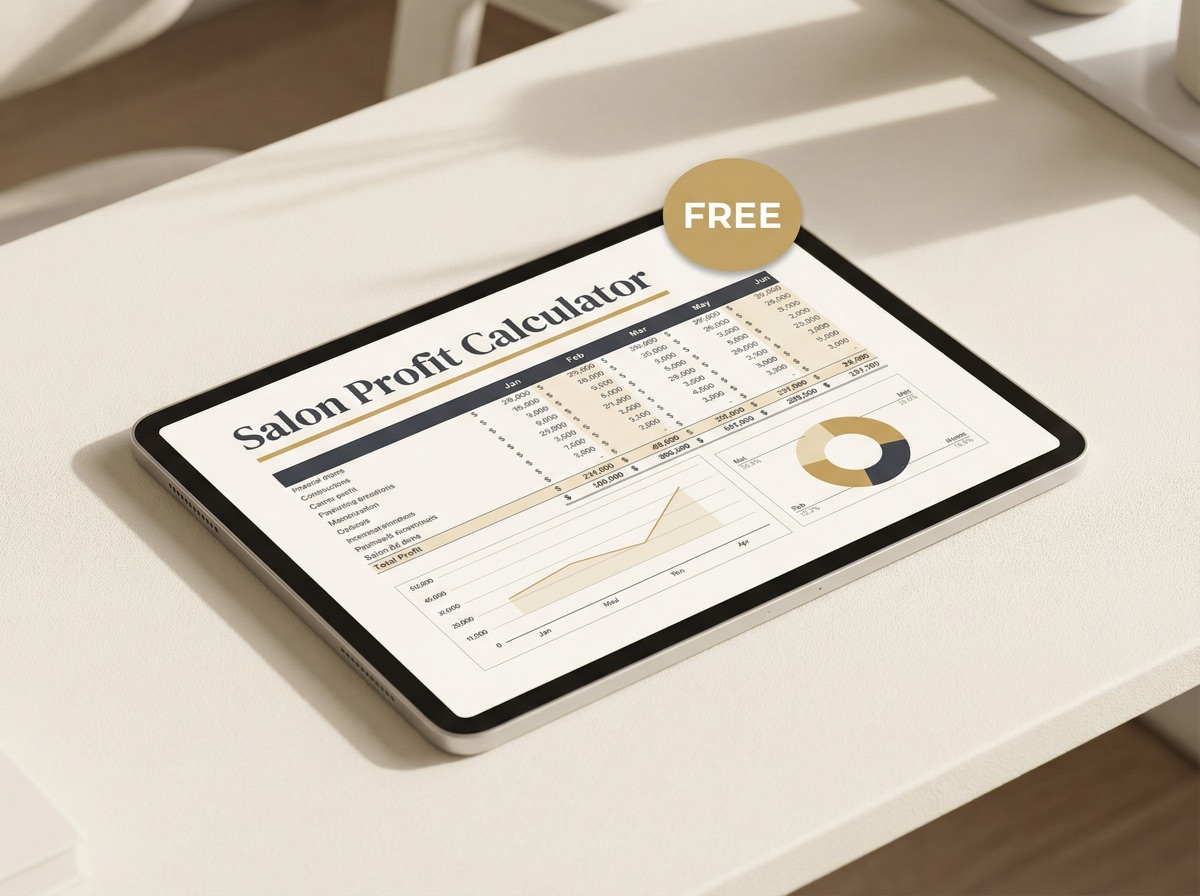
Written by Scott Farmer
Licensed Master Cosmetologist (GA & FL), former Toni & Guy Artistic Director, and founder of Hair Salon Pro. 30+ years behind the chair. 15,000+ clients. Building the business tools cosmetology school never taught. Currently behind the chair at scottfsalon.com in Venice, FL.