Local SEO for Hair Salons: How to Rank on Google in 2026 (Complete Guide)
 Scott Farmer
·
May 6, 2026
·
24 min read
Scott Farmer
·
May 6, 2026
·
24 min read
Quick Answer: How do hair salons rank on Google in 2026?
You rank by showing up where local clients already search and building credibility there. Set up and optimize your Google Business Profile, build service pages, run a steady review strategy, add citations and schema markup, and account for AI-powered search. Work through it once and your salon becomes easier to find than 95 percent of the competition in your area.
Before Google existed, Scott Farmer was already doing local SEO for hair salons. Additionally, he just didn’t call it that.
“Word of mouth and being visible. However, you walked in somewhere, you introduced yourself, you built relationships with people who already had the clients you wanted. A good relationship with a front desk person at a hotel or a real estate agent who works with relocating families was worth more than any ad.”
That was the game in 1995. As a result, build trust with the right people. Get seen by the clients who are already looking.
The principle hasn’t changed. In practice, google just scaled it.
Local SEO for hair salons works exactly the same way: you show up where your potential clients are already searching, you build credibility, and you make it easy for them to choose you over the salon down the street. That said, a hotel front desk person in 1995 told ten people a week about the best salon in town. Your Google Business Profile tells ten thousand. The tool is different. The logic is identical.
This guide covers everything you need to do that: Google Business Profile setup, service pages, reviews, citations, schema markup, and what’s changed with AI-powered search in 2026. For example, work through this once and your salon will be easier to find than 95% of the competition in your area.
Table of Contents

- Why Local SEO Is the Most Valuable Marketing Channel a Salon Has
- How Google Decides Who Ranks Locally
- Your Google Business Profile, The Foundation
- Local SEO for Hair Salons: Service Pages That Win
- The Review Strategy That Actually Moves Rankings
- Why Your Online Presence Might Be Costing You Clients
- Local Citations
- Your Website’s Role in Local SEO
- Schema Markup for Hair Salons
- AI Overviews and the New Era of Local Search
- Competitor GBP Analysis
- Your Local SEO 90-Day Action Plan
- FAQ
Why Local SEO Is the Most Valuable Marketing Channel a Salon Has
Someone searching “hair salon near me” is not browsing. In fact, they want an appointment. Today.
That’s the difference between search traffic and social media traffic. When someone finds you on Instagram, they might follow you, watch your reels, like your photos. Overall, maybe they book in three months. Maybe never.
When someone searches “balayage salon [your city],” they have their phone out and they’re ready to book. Because of this, search intent is the closest thing to a guaranteed lead that exists in marketing.
The numbers back this up. Ultimately, local search traffic converts at 28% for phone calls and in-store visits, according to Google’s own data. Social media traffic to most service business websites converts at under 2%. That’s 14 times more action per visitor from search.
The three places Google displays local businesses:
- Google Business Profile (the Map Pack), The 3 listings that appear above organic results, with the map on the right. This is prime real estate.
- Organic search results, Your website’s blog posts and service pages ranking below the Map Pack.
- Google Local Services Ads, Paid ads that show above the Map Pack. Pay-per-lead, not pay-per-click.
The Map Pack is where you want to be. Instead, studies consistently show the top 3 spots capture 80% of clicks. If you’re not in those top 3, most potential clients in your area never see you.
Most salons do local SEO for hair salons poorly. Of course, that gap is your opportunity.
How Google Decides Who Ranks Locally
Google uses three factors to rank local businesses. Even so, understanding all three changes how you approach everything.
Relevance
Does your listing match what the person searched for?
If someone searches “balayage specialist near me” and your Google Business Profile doesn’t mention balayage anywhere, Google has no reason to show you. Still, this is why filling out every field in your GBP matters. Google can only show relevant results for categories and services it knows you offer.
Proximity
How close is your salon to the person searching?
You can’t move your salon closer to every searcher, so proximity is the factor you have the least control over. But here’s what most guides don’t tell you: proximity matters less than it used to. Beyond that, google has gotten much better at prioritizing relevance and prominence over raw geography.
A salon 2 miles away with 200 reviews, a complete GBP, and active posting can outrank a salon half a mile away with 15 reviews and a half-filled profile.
Prominence
How well-known and credible is your business online?
This is the factor with the most room for improvement. To be clear, prominence is built from reviews, backlinks, citations, website authority, and how often your business is mentioned online. Every action in this guide builds prominence.
Your Google Business Profile, The Foundation
Your Google Business Profile is the single most important local SEO asset you have. Meanwhile, more important than your website for Map Pack rankings. More important than any social profile.
Scott runs a salon in Venice, FL. In contrast, venice is a smaller market where word gets around fast. His results with GBP have been direct and measurable.
“Google Business Profile, reviews, and showing up consistently. With that in mind, venice is a smaller market, people talk. If you do good work and you ask for the review while the client is happy, it compounds. One good review leads to another. The salons that don’t ask don’t get them.”
Get this right before you do anything else.
Claiming and Verifying Your Profile
Go to google.com/business. Furthermore, search for your salon name. If it exists and you haven’t claimed it, claim it. If it doesn’t exist, create it.
Verification usually happens via postcard (5-7 days), phone, or video. In other words, an unverified profile is essentially invisible.
Filling Out Every Field, Including the Ones Most Salons Skip
Most salon owners fill in the name, phone, address, and hours. That’s it. At the same time, that leaves a significant amount of relevance signals on the table.
Go through every single section:
Business Name, Use your real business name only. Notably, no keyword stuffing. “Sarah’s Salon, Best Balayage in Austin” will get your profile suspended.
Address, Match exactly what’s on your website, invoices, and every directory. Importantly, character-for-character.
Phone Number, Local number, not a tracking number or national line. Additionally, this builds trust with Google.
Hours, Keep these accurate. However, wrong hours lead to bad reviews. Update for holidays every time.
Website, Link to your homepage or booking page.
Business Description, You get 750 characters. Use them. As a result, include your city, your primary services, what makes you different, and 2-3 natural mentions of keywords like “hair color in [city]” or “balayage specialist.” Write for a human, not an algorithm.
Primary Category, “Hair Salon” for most salons. In practice, this is the most important category field.
Secondary Categories, Add everything that applies: “Hair Color Salon,” “Hairdresser,” “Beauty Salon,” “Nail Salon” if you offer nails. That said, the more relevant categories you list, the more searches you appear in.
Services, This is the most underused section in GBP. For example, add every service with a description and price range. “Balayage,” “Keratin Treatment,” “Men’s Haircut,” “Brazilian Blowout”, all of it. Use the exact terms your clients search for.
Products, If you retail any products, list them here.
Attributes, Check every box that applies: “Women-led,” “Wheelchair accessible,” “LGBTQ+ friendly,” “Free Wi-Fi.” These show up on your profile and in filtered searches.
The GBP Q&A Section, Seed It Yourself
The Q&A section on your profile is ignored by almost every salon owner. This is a mistake.
Anyone can ask and answer questions on your profile. If you don’t seed it, you risk random people giving inaccurate answers that potential clients see before they ever contact you.
Create 8-10 questions yourself and answer them:
- “Do you do balayage?”
- “Is parking available?”
- “How far in advance do I need to book?”
- “Do you take walk-ins?”
- “What hair color brands do you use?”
Use your target keywords naturally in the answers. In fact, these Q&As are indexed by Google and can help you rank for those terms.
Your GBP Photo Strategy
Google’s data shows profiles with more than 100 photos get 1,065% more website visits than profiles with fewer than 10. Overall, that number is not a typo.
You don’t need 100 photos on day one. But you need a system.
Upload at minimum:
– 10-15 before/after client photos (with permission)
– Interior shots: reception, styling stations, shampoo bowls
– Exterior shots: front door, parking area, signage
– Team photos: individual and group
– Products you use and retail
– Your logo as your profile photo
Post new photos weekly. Because of this, this signals to Google that your business is active. Stale profiles with no new photos for 6 months quietly drop in rankings.
Name your photo files before uploading: “balayage-hair-salon-venice-fl.jpg” rather than “IMG_4872.jpg.” Small detail. Adds up.
The GBP Posting Calendar
GBP posts expire after 7 days (except events and offers). Ultimately, post twice a week to keep fresh content on your profile.
What to post:
- Service spotlights, “Book a Keratin Treatment this month. Smooth, frizz-free results for 3-4 months. Link in bio.” Include a before/after photo.
- Client results, Single photo, 2-3 sentences describing the transformation and what service was done.
- Seasonal offers, “Summer Hair Check. Split end treatment + toner refresh. Book before June 30.”
- Behind the chair, A quick clip or photo of a service in progress.
Batch these on Sunday for the week. Instead, two posts per week, every week. This habit moves rankings faster than most people expect.
Local SEO for Hair Salons: Service Pages That Win
Here’s the mistake most salons make: one “Services” page listing everything they offer. Short descriptions. No city mentioned. No depth.
Google cannot rank a generic services page for “balayage specialist [city]” because there’s nothing on that page telling Google it’s about balayage in that city.
The fix is dedicated service pages, and this is one of the most important local SEO moves for hair salons.
Why One Services Page Loses
A generic services page tries to rank for 20 different keywords at once. Of course, it does none of them well. Google rewards depth and specificity.
How to Build a “Balayage in [City]” Page That Ranks
Each major service gets its own page. Not a paragraph. A full page.
If someone in your city searches “balayage specialist near me,” what would the perfect page look like for them? Even so, it would explain what balayage is, who it’s right for, what the process looks like, how long it takes, what it costs, who’s doing it, and how to book. That’s 600-1,200 words of content, minimum.
Anatomy of a Local Service Page
URL: yoursalon.com/balayage-[city]-[state] (e.g., yoursalon.com/balayage-venice-fl)
Title Tag: Balayage in Venice FL | [Salon Name]
H1: Balayage in Venice, FL, Natural, Sun-Kissed Color Done Right
Opening paragraph: Include the service name, city, and what makes your approach different. Still, this is the first 100 words. Make them count.
Body content:
– What the service is and who it’s for
– Your process, step by step
– How long it takes and what to expect
– Pricing (or a range. Don’t hide it)
– Who performs the service (a named stylist if possible)
– Real client results with photos (alt text should include city and service name)
– A clear booking CTA
Include an embedded Google Map, your address in the footer, a link to your GBP, and internal links to related blog content like how to price salon services for maximum profit.
How Many Pages and Where to Start
Start with your top 3 revenue services. To be clear, for most salons that’s:
- Color services (balayage, highlights, all-over color)
- Haircut and styling
- Keratin or chemical treatments
Build those first. Once they’re live and indexed, add the next tier: extensions, bridal, men’s services. Meanwhile, over 12 months you’ll have 10-15 dedicated local service pages working for you 24 hours a day.
The Review Strategy That Actually Moves Rankings
This is where Scott’s Venice experience gets specific, and it’s worth understanding exactly why.
“If you do good work and you ask for the review while the client is happy, it compounds. In contrast, one good review leads to another. The salons that don’t ask don’t get them.”
That last sentence is the whole strategy. With that in mind, the work is the easy part. The asking is where most salons fail.
Review Velocity Beats Review Volume
Four new reviews this month beats 40 reviews from two years ago.
Google’s algorithm values recency. Furthermore, a salon with 80 reviews all from 2022 ranks lower than a salon with 45 reviews spread across the last 18 months. Steady, consistent new reviews are what move the needle. That’s what velocity means.
Target: 4 new reviews per month, minimum.
Which Platforms Matter in 2026
In order of local SEO impact:
- Google, The only one that directly affects Map Pack rankings. This is your primary focus.
- Yelp, Still relevant, especially in competitive markets. Google pulls Yelp reviews into local knowledge panels.
- Facebook, Matters for social proof and trust. Less direct SEO impact.
- StyleSeat / Vagaro / Booksy, Platform-specific reviews that help within those booking systems.
80% of your effort goes to Google. The rest is bonus.
The Exact Moment to Ask, and What to Say
The best time to ask is right after the appointment, while the client is still in the chair or standing at the checkout desk. They’re happy. In other words, their hair looks great. That emotion is what drives action.
Don’t wait until they’re in the car. At the same time, don’t send a text two days later as your first ask. Ask in person, at peak happiness, before they leave.
Here’s how to do it without feeling transactional:
“You look amazing. If you have 60 seconds, I’d really appreciate it if you left us a Google review, it helps more than anything else I can do. Notably, i have a QR code right here.”
Then hand them a card with your Google review QR code. Importantly, you can generate one for free at Google’s review link generator. Print 50 cards. Keep them at the desk.
That’s it. No apps. Additionally, no complicated systems. Hand them a card, say those words.
Word-for-Word Email Template
Send this within 24 hours of their appointment:
Subject: How’d we do, [First Name]?
Hi [First Name],
Thanks so much for coming in yesterday. However, i hope you’re getting compliments on your hair.
If you have 60 seconds, leaving us a Google review makes a huge difference for the salon. As a result, you can do it right here: [YOUR GOOGLE REVIEW LINK]
It doesn’t need to be long. In practice, even just a sentence or two helps.
Thank you,
[Your name]
[Salon name]
Word-for-Word Text Message Template
SMS has a 98% open rate vs email’s 21%. That said, for clients who’ve given you their mobile number:
“Hey [First Name], loved having you in today! If you have a sec, a Google review would mean the world: [SHORT LINK]. For example, thanks so much!, [Your Name] at [Salon]”
Keep it under 160 characters so it doesn’t split into two messages.
Responding to Reviews, All of Them
Respond to every single review. In fact, not just the bad ones.
For positive reviews: thank them by name, mention the service, and add a line that includes a keyword. “So glad you love your balayage, Emma. Overall, see you for your toner refresh next month!”
For negative reviews: stay calm, stay professional, take it offline. “Thank you for the feedback. Because of this, i’d love to make this right, please call us at [phone] so we can talk.” Never argue. Never make excuses. One composed response shows every future client how you handle problems.
Handling Fake or Competitor Reviews
It happens. Ultimately, here’s the process:
- Do not respond to obvious spam or fake reviews.
- Click “Report Review” in Google Maps.
- Submit a detailed appeal through Google Business Profile Help.
- Document everything, screenshot the review, note the date.
Google removes fake reviews, but it takes time. Instead, keep asking for real reviews. Volume buries the fakes faster than waiting for Google to act.
Why Your Online Presence Might Be Costing You Clients
This is a harder truth than most people want to hear.
A lot of salon owners treat their online presence like a personal Instagram. Beautiful pictures. Great content. Zero call to action. No location tag. No way to book.
Scott put it plainly: “They treat it
Scott put it plainly: “They treat it like a personal Instagram instead of a business tool. Of course, beautiful pictures with no call to action, no location, no way to book. If someone has to work to find your phone number, they won’t. Make it effortless or lose them to the salon that did.”
Thirty years behind the chair teaches you where clients come from. Even so, they don’t come from admiring your content. They come from finding you, trusting you, and booking you. In that order.
Vanity content is anything that gets likes but doesn’t lead to bookings. Still, beautiful content that includes your location, a booking link, and a clear next step is marketing. The difference is a few seconds of setup. The gap in results is a month’s worth of clients.
Run this check on your online presence right now:
- Can someone find your phone number in under 10 seconds on your Instagram profile?
- Does your website have a “Book Now” button visible without scrolling on mobile?
- Do your GBP photos and social posts include your city or neighborhood?
- When someone Googles your salon name, does your GBP show up with complete information?
If any answer is no, you’re making your potential clients do extra work. They won’t. Beyond that, the salon that made it easy already got the booking.
Every piece of content you post should do one thing: make it easier for the right client to find you and book. To be clear, that’s the difference between an audience and a full appointment book.
Local Citations
A citation is any online mention of your salon’s name, address, and phone number. Meanwhile, the SEO world calls this NAP. Citations don’t need to be links. Consistent mentions across the web build Google’s confidence that your business is real and where you say it is.
Why Inconsistency Tanks Rankings
Imagine your salon is listed as “Sarah’s Salon” on Google, “Sarah’s Hair Salon” on Yelp, and “Sarah’s Beauty Salon” on Facebook. In contrast, to you, that’s the same business. To Google’s algorithm, those are three different entities.
Every inconsistency reduces the confidence signal. Before you build new citations, audit and fix existing ones.
Audit Your Current Citations
Search Google for: “your salon name” + “your city.” Look at the top 20 results. With that in mind, write down every listing that shows your name, address, or phone number. Check each one for accuracy. Update anything that doesn’t match your GBP exactly.
A free tool called Whitespark Local Citation Finder can speed this up.
The 12 Directories Every Salon Must Claim
These are not optional. Furthermore, claim them, fill them out, and match your GBP exactly:
- Google Business Profile (the master record, everything else mirrors this)
- Yelp for Business
- Facebook Business Page
- Bing Places for Business
- Apple Maps (Apple Business Connect)
- Yellow Pages (yp.com)
- Foursquare
- Angi (formerly Angie’s List)
- MapQuest
- Nextdoor Business
- Alignable
- Chamber of Commerce (your local chapter, usually free to list)
Salon-specific directories:
– StyleSeat
– Vagaro (even if you use a different booking system, you can list without using their booking)
– Booksy
– The Knot (if you do bridal)
– WeddingWire
Filling out all of these takes about 3-4 hours. Do it once. In other words, check annually for updates.
Your Website’s Role in Local SEO
Your website supports your GBP ranking and does the heavy lifting for organic search rankings. Both matter.
The Non-Negotiables
Footer NAP: Your salon name, address, and phone number must appear in the footer of every page. At the same time, exactly as it appears on your GBP.
Embedded Google Map: Embed your Google Map on your Contact page and ideally your homepage too. Notably, this creates a clear geographic signal that Google reads.
Page Speed: Google has a mobile page speed floor. Importantly, below it, you don’t rank. Run your site through Google’s PageSpeed Insights. Anything below 50 on mobile needs attention.
Mobile-First: Over 70% of local searches happen on mobile. If your site doesn’t look good and function perfectly on a phone, you’re losing clients before they ever call.
Location-Specific Content
Your blog is a local SEO asset, not just a marketing asset. Additionally, write content that ties your expertise to your city:
- “Best Hair Color Trends in [City] for 2026”
- “[City] Bridal Hair: What to Book and When”
- “Why [City] Stylists Are Switching to Olaplex”
These posts build topical authority while establishing geographic relevance. For a deeper look at building a content strategy, the salon marketing guide covers this well.
Internal Linking Local Pages to Blog Content
Your service pages and blog content should link to each other. As a result, a blog post about “how balayage works” should link to your “Balayage in [City]” service page. Your service page should link to the blog post.
This tells Google that your content is related, builds topical depth, and keeps visitors on your site longer. In practice, every internal link is a signal. For more on building content that converts, see how to retain salon clients and reduce no-shows.
A strong salon business plan typically includes an SEO budget and timeline. That said, local SEO for hair salons compounds over time, the work you do in month one pays dividends in month twelve.
Schema Markup for Hair Salons
Schema markup is code that helps Google understand your content without guessing. For example, most salon websites have zero schema. That’s a missed opportunity.
What LocalBusiness Schema Does
Schema tells Google: “This is a hair salon. In fact, it’s located at this address. It’s open these hours. It has this phone number. These are the services it offers.”
Google uses this data to populate the knowledge panel on the right side of search results, build rich snippets, and inform AI Overviews. Overall, salons with proper schema get their information displayed more accurately and more prominently.
How to Add It Without Touching Code
If you use WordPress with Yoast SEO Premium (which hairsalonpro.com does), the Local SEO extension handles this automatically once you configure it. Because of this, go to Yoast SEO > Search Appearance > Local. Fill in your business type (Hair Salon), name, address, hours, phone, and price range.
Alternatively, use Google’s Structured Data Markup Helper (search for it, it’s free). Ultimately, it walks you through generating the schema code, then you paste it into your site’s header or use a plugin.
FAQ Schema on Service Pages
Every service page should have a FAQ section at the bottom with 4-6 questions. Instead, questions like “How long does balayage take?”, “How much does balayage cost in [city]?”, “How do I maintain balayage at home?”
Add FAQ schema to each FAQ section. Of course, this gives your page a chance to show as a rich result in Google. The question and answer show right on the search results page, above the regular results. More visibility without paying for ads.
AI Overviews and the New Era of Local Search
This is the section that makes this guide different from everything else published about local SEO for hair salons. Even so, most guides were written before Google’s AI Overviews rolled out at scale. The rules changed.
What AI Overviews Are
AI Overviews (formerly “Search Generative Experience”) are the AI-generated summaries that appear at the top of Google results for many searches. Still, they pull information from multiple sources and present a summarized answer.
For some “best hair salon near me” or “how to find a good colorist” searches, Google now generates a paragraph-style answer that recommends businesses. If your salon appears in that AI-generated answer, you get visibility that sits above even the Map Pack.
How Google Selects Businesses for AI Summaries
Google’s AI Overviews pull from:
- Well-structured GBP profiles (complete, accurate, active)
- Websites with clear entity information (schema markup, consistent NAP)
- Sites with high E-E-A-T signals (Experience, Expertise, Authority, Trust)
- Frequently cited and mentioned businesses across the web
- Positive review profiles with recent activity
A complete GBP, proper schema, active posting, and consistent citations all build your chances of appearing in AI Overviews. Beyond that, everything you’re already doing in this guide counts toward that.
How to Optimize Your Website Content for AI Search
AI systems like ChatGPT, Perplexity, and Google’s own AI want concise, direct, accurate answers. To be clear, here’s how to structure your content so it gets cited:
Answer questions directly in the first paragraph. If you write a page about “what is balayage,” your first sentence should answer it cleanly. Meanwhile, don’t bury the answer in paragraph 4.
Use clear headers. In contrast, aI systems scrape structured content. H2 and H3 headers that match common questions make it easy for AI to extract and credit your answer.
Include specific facts. “Balayage typically takes 2-4 hours and costs $150-$350 in Venice, FL” is far more useful to an AI summary than “balayage is a popular technique that takes varying amounts of time.”
Build brand entity recognition. With that in mind, the more your business is mentioned across the web (directories, citations, press, social profiles), the more AI tools recognize your salon as a known entity worth citing.
Get mentioned in other content. Furthermore, guest posts on beauty industry sites, mentions in local news, and references in other salons’ blog posts all count. This is what SEO pros call off-page entity building.
For ChatGPT and Perplexity: these tools pull from sources like Reddit, Yelp, and industry publications. In other words, having an active Yelp profile and genuine positive reviews matters for AI citations, not just Google rankings.
According to Google’s own guidelines for local search, completing your Google Business Profile fully and accurately is the single most impactful action for improving local visibility.
Competitor GBP Analysis
Before you compete, know what you’re competing with. At the same time, a 15-minute monthly review of your top 3 competitors tells you exactly where to focus.
What to Look at in a Competitor’s Profile
Open Google Maps. Notably, search your primary service + city. Look at the top 3 results that aren’t you.
For each competitor, check:
- Review count and recency, Are they getting 4+ reviews a month? More? Fewer?
- Average rating, Below 4.5 is a vulnerability you can exploit.
- Photo count and freshness, When was the last photo uploaded?
- GBP post activity, Are they posting? How often? What’s the quality?
- Services listed, What are they missing that you offer?
- Q&A section, Is it seeded? Empty?
- Attributes, What have they checked or missed?
How to Identify Exploitable Gaps
Gaps you can act on fast:
- They have 80 reviews but haven’t gotten a new one in 4 months. Velocity beats volume. Start your review system this week.
- Their photos are old, dark, filtered shots from 2023. Upload 10 current, well-lit photos today.
- They haven’t posted to GBP in 60 days. Post twice a week. In 30 days your profile looks more alive than theirs.
- They don’t have a dedicated balayage service page. Build yours. Win that keyword.
The 15-Minute Monthly Check
Set a recurring calendar reminder: first Monday of each month, 15 minutes.
Pull up the same 3 competitor profiles. Note any changes. Importantly, update your own strategy accordingly. This keeps you from being outflanked while you’re focused elsewhere.
Your Local SEO 90-Day Action Plan
Everything above is the full picture. Additionally, this is the sequence. Do this in order.
Month 1: GBP Foundation + Citation Cleanup
Week 1:
– Claim and verify your GBP if not done
– Fill out every GBP field: description, services, attributes, Q&A (seed 8 questions yourself)
– Upload 15+ photos (exterior, interior, team, before/afters)
Week 2:
– Set up your GBP posting calendar, 2 posts per week, planned for the month
– Create your review QR code and print 25 cards
– Start asking for Google reviews in-person at every appointment
Week 3:
– Audit existing citations (search your salon name + city, check top 20 results)
– Fix any NAP inconsistencies you find
– Confirm your GBP is fully complete
Week 4:
– Claim all 12 core directories (2-3 per day to make it manageable)
– Claim salon-specific directories
– Set a 30-day review count baseline: how many Google reviews do you have today?
Month 2: Local SEO Service Pages + Review Velocity
Week 5-6:
– Build your first dedicated service page (top revenue service + city)
– URL: yoursalon.com/[service]-[city]-[state]
– Minimum 800 words, with pricing, process, photos, booking CTA, and embedded map
– Internal link from your homepage and main services page
Week 7-8:
– Build your second dedicated service page
– Send review request emails/texts to clients from the past 90 days (batch send)
– Target: 4 new Google reviews by end of Month 2
Month 3: Content + Schema + AI Search Optimization
Week 9-10:
– Install or configure LocalBusiness schema (Yoast Local SEO extension or Google’s Structured Data Helper)
– Add FAQ schema to your top 2 service pages
– Check Google Search Console: are your service pages indexed?
Week 11-12:
– Write 2 location-specific blog posts (city + service combination topics)
– Internal link them to your service pages
– Internal link your service pages to your blog content
– Do your first competitor GBP analysis (15 minutes)
– Check your Map Pack ranking: are you in the top 5 for your primary keyword?
At the 90-day mark, pull your GBP Insights. However, you’ll see search impressions, direction requests, and website clicks. Compare to your baseline from Month 1.
Most salon owners who execute this local SEO plan see a ranking improvement within 6-8 weeks. As a result, the ones who stay consistent with reviews and posting reach top-3 positioning within 3-4 months.
FAQ
How long does local SEO take to show results?
Expect to see movement in 6-10 weeks. In practice, initial ranking improvements come fastest from GBP optimization and review velocity. Building to top 3 typically takes 3-6 months of consistent work. The timeline depends on how competitive your market is and how active your competitors are.
Do you need a website to rank
Do you need a website to rank in Google Maps?
No. You can rank in the Map Pack with just a Google Business Profile, especially in less competitive markets. But a website with local service pages helps you go deeper in rankings and gives you organic search results in addition to Maps. For more on building your overall business foundation, see how to build a salon business plan that drives growth.
What’s the single most important action for local SEO?
Claim and complete your Google Business Profile. Done right, it takes about 2 hours. No single action delivers more ranking improvement faster.
How many reviews do you need to rank in the top 3?
There’s no hard number. In a small market, 30 reviews might put you at number one. In Miami or Chicago, you might need 300+. The more useful target: match your top competitor’s review count and velocity, then exceed it.
What do I do if my GBP gets suspended?
Don’t panic. GBP suspensions are triggered by a guideline violation: keyword stuffing in your name, a virtual office address, or a report from a competitor. Log into Google Business Profile Help, submit a reinstatement request, and explain what your business is and why the profile should be restored. Response takes 3-7 business days. While you wait, document everything and don’t make changes to the profile.
Should I use Google Local Services Ads alongside organic SEO?
Yes, if you have the budget. Google Local Services Ads (LSAs) show above even the Map Pack and you only pay when someone calls or messages you. The LSA “Google Guaranteed” badge also adds trust. Use both. LSAs give you immediate visibility while SEO builds. Then scale back ads as organic rankings grow.
Will AI Overviews hurt organic traffic?
For informational searches, yes. Some clicks go to the AI answer instead of clicking through to a site. For local “near me” searches, the impact is smaller because Google still shows the Map Pack and local results alongside AI summaries. Focus on appearing in the AI Overview rather than competing with it.
How does local SEO connect to my other marketing?
Local SEO for hair salons works best when it connects to your social media presence and your social media content calendar. Content you post on Instagram that drives traffic back to your website builds domain authority. Reviews you collect offline show up online. Every channel reinforces the others.
Want to Know Exactly How Much More Revenue Better Visibility Could Mean?
Run your numbers through the free Salon Profit Calculator. Put in your current client count, average ticket, and how many new clients you want per month. It shows you the revenue gap and what it takes to close it.
Takes 2 minutes. No signup required.
Written by Scott Farmer
Licensed Master Cosmetologist | 30+ Years Behind the Chair | Venice, FL
Scott Farmer has spent over three decades behind the chair, serving 15,000+ clients across independent and salon environments. He built his career through client relationships, word of mouth, and showing up consistently. Those are the same principles that translate directly to local SEO. He later served as an Artistic Director at Toni and Guy before returning to the chair on his own terms. The advice on this site comes from real experience, not theory.
Double Your Chair Income, Without Working More Hours
Getting found is step one. Turning those visits into profit is the Profit-First System I teach live on when you are ready.
Run the Free Salon Profit Calculator
Free. Available now. No registration required.
Free Download
Get the Salon Profit Calculator
See exactly where your salon is losing money — in under 5 minutes.
Download Free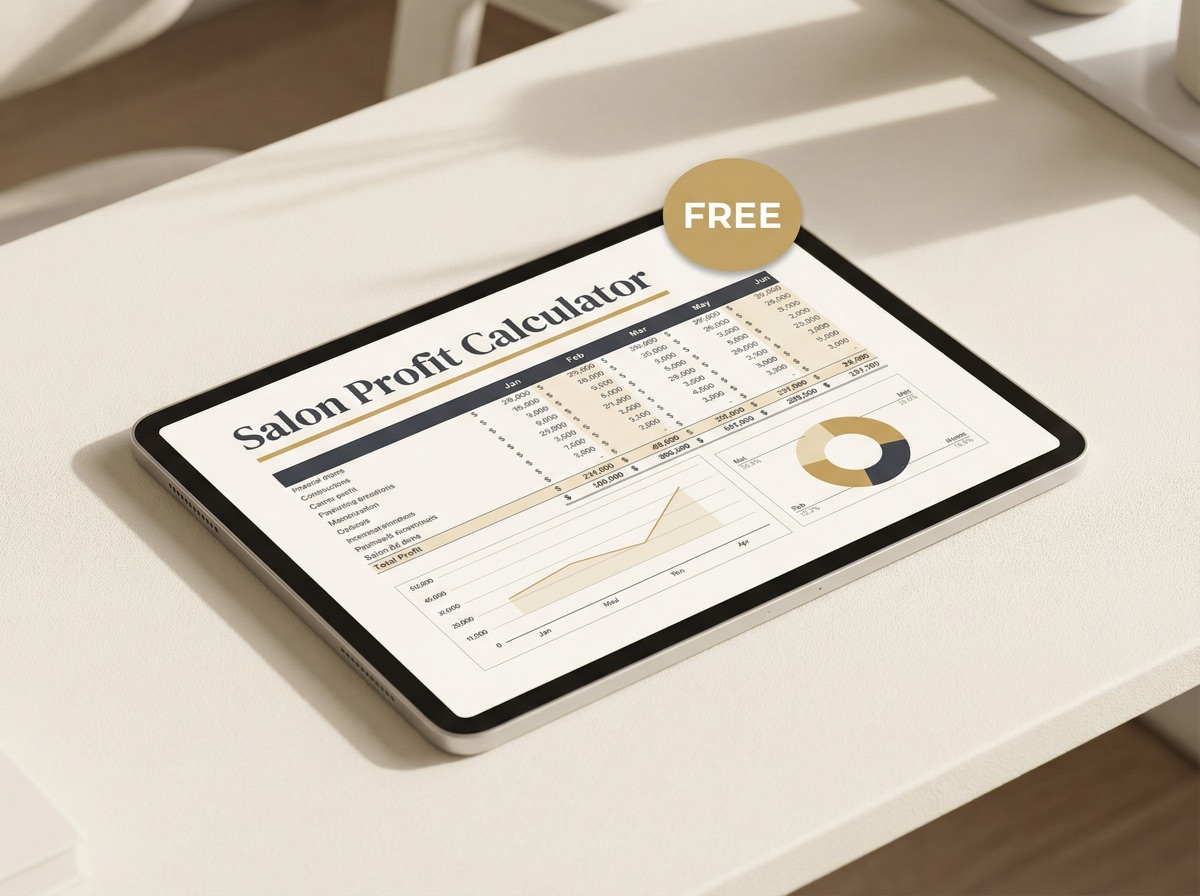
Written by Scott Farmer
Licensed Master Cosmetologist (GA & FL), former Toni & Guy Artistic Director, and founder of Hair Salon Pro. 30+ years behind the chair. 15,000+ clients. Building the business tools cosmetology school never taught. Currently behind the chair at scottfsalon.com in Venice, FL.