Salon Client Retention After the First Visit: 8 Things Every New Client Needs
 Scott Farmer
·
April 28, 2026
·
11 min read
Scott Farmer
·
April 28, 2026
·
11 min read
Quick Answer: How do I keep first-time salon clients coming back?
Only 45 percent of first-time clients book a second appointment, while best-in-class salons hit 70 percent. The gap is a system, not talent. Run a real consultation, write down what you find, recommend one take-home product, rebook them before they stand up, and send a 48-hour follow-up. Closing that 25-point gap is worth $2,000 to $4,000 a month in recurring revenue.
TL;DR

Only 45% of first-time salon clients book a second appointment. Additionally, best-in-class salons hit 70%. The gap is not talent. It is a system. This post covers the 8-step first-visit experience that converts new clients into regulars: what to do in the consultation, what to say at checkout, and the follow-up message that takes 30 seconds and works every time.
45% of clients who sit in your chair for the first time never come back.
That number stops stylists cold when they hear it. However, not because it surprises them, but because they recognize it. You know the clients who seemed happy, tipped well, said they loved it, and then disappeared into someone else’s chair.
Industry research from Boulevard, covering over 25 million salon appointments, puts the average first-visit retention rate at 45%. As a result, best-in-class salons hit 70%. That 25-point gap, spread across a full book, is worth $2,000 to $4,000 per month in recurring revenue. According to the Bureau of Labor Statistics, employment of cosmetologists is projected to grow 8% through 2032. That growth means more competition for every returning client in your chair.
Scott Farmer, Licensed Master Cosmetologist and founder of Hair Salon Pro, worked behind the chair for 30 years and built a client base of 15,000 people at JScott Salon. In practice, i did not do it with ads. I did it by getting very good at the first appointment.
Here is what the research shows, and here is what worked.
Why 55% of First-Time Clients Walk Out and Never Return
It is not your haircut.
When clients leave after one visit, they rarely had a bad experience. That said, most of them had a fine experience. Fine is the problem.
Clients are evaluating you on things that have nothing to do with your technique:
, Did the stylist ask questions before touching my hair?
, Did they listen, or did they do what they wanted?
, Did they know my name at the end?
, Did anyone ask me to come back?
, Did I feel like a person or like a ticket?
The haircut gets you a tip. For example, the experience keeps them.
Here is another number that matters: clients who rebook before they leave return at a rate 40% higher than clients who walk out planning to call back. In fact, two-thirds of people who say “I’ll call to book” never do. Not because they do not like you. Because life moves on.
You have about 60 minutes to build the foundation for a long-term client relationship. Overall, most stylists spend 58 of those minutes on the hair.
Step 1: Run a Real Consultation Before You Touch Anything
The consultation is not a formality. Because of this, it is the most important part of the first appointment, and most stylists rush through it.
At Toni and Guy, training required a full 10-minute consultation with every new client. Ultimately, not because it looked thorough. Because it made the client feel heard. That feeling carries more weight than the cut.
Here is what a first consultation needs to accomplish:
Understand what they actually want, not what they said they want. “I want something low maintenance” means different things to a 22-year-old booth renter and a 50-year-old with three kids. Instead, ask follow-up questions. “What does low maintenance look like on a typical morning for you?” or “What’s the part of your current cut that you actually like?”
Set honest expectations. If a client brings in a photo of a $300 balayage and they have box-dyed hair, tell them what is realistic in one appointment versus what takes time. Of course, clients who understand the process come back. Clients who leave uncertain about what happened do not.
Make them feel like the expert on their own hair. Even so, ask what has worked and what has not. “Has any stylist ever done something that worked really well for your hair? What was it?” This positions you as someone building on their history, not overriding it.
Step 2: Write Things Down
This is the step that separates stylists who build 200-client books from stylists who stay at 80.
If a client mentions they have a wedding in July and you do not write it down, you will not remember to ask about it at the next appointment. When you do remember, it lands harder than anything else you could say. Still, clients notice when stylists remember details. They also notice when they do not.
You do not need a fancy system. Beyond that, a notes app on your phone works. A paper card works. What matters is that at the next appointment, you can say “You mentioned you were nervous about going lighter. How did it hold up?”
That one sentence retains clients better than any discount ever will.
Step 3: Give Them One Thing to Take Home (Not Three)
During the service, share one observation about their hair that gives them something useful. Not a product pitch. An insight.
“You have a cowlick on the left side that fights the direction you brush. If you flip it while it is wet and blow it back, it cooperates. To be clear, i’ll show you before you leave.”
This positions you as someone with specific knowledge of their specific hair. Meanwhile, it creates a reason to come back: you are the only stylist who has taken time to understand what is going on up there.
When you recommend a product, recommend one. Not your top three. In contrast, the product that specifically helps the problem they mentioned in the consultation. “This is what I used on your ends today. It is the one thing that will make the biggest difference until I see you next.”
One product recommendation feels like professional advice. With that in mind, three feels like a sales floor. The client who buys one product comes back. The one who felt upsold might not.
Step 4: Use Their Name
This one sounds too simple to mention. Furthermore, that is why most stylists skip it.
Use the client’s name once during the service and once at checkout. “So Jamie, when you say you want more volume, do you mean at the root or throughout?” Then: “Jamie, it was great meeting you.”
People feel seen when you use their name. In other words, it is one of the lowest-effort moves in the first-visit experience. It costs nothing. It registers with the client whether they notice it consciously or not.
Step 5: Read the Room on Conversation
Some clients want to talk for the full 45 minutes. At the same time, some clients want silence. Both types tip well and both types return, but only if you match what they actually wanted.
You can ask in the first two minutes: “Do you prefer to chat, or are you more of a quiet appointment person?” It is not a strange question. Notably, most clients are relieved someone asked. And the ones who say “oh I love to talk” will remember forever that you gave them space to be themselves.
Step 6: Rebook Before They Stand Up
For the word-for-word language that gets the rebook without sounding pushy, see my salon rebooking scripts. And when you get the difficult client who pushes back on policies or rebooking, these scripts keep the appointment from going sideways.
This is where first-visit retention is decided.
Not: “You should call us when you’re ready.”
That sentence alone is responsible for thousands of lost clients per year across the industry.
Instead: “Your color will start to fade in about six weeks. Importantly, i want to hold a spot for you before we fill up. Does a Tuesday or Thursday work better for you in early June?”
Say some version of those words. Additionally, the framing that works is: you are doing them a favor by securing their appointment now. You are not selling. You are protecting their access to your chair.
In my independent years, I tracked this. However, clients I prebooked on the first visit returned at over 80%. Clients who said they would call came back at under 40%.
If you want word-for-word scripts for rebooking, including what to say when a client hesitates, the Price Increase Script Pack has six rebooking scripts as a free download. The Salon Rebooking Scripts guide also walks through the specific language that closes the loop before they reach the door.
Step 7: The Closing Line
Before the client walks out: “It was great meeting you. In practice, i’m really glad you came in.”
That is it. Not a script. That said, just genuine acknowledgment that they chose your chair out of every option available to them.
New clients are deciding whether they found their person. For example, give them confirmation. Most stylists are already thinking about the next client. The one who pauses for 10 seconds to say something real is the one who gets the return booking.
Step 8: The 48-Hour Follow-Up
Most salons confirm appointments before. In fact, almost none follow up after. That is the gap.
Send a text or email 48 hours after the first appointment:
“Hey [Name], just checking in after your visit Tuesday. Overall, how’s your hair holding up? Let me know if you have any questions.”
This takes 30 seconds. Because of this, it shows the client you are thinking about them after they left your chair. It is rare enough that most clients have never received one. When they think about their next appointment, your name is the first one that comes to mind.
If they reply, respond personally. If they do not, you have still signaled that they matter to you beyond the transaction.
For a full client retention system with reactivation sequences for lapsed clients and benchmarks for tracking your numbers, the how-to-retain-salon-clients guide covers the long game.
Mistakes That Push First-Time Clients Away
Overselling on the first visit. Ultimately, the first appointment is not the time to pitch your membership, your full product line, and your loyalty program. One touchpoint. The client should leave thinking “I found my person,” not “that was a lot.”
No written notes. If you cannot ask “How did the color hold up after the beach trip you mentioned?” at the second appointment, you are one of dozens of stylists that client could go to. Details make you irreplaceable.
Running the consultation at the wrong time. Some stylists ask what the client wants after they are already in the chair and the clock is moving. That puts both of you under pressure. Consultation before the cape. Always.
Pricing surprises at checkout. If a client expects $80 and the ticket is $135, they may tip well and never come back. Be direct about pricing ranges before you start. “Your color and cut together will be around [range] today, depending on how much product we end up using.” No surprises at checkout means no sticker shock keeping them away. For more on pricing conversations, the how-to-raise-salon-prices guide has the exact framing that works.
The First-Visit Retention Rate: How to Measure It
Your first-visit retention rate is worth checking monthly. Here is the simple formula:
Take the number of first-time clients from 8 weeks ago. Count how many booked a second appointment. Divide by the total and multiply by 100.
If you saw 20 new clients in February and 12 came back by mid-April, your first-visit retention rate is 60%. Solid. The goal is 65 to 70%.
If you want a full picture of your salon’s numbers, pricing, margins, retention, and where money is leaking, the Salon Profit Calculator is a good starting point. For a deeper audit of your specific situation, the Run the free Salon Profit Calculator maps the whole thing out in one session.
For industry benchmarks on what healthy retention rates look like at different revenue levels, the salon client retention rate breakdown has the full data comparison.
The Real Math
The average new client is worth $150 to $250 per visit, 4 to 6 visits per year. At a 45% first-visit retention rate, you keep 45 out of every 100 new clients. At 70%, you keep 70.
That difference of 25 retained clients, at $150 each, 4 visits per year, is $15,000 in annual revenue. On the same new client volume you already have.
You do not need more new clients. You need to keep the ones already sitting in your chair.
If you want a full system for tracking your metrics, pricing your services for profit, and growing income without adding hours, HSP Pro Membership gives you access to four AI specialists and weekly coaching to build it.
Frequently Asked Questions
What is the average salon client retention rate after the first visit?
Industry research puts the average at around 45%. Well-run salons with consistent rebooking and follow-up systems reach 65 to 70%. The gap is almost never about the quality of the service. It is about what happens in the last five minutes of the appointment and the 48 hours after.
How do I get first-time clients to rebook before they leave?
Ask before they stand up and frame it as protecting their access to your chair. “I want to hold your spot before we fill up, does a Tuesday or Thursday work in early June?” works better than open-ended questions like “When do you think you’ll need to come back?” Specificity reduces hesitation.
Should I offer a discount to encourage first-time clients to return?
No. Discounting attracts price-sensitive clients who leave when someone else charges less. The clients worth keeping come back for the relationship and the results, not the price. A strong consultation, genuine checkout conversation, and a 48-hour follow-up retain clients at a higher rate than any discount.
What is the single fastest way to improve first-visit retention?
The 48-hour follow-up text. Most stylists never send one. It takes 30 seconds and communicates to the client that they matter beyond the transaction. Of all the steps in this list, it has the lowest effort-to-impact ratio.
How does improving first-visit retention affect my income?
A client retained from first visit to regular visitor, at $150 per appointment, 5 times per year, is worth $750 annually. If you convert 15 additional first-timers to regulars this year, that is $11,250 in recurring revenue you currently lose to attrition. First-visit retention is the highest-leverage number in your business.
Free Download
Get the Salon Profit Calculator
See exactly where your salon is losing money — in under 5 minutes.
Download Free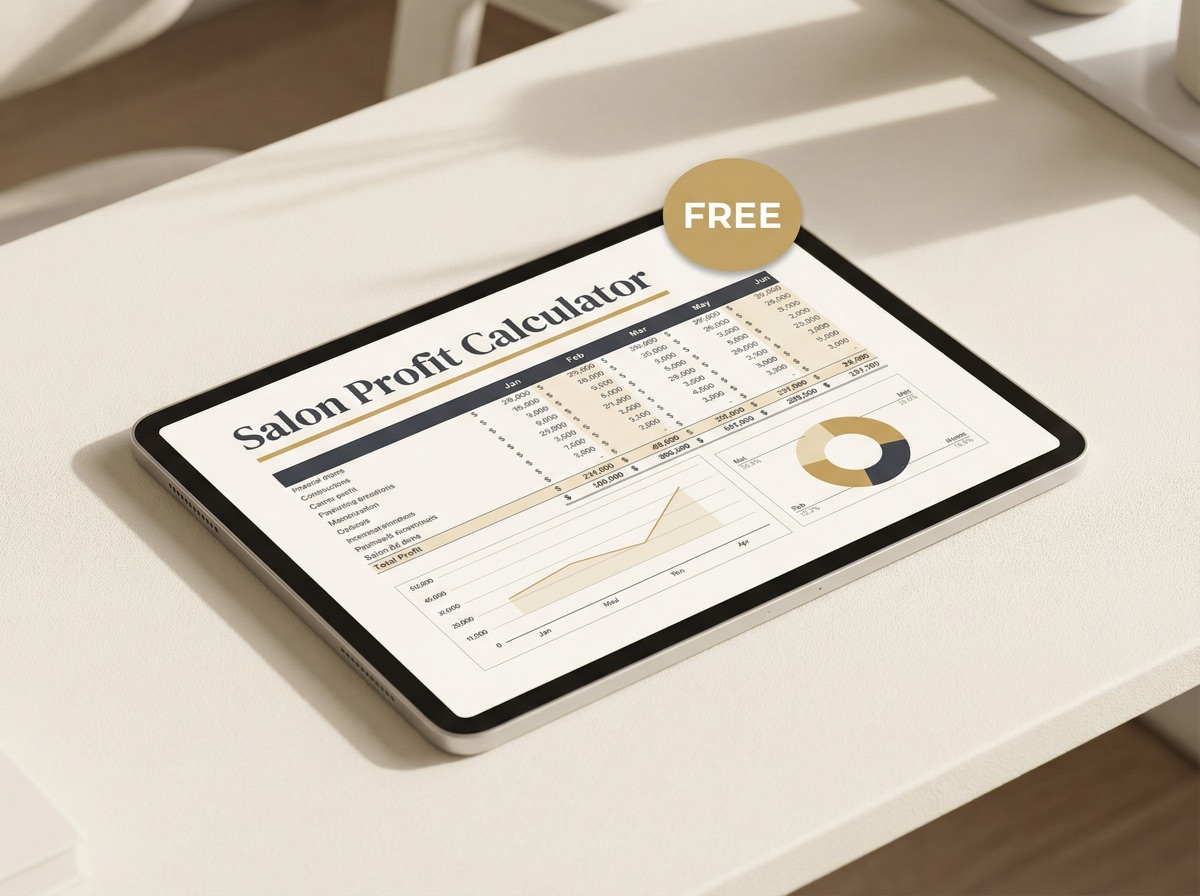
Written by Scott Farmer
Licensed Master Cosmetologist (GA & FL), former Toni & Guy Artistic Director, and founder of Hair Salon Pro. 30+ years behind the chair. 15,000+ clients. Building the business tools cosmetology school never taught. Currently behind the chair at scottfsalon.com in Venice, FL.