Salon Membership Program: Why Most Stylists Never Do It (And How to Start Yours)
 Scott Farmer
·
April 18, 2026
·
18 min read
Scott Farmer
·
April 18, 2026
·
18 min read
Quick Answer: How do you start a salon membership program?
Start simple with a haircut package clients pay for on the 1st of every month whether they come in or not. The real block is not software or pricing, it is the mental shift away from trading time for money. Done right, even a basic membership can put $1,000 to $1,500 in guaranteed monthly income on your books.
Here is the truth about salon membership programs: most stylists already know they work. Additionally, they’ve seen the math. They’ve read the articles. And they still don’t do it.
Starting a salon membership program is one of the highest-ROI moves available to any stylist or suite owner, and one of the most consistently avoided. However, scott Farmer, Licensed Master Cosmetologist and founder of Hair Salon Pro, has spent 30 years watching talented stylists leave tens of thousands of dollars on the table, not because the model is too complicated, but because they couldn’t make the mental shift to pull it off.
That’s what this article is actually about. As a result, i’m going to tell you why stylists freeze up, what the real hang-up is, and how a simple salon membership program, starting with something as basic as a haircut package, can put $1,000 to $1,500 in guaranteed monthly income on your books before you pick up a pair of shears.
One thing I want to be straight about upfront: I have not personally run a membership program. In practice, i’m not going to pretend I have. What I do have is 30 years of watching this industry from the inside, thousands of conversations with stylists across every kind of salon, and a clear eye for what works and what doesn’t. The membership model works. The problem is getting past the mental block that stops most people from starting.
Table of Contents

- The Real Reason Stylists Don’t Start a Membership (It’s Not What You Think)
- Why Salon Membership Programs Work: The Math Is Not Complicated
- The Best Salon Membership Program for Most Salons Is Simpler Than You Think
- What to Include (Without Undercharging Yourself)
- How to Price It Right
- Setting Up the System
- How to Fill Your First 10 Spots in 30 Days
- Handling the Two Objections You Will Hear
- Managing Members Once You Have Them
- Real Numbers: What 20 Members Actually Looks Like
- FAQ
The Real Reason Stylists Don’t Start a Membership (It’s Not What You Think)
It is not the software. It is not the time. That said, it is not the pricing.
The reason most stylists never launch a salon membership program is that they genuinely cannot get their head around how it works. For example, i don’t say that to be harsh. I say it because understanding the block is the first step to getting past it.
Stylists are wired to trade time for
Stylists are wired to trade time for money. In fact, you do a haircut, you get paid. You do a color, you get paid. The transaction is clean, immediate, and directly tied to the service. Forty years of salon culture has trained everyone behind the chair to think this way.
A membership flips that model. Overall, the client pays on the 1st of every month whether they come in or not. And that is exactly where the mental block lives.
Most stylists hear that and immediately think: “What if they don’t come in? Because of this, am I giving away a service for free? What if they come in twice and I only charged them once? What if I fill up with members and don’t have room for my regular clients?”
These fears feel logical. They are not. But they are real, and you have to walk through each one before the model makes sense.
Fear 1: “What if they don’t come in?”
If a member pays $69 on the 1st and never books, you just made $69 for doing nothing. Ultimately, that is not a problem. Over time, clients who consistently skip their monthly service tend to cancel. That is also fine. The math still works because the ones who do come in are paying a predictable rate you set in advance.
Fear 2: “Am I giving away a service?”
You are offering a discount in exchange for a guarantee. Instead, they get a lower price and priority access. You get reliable monthly revenue and a client who is committed. That is not giving something away. That is a trade.
Fear 3: “What if they come in twice?”
Your membership includes one service per calendar month. Of course, you state that clearly at sign-up. If they want a second service, they pay your member rate for it. This is not complicated to manage.
Fear 4: “What if I run out of room?”
This is actually the best problem you could have, because it means you have a waitlist. And a waitlist is leverage. But the fear of being too popular is not a reason to avoid launching.
The mental block is not rational. Even so, it is just unfamiliar. Once you run your first 10 members for 90 days and see the recurring billing hit your account on the 1st, the model clicks. The challenge is getting to 10 members before you talk yourself out of it.
Why Salon Membership Programs Work: The Math Is Not Complicated
Single-service clients are fine. But they are unpredictable. Still, they rebook when they feel like it, they go long between appointments, and they cancel when something comes up.
Membership clients have committed. Beyond that, the payment comes out whether they book or not. They rebook faster because they don’t want to waste a paid month. Over time, they spend more on retail and add-ons. And they refer more people because they feel like insiders.
A well-built salon membership program is one of the most effective client retention tools in the industry because it creates a financial commitment on both sides.
LTV Comparison: Member vs. Non-Member
A typical client visits 4 to 6 times per year at $80 to $150 per visit. To be clear, total annual value: $320 to $900.
A membership client at $69/month generates $828 in guaranteed revenue per year. Meanwhile, add retail purchases and add-on services, and that same client is often worth $1,200 to $1,600 annually.
Over three years, a non-member client generates $960 to $2,700 total. In contrast, a member over the same three years generates $2,484 in membership fees alone, before a single retail purchase.
What $497/Month in Guaranteed Revenue Does to Your Stress
This is what most stylists don’t think about until they’ve felt it.
When you have $0 guaranteed at the start of every month, every slow week feels like a crisis. With that in mind, every cancellation is a real financial hit. You’re checking your book on Sunday night hoping Tuesday fills up.
Six or seven members at $69 to $79/month puts $497 on your books before you’ve touched a single client. Furthermore, you’re not starting from zero anymore. You’re building on a floor.
At 20 members, that floor is $1,380 to $1,580. In other words, at 30 members, $2,070 to $2,370. That is what financial stability behind the chair actually looks like. To understand how membership income fits your overall salon profit margins, run those numbers alongside your service revenue.
The Best Salon Membership Program for Most Salons Is Simpler Than You Think
Here is where most people overthink it.
They picture a three-tier system with color packages and product credits and quarterly bonuses and they get overwhelmed before they’ve signed up a single member.
Start with one service. A haircut.
For most salons, especially higher-volume operations doing 10 or more cuts a day, a haircut membership is the cleanest possible entry point. At the same time, it is a service every client needs on a regular schedule, the cost is predictable, the time required is consistent, and the discount you offer can be modest because the value to the client is primarily about locking in their slot and their price.
A simple salon membership program at $59 to $69/month, one cut per month plus priority booking, is enough to prove the model. Notably, it’s simple to explain, simple to manage, and simple to scale.
Once you have 10 to 15 haircut members running smoothly, then consider adding a color tier for clients who want more. But start with one. Importantly, the complexity of a multi-tier system is one of the main reasons salons build out a membership, never quite finish it, and never launch.
Done beats perfect every time.
What to Include (Without Undercharging Yourself)
The most common mistake is over-loading the membership with services at too low a price. Additionally, you underprice, you resent the clients, the program falls apart. Build it around value clients genuinely want, at a price you can sustain indefinitely.
Haircut Membership (Best Starting Point)
- One haircut per month
- 10 to 15 percent off additional services
- Priority booking access
- Typical price range: $49 to $89/month
Color Membership (For Committed Color Clients)
- One color service per month (root touch-up or gloss, not full foils every visit)
- Complimentary toner between visits
- 15 percent off additional services
- Typical price range: $99 to $179/month
Full-Service VIP Tier (If You Want a Third Option)
- One cut and style per month
- One color service every 6 to 8 weeks on a set calendar
- Priority scheduling and exclusive retail pricing
- Typical price range: $149 to $249/month
You don’t need all three on day one. However, one tier is enough to launch. If you’re going to add a second, add it at the 90-day mark after you understand what your members actually want.
Perks That Cost Nothing but Feel Premium
These add perceived value without adding cost:
- Priority booking: Members get access to the next month’s calendar five to seven days before it opens to everyone else. They feel the perk every single month.
- Text booking access: “Just text me directly” is worth more to most clients than any discount.
- Birthday month bonus: One complimentary add-on during their birthday month. A toner or a conditioning treatment. Costs $3. Feels generous.
- Renewal check-in text: “Hey [name], your membership renewed. Ready to get you booked for this month?” Takes 10 seconds. Keeps them engaged.
None of these cost money. As a result, all of them reduce churn.
How to Price It Right
The number one error in salon membership pricing is discounting your way to a full roster, then realizing you’re booked solid but barely profitable.
The Break-Even Formula
Start with the actual cost of delivering the service.
For a haircut membership:
- Your standard haircut price: $55
- Chair time: 45 minutes
- Product cost: $2 to $5
- Implied cost per visit: $57 to $60
If you price the membership at $45/month, you are losing money every time they come in. In practice, you haven’t even factored in payment processing fees of 2.5 to 3 percent or the admin time managing the membership.
The floor:
(Cost of included services) x 0.85 = minimum viable membership price
Members get roughly a 10 to 15 percent discount. No more. That said, a membership is not a charity. It’s a trade. They get a better price and guaranteed access. You get predictable monthly revenue.
The ceiling:
Price at the level where you’d be genuinely comfortable if 100 percent of your clients moved to this plan.
If every client at $49/month would leave you underpaid and worn out, the price is wrong. For example, find the number where you’d be happy, and where clients still see the value.
For a full framework on how to price salon services for maximum profit, start with your overhead numbers before setting membership tiers.
Price Examples by Service Type
| Service Type | Standard Price | Membership Price | Client Benefit |
|---|---|---|---|
| Women’s haircut | $55 to $85 | $49 to $69 | Discount + priority |
| Men’s haircut | $35 to $55 | $39 to $49 | Guaranteed slot + simplicity |
| Root touch-up | $85 to $125 | $79 to $109 | Savings + no wait |
| Gloss/toner | $45 to $75 | $39 to $59 | Savings + guaranteed schedule |
| Cut + color combo | $150 to $220 | $149 to $199 | Structure + savings |
Men’s memberships can be priced at or slightly above your standard rate because what they’re paying for is the convenience and the guaranteed slot, not a discount. In fact, most men hate booking. Give them a system that does it automatically and they’ll pay for it.
Setting Up the System
You don’t need a complicated tech stack. Overall, you need a system that handles recurring billing reliably and that you can actually manage without spending three hours a week on admin.
Software Options
Square Appointments + Square Subscriptions: The simplest all-in-one option if you’re already on Square. Because of this, set up a subscription product, link payment methods, and Square handles auto-billing. Reporting is basic but it works.
Vagaro: Built-in membership feature with recurring billing, member tracking, and service redemption. Ultimately, strong if you’re already on Vagaro. Members can check their remaining services in the app, which cuts down on “did I use mine this month” texts.
Boulevard: The most robust option, with smart scheduling and automated member communication. Instead, better suited to higher-volume operations. Starts around $175/month for the platform, so the math needs to work for smaller books.
Manual with Stripe or Square: If you have fewer than 15 members and want to test before committing to software, recurring payment links through Stripe or Square plus a Google Sheet for tracking is a legitimate way to start. Of course, it doesn’t scale past 20 to 25 members, but it’s enough to prove the model.
Recurring Billing Setup
Whichever platform you use, make sure you have:
- Auto-billing on the same day each month (the 1st is clean and easy to remember)
- An automated notification when a card fails, so you follow up immediately
- A simple record of who has and hasn’t used their monthly service
- No paper card numbers anywhere
Cancellation Policy Language
Your cancellation policy protects the program. Even so, it needs to feel fair without creating an easy exit every slow month.
This language works:
“Memberships are month-to-month with a 30-day cancellation notice. Still, to cancel, text or email [contact] at least 30 days before your next billing date. Unused monthly services do not carry over.”
The 30-day window prevents impulse cancellations. Beyond that, the no-rollover clause stops clients from banking three months and then demanding three services at once. Both are fair and both are standard.
How to Fill Your First 10 Spots in 30 Days
You don’t need a marketing campaign to fill your first 10 spots. To be clear, you need conversations.
The Warm List Method
Write down your 30 to 40 most loyal clients. Meanwhile, the ones who rebook every four to six weeks without being asked, never cancel last minute, tip consistently, and buy retail. These people already behave like members. You’re just formalizing the relationship.
Reach out personally. Not a mass blast. A text like this:
“Hey [name], I’m launching something new next month and I thought of you first. In contrast, i’m starting a small membership program. [One sentence on what’s included.] It’s [price]/month and I’m only opening [X] spots to start. Want me to hold one for you?”
This works because it’s personal, specific, and creates real scarcity. With that in mind, loyal clients say yes to things that save them money and guarantee their spot.
Aim to close five to seven members from your warm list before you go public with it.
The Checkout Conversation
The best time to pitch a membership is at checkout, right after a great service.
“Before you head out, I wanted to mention something I’m launching. Furthermore, i’m starting a small membership for clients who come in regularly. [Describe the benefit in one sentence.] It’s $X a month and locks in your spot. I’m only doing [number] spots. Want to be on the list?”
If they say yes: “Perfect. In other words, i’ll send you the details tonight.”
If they say no: “No worries at all. At the same time, i’ll keep you posted.”
No pressure. No follow-up guilt. Move on.
This works because you’ve just delivered value and the client is in a positive frame of mind. Notably, the offer feels like a natural extension of what you already do for them.
Instagram and Text Templates
Once you’ve filled five to seven spots from your warm list, open it publicly.
Instagram caption:
“Opening [X] spots in my new monthly membership. Importantly, here’s what’s included: [bullet points]. [Price]/month, month-to-month, cancel anytime. Link in bio to grab your spot. Spots go fast. [Date] is the cutoff.”
Text to your full client list:
“Hey! Additionally, quick note, I just launched a monthly membership for regular clients. [One line on what’s included.] [Price]/month. First [X] spots are open now. Reply YES if you want the details.”
Texts outperform emails for local salon clients by a factor of three to five. However, a list of 100 clients texted about a membership will get 15 to 25 responses and convert 3 to 8 into members. That’s enough to start.
Handling the Two Objections You Will Hear
“I Don’t Come In Every Month”
This comes up constantly and it’s a fair concern.
Your response: “That’s actually why this works well. As a result, the membership isn’t about forcing you to come in more often. It’s about locking in your spot and your rate so that when you do come in, there’s always room for you and your price doesn’t change. Most of my members come in a bit more consistently once they’ve got it covered.”
State the benefit and let them decide. In practice, don’t over-explain.
“Can I Pause It?”
Have a written answer ready before anyone asks.
Standard approach: no pausing. That said, the membership fee holds your priority status and your slot. If they’re traveling, their spot doesn’t disappear, but the billing continues.
Softer approach: offer one pause per year of up to 30 days for travel or medical situations. For example, this feels generous without creating a revolving door.
Whatever your policy is, state it before they sign up. In fact, surprises kill memberships faster than anything else.
Managing Members Once You Have Them
A salon membership program is only as good as how you run it day to day.
Priority booking logistics: Open the next month’s calendar to members five to seven days before it opens to the general public. Overall, they feel this perk every single month. It is tangible and real.
Tracking service redemption: In the last week of each month, check who hasn’t booked. Because of this, send a quick text: “Hey [name], your membership is all set but I don’t see you on the calendar yet. Want me to grab you something this week?” This recovers unused appointments, keeps retention high, and shows clients you’re paying attention.
Reducing churn: The biggest predictor of cancellation is unused months. Ultimately, clients who use their membership consistently stay. Clients who forget they have it, skip a month, check their credit card statement, and cancel. The check-in text prevents most of this.
Annual pricing review: Once a year, you can adjust membership pricing. Instead, give 30 to 60 days notice. Frame it as a reflection of your continued investment in skills and your space. Most long-term members absorb a $5 to $10/month increase without issue.
According to a McKinsey consumer behavior report, subscription customers have 3-5x higher lifetime value than one-time buyers. Of course, the salon membership model applies exactly the same dynamic.
Real Numbers: What 20 Members Actually Looks Like
The setup:
, 15 members on the Haircut Membership at $69/month
, 5 members on the Color Membership at $129/month
Monthly guaranteed revenue:
, Haircut members: 15 x $69 = $1,035
, Color members: 5 x $129 = $645
, Total membership revenue: $1,680/month
Service delivery cost:
, 15 haircuts at $8 product cost: $120
, 5 color services at $25 product cost: $125
, Total delivery cost: $245
Net membership revenue after product cost: $1,435/month
Additional member spending (conservative estimate):
, 30 percent of members buy retail monthly: 6 members x $35 = $210
, 20 percent add a service at member rate: 4 members x $30 net = $120
, Additional member revenue: $330/month
Total member revenue contribution: $1,765/month
Compare that to the same 20 clients booking without a membership, eight times per year at $75 average. Even so, that’s $12,000 per year, or $1,000/month. The membership version of those same 20 clients: $1,765/month, with predictability.
According to the Bureau of Labor Statistics, the median annual wage for hairstylists is around $35,000. Still, a membership model that adds $497 to $994 in guaranteed monthly income moves a stylist from that median to a genuinely different financial position without adding a single new client.
The math is not close.
Use the Salon Profit Calculator to model what 10, 20, or 30 members would do to your specific revenue numbers.
FAQ
How many members do I need before a salon membership program makes sense?
Five is enough to test it. Beyond that, ten is enough to prove it. The infrastructure takes two hours to set up. Don’t wait for a perfect system before you launch. Launch with five spots, learn what you didn’t expect, and scale from there.
What if clients use their membership for
What if clients use their membership for services they would have paid full price for anyway?
This will happen. It’s fine. To be clear, your revenue per visit drops slightly, but your total monthly revenue and visit frequency both go up. Track total revenue per member over three to six months and compare it to what they spent before the membership. The number almost always goes up.
Should I offer a discount for annual prepayment?
Only if cash flow is your primary challenge right now. Annual prepayment gives you a lump sum but removes the monthly recurring income, which is the entire point of the model. If you do offer it, price it at 10 months (two months free). Don’t offer more than that.
How do I handle a member who tries to book an extra service on their membership?
Clarify at sign-up that the membership covers one service per calendar month. If someone tries to use it twice, a simple “Your next membership service is available in [month]. Want to add today’s service at your member rate?” handles it cleanly and without conflict.
Can booth renters and suite owners run a salon membership program?
Yes. You’re the business owner in your space. There’s no structural reason a membership wouldn’t work. Make sure your booking software supports recurring billing, or use Stripe or Square for the payment side and manage the rest yourself.
How does a membership program work with a referral program?
They work well together. Members make great referral sources because they’re committed to the salon. Give members an extra incentive for referrals, like a service credit on top of your standard salon referral program rewards. The combination builds your book faster than either strategy alone.
Your first 10 members are probably in your phone right now. They’re the clients who rebook without being asked, never cancel last minute, and send you their friends. Give them first access, use the warm list script, and you can have a membership running by the end of this month.
To see what predictable monthly income would do to your specific numbers, use the Salon Profit Calculator. Plug in your client volume and pricing and see how much guaranteed income your current client base could generate.
And if you want a full breakdown of pricing strategy for every service you offer, not just memberships, the Hair Salon Pro pricing resources were built specifically for independent stylists and suite owners.
Double Your Chair Income, Without Working More Hours
Memberships create steady income. The Profit-First System makes that income profitable. I teach it live on when you are ready.
Run the Free Salon Profit Calculator
Free. Available now. No registration required.
Free Download
Get the Salon Profit Calculator
See exactly where your salon is losing money — in under 5 minutes.
Download Free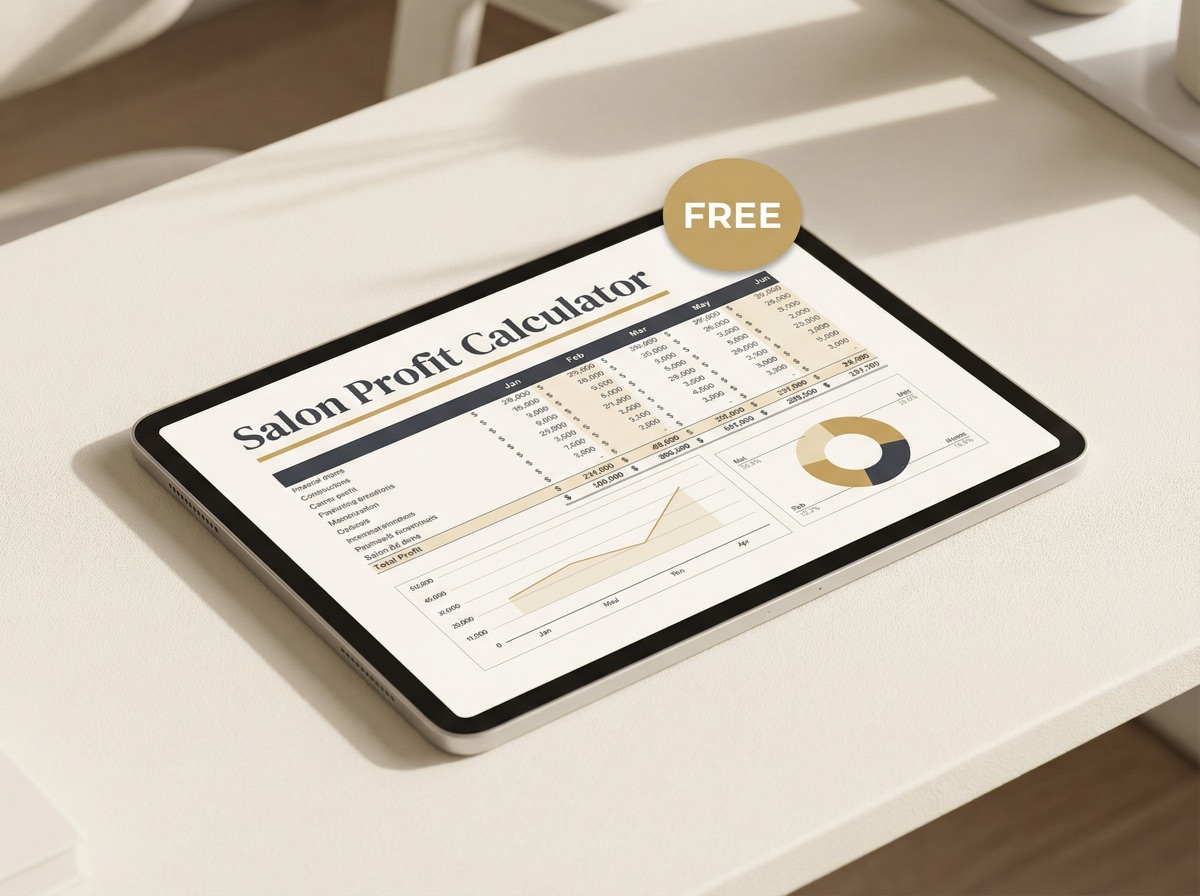
Written by Scott Farmer
Licensed Master Cosmetologist (GA & FL), former Toni & Guy Artistic Director, and founder of Hair Salon Pro. 30+ years behind the chair. 15,000+ clients. Building the business tools cosmetology school never taught. Currently behind the chair at scottfsalon.com in Venice, FL.