Stylist Income Formula: Calculate What You Need to Charge | Hair Salon Pro
 Scott Farmer
·
May 6, 2026
·
11 min read
Scott Farmer
·
May 6, 2026
·
11 min read

TL;DR: Five things to know before you keep reading.
- The stylist income formula works backward from your annual income goal to tell you exactly what to charge per hour and per client.
- Most stylists set prices based on what “feels right” or what the stylist next door charges. Neither one is math.
- Four inputs drive everything: your target income, a tax buffer, your chair costs, and your overhead.
- Two variables you can control today (average ticket and rebooking rate) have more impact than working extra hours.
- The formula shows you the number. A price increase plan gets you there without losing clients.
I spent 20 years behind the chair without ever running this formula once. Not a single time.
And that is exactly why, at JScott Salon in Atlanta, I was taking home $4,000 a month while completely booked solid. Six days a week. Twelve-hour days on the floor. Doing the work, loving the craft. Still coming up short every month when the bills hit.
The stylist income formula is the math I wish someone had handed me on day one. It does not tell you what the market will bear. It tells you what the math demands. There is a difference, and once you see it, you cannot unsee it.
What the Stylist Income Formula Is (and Why Most Stylists Skip It)
The formula is not complicated. But it does require you to answer a question most stylists never ask: what do you actually need to earn?
Not what you hope to earn. Not what your friend earns. What do you need, after taxes, after chair rent, after product costs, to take home a number that covers your life and builds something?
Most stylists skip this step because it feels uncomfortable. They set prices based on their market, their confidence, or what the last salon they worked at charged. Then they wonder why being fully booked still feels like treading water.
If that sounds familiar, you are not bad at business. You are just missing the formula. And you are not alone. The Bureau of Labor Statistics reports the median annual wage for hairdressers is around $33,000. The average stylist is dramatically undercharging for a skilled trade.
The Stylist Income Formula: Four Components
The formula works in four layers. Each one feeds into the next.
Component 1: Target Annual Income
Start here. What do you want to take home after taxes? Not gross. After.
Be specific. $48,000/year? $72,000? $90,000? Write the number down. This is your anchor.
For this example, we will use $60,000 net as the target.
Component 2: Tax Buffer
Self-employed stylists (booth renters especially) owe self-employment tax plus income tax. A 30% buffer is a safe planning number for most stylists in the U.S. Commission stylists have taxes withheld, but their effective rate is still 20-25% on their chair income once all deductions are counted.
To gross $60,000 net, you need to earn roughly $85,700 gross (using a 30% effective rate).
Formula: Net target divided by 0.70 = gross revenue needed from your chair.
Component 3: Chair Costs
This is what it costs you directly to sit in your chair and do the work: booth rent, product costs, tools, education.
Booth renters: typical chair rent runs $400-$800/month depending on market. Add $150-$300/month in product costs. Call it $800/month all-in, or $9,600/year.
Commission stylists: your chair costs are built into the commission split, but you should still account for any out-of-pocket product use, tools, and continuing education.
Add chair costs to your gross income need:
$85,700 + $9,600 = $95,300 in gross chair revenue needed per year.
Component 4: Overhead Allocation
If you rent a suite, own a salon, or have any operational costs beyond straight booth rent, add them here. Suite renters typically carry utilities, insurance, and software. Even $200/month adds up to $2,400/year.
For booth renters inside a commission salon, this component may be zero. Your overhead is already wrapped into the structure.
Adjusted total for this example: $95,300 (keeping the previous number for simplicity; suite renters should add their additional overhead).
From Annual Goal to Weekly Chair Revenue
Once you have your annual number, divide by working weeks.
Most stylists work 48 weeks per year (accounting for vacation, sick days, holidays, and slow weeks). Some work 50. Be honest about how many weeks you actually generate full revenue.
$95,300 divided by 48 weeks = $1,985/week in chair revenue needed.
Round up to $2,000/week for clean math.
From Weekly Revenue to Client Count
Now divide your weekly revenue target by your average ticket. That is the average dollar amount you collect per client visit.
- Booth renter at $130 average ticket: $2,000 divided by $130 = 15.4 clients per week
- Commission stylist at $65 average ticket (after split): $2,000 divided by $65 = 30.8 clients per week
This is where most stylists have a moment of reckoning. Thirty clients a week on a commission split is a brutal pace. Fifteen clients at a $130 ticket is manageable. The ticket is everything.
From Client Count to Hourly Rate
A full-time stylist works roughly 6 productive hours per day (accounting for setup, cleanup, no-shows, and gaps). Over five days that is 30 billable hours per week.
- Booth renter: $2,000 divided by 30 hours = $66.67/hour minimum
- Commission stylist: $2,000 divided by 30 hours = $66.67/hour needed from chair time
If you are charging $45/hour for color services, you can see the gap immediately.
Full Math for Two Stylist Profiles
Here is the complete stylist income formula worked out for two real scenarios.
| Input | Booth Renter | Commission Stylist |
|---|---|---|
| Net income goal | $60,000/year | $60,000/year |
| Gross needed (30% tax buffer) | $85,700/year | $85,700/year |
| Chair costs (annual) | $9,600/year | $0 (wrapped in split) |
| Total gross chair revenue needed | $95,300/year | $85,700/year |
| Working weeks per year | 48 | 48 |
| Weekly revenue target | $1,985/week | $1,785/week |
| Average ticket | $130 | $65 (after split) |
| Clients per week needed | 15.3 | 27.5 |
| Billable hours per week | 30 | 30 |
| Minimum effective hourly rate | $66/hour | $59/hour |
The commission stylist needs nearly twice as many clients to reach the same income. That math is why so many stylists on commission end up fully booked but still broke. The structure of the split makes the volume requirement almost impossible to sustain long-term.
The 3 Variables That Change Everything
Once you have your formula number, you can stress-test it. Three variables move the needle harder than anything else.
Variable 1: Average Ticket
This is the single most powerful lever in the formula. Raising your average ticket from $130 to $160 drops your required weekly client count from 15 to 12.5. That is 2.5 fewer clients per week, roughly one service, without touching your income goal.
Dollar impact: Going from $130 to $160 average ticket across 15 weekly clients adds $450/week to your chair revenue, or $21,600/year at 48 working weeks.
Want to understand how ticket size compounds over time? The salon profit calculator lets you model this in real time with your actual numbers.
Variable 2: Rebooking Rate
If 80% of your clients rebook before they leave the chair, you are essentially preselling your week before it starts. If 50% rebook, you fill those gaps with new clients, which costs marketing time, energy, and often results in lower-ticket services.
Dollar impact: A stylist with 15 weekly clients at 80% rebooking versus 50% rebooking saves roughly 4-5 hours per month in gap-filling and consultation time for cold clients. At $66/hour, that is $264-$330/month in recovered productivity.
Variable 3: Hourly Rate Positioning
If your services are priced at $50/hour effective rate but the formula says you need $66/hour, you have a $16/hour gap. At 30 billable hours per week, that is a $480/week shortfall, or $23,040/year in income you are leaving behind every single year you do not fix it.
This is the number that should make you take hair salon pricing strategy seriously. Not as a nice-to-have. As a survival skill.
Why Most Stylists Get the Formula Wrong
The formula is simple. Getting stylists to run it honestly is harder. Three things consistently break it.
Emotional Pricing
Stylists price based on what they feel comfortable charging, not what the math requires. Comfort-based pricing almost always comes in under the formula number. The fix is running the formula first, then building confidence second. Not the other way around.
Back when I transitioned from working under the Toni and Guy structure into independent work at JScott Salon, I had to unlearn the idea that my prices were already “enough.” The market would have paid more. I just had to ask for it.
Not Counting Gap Hours
Most stylists calculate their hourly rate based on their booked hours. But they are also working during consultation time, no-show gaps, setup, and cleanup. If you have 30 booked hours but your chair is occupied for 40 hours per week total, your effective hourly rate is lower than your formula assumes.
Count all the hours. Or price high enough that the math still works even when gaps appear.
Ignoring the Tax Buffer
This one destroys booth renters. Commission stylists have taxes withheld and forget about quarterly estimates. Booth renters collect full ticket revenue and feel “rich.” Then April comes.
The Professional Beauty Association consistently notes that financial literacy gaps are one of the top business challenges for independent beauty professionals. Running the formula with a 30% tax buffer built in from day one prevents the quarterly panic.
Seat owners and salon suite operators face this too, as covered in detail in the salon suite profit breakdown.
How to Use the Formula to Raise Prices Without Losing Clients
Knowing your formula number is step one. Closing the gap is step two. Here is how to do it without walking into the salon Monday morning with a new price sheet and hoping for the best.
Step 1: Find Your Gap Number
Run the formula on your current pricing first. What are you actually earning per hour right now? Compare that to what the formula says you need.
If your gap is $15/hour or less, one meaningful price increase closes it. If your gap is $30+/hour, you need a phased approach over 6-12 months plus a ticket strategy: add services, retail, or premium treatments to lift the average without a single-price shock.
Step 2: Raise New Client Prices First
Your existing clients are invested in you. They booked because they trust you. New clients have no price anchor. They search your name, find your booking link, and make a decision.
Raise new client prices to your formula rate immediately. Apply them to any client who has not visited in 90+ days. You lose almost no one using this method. The how much should a stylist charge deep dive covers this exact sequencing.
Step 3: Give Loyal Clients a Grace Period, Then Raise
Existing clients get 90-120 days notice, then move to the new rate. Frame it as a reflection of the value you bring. Not an apology. You are a licensed professional with real skills. The busy but not profitable salon breakdown shows what happens to stylists who keep skipping this step year after year.
Be direct. One clear message. No over-explaining.
Frequently Asked Questions
What is the stylist income formula?
The stylist income formula calculates how much chair revenue you need per week to hit your annual income goal, after accounting for taxes, chair costs, and overhead. It works backward from your target net income to give you a specific minimum hourly rate and weekly client count. Run the formula once and it tells you exactly where your pricing needs to be.
How do I calculate what I should charge per hour as a stylist?
Start with your annual net income goal. Add a 30% tax buffer to get your gross target. Add annual chair costs (rent, product, tools). Divide by 48 working weeks to get your weekly revenue target. Then divide by 30 billable hours per week. That number is your minimum effective hourly rate. If your current pricing is below it, you have a gap to close.
Does the formula work for both booth renters and commission stylists?
Yes, with one adjustment. Commission stylists do not pay chair rent directly, so their chair cost component is lower. But their effective take-home per ticket is also lower, typically 40-50% of the ticket price after the salon’s commission split. Commission stylists usually need significantly more weekly clients than booth renters to hit the same income goal, which is why the formula often reveals that moving to booth rental or a suite is the better long-term path for high earners.
What if I run the formula and I’m way below where I need to be?
Do not panic. Most stylists are. The formula tells you the truth so you can build a plan, not so you can feel bad. Start by identifying which of the three variables (average ticket, rebooking rate, or hourly rate) is furthest from where it needs to be. Usually it is ticket size, and that is the fastest one to move. A live webinar at hairsalonpro.com/sage/ can run this analysis on your actual numbers and tell you the fastest path from where you are to where the formula says you need to be.
Run the Formula on Your Real Numbers
Reading the formula is one thing. Plugging in your actual numbers is another. Most stylists discover a gap they did not know existed, along with a clear path to closing it.
The live webinar does exactly that. It takes your real chair revenue, your costs, your current pricing, and your rebooking rate. It shows you exactly where the money is leaking and how to fix it. It is free to attend. You walk away with a specific number to hit and a plan to get there.
Go to hairsalonpro.com/sage/ and run the formula on your actual numbers today.
Free Download
Get the Salon Profit Calculator
See exactly where your salon is losing money — in under 5 minutes.
Download Free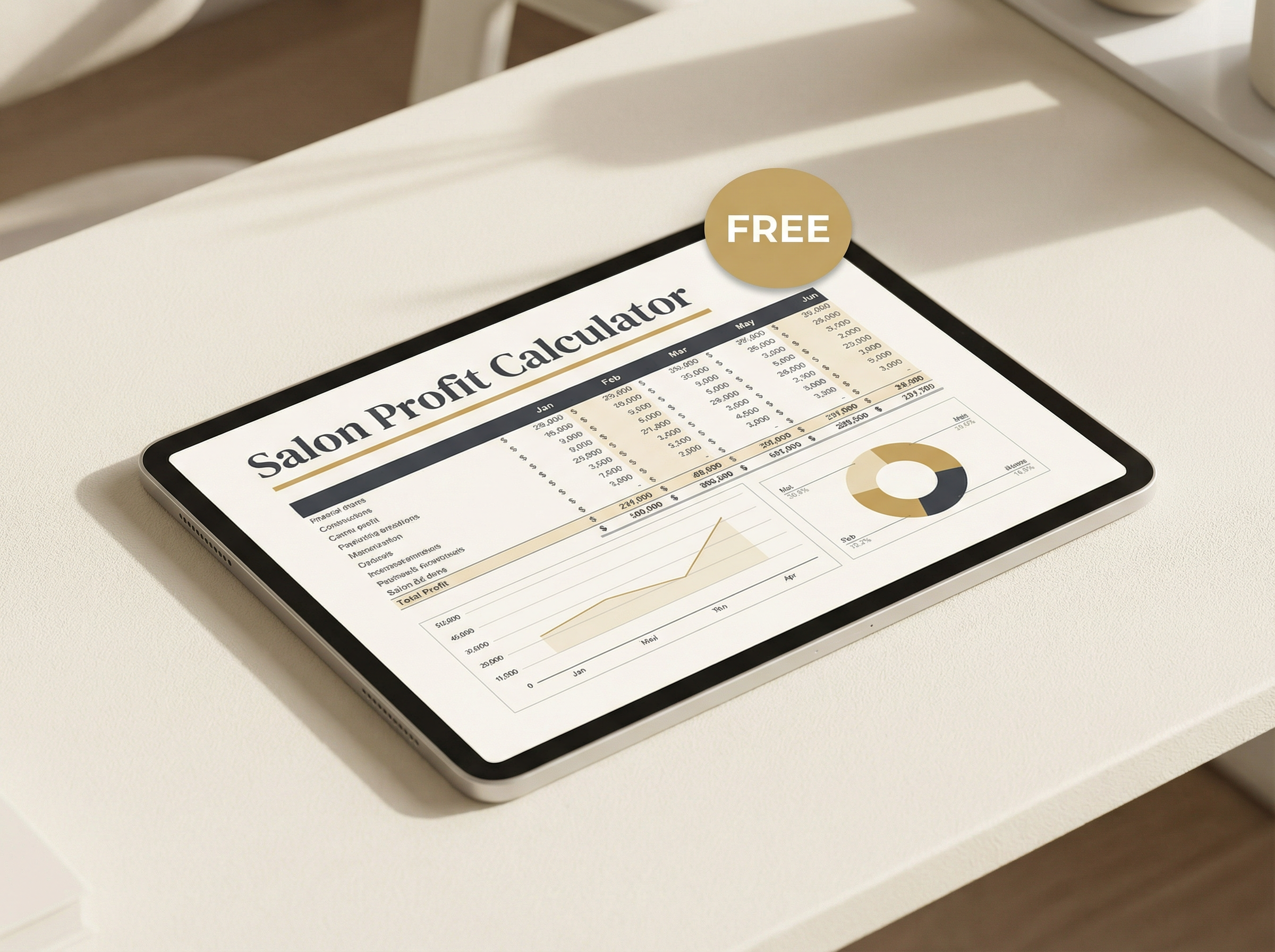
Written by Scott Farmer
Licensed Master Cosmetologist (GA & FL), former Toni & Guy Artistic Director, and founder of Hair Salon Pro. 30+ years behind the chair. 15,000+ clients. Building the business tools cosmetology school never taught. Currently behind the chair at scottfsalon.com in Venice, FL.