Salon Pricing Formula: The Exact Math to Set Your Service Prices
 Scott Farmer
·
April 29, 2026
·
13 min read
Scott Farmer
·
April 29, 2026
·
13 min read
Eighty percent of stylists set their prices by looking at what the salon down the street charges. Additionally, that is not pricing strategy. That is organized guessing. And it costs the average stylist over $10,000 a year in income they should be earning.
I spent 30 years behind the chair before I finally built a real salon pricing formula. However, the first dozen years running my own salon, I priced by feel. Competitive with the market. Somewhere in the middle. Not too high, not embarrassing. And every year I looked at my numbers and wondered why I was working harder than I ever had and still not hitting the income I wanted.
The problem was not my skills. As a result, it was not my location. It was that I was pricing my services based on someone else’s cost structure, not mine.
Here is the formula I should have built from day one. In practice, learn it once and you will never set a price by gut feel again.
TL;DR: The salon pricing formula is: Target Hourly Rate = (Annual Income Goal + Annual Business Costs) ÷ Annual Billable Hours. Then multiply by service time to get your floor price, add 20-25% for profit margin, and round to market. That said, a solo booth renter targeting $60K take-home needs a minimum hourly rate of about $65. That means a women’s haircut starting at $85 and a full balayage starting at $230. Use the salon profit calculator to run your numbers in under three minutes.
Last updated: April 2026
Why Does Copying Competitor Prices Keep You Broke?

When you price based on what the stylist two doors down charges, you are making a dangerous assumption: that her business looks like yours.
It does not. For example, her booth rent might be $150/week. Yours is $300. She may buy product through a supplier deal you do not have. Her income goal may be $45,000 a year. Yours is $70,000. She may work 40 client hours a week to your 25.
Matching her prices means you built your business on her math. And if her math is wrong for your costs, there is only one place that difference shows up: your paycheck.
This is the mechanism behind the “fully booked but broke” trap that hits so many stylists. You are busy. The chair is full. In fact, the money still feels tight. That gap between busy and profitable almost always traces back to prices that were set too low and never properly recalculated.
The hair salon profit margin at the average independent salon runs 8 to 12%. Overall, the formula below builds in a 20-25% margin instead. That is the difference between a business that survives and one that grows.
The Salon Pricing Formula
The formula has one job: tell you the minimum dollar amount your chair needs to generate per hour before you make any profit.
Target Hourly Rate = (Annual Income Target + Annual Business Costs) ÷ Annual Billable Hours
Once you have your target hourly rate, pricing any service takes ten seconds:
Service Price = Target Hourly Rate × Service Time in Hours
Add a profit margin and round to a clean market number. Because of this, here is how to calculate each variable.
Step 1: Calculate Your Total Annual Business Costs
Write down every dollar your business spends in a year before you pay yourself:
Booth or chair rent: The range for independent stylists is $150 to $500 per week. Ultimately, at $300/week and 50 working weeks, that is $15,000/year.
Professional product and supplies: Budget 10 to 15% of your expected gross revenue. If you plan to gross $90,000, that is $9,000 to $13,500 in product. Instead, for a simpler starting estimate, track your monthly product spend and multiply by 12.
Business insurance: Cosmetology liability insurance runs $300 to $600/year for a solo stylist. Worth every dollar.
Licenses and continuing education: Licensing fees, renewal, and required CE typically run $300 to $800/year depending on your state.
Booking software and business tools: Add your booking app, payment processing fees, email marketing platform, and any subscription tools. Of course, budget $100 to $250/month, or $1,200 to $3,000/year.
Marketing and miscellaneous: Business cards, any paid promotions, content tools. Even so, budget $500 to $1,500/year.
A typical solo booth renter comes out between $18,000 and $30,000 in annual costs depending on location and product usage. Still, write down your real number. This is your cost floor.
Step 2: Set Your Income Target
This is where most stylists sabotage themselves before the formula even starts. Beyond that, they set the income target too low.
Do not price for survival. To be clear, price for the business you are building.
The Bureau of Labor Statistics puts the median wage for hairstylists at around $31,000 to $33,000 per year. Meanwhile, that figure pulls in employed stylists at commission salons where the owner absorbs overhead costs. As an independent stylist running your own chair, your target should be meaningfully higher.
Common income targets by model:
- Solo booth renter: $45,000 to $75,000/year
- Suite owner: $60,000 to $95,000/year
- Multi-chair salon owner drawing a salary: $65,000 to $130,000/year
Pick a specific number. Not a range. In contrast, not “more than last year.” Write “$62,000” and build the formula around it.
Step 3: Count Your Real Billable Hours
Not all of your work week generates client revenue. With that in mind, time spent on admin, ordering, cleaning, setting up, and taking consultations does not get billed. Ignoring that gap means you overcount your billable hours and set your prices too low.
Here is a realistic breakdown for a full-time independent stylist:
- Total weekly work hours: 45
- Non-billable time (admin, consults, cleaning, restocking, scheduling): 10 to 12 hours
- Available client-facing hours: 33 to 35
- Realistic booking rate (accounting for gaps, cancellations, no-shows): 80 to 85%
- Effective billable hours per week: 26 to 30
At 48 working weeks per year (four weeks off for vacation, illness, and slow holidays), a stylist booking 28 billable hours per week has 1,344 annual billable hours.
Use a conservative estimate. Furthermore, the formula only works if the input is honest.
Step 4: Run the Numbers
Here is a full worked example.
Scenario: Solo booth renter, $60K income goal
| Variable | Amount |
|---|---|
| Income target | $60,000/year |
| Booth rent | $15,000/year ($300/week × 50 weeks) |
| Products and supplies | $7,500/year |
| Insurance, licensing, software, marketing | $4,200/year |
| Total annual need | $86,700 |
| Annual billable hours | 1,344 (28 hours/week × 48 weeks) |
| Target hourly rate | $64.51/hour |
Now apply the rate to your services:
| Service | Time | Minimum Price |
|---|---|---|
| Women’s haircut | 75 minutes | $80.64 → charge $85 |
| Men’s haircut | 45 minutes | $48.38 → charge $55 |
| Single-process color + cut | 2.5 hours | $161.27 → charge $165 |
| Full balayage + cut | 3.5 hours | $225.78 → charge $230 |
| Gloss treatment (add-on) | 30 minutes | $32.25 → charge $35 |
These are your floors. In other words, not your market rates. Not what you think your clients will pay. The minimum you need to charge to hit your income goal. If market rates in your area support higher prices, charge higher.
Use the salon profit calculator to run your own scenario in under three minutes.
How Do You Price Different Services with the Salon Pricing Formula?
Haircuts
Haircuts are pure time. At the same time, charge for consultation-to-finish, not just the cut. A thorough shampoo, haircut, and blow-dry for a new client takes 75 to 90 minutes when done right. Price the full block, not just the scissors time.
One mistake I see constantly: stylists charge the same price for a 45-minute men’s cut and a 90-minute women’s cut. Notably, different service time. Different price. Your menu should reflect that.
Color Services
Color pricing has two components: your time AND your product cost. Importantly, calculate them separately and add them together.
Color service price = (Hourly rate × service time) + (product cost × 1.5 markup)
A full balayage might burn $35 to $50 in lightener, toner, bond builder, and foils. Additionally, at a 1.5 markup, that adds $52 to $75 on top of your time cost.
I trained under the Toni and Guy system and spent years behind the chair with Redken and Paul Mitchell education. However, color technique matters. So does color pricing. Undercharging for color is the fastest way to make your most skilled services your least profitable. The formula keeps that from happening. Scott Farmer, Licensed Master Cosmetologist and founder of Hair Salon Pro, has applied this formula across 30 years and 15,000+ clients at JScott Salon, Toni and Guy, and his current Venice, FL studio.
Treatments and Add-Ons
Treatments are your highest-margin services. As a result, a 15-minute deep conditioning treatment might cost you $6 in product. If you charge $30, that is a 400% product margin. Make them easy to add at checkout and easy for clients to say yes to.
Pricing floor for add-ons: charge 3 to 4 times the product cost plus 15 minutes of your hourly rate. In practice, a $6 product at a $64/hour rate and 15 minutes of time is: ($6 × 4) + ($64 × 0.25) = $24 + $16 = $40. Round to $35 to $45 depending on your market.
What Profit Margin Are Most Stylists Forgetting?
The formula gets you the per-service price. The next layer is service-menu strategy: how to price salon services across your full menu covers the three pricing decisions that build the entire menu.
Everything above gets you to break-even. For example, add a profit margin on top or the formula only works if nothing ever goes wrong.
Add 20 to 25% above your target hourly rate. In fact, here is what that looks like in dollars:
- At a $64.51/hour floor, a 20% margin adds $12.90/hour
- New effective hourly rate target: $77.41/hour
- A 90-minute haircut at this rate: $116.12 → charge $120
- A 3.5-hour balayage: $270.93 → charge $275
That margin covers slow weeks, broken tools, product price increases, and the month you are sick for four days. Overall, without it, every unexpected cost comes directly out of your paycheck.
There is one more cost most stylists miss entirely: self-employment tax. As a booth renter or suite owner, you owe self-employment tax on your net profit at 15.3% on the first $168,600 of earnings. On $60,000 in net income, that is $9,180 you owe before federal and state income taxes. Budget 28 to 32% of net profit for total tax liability and factor it into your income target from the start.
What Should You Do When Your Salon Pricing Formula Price Feels Too High?
If the formula spits out numbers that feel out of reach for your current market, you have three options.
Option 1: Phase in price increases on new clients first. Ultimately, existing clients stay at their current rate for 6 months. Every new client books at the new formula price. You build toward the target rate without a mass conversation.
Option 2: Use a price increase letter. Instead, done correctly, most clients accept a price increase with minimal pushback. The Price Increase Script Pack has the exact letter and script I use. It is free. Download it, send it, and stop avoiding the conversation.
Option 3: Build the gap with add-ons. If raising your base cut price by $25 feels risky today, add a $35 conditioning treatment to every color service. Of course, build your average ticket up before you raise your base rates. You will often find that the average revenue per client crosses your formula target faster than you expected.
For more on executing a price raise without client fallout, read How to Raise Salon Prices Without Losing Clients.
What Are the Biggest Salon Pricing Mistakes?
Pricing by feel. “Eighty dollars feels right” is not a business decision. Even so, the formula takes 30 minutes. Do it.
Ignoring self-employment tax. Still, you do not take home every dollar of net profit. Budget for SE tax before you set your income target or you will be short every quarter.
Same price for every color service. Beyond that, a root touch-up and a full balayage are not the same service. Charge for the time and product each one actually requires.
Skipping the annual recalculation. Product costs go up. To be clear, booth rent increases. Your skill level grows. Run the formula every January and adjust.
Underpricing to fill slow days. Meanwhile, discounting during slow periods trains clients to wait for the discount. Instead, learn to fill slow days at the salon without cutting prices.
How Do You Price Hair Salon Services?
Price every hair salon service off the same formula: (fixed costs + target income + product cost + tax set-aside) divided by billable hours. In contrast, run the math once a year, build a tier system on top (short / medium / long, base color / correction / specialty), and never copy a competitor’s menu. The salon down the street does not know your overhead.
The 4 steps that turn that formula into a real price list:
- Calculate your chair cost per hour. Add rent, supplies, insurance, software, education, and a $3,000 to $5,000 annual repair buffer. Divide by billable hours (usually 1,200 to 1,500 per year for a solo stylist working 4 to 5 days). That is what your chair has to make per hour before you take home anything.
- Set your minimum hourly rate. Chair cost plus your target hourly take-home plus a 25 to 30% tax set-aside. For most stylists this lands between $90 and $160 per hour, depending on market and overhead.
- Time every service honestly. A women’s cut and style is rarely 30 minutes when you include the consultation, the shampoo, the dry-down, and the next-client transition. Track actual chair time for two weeks, then price off the real number.
- Add a tier system on top, not on the side. Length, density, and complexity are standard add-ons, not surprise charges at the chair. Publish them on the menu in plain language so the conversation already happened before the client sat down.
For the exact numbers on your chair,
For the exact numbers on your chair, run the Salon Profit Calculator with your booth rent, target income, and weekly hours. With that in mind, it outputs your minimum hourly rate in about ninety seconds, and that rate is the floor under every service on your menu.
What Is the Average Labor Assumption for a Hair Salon?
Most hair salons should plan for labor at 50 to 55% of gross service revenue when the owner runs a commission shop, 35 to 45% when running a hybrid model, and 0% labor cost on the books when running booth-rental (the renters cover their own pay through rent). Furthermore, anything above 55% labor on a commission salon means the price menu cannot support the team you have built.
How the labor number breaks down on a commission salon doing $400,000 a year in gross service revenue:
- Stylist commission: 40 to 45% of service revenue ($160K to $180K)
- Payroll taxes and insurance on those wages: 8 to 10% on top ($13K to $18K)
- Owner draw or salary: separate line, not inside the labor ratio
If your labor ratio sits over 55%, the fix is rarely cutting commission. In other words, the fix is raising prices. Most owners discount themselves into a labor ratio they cannot survive and then blame the stylists. Run the formula above to see where your prices should actually sit.
Frequently Asked Questions
How do I know if my market supports my formula price?
Research the top 3 stylists in your area by client reviews and reputation, not just Google rankings. At the same time, what are they charging? If they are consistently booked 6 to 8 weeks out, the market supports those rates. Your goal is to build toward that tier, not compete with discount salons.
Should I charge extra for thick or long hair?
Yes. Longer and thicker hair uses more product and takes more time. Notably, a simple tiered structure works: base price for short, base plus $15 for medium, base plus $25 to $30 for long or thick. Set it as a standard add-on, not a case-by-case surprise conversation.
What is a good profit margin for a solo booth renter?
Aim for 20 to 25% operating margin after all costs, including your own target salary. If your gross revenue is $90,000, your costs including a $62,000 income target are $70,000, and you have $20,000 left over, that is a 22% margin. Importantly, that cushion funds retirement savings, equipment upgrades, and slow season.
How often should I raise my prices?
At minimum once a year. Additionally, product costs rise with inflation. Your experience behind the chair grows every year you are in business. A 5 to 8% annual increase keeps you current and rarely triggers client pushback when communicated properly.
What if I raise prices and lose clients?
You probably will lose some. However, that is not a failure. A full book at accurate prices means fewer clients and more money per hour. The clients who leave over a $10 increase were often not your best clients to begin with. Focus on the math, not the headcount. Understanding your profit margin before and after a price increase shows whether the change actually helped.
Price What Your Chair Costs to Run
The salon pricing formula is not complicated. As a result, the math takes less time than your average root touch-up. What it gives you is clarity: a specific number that tells you what your services must cost before you make a single dollar of profit.
Most stylists skip this calculation and end up fully booked without the income to show for it.
Run your numbers in the Salon Profit
Run your numbers in the Salon Profit Calculator now. In practice, plug in your booth rent, your target income, and your weekly hours. You will see your minimum hourly rate in under three minutes.
If you want a deeper look at where your money is going and exactly what your pricing should be set to, the Run the free Salon Profit Calculator walks through your full business picture in one focused session. One hour. Real numbers. No more guessing.
Schema: FAQPage
Put Your Numbers to Work
Use the free salon pricing calculator to apply this formula to your actual numbers — service costs, overhead, and target profit margin included.
free salon pricing calculator →Free Download
Get the Salon Profit Calculator
See exactly where your salon is losing money — in under 5 minutes.
Download Free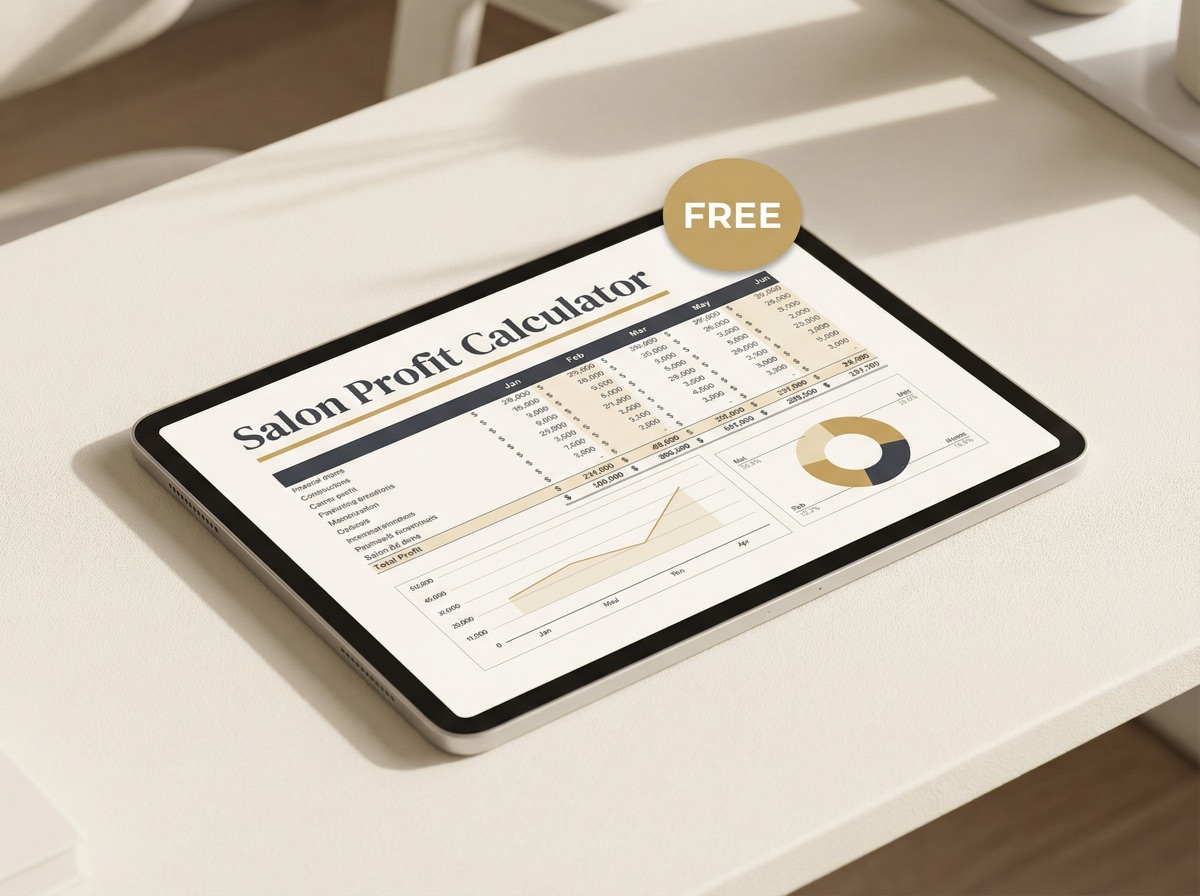
Written by Scott Farmer
Licensed Master Cosmetologist (GA & FL), former Toni & Guy Artistic Director, and founder of Hair Salon Pro. 30+ years behind the chair. 15,000+ clients. Building the business tools cosmetology school never taught. Currently behind the chair at scottfsalon.com in Venice, FL.