Health Insurance for Self-Employed Hairstylists: What I Wish I Had Known 20 Years Ago
 Scott Farmer
·
May 31, 2026
·
14 min read
Scott Farmer
·
May 31, 2026
·
14 min read
TL;DR

- Self-employed hairstylists, booth renters, and suite owners have no employer-sponsored health insurance. You are responsible for finding, paying, and renewing your own coverage every single year.
- The ACA Marketplace (healthcare.gov) is the primary option for most independent stylists. With income-based subsidies, many stylists pay $0 to $150 per month for real coverage. Most never check their eligibility.
- A Health Savings Account (HSA) paired with a high-deductible plan is the single best tax move most stylists ignore. You contribute pre-tax dollars, they grow tax-free, and you spend them tax-free on qualified medical expenses.
- Professional association plans through organizations like the Professional Beauty Association offer group-rate access to self-employed beauty professionals. Worth comparing before you accept any individual rate as final.
- I break down the financial systems that let independent stylists keep more of what they earn inside Hair Salon Pro. Run the free Salon Profit Calculator.
Last updated: May 2026
Quick Answer:
Self-employed hairstylists have four main health insurance options: ACA Marketplace plans at healthcare.gov (income-based subsidies can drop costs to $0-$200/month), professional association group plans through organizations like PBA, short-term health plans (low cost, limited coverage), and spouse or domestic partner employer-sponsored plans. Additionally, the ACA Marketplace is the right starting point for most independent stylists. Open Enrollment runs November 1 to January 15. Special Enrollment opens within 60 days of any major life change.
I went without health insurance for two
I went without health insurance for two years in my mid-thirties.
Not because I was reckless. Because I could not figure out the options, the cost was terrifying, and I was busy enough behind the chair that I kept pushing it to next month. However, i was working independent at the time, building my own book, and every dollar I spent on overhead felt like a dollar not going into my business.
Then I had a kidney stone. As a result, one emergency room visit. No surgery. No complications. Just the stone, a few hours of IV fluids, and a prescription for pain medication.
The bill was $7,200.
That was the last year I went without health insurance. And that is the only reason I am telling you this story, because I know how many independent stylists are making the same calculation I was making and getting it exactly as wrong as I was.
I am Scott Farmer, Licensed Master Cosmetologist with over 30 years behind the chair and more than 15,000 clients served. In practice, i built JScott Salon, worked as an independent stylist, and now run my own suite in Venice, FL. I have been on the W-2 side of a salon, the 1099 side, and the owner side. Every version of this career has a different health insurance reality, and most of us figure it out by trial and error.
This is the guide I wish I had found in my first year behind the chair.
Disclaimer: This article is educational only. That said, it is not professional health insurance or tax advice. Speak with a licensed insurance broker and a tax professional for guidance specific to your situation.
Why Health Insurance Is Different When You Are Self-Employed
If you work as a W-2 employee at a commission salon, your employer can offer group health insurance at group rates. For example, they often pay 50 to 100 percent of the premium. You contribute the rest pre-tax through payroll deductions. It is automatic, simple, and heavily subsidized.
Booth renters, suite owners, and independent stylists get none of that.
The Bureau of Labor Statistics reports the median annual wage for hairdressers at around $34,000. In fact, with no employer-sponsored benefits on top of that wage, health coverage comes entirely out of your pocket. And unlike retirement savings (where you can delay and catch up later), health insurance is not something you can defer without real risk.
Every year without coverage is a gamble that a single diagnosis, injury, or emergency room visit will not wipe out months of work.
The good news is the options are better than most stylists know. Overall, the bad news is you have to go find them yourself.
Option 1: The ACA Marketplace (Healthcare.gov)
This is the right first stop for most self-employed hairstylists.
The Affordable Care Act created a federal marketplace at healthcare.gov where you can shop for individual and family health plans from private insurance companies. The key feature that makes this worth your time: income-based subsidies that can reduce your monthly premium to near zero if your income qualifies.
The subsidies are called Premium Tax Credits. Ultimately, they are based on your household income as a percentage of the Federal Poverty Level. For 2026, a single person earning under roughly $37,000 per year likely qualifies for substantial premium help. Many stylists earning $25,000 to $40,000 pay $50 to $150 per month for solid coverage after subsidies.
The subsidy calculation uses your estimated annual income. If your income swings year to year (as it does for most of us), you estimate at enrollment and reconcile at tax time. Instead, a licensed insurance broker can help you estimate correctly so you do not owe money back in April.
When Can You Enroll?
- Open Enrollment: November 1 through January 15 each year. Plans start January 1 or February 1.
- Special Enrollment: Within 60 days of a qualifying life event. Losing coverage from a spouse’s job, getting divorced, having a baby, and moving to a new state all trigger Special Enrollment. Starting a new independent contractor arrangement after leaving a W-2 job also qualifies.
If you miss Open Enrollment and have no qualifying life event, you wait until the next window. Of course, that is the year I had the kidney stone.
What the ACA Plans Actually Cover
All Marketplace plans must cover 10 essential health benefits including:
– Emergency room and hospital care
– Outpatient care
– Prescription drugs
– Mental health and substance use services
– Preventive care (annual physicals, cancer screenings, vaccines at $0 cost-sharing)
– Maternity and newborn care
Plans come in four metal tiers: Bronze (lowest premium, highest out-of-pocket), Silver, Gold, and Platinum (highest premium, lowest out-of-pocket). Even so, for most healthy stylists in their 20s and 30s, a Bronze plan with an HSA (more on that below) is the smartest financial move. For stylists with ongoing prescriptions or chronic conditions, Gold often pencils out better over a full year.
Option 2: Professional Association Group Plans
One of the least-used options available to independent stylists is group coverage through professional associations.
The Professional Beauty Association offers a member benefits program that includes access to group health insurance rates. Still, as a licensed cosmetologist, you qualify for membership, and that membership buys you access to group-negotiated rates that individual plans on the open market cannot match.
Other associations to check in your state: the National Cosmetology Association, state-level beauty and cosmetology associations, and Chamber of Commerce membership in your city (some Chambers offer health plan access to small business members).
When I was at a Toni and Guy salon building my skills as an Artistic Director, I did not think about this option at all. Beyond that, i had employer coverage. The moment I went independent, I had to figure out everything from scratch, and the association route was one I did not find for several years. Do not make the same mistake.
Group plans through associations are not always cheaper than subsidized ACA plans, especially if your income qualifies for large subsidies. But if you earn more than the subsidy threshold (roughly $52,000 per year for a single person in 2026), association group rates may beat individual market rates significantly.
Option 3: Health Savings Accounts Paired with High-Deductible Plans
If you are generally healthy, this is the most tax-efficient approach for self-employed stylists.
A Health Savings Account (HSA) is a special savings account that works only with a qualifying high-deductible health plan (HDHP). To be clear, the combination is powerful for three reasons:
- You contribute pre-tax dollars. For 2026, the HSA contribution limit is $4,300 for individuals and $8,550 for families. Every dollar you contribute reduces your taxable income by that amount. At the 22% federal tax bracket, a $4,300 contribution saves $946 in federal taxes.
- The money grows tax-free. Unlike a regular savings account, HSA funds can be invested (most providers offer index fund options once your balance exceeds $1,000 to $2,000).
- You spend tax-free on qualified medical expenses. Prescriptions, doctor visits, dental, vision, mental health, glasses, contacts, and hundreds of other eligible expenses all spend from HSA funds at zero tax cost.
The self-employed health insurance deduction (IRS Publication
The self-employed health insurance deduction (IRS Publication 535) also lets you deduct 100 percent of your health insurance premiums from your gross income, not just your itemized deductions. Meanwhile, this is a dollar-for-dollar reduction in taxable income, available whether you itemize or take the standard deduction.
Put these together: a $3,600 per year HDHP premium plus a $4,300 HSA contribution equals $7,900 in tax-deductible expenses. In contrast, at the 22% bracket, that is $1,738 in federal tax savings on top of the coverage itself.
At JScott Salon, when I moved to a high-deductible plan and opened an HSA, my effective annual healthcare cost dropped by about $1,400 compared to a lower-deductible plan with similar coverage. With that in mind, i was healthier that year than average, but even in a year with real medical spending, the math usually favors the HDHP-plus-HSA combination for self-employed stylists who are not managing ongoing chronic conditions.
Option 4: Spouse or Partner Coverage
If you are married or in a domestic partnership where your partner has employer-sponsored coverage, getting added to their plan is almost always the cheapest option.
W-2 employer plans are subsidized by the employer and priced at group rates. Furthermore, your share of the premium is usually far less than any individual plan you could find on your own. If this option is available to you, take it before you explore anything else.
One note: verify your partner’s plan treats domestic partners the same as spouses. In other words, some states require it, others do not. The premium contribution for a domestic partner may be treated differently at tax time than a legally married spouse.
Option 5: COBRA After Leaving a W-2 Job
If you left a commission salon position or any W-2 job within the last 18 months, you may still be eligible for COBRA continuation coverage on your former employer’s plan.
COBRA lets you keep your exact same coverage by paying 100 percent of the premium plus a 2 percent administrative fee. At the same time, on most employer plans, that means you are paying the full cost plus that fee, which tends to run $400 to $800 per month for individual coverage and $1,000 to $1,800 for family coverage.
That is expensive. But it buys you time while you evaluate ACA Marketplace options, especially if you left a job mid-year and the Marketplace Open Enrollment window has already closed.
COBRA is a bridge, not a long-term strategy. Once your Special Enrollment window opens (within 60 days of losing employer coverage), shop the Marketplace and the association options before renewing COBRA.
What Most Stylists Get Wrong About Deductibles
The most common mistake I see independent stylists make when choosing a health plan is picking the lowest premium without understanding the deductible.
Your premium is what you pay every month regardless of whether you use the insurance. Notably, your deductible is what you pay out-of-pocket before the insurance starts covering costs.
A Bronze plan might cost $85 per month but carry a $7,000 deductible. If you have a $7,200 emergency room visit (like my kidney stone), you pay $7,000 before insurance touches the bill. Importantly, the $85 premium feels affordable until that moment.
For healthy stylists with no major medical history, that tradeoff can still make sense financially. But you need to pair it with an HSA and the discipline to actually fund the account. Additionally, without the HSA as your buffer, a low-premium high-deductible plan leaves you exposed.
Run the math before you choose:
Annual total cost = (Monthly premium x 12) + Expected out-of-pocket spending
Compare that number across Bronze, Silver, and Gold tiers for a few realistic spending scenarios (healthy year, moderate year with one specialist visit, rough year with a procedure). However, the answer is almost never obvious before you do the math.
How Health Insurance Connects to Your Tax Strategy
One fact that surprises most independent stylists: you can deduct 100 percent of your health insurance premiums as a self-employed business owner.
This is the Self-Employed Health Insurance Deduction, available on Schedule 1 of your federal return. As a result, it applies to your premiums and to long-term care insurance premiums as well. The deduction is limited to your net self-employment income. If your business had a loss year, the deduction is limited accordingly.
The deduction applies to:
– Health insurance premiums for you
– Health insurance premiums for your spouse
– Health insurance premiums for your dependents under age 27
Pair this with the HSA deduction, and a self-employed stylist netting $50,000 can legitimately reduce taxable income by $8,000 to $12,000 through healthcare-related deductions alone. In practice, that is $1,760 to $2,640 in federal tax savings at the 22% bracket.
This is not advanced tax strategy. That said, it is the baseline that every independent stylist should be using. Most are not.
The IRS Publication 535 covers the business expense rules in full. For example, a CPA or enrolled agent who works with self-employed clients will know exactly how to apply these deductions for your situation.
What Coverage Do You Actually Need?
The answer depends on your age, health history, medications, and income. But here is the framework I use when thinking through coverage decisions:
Non-negotiable for every self-employed stylist:
– Hospital/emergency room coverage (this is what the $7,200 kidney stone bill taught me)
– Prescription drug coverage
– Preventive care (annual physical, relevant screenings)
Important for most stylists:
– Mental health coverage (salon owner burnout is real in this industry, and therapy is a business expense when you run your own chair)
– Outpatient specialist visits
Nice to have but not the priority:
– Dental and vision (these are typically sold as separate, inexpensive add-ons rather than bundled with medical)
– Chiropractic (physically demanding work at the chair creates real musculoskeletal issues over time)
A major medical emergency without hospital coverage is the scenario that ends careers. In fact, that is the risk you are managing first.
A Practical Checklist: Finding Your Plan This Year
- Go to healthcare.gov and run the subsidy estimator with your estimated annual income. Even if you think you earn too much, check. The subsidy thresholds are higher than most stylists expect.
- Call a licensed health insurance broker. They are free (paid by the insurance company, not you), they know the local plans, and they can compare ACA, association, and short-term options in one conversation.
- Check the Professional Beauty Association member benefits page for group plan access.
- If you choose a high-deductible plan, open an HSA immediately. Even funding it with $100 per month ($1,200 per year) builds a real buffer over three to four years.
- Schedule enrollment dates in your calendar before Open Enrollment (November 1) so you are comparing options in October, not scrambling in January.
- Run the Salon Profit Calculator to identify where in your monthly cash flow the premium fits without creating cash pressure. The premium is a fixed business expense. Budget it like chair rent.
The stylists I know who handle this best treat health insurance the same way they treat booth rental insurance and retirement savings: as a non-negotiable line item in their business, not a luxury they get to someday.
Frequently Asked Questions
Is health insurance tax-deductible for self-employed hairstylists?
Yes. The Self-Employed Health Insurance Deduction lets you deduct 100 percent of your health insurance premiums from your gross income on your federal return. Overall, this applies to your own premiums and premiums for your spouse and dependents under 27. The deduction is available on Schedule 1 and applies even if you take the standard deduction. It is limited to your net self-employment income for the year.
Can a booth renter get health insurance through the salon they rent from?
No. Booth renters are independent contractors, not employees. Because of this, under IRS rules, an employer cannot provide employee benefits (including group health insurance) to independent contractors. If the salon owner tried to include you in their group plan as a contractor, it would create tax and classification problems. You must find your own coverage as a self-employed person.
What is the cheapest health insurance option for a hairstylist making $35,000 per year?
At roughly $35,000 in annual income, a single person qualifies for significant ACA Premium Tax Credits. Ultimately, many stylists at this income level find Silver plans on the Marketplace after subsidies running $50 to $150 per month. Check healthcare.gov with your actual income estimate to see your specific subsidy. At this income level, the Marketplace is almost always cheaper than any individual plan purchased outside the marketplace.
What happens if I miss Open Enrollment?
You must wait until the next Open Enrollment window (starting November 1) unless you have a qualifying life event. Instead, qualifying events include losing other coverage, getting married or divorced, having or adopting a child, or moving to a new state. Becoming newly self-employed after leaving a W-2 job qualifies for Special Enrollment within 60 days of losing your prior coverage.
Should I get a low-deductible or high-deductible health plan as a hairstylist?
If you are generally healthy and willing to open and fund an HSA, a high-deductible plan (HDHP) combined with an HSA is usually the most cost-efficient option. HDHPs carry lower monthly premiums, and the HSA lets you save the premium difference pre-tax to cover the higher deductible if you need it. If you have ongoing prescriptions, regular specialist visits, or chronic conditions, a lower-deductible plan often costs less over a full year despite the higher premium.
The Bottom Line
I went without health insurance for two years because I did not understand my options and the cost felt impossible. One kidney stone changed that.
The options available to you as a self-employed hairstylist today are better than what I had, and the information to find them is free. The ACA Marketplace, association group plans, HSA-paired high-deductible plans, and the self-employed premium deduction can combine to give you real coverage at a manageable cost, with significant tax savings on top.
The Salon Profit Calculator can show you
The Salon Profit Calculator can show you exactly where the premium fits in your monthly cash flow. And if you want the full system for keeping more of what you earn behind the chair, I am walking through the Profit-First framework live on when you are ready.
Run the free Salon Profit Calculator..
Free Download
Get the Salon Profit Calculator
See exactly where your salon is losing money — in under 5 minutes.
Download Free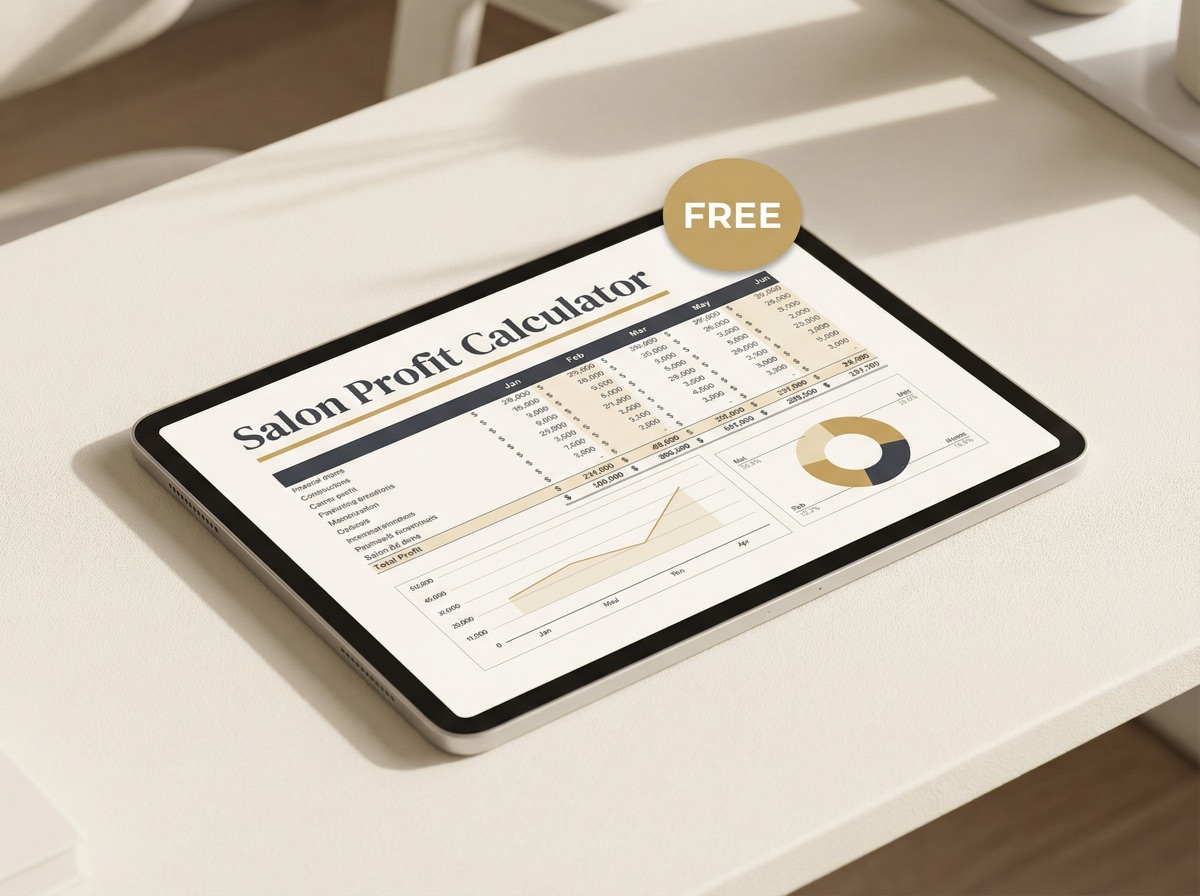
Written by Scott Farmer
Licensed Master Cosmetologist (GA & FL), former Toni & Guy Artistic Director, and founder of Hair Salon Pro. 30+ years behind the chair. 15,000+ clients. Building the business tools cosmetology school never taught. Currently behind the chair at scottfsalon.com in Venice, FL.