How Many New Clients Should a Salon Get Per Month? The 10-Per-Month Benchmark
 Scott Farmer
·
May 30, 2026
·
13 min read
Scott Farmer
·
May 30, 2026
·
13 min read
Quick Answer: How many new clients should a salon get per month?
A solo stylist or single-chair salon should aim for at least 10 new client requests per month to keep the book growing. Multi-chair salons need 8 to 12 per active stylist. That offsets the natural 10 to 20 percent annual client attrition every salon faces. Track new requests weekly, not monthly, to catch demand drops before they hit revenue 60 to 90 days later.
Last updated: May 2026
$127
$127. That was the gap between what I billed in March and what I billed in January, two years into owning JScott Salon. Two months in a row of flat revenue. Nobody cancelled. Nobody complained. My rebook rate was solid. Everything felt fine.
But it was not fine. I had stopped getting new clients. Not stopped trying. Stopped counting. And by the time I noticed, the hole in my book was already two months deep.
I pulled my appointment records and counted backward. In January, I had 16 new guests. In February, 9. In March, 4. My existing clients were coming in like clockwork. But the pipeline of new demand had quietly shut off, and I did not notice because I was busy cutting hair.
That experience changed how I run my business forever. I started tracking one number every single week: new client requests. Not new clients who came in. New requests. People who called, DM’d, booked online, or walked in asking for an appointment for the first time.
I am Scott Farmer, Licensed Master Cosmetologist with over 30 years behind the chair and more than 15,000 clients served. I built JScott Salon, worked as an independent stylist, and now operate my own suite in Venice, FL. I have tracked new client demand across three different salon models. The benchmark I am about to share is not from an industry report. It is from 6 years of weekly tracking at my own salon, validated against what I see in the stylists I mentor.
Why Does New Client Demand Matter More Than Revenue?

Revenue is a lagging indicator. By the time your revenue drops, the problem began weeks or months earlier. New client demand is a leading indicator. It tells you where your revenue is going before it gets there.
Here is why this matters for every salon professional.
Natural attrition is constant. Every salon loses clients every year. Clients move, change jobs, switch stylists, stop getting services, or just drift away. Even the best stylist with a 90% rebook rate loses clients every single month. It is not personal. It is math.
The replacement math is not optional. If you have 120 regular clients and lose 15% per year, that is 18 clients gone in 12 months. That is roughly 1.5 clients per month disappearing from your book. If your average client comes every 6 weeks and spends $95 per visit, each lost client represents $823 in annual revenue.
Formula:
Lost clients per year = Active clients x Attrition rate
Annual revenue loss = Lost clients x (52 / Visit frequency in weeks) x Average ticket
Example: 120 clients x 15% = 18 lost. 18 x 8.67 visits x $95 = $14,824 in revenue you must replace just to stay flat.
That $14,824 is what I call the replacement floor. You have to generate at least that much new client revenue every year just to keep your income from shrinking. And the only way to generate it is new demand.
What Is a Good Number of New Clients Per Month for a Salon?
Here are the benchmarks I use, based on my own tracking and what I see across the stylists I work with.
Solo Stylist or Single-Chair Salon
| Monthly New Requests | Status | What It Means |
|---|---|---|
| 0-4 | Danger zone | Your book is actively shrinking. Revenue decline will show up in 60-90 days. |
| 5-9 | Maintenance mode | You are roughly replacing attrition. Not growing, not shrinking. |
| 10-15 | Growth mode | You are building your book faster than you are losing clients. This is the target. |
| 16+ | Strong demand | You have the luxury of selectivity. Screen for ideal clients and raise prices. |
Multi-Chair Salon (Per Stylist)
The benchmark scales per active stylist. A 4-chair salon with 3 active stylists needs 24-36 new requests per month total, or 8-12 per stylist. When I ran JScott Salon with 3 stylists besides myself, I tracked each person’s new guest count individually. The total salon number hid problems. One stylist getting 15 and another getting 2 looked like 17 total, which seemed fine. But the stylist at 2 was 90 days from a crisis.
Booth Renters and Suite Owners
You are a solo operator. Your benchmark is 10 per month minimum. But here is where booth renters have a structural disadvantage: you are responsible for 100% of your own demand generation. No salon owner is running ads for you. No front desk is routing walk-ins to your chair. When I transitioned to independent work in Venice, this was the biggest adjustment. At JScott, the salon brand generated demand. As an independent, I was the brand, the marketer, and the stylist. My new client count dropped from 14 per month to 3 in the first 60 days. I had to rebuild every demand channel from scratch.
How Do You Measure New Client Requests Correctly?
Most stylists measure this wrong. They count new clients who actually sat in their chair. That is the wrong number. You need to count requests, not completions.
A request is any first-time contact asking about booking an appointment. That includes:
- Online bookings from first-time clients
- Phone calls from new prospects
- Instagram DMs asking about availability or pricing
- Walk-ins requesting a new appointment
- Referral messages from existing clients forwarding your info to a friend
- Google Business Profile calls and direction requests (new-to-you callers)
Why requests, not completions? Because the gap between requests and completions is its own diagnostic tool. If you get 12 requests but only 6 book, your conversion problem is separate from your demand problem. Most stylists who think they have a “not enough clients” problem actually have a “not converting enough inquiries” problem.
When I was at my peak at JScott, we had a 78% request-to-booking conversion rate. During training with Toni and Guy, I learned that elite salons tracked this number religiously. The industry average conversion rate is closer to 50-60%. The difference between 50% and 78% on 12 monthly requests is 3 extra clients per month, which at $95 average ticket adds $3,420 in annual revenue.
Formula:
New client revenue potential = Monthly requests x Conversion rate x Average ticket x 12 months
Example: 12 requests x 78% x $95 x 12 = $10,676/year from new clients alone
Track both numbers. Requests tell you if your marketing is working. Conversions tell you if your booking process is working.
What Are the 5 Sources of New Client Demand for a Salon?
Not all new client sources are equal. Here is what I have seen, ranked by quality (meaning likelihood to rebook and become a long-term client).
Source 1: Client Referrals (Best Quality)
Referred clients rebook at nearly double the rate of walk-ins. At JScott Salon, referral clients had a 74% rebook rate after first visit. Walk-ins were at 38%. The reason is simple: someone they trust already vouched for you.
A simple referral system does not need to be complicated. I gave every client two business cards at checkout. One for their wallet, one to hand to a friend. That is it. No discount. No incentive program. Just two cards and the words: “If you know someone looking for a stylist, I am always happy to take care of your people.”
I built 15,000 clients over my career. The majority came from referrals. The math scales: if 120 clients each refer one person per year, that is 10 referral requests per month. That alone hits the benchmark. Read the full referral playbook in my post on how to build a salon referral program.
Source 2: Google Business Profile and Local Search
When someone in your area searches “hairstylist near me” or “salon in [city],” your Google Business Profile is the front door. For booth renters and suite owners, this is the single most important free marketing channel. I get 4-6 new requests per month in Venice just from my Google listing. Zero ad spend. Zero Instagram hustle. Just a well-maintained listing with real photos, accurate hours, and 5-star reviews that mention specific services.
Source 3: Instagram and Social Media
Social media is a visibility tool, not a booking tool. It warms up cold prospects who already found you somewhere else. The stylist who gets 12 new clients from Instagram alone is rare. The stylist who gets 12 clients because prospects found them on Google, then checked their Instagram to see their work, then booked, is common.
If your Instagram content plan is not converting to bookings, the problem is usually that you are posting transformations without a clear call to action. Every post needs one next step: “DM me to book” or “Link in bio.”
Source 4: Walk-Ins
Walk-ins are unreliable but free. If you work in a high-traffic location, you may get 2-4 walk-in requests per month. If you are in a suite behind a locked door, walk-ins are zero. Do not build your demand strategy around walk-ins. They are a bonus, not a foundation.
Source 5: Paid Advertising
Google Ads and Meta Ads can generate new client requests, but the cost per acquisition matters. If you are spending $200 per month on ads and getting 4 new clients, your cost per new client is $50. If your average first-visit ticket is $85, you need that client to come back at least once to break even on the ad spend. There is no single right marketing budget for a salon. What matters is your cost per new client and whether that client comes back. Track both every month and only spend more where the number holds up.
What Happens When New Client Demand Drops Below 10 Per Month?
The decline is not immediate. It is a 60-to-90-day lag. That is what makes it dangerous. You feel busy today because the appointments on your book were generated weeks ago. The pipeline that will fill your book in 90 days is running dry.
Here is what the decline looks like in practice:
Month 1: Demand drops. New requests fall from 12 to 4. You do not notice because your current book is full. Revenue is steady. Everything feels fine.
Month 2: Gaps appear. The clients who would have been booking their second and third appointments are not there because they never came in the first time. You start seeing 1-2 open slots per week. You fill them with existing clients who want to move up their appointment or add a service. Revenue holds, but you are working harder to hold it.
Month 3: Revenue declines. Those open slots are harder to fill. You start running slow days. The math shows up on your bank statement. This is when most stylists panic, drop their prices, run a “new client special,” and attract the wrong kind of client. The discount spiral starts.
I have seen this pattern repeat across dozens of stylists. The ones who track new requests weekly catch the drop in Month 1 and adjust immediately. The ones who only track revenue do not catch it until Month 3, when the damage is already done.
If you are not tracking your salon KPIs weekly, this is the number to start with. Not revenue. Not rebooks. New client requests. Add it to your weekly tracking routine today.
How Do You Increase New Client Requests From Under 10 to 15 Per Month?
You do not need a marketing degree. You need three things working at the same time.
1. Ask for referrals consistently. Not once. Every appointment. The two-card method I described above works because it is simple enough to do every single time. Most stylists ask for referrals once, get one, and forget. Consistency is the multiplier. If you build a real referral system, your book fills itself.
2. Optimize your Google Business Profile. Update your photos quarterly. Respond to every review within 24 hours. Post one Google update per week showing your work with a booking link. This alone can move your request count by 3-5 per month within 60 days.
3. Create one piece of content per week that answers a question your ideal client is asking. Not a before-and-after. A tip, a recommendation, a styling hack for their specific hair type. This positions you as the expert in your niche and gives prospects a reason to choose you over the 17 other stylists in their area.
Here is what NOT to do when demand drops. Do not slash your prices. Do not run a Groupon. Do not post “openings available” on Instagram three times a day. Those moves attract price-sensitive clients who will not rebook at full price. If demand is low, the answer is to market better, not to charge less. I wrote about this exact trap in my post about how to fill slow days at salon.
What Is the Connection Between New Client Demand and Pricing Power?
This is the part most stylists miss entirely.
When your new client requests consistently exceed 15 per month, you have pricing power. That means you can raise your prices, and demand will absorb the increase without a net client loss.
At JScott Salon, I tracked the relationship between demand and pricing for years. Every time my new client requests averaged above 15 per month for a consecutive quarter, I raised my prices by $5-$10. My request count dipped by 10-15% after each increase, then recovered within 60 days. The net result: same client count, higher revenue.
Formula:
Pricing power threshold = Monthly new requests consistently above 1.5x attrition replacement rate
If attrition replacement needs 10 new clients/month, pricing power kicks in above 15/month sustained for 90+ days
If you are sitting at 6 new requests per month and wondering whether to raise prices, the answer is not yet. Build demand first. Then raise prices into the demand. That sequencing is the difference between a price increase that grows your income and one that empties your book.
Run the numbers through the free Salon Profit Calculator to see exactly how a price increase at your current demand level affects your take-home.
Frequently Asked Questions
How many new clients per month is average for a solo stylist?
The industry average for a solo stylist in a metro area is 5-8 new client requests per month. But average is not the target. The median hairdresser, hairstylist, and cosmetologist earned $35,790 a year in May 2025, according to the BLS Occupational Employment and Wage Statistics survey (SOC 39-5012). The stylists who consistently earn six figures track at 10-15 new requests per month and convert 70% or more into booked appointments.
What is a good new client rebook rate after the first visit?
A first-visit rebook rate above 60% is healthy. Above 70% is strong. Below 50% signals a consultation or experience problem. At JScott Salon, my personal first-visit rebook rate was 72%. The difference between 50% and 72% on 10 new clients per month is 2.2 extra repeat clients per month, or roughly $2,500 in additional annual revenue at a $95 average ticket.
Should I track new client requests if I am fully booked?
Yes. Being fully booked today does not mean you will be fully booked in 6 months. Client attrition is constant. If you stop tracking demand because your book is full, you will not notice when the pipeline slows down until open slots appear. I was fully booked for 18 consecutive months at JScott before demand quietly dropped. I did not notice for 3 months because I was too busy cutting hair to count.
How long does it take to increase new client demand from 4 to 10 per month?
With consistent referral requests, an optimized Google Business Profile, and one piece of weekly content, most stylists can move from 4 to 10 new requests per month within 90 days. The referral system alone, if you run it every single appointment, typically adds 3-5 requests per month within 60 days. It is not fast, but it compounds. Every new client who becomes a regular creates another potential referral source.
Does salon location affect the new client benchmark?
Yes. A high-traffic downtown salon may get 5-8 walk-in requests per month that a suite in a quiet strip mall would never see. But the 10-per-month benchmark adjusts because the suite stylist needs more referrals and digital requests to compensate. The total target stays the same. The source mix changes. If your location generates zero walk-ins, your referral and Google channels need to carry more weight.
Found this useful? Tell Google you want to see more from Hair Salon Pro in your search results and AI answers.
Free Download
Get the Salon Profit Calculator
See exactly where your salon is losing money in under 5 minutes.
Download Free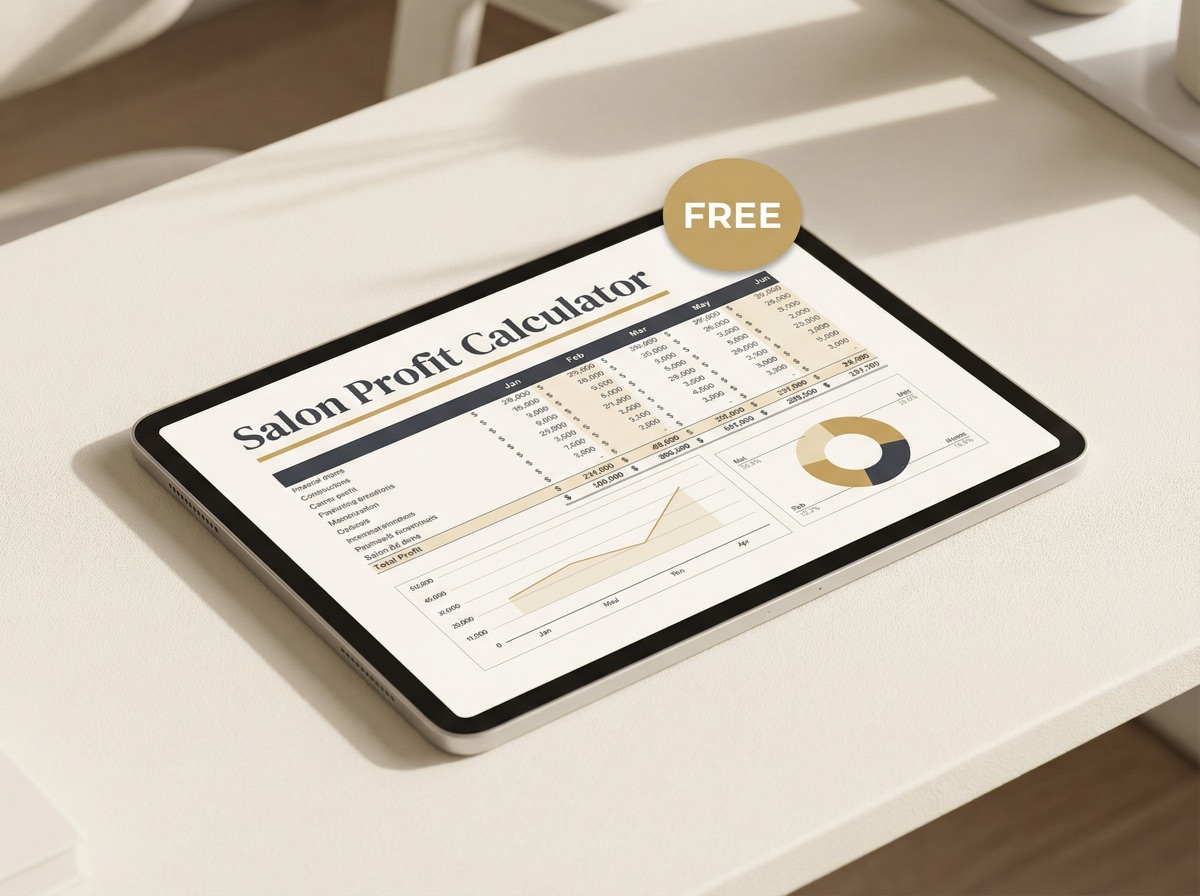
Written by Scott Farmer
Licensed Master Cosmetologist (GA & FL), former Toni & Guy Artistic Director, and founder of Hair Salon Pro. 30+ years behind the chair. 15,000+ clients. Building the business tools cosmetology school never taught. Currently behind the chair at scottfsalon.com in Venice, FL.