How to Raise Salon Prices Without Losing Clients
 Scott Farmer
·
April 15, 2026
·
10 min read
Scott Farmer
·
April 15, 2026
·
10 min read
TL;DR

- If you have not raised your prices in the last 12 months, you gave yourself a pay cut. The Bureau of Labor Statistics inflation calculator shows $100 in 2020 buys $122 of goods in 2026. Your $50 haircut is now worth $41 in real purchasing power.
- A $12 per-service increase on 25 clients a week adds $15,600 a year in found revenue. One change. Not more hours, not more clients, not a new marketing strategy. Just charging what your chair actually costs to operate.
- 85% to 95% of clients stay after a well-communicated price increase. The 5% to 15% who leave are typically your lowest-value clients. The Professional Beauty Association reports the average salon raises prices every 12 to 18 months. The most profitable salons review twice a year.
- The 5-step process: calculate your real cost per service, choose a calculated (not round) number, give 30 days notice, raise everyone on the same day, add visible value alongside the increase. No apology. No exceptions. No drama.
- Scott Farmer, Licensed Master Cosmetologist with over 30 years behind the chair and more than 15,000 clients served, built JScott Salon in Lawrenceville, Georgia and now practices in Venice, Florida. Run your numbers through the free Salon Profit Calculator and grab the Price Increase Script Pack with 12 ready-to-use scripts for every client conversation.
Last updated: June 2026
Quick Answer: To raise salon prices without losing clients, calculate your actual cost per service first, raise by a calculated (not round) amount, give clients 30 days written notice, raise everyone on the same date, and add visible value alongside the increase. Additionally, industry data shows 85% to 95% of clients stay after a well-communicated increase. A $12 increase on 25 weekly clients adds $15,600 per year in revenue without working more hours.
You know you need to raise your
You know you need to raise your prices. However, you have known for months.
Maybe you figured it out when you checked your bank account after a fully booked week and wondered where all the money went. As a result, maybe a newer stylist posted their prices on Instagram and you realized they charge more than you with half your experience.
But every time you think about how to raise salon prices, the same voice kicks in. What if they leave? In practice, what if they tell their friends? What if my chair goes empty?
So you do nothing. And the leak keeps running.
I was the same way. When I was running JScott Salon, I was so scared to raise my prices that I would rather work 12-hour Saturdays than ask a client to pay $5 more per cut. That said, that fear cost me more money over the years than any bad hire, bad lease, or bad economy.
When I finally raised my prices, I kept almost every client. For example, the ones who left were the ones I should have let go years ago.
I am Scott Farmer. In fact, licensed Master Cosmetologist with over 30 years behind the chair and more than 15,000 clients served. I built JScott Salon in Lawrenceville, Georgia, and now run my practice in Venice, Florida. The pricing strategies below are the exact ones I used when I raised my own prices and coached other stylists through the same conversation.
Here is the process that worked for me. And it has worked for every stylist I have coached through it since.
Why Do Salon Owners Wait Too Long to Raise Prices?
The short answer: fear. Overall, the long answer is worse.
Product costs go up every year. Rent goes up. Insurance goes up. Because of this, education costs go up. But most stylists set their prices once and then avoid looking at them again until they are in trouble.
The Bureau of Labor Statistics inflation calculator shows that $100 in 2020 buys about $122 worth of goods in 2026. If you charged $50 for a haircut in 2020 and still charge $50 today, you gave yourself a pay cut. Ultimately, your clients did not even notice.
Here is the other problem. When you wait too long, the gap between what you charge and what you should charge gets bigger. Instead, a $5 increase is easy to absorb. A $25 increase is hard to explain. The longer you wait, the bigger the jump, and the more clients you risk losing.
Our salon profit calculator shows you exactly what your chair costs per hour. Of course, most stylists who run it for the first time realize they have been undercharging by $8 to $20 per service. That adds up to $500 to $2,000 a month in money they are giving away.
How Do You Know When It Is Time to Raise Your Salon Prices?
If any of these are true, you are overdue.
You have not raised prices in 12+ months. Even so, everything else costs more. Your services should too.
Your book is 80% full or more. Still, demand for your time exceeds supply. That is the textbook definition of “time to charge more.” If you are fully booked but still broke, your prices are the problem.
You calculated your real hourly rate and it is below $50. After rent, product, taxes, and downtime, many stylists make $25 to $35 per hour. Beyond that, that is less than what a plumber charges for a service call. Calculate yours with our stylist income formula and see where you land.
Newer stylists in your market charge more than you. If someone with 3 years of experience charges $85 for a balayage and you charge $75 with 15 years of experience, you are undervaluing your work.
You dread Mondays. To be clear, this is the quiet sign. When the money does not match the effort, resentment builds. You start cutting corners on client experience because you feel underpaid. That cycle destroys businesses.
How to Raise Salon Prices in 5 Steps
This is the exact process that works. No drama. No mass exodus.
Step 1: Calculate your real number
Do not guess. Meanwhile, pull your cost per service, your rent per chair hour, your product cost per service, and your target income. Divide it out. The number you get is what each service needs to earn to pay you what you are worth.
Use a pricing calculator or the hair salon pricing strategy guide to work through the math. In contrast, the number you get will probably be higher than what you charge now. That gap is how much money you are giving away on every appointment.
Step 2: Choose a calculated number, not a round one
Never raise to a round number. With that in mind, clients respond differently to $47 than to $50. A calculated number feels like you did math. A round number feels like you made it up.
If your math says your cut should be $47, charge $47. If it says $93, charge $93. Furthermore, the specificity builds trust because it tells the client there is a reason behind the number.
Step 3: Give 30 days notice
Do not surprise anyone. In other words, post a simple sign at your station. Send a text or email. Something like:
“Starting [date], my pricing will be updated to reflect my current costs and continued education. At the same time, i am giving you 30 days notice so there are no surprises. I value you as a client and I am committed to giving you the best experience in my chair.”
That is it. No apology. No long explanation. Notably, no asking for permission.
Step 4: Raise everyone on the same day
Do not stagger it. Importantly, do not grandfather your favorite clients. Everyone pays the new rate on the same day. If you make exceptions, you create resentment when people find out (and they will find out).
The only exception: prepaid packages or gift certificates purchased before the notice. Additionally, honor those at the old price.
Step 5: Add value before or alongside the increase
A price increase paired with a visible improvement is nearly bulletproof. Examples:
- New product line in the backbar
- Better consultation process (extra 5 minutes at the start)
- Upgraded finishing touches (neck trim, quick style lesson)
- A small client loyalty reward (rebook within 4 weeks, save $10)
You are not doing these things to “justify” the increase. However, you are doing them because higher prices attract better clients who expect better service. Start delivering that service now.
What Should You Say to Clients Who Push Back?
Most clients will not say a word. As a result, the industry standard is that 85% to 95% of clients stay after a well-handled price increase. The 5% to 15% who leave are usually the clients who tip least, cancel most, and complain about everything.
But some will ask. In practice, here are three scripts that work.
For the client who says “That is more than I expected”:
“I hear you. That said, my costs have gone up across the board this year, and I wanted to make sure I can keep giving you the same quality. The new price reflects what it actually costs me to give you a great experience.”
For the client who says “I will need to think about it”:
“I totally understand. Take your time. For example, i would rather you come less often and still get the best than feel pressured every visit.”
For the client who says “I am going to look around”:
“I respect that. If you find someone you love, that is great. And if you want to come back, the door is open.”
During my time as an Artistic Director at Toni and Guy, I watched dozens of stylists handle this conversation. In fact, the ones who apologized and offered discounts lost more clients than the ones who stated the new price with confidence and moved on.
If you want the full set of 12 scripts for every type of client conversation, grab the free Price Increase Script Pack. Overall, they are the exact words I used when I raised my own prices.
What Happens After You Raise Your Prices?
Three things happen, usually in this order.
Week 1 to 2: A few clients cancel or do not rebook. This feels terrible. It is actually fine. Count them. It will be fewer than you feared.
Month 1 to 2: Your revenue per appointment goes up. Even with slightly fewer clients, your total revenue stays flat or increases because each appointment is worth more. Your stress drops because you need fewer clients to hit your number.
Month 3+: Better clients find you. Higher prices attract people who value quality over bargains. They tip better, cancel less, buy retail, and refer other good clients. Your chair starts to feel different.
The math on this is simple. If you raise your average ticket by $12 and see 25 clients a week, that is $300 a week. Over a year, that is $15,600 in found revenue. From one change.
According to the Professional Beauty Association, the average salon raises prices once every 12 to 18 months. The most profitable salons review pricing twice a year and adjust as costs change.
Frequently Asked Questions
How much should I raise my salon prices?
Calculate your actual cost per service first. Most stylists find they are undercharging by $8 to $20 per service. Raise to your calculated number, not a round one. If the gap is large (over $25), consider a two-stage increase: half now, half in 6 months.
How often should salon prices increase?
At minimum, once per year. Many successful salon owners review pricing every 6 months and adjust if costs have changed. Annual increases of 5% to 10% are standard in the industry and most clients expect them.
Will I lose clients if I raise my prices?
Some. But fewer than you think. Industry data consistently shows 85% to 95% client retention after a well-communicated price increase. The clients you lose are typically your least profitable ones. Read our hair salon pricing strategy guide for the full framework.
Should I raise prices for existing clients or just new ones?
Both, on the same date. If you only raise for new clients, existing clients will eventually find out and feel insulted. Uniform pricing is fairer, simpler, and avoids resentment.
Can booth renters raise their own prices?
Yes. Booth renters control their own pricing and do not need the salon owner’s permission to raise rates. Calculate your total costs (booth rent, products, tools, insurance, self-employment taxes) and set prices so each service covers your costs and pays your target hourly rate. Many booth renters undercharge because they compare to commission stylists, but your overhead structure is different and your pricing should reflect that.
Your prices are the biggest lever in your business. Not your client count. Not your hours. Not your Instagram following. Your prices.
If you have not raised them in the last 12 months, you are giving away money every single week. And the longer you wait, the harder the conversation gets.
Start with the math. Download the free Price Increase Script Pack and use the scripts the next time you are ready to charge what you are worth. Twelve scripts. Every scenario. No more guessing what to say.
Double Your Chair Income, Without Working More Hours
Raising prices is the start. When you run your numbers, I teach the full Profit-First System so the raise sticks and your income doubles.
Run the Free Salon Profit Calculator
Free. Available now. No registration required.
Put Your Numbers to Work
Before you raise prices, run your numbers. The free salon price increase calculator shows exactly how a price change affects your monthly take-home.
free salon price increase calculator →Free Download
Get the Salon Profit Calculator
See exactly where your salon is losing money — in under 5 minutes.
Download Free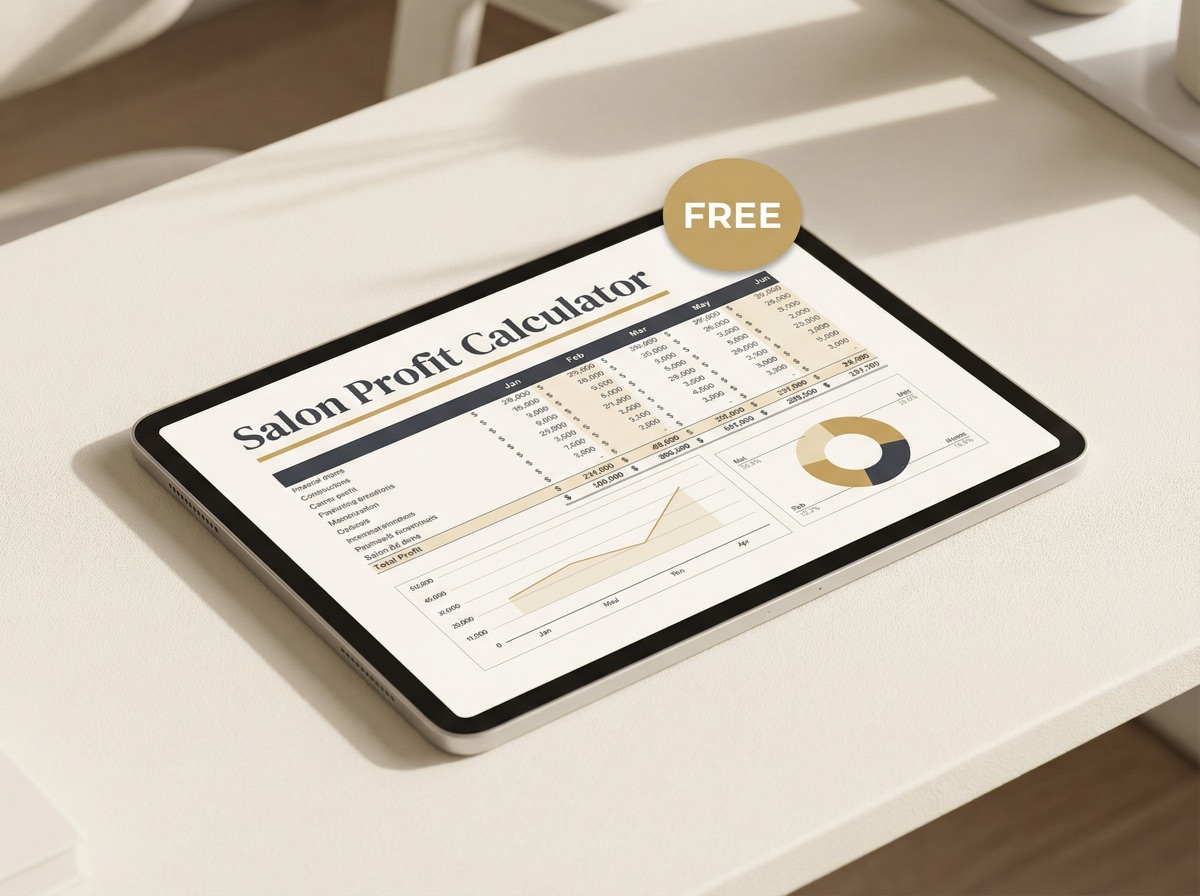
Written by Scott Farmer
Licensed Master Cosmetologist (GA & FL), former Toni & Guy Artistic Director, and founder of Hair Salon Pro. 30+ years behind the chair. 15,000+ clients. Building the business tools cosmetology school never taught. Currently behind the chair at scottfsalon.com in Venice, FL.