Salon KPIs: 7 Numbers Every Salon Owner Should Track Weekly
 Scott Farmer
·
April 29, 2026
·
12 min read
Scott Farmer
·
April 29, 2026
·
12 min read
Quick Answer: Which salon KPIs should you track weekly?
Track seven numbers and ignore the rest: average service ticket, client retention rate, pre-book rate, retail-to-service ratio, chair utilization rate, new client acquisition cost, and net profit margin. You do not need a $200-a-month dashboard. A notebook, a calculator, and 15 minutes every Monday morning will tell you more about your business than any software, and it shows you exactly where profit is leaking.
Get the Free KPI Tracker (Google Sheet) →
Click File → Make a copy to save your own editable version.
Last updated: April 2026
Most salon owners can tell you how much they made last month. Ask them their client retention rate and you get a blank stare. Ask about their chair utilization percentage and they change the subject.
This is not a knowledge gap
This is not a knowledge gap. It is a profit gap.
If you do not know which salon KPIs to track, you are running your business on feelings instead of numbers. And feelings are expensive. The owner who “feels” busy is often the same owner wondering why there is nothing left after rent, products, and taxes.
I spent years behind the chair operating exactly this way. Revenue looked fine. The book was full enough. But I had no idea my pre-book rate was sitting at 34%. It should have been 70%+. My retail ratio was under 4% when it should have been 15-20%. And my real profit margin was 9%.
Those three numbers cost me roughly $1,800 a month in lost income. I just did not know it because I was not tracking them.
Here are the 7 salon KPIs that actually matter, how to calculate each one, and what they should look like in a healthy salon business.
What Are Salon KPIs and Why Do They Matter?

KPI stands for Key Performance Indicator. That said, it is a number that tells you something important about how your business is performing.
The problem is most KPI lists for salons are written by software companies trying to sell you a $200/month dashboard. For example, they give you 25, 30, sometimes 40 metrics to track. Revenue per square foot. Social media engagement rate. Client satisfaction score. Employee turnover index.
You do not need 40 numbers. You need 7.
These 7 salon KPIs cover every part of your business that directly affects how much money you take home. If any one of them is off, you feel it in your bank account whether you track it or not. The difference is that tracking them lets you fix the problem before it eats six months of profit.
The 7 Salon KPIs Every Owner Should Track
1. Average Service Ticket
What it is: The average dollar amount a client spends per visit, including all services.
How to calculate it: Total service revenue for the week divided by total client visits.
Example: You brought in $4,200 in services this week across 48 client visits. Your average ticket is $87.50.
Why it matters: This is the fastest lever you have. Raising your average ticket by $15 across 25 clients per week adds $375/week to your revenue. That is $1,500/month, and you did not need a single new client to get it.
Most stylists raise their average ticket through add-on services, not price increases. A $35 deep conditioning treatment or a $25 toner refresh added to every third appointment moves this number without any awkward pricing conversations. Though if you have not raised your prices in over a year, the math says you should. Here is a complete pricing strategy guide with the formula and the scripts.
Healthy range: $85-$150 for most markets. If yours is below $75, your pricing or your service menu needs attention. Use the Salon Profit Calculator to see how a $15 ticket increase changes your monthly income.
For a deeper dive, read the full guide on how to increase your salon’s average ticket.
2. Client Retention Rate
What it is: The percentage of clients who come back within their expected return window. That is typically 6-8 weeks for cuts, 8-12 weeks for color.
How to calculate it: Clients who returned within their expected window divided by total clients from that same period, times 100.
Example: You saw 90 clients in February. Even so, by mid-April (8 weeks later), 63 of them had booked again. Your retention rate is 70%.
Why it matters: Acquiring a new client costs 5-7 times more than keeping an existing one. According to Professional Beauty Association data, most salons lose 10-25% of their client base every year without realizing it.
Do the math. If you serve 100 unique clients and lose 20% annually, you need 20 new clients just to stay flat. At a $95 average ticket visiting 6 times a year, that is $11,400 in annual revenue walking out the door. Every year.
Healthy range: 70-80%+ retention is strong. Below 60% signals a service, pricing, or rebooking problem.
3. Pre-Book Rate
What it is: The percentage of clients who schedule their next appointment before leaving the salon.
How to calculate it: Clients who pre-booked divided by total clients seen, times 100.
Why it matters: Pre-booking is the single best predictor of a full book. A stylist with a 75% pre-book rate will almost never have a slow week. A stylist with a 30% pre-book rate will spend half their Tuesday mornings staring at gaps in the schedule.
Early in my career, pre-booking was not something anyone pushed. You did the service, the client left, and maybe they called back in 6 weeks. Then I worked as an Artistic Director at Toni and Guy, where pre-booking was tracked weekly and posted for every stylist to see. The stylists with 70%+ pre-book rates were fully booked months out. The ones at 30% were always scrambling.
That one metric showed me the difference between a reactive business and a proactive one.
Healthy range: 60-80%. If you are below 50%, you need a rebooking system. It can be as simple as saying “Let me get you on the calendar before you leave” while the client is still in the chair.
4. Retail-to-Service Ratio
What it is: How much of your total revenue comes from retail product sales versus services.
How to calculate it: Retail revenue divided by total revenue, times 100.
Example: You made $5,000 in services and $800 in retail this week. Your retail ratio is 13.8%.
Why it matters: Service margins in most salons sit between 8% and 15%. Product margins sit between 40% and 50%. Every dollar of retail you sell is 3-5 times more profitable per dollar than another service.
A stylist doing $4,000/week in services with zero retail keeps about $320-$600 in profit from those services (at 8-15% margin). Add $600/week in retail at a 45% margin, and that is another $270 in profit. You just increased your take-home by 45-84% without adding a single appointment.
Healthy range: 15-25% retail ratio. The industry average is closer to 8-10%, which is one reason the average salon profit margin sits at just 8.2%.
5. Chair Utilization Rate
What it is: The percentage of your available working hours that are filled with paying clients.
How to calculate it: Booked service hours divided by total available hours, times 100.
Example: You work 40 hours this week. Between gaps, no-shows, and late cancellations, only 28 hours had a client in your chair. Your utilization is 70%.
Why it matters: Every empty hour in your chair has a cost. If your average service generates $95/hour, a 70% utilization rate means you are leaving about $230/day on the table compared to 100%. Over a month, that is nearly $5,000 in potential revenue that evaporated.
Nobody hits 100%. That is not realistic. But the gap between 65% and 85% is the gap between a stylist who “does okay” and a stylist who is fully booked and actually profitable.
Healthy range: 75-85% is strong. Below 65% means your book has holes that need attention. Common fixes: enforce your cancellation policy, batch similar services to reduce transition time, and build add-ons into existing appointments instead of chasing new bookings.
6. New Client Acquisition Cost
What it is: How much it costs you to get one new client in the door.
How to calculate it: Total marketing spend (ads, promotions, referral bonuses, listing fees) divided by new clients gained in that period.
Example: You spent $300 on Instagram ads and $50 on a Yelp listing this month. You got 8 new clients. Your acquisition cost is $43.75 per client.
Why it matters: If it costs you $44 to acquire a client who spends $95 on their first visit and never returns, you barely broke even after product costs. If that same client comes back 6 times over the next year, your return on that $44 is $570 in revenue. That said, that is the difference between a sustainable marketing spend and throwing money away.
This is why retention (KPI #2) and pre-booking (KPI #3) come before acquisition. Fix retention first. Then spend money bringing new people in.
Healthy range: Under $50/client for social media and referral-based marketing. If you are paying more than $75/client every month, your targeting or your offer needs work. According to the Bureau of Labor Statistics, the beauty industry operates on thin margins already. Overspending on acquisition is one of the fastest ways to erode what little profit exists.
7. Net Profit Margin
What it is: The percentage of revenue that stays in your pocket after every single expense is paid.
How to calculate it: (Total revenue minus total expenses) divided by total revenue, times 100.
Example: You brought in $8,000 this month. Your total costs (rent, products, supplies, software, insurance, merchant fees, marketing, continuing education) came to $6,800. Your net profit is $1,200. Your margin is 15%.
Why it matters: This is the KPI that tells you the truth. Revenue is vanity. Profit is sanity. A stylist making $10,000/month at an 8% margin takes home $800. A stylist making $7,000/month at a 22% margin takes home $1,540. The second stylist works less, earns more, and sleeps better.
For detailed benchmarks by salon model (commission, booth rental, suite), read the full breakdown on hair salon profit margins.
Healthy range: 15-25% for most salon models. Suite owners and booth renters can hit 25-35%.
How to Track Salon KPIs Without Expensive Software
You do not need a $200/month salon management platform to track 7 numbers.
Here is the minimum viable system:
Option 1: A notebook. Write the 7 KPIs at the top of a page every Monday. Fill them in from last week’s numbers. Takes 15 minutes. Costs nothing.
Option 2: A simple spreadsheet. One row per week, 7 columns. Auto-calculate the formulas. You can build this in Google Sheets in 20 minutes.
Option 3: Your existing salon software. If you already use Vagaro, GlossGenius, Square, or any booking platform, most of these numbers live in your reports tab. You just have to look at them. The problem was never the software. The problem was not having a weekly habit of checking.
The important thing is consistency. Even so, tracking these 7 numbers every week for 8 weeks will teach you more about your business than any course, podcast, or Instagram tip ever could.
The 15-Minute Weekly Salon KPI Check
Set this for every Monday morning before your first client. Or Sunday night after you close out the week. Pick a time that sticks.
- Pull last week’s total service revenue and client count. Calculate your average ticket.
- Check how many clients from 6-8 weeks ago came back this week. Estimate your retention rate.
- Count how many clients booked their next appointment before leaving. Calculate your pre-book rate.
- Add up retail sales. Divide by total revenue. That is your retail ratio.
- Count your booked service hours versus your available hours. That is utilization.
- Add up marketing spend. Divide by new clients. That is your acquisition cost.
- Subtract all expenses from all revenue. Divide the difference by revenue. That is your margin.
Write all 7 down. Compare to last week. Look for the number that moved the wrong direction.
That one number is your priority for the week.
3 Salon KPI Tracking Mistakes That Cost You Money
Tracking Too Many Numbers
This is the most common mistake. Salon software dashboards love showing you 30+ metrics in colorful charts. It feels productive to look at all of them. It is not. Focus on the 7 that matter. Ignore the rest until those 7 are healthy.
Tracking Without Acting
Numbers without action are decoration. If your pre-book rate has been 35% for three months and you have not changed your checkout process, tracking it is pointless. Every weekly check should end with one specific action tied to the weakest KPI.
Comparing to Industry Averages Instead of Your Own Baseline
Industry averages are useful as starting points, but your real benchmark is last month’s number. A salon owner with a 12% profit margin who moves to 16% in 90 days has made a bigger impact than someone who was started at a 20% margin and never improved it. Track your trend, not just your score.
Frequently Asked Questions
What KPIs should a salon owner track?
The 7 most impactful salon KPIs are average service ticket, client retention rate, pre-book rate, retail-to-service ratio, chair utilization rate, new client acquisition cost, and net profit margin. These cover pricing, client loyalty, scheduling efficiency, sales mix, marketing effectiveness, and overall profitability. Track all 7 weekly for a complete picture of your salon’s financial health.
How often should I check my salon KPIs?
Weekly. Not monthly, not quarterly. Weekly reviews catch problems before they compound. A dip in your pre-book rate this week becomes a scheduling gap in 6 weeks. Catching it now gives you time to fix it. Set a recurring 15-minute check every Monday morning.
Do I need salon software to track KPIs?
No. A notebook or a simple Google Sheets spreadsheet works for any solo stylist or small salon owner. Salon management software like Vagaro or GlossGenius can automate some of the data collection, but the numbers themselves are easy to calculate by hand. The habit matters more than the tool.
What is a good client retention rate for a salon?
A healthy client retention rate for a salon is 70-80% or higher, meaning 7 or 8 out of every 10 clients return within their expected visit window. The industry average hovers around 60-65%. Every 5% improvement in retention can increase annual revenue by $5,000-$15,000 depending on your average ticket and client volume.
What is the most important KPI for a salon?
Net profit margin. Every other KPI feeds into it. You can have a high average ticket and still lose money if your costs are out of control. You can have perfect retention and still struggle if you are underpriced. Profit margin is the final truth. Start there, then work backward through the other 6 KPIs to find what is holding it down. Use the free Salon Profit Calculator to find your number in under 5 minutes.
Your Numbers Are Telling You Something
Scott Farmer, Licensed Master Cosmetologist and founder of Hair Salon Pro, built this KPI framework after 30 years behind the chair and 15,000+ clients. His core lesson: every week you skip the KPI check is another week of flying blind. And behind the chair, blind is expensive.
If you want to see exactly where your salon stands right now, start with the free Salon Profit Calculator. Plug in your numbers and get your current margin, average ticket benchmark, and a breakdown of where profit is leaking.
For a full analysis of all 7 KPIs with a personalized action plan, run a Run the free Salon Profit Calculator. It walks you through your pricing, utilization, retention, and retail performance. You leave with the specific changes that will move your income the most, based on your actual numbers.
The salon owners who track their KPIs are the ones who stop guessing and start growing. The numbers are already there. You just have to look at them.
Free Download
Get the Salon Profit Calculator
See exactly where your salon is losing money — in under 5 minutes.
Download Free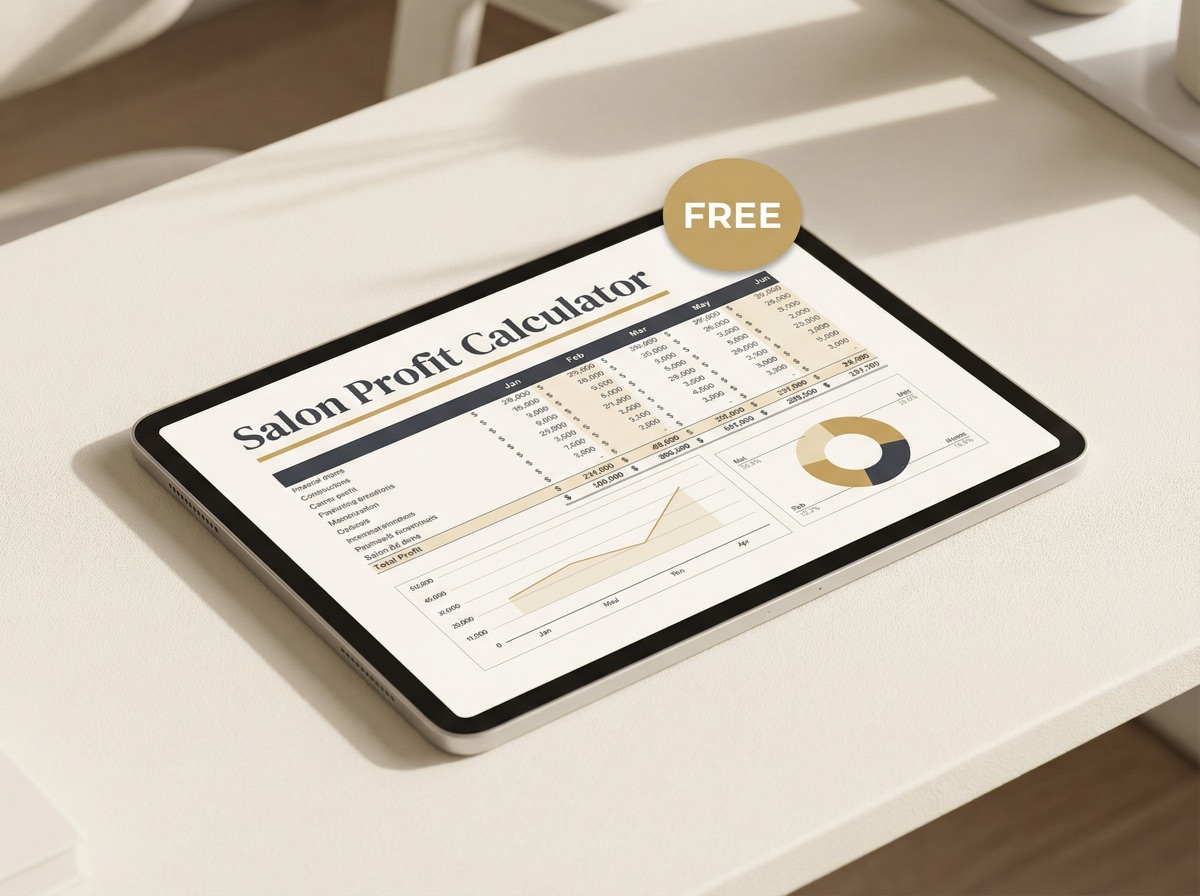
Written by Scott Farmer
Licensed Master Cosmetologist (GA & FL), former Toni & Guy Artistic Director, and founder of Hair Salon Pro. 30+ years behind the chair. 15,000+ clients. Building the business tools cosmetology school never taught. Currently behind the chair at scottfsalon.com in Venice, FL.