Salon Standard Operating Procedures: The SOPs Every Salon Needs to Stop Losing Money
 Scott Farmer
·
April 29, 2026
·
23 min read
Scott Farmer
·
April 29, 2026
·
23 min read
Last updated: June 2026
Download the Core SOP Pack (PDF) →
For years, I thought showing up was enough.
I was good at my craft. My chair was full. I assumed the clients would keep coming because I was good, and that the salon would run because I was there. I was wrong on both counts. When I finally sat down and looked at the numbers, looked hard at them, I realized that even when I was busy, I needed to be promoting and studying what was working. The busy season is exactly when you build the salon standard operating procedures that carry you through the slow one.
That shift in thinking is what led me to the single most powerful thing I have ever done for my salon: building an education system that runs every week without fail. Not a folder. Not a binder. A rhythm.
Most SOP guides are about paperwork. This one is different. Salon standard operating procedures, done right, are about creating a business that runs the same way whether you are behind the chair or on a plane. We will cover the weekly education system that holds a salon together, plus four complete templates you can put to work today.
Quick Answer: Salon standard operating procedures are step-by-step documents that explain how every task in your salon gets done the same way every time, whether the owner is behind the chair or not. Start with six core SOPs: opening, closing, booking, no-shows, end-of-day reconciliation, and complaint handling. The highest-leverage SOP is a weekly team education meeting split into a theory block (culture, greeting, checkout standards) and a technical block (hands-on skills). In my own salon, implementing these SOPs cut no-shows from 4-5 per week to 1-2 and freed up
$75 x 3 x 4 = $900 per monthfrom the same chair.
Table of Contents

- Why Do Most Salon SOPs Miss the Point?
- What Salon Standard Operating Procedure Made the Biggest Difference in My Business?
- What 6 Areas Does Every Salon Need SOPs For?
- What Does a Complete Salon Opening SOP Look Like?
- What Does a Client Booking and Confirmation SOP Look Like?
- What Does a No-Show and Late Cancellation SOP Look Like?
- What Does an End-of-Day Reconciliation SOP Look Like?
- How Do You Write Your Own Salon SOPs Without Killing a Week?
- How Do You Get Your Team to Follow Salon SOPs?
- What Happens to Your Salon Revenue After 90 Days of SOPs?
- FAQ
- What Is Your Next Step to Building Salon SOPs That Run Without You?
Why Do Most Salon SOPs Miss the Point?
A salon standard operating procedure is a written, step-by-step document that explains how a specific task gets done in your salon. Not how you think it gets done. Not how you would like it to get done. How it reliably, repeatably gets done when you are not standing there.
Most salon owners write SOPs about things like opening the register or locking the back door. Those matter. But the most important salon standard operating procedures are the ones that hold your culture together, not just your checklist.
Here is what I mean.
Your best stylist calls in sick. The whole day does not fall apart because she is not there. It falls apart because everything she knew lived in her head. The way she greeted new clients. The way she walked someone through checkout. The way she made every person feel like they were the only appointment on the books.
That is not a people problem. That is a systems problem.
The Bureau of Labor Statistics counts over 670,000 hairdressers and cosmetologists in the US. Most of them work at salons that run on whoever happens to be in the building that day. The salons that run the same way every single day, whether the owner is behind the chair or on a plane, are not the ones with the most talented staff. They are the ones with the best systems.
What Salon Standard Operating Procedure Made the Biggest Difference in My Business?
When people ask me which SOP moved the needle most in my salon, they expect me to say the booking script or the no-show policy. The answer is neither.
The salon standard operating procedure that changed everything was weekly team education. Every week. No exceptions.
Here is exactly how it ran.
Before every class, we did a theory portion. Not a lecture. An actual conversation that touched on how the salon culture worked, how we greeted a guest, and how checkout ran. We covered the standards. We covered what it felt like to walk into our salon as a client. We asked: does this place feel consistent? Does every person on this team know the answer to that question?
Then we moved into the technical portion. Hands-on skills. New techniques. Product knowledge. Whatever the team needed to stay sharp or learn something new.
Two things happened over time. New team members absorbed the culture through repetition, not through reading a handbook once on day one. Veterans stayed sharp. Nobody drifted. And the salon started running the same way whether I was in the building or not.
That is the goal.
One team meeting per week is not a lot to ask. But running it with structure, with a theory block every time, with the same cultural touchpoints repeated until they are instinctive. That is where it becomes a system.
What to Cover in the Theory Block (Every Week)
- How we greet a guest who walks through the door for the first time
- What the client experience feels like from the moment they sit down
- How we handle checkout: what we say, what we offer, what we do not skip
- What our culture expects from every person on the team
- One standard to reinforce that week (rotate through your core expectations)
It takes 15 minutes. Done every single week, it is worth more than any operations manual you will ever write.
What to Cover in the Technical Block
- New technique or product demonstration (rotating by stylist or by product line)
- Color formula review: what is working, what is not
- Skill refinement: not just new things, but the fundamentals done better
- Guest scenario practice: how do we handle this situation when it comes up?
A 60-minute weekly training, split between theory and technical, will do more for your team’s consistency than any hire you make.
What 6 Areas Does Every Salon Need SOPs For?
You do not need salon standard operating procedures for every single thing that happens in your salon. You need them for the things that cost you money when they go wrong.
Opening and Closing Procedures
This is where consistency either starts or falls apart. A proper opening routine means every client who walks in at 9:02 AM gets the same experience. A proper closing routine means the cash is right, the space is clean, and whoever opens tomorrow is not starting the day in a panic.
Client Booking and Confirmation
The booking call is your first impression. If it goes poorly, the client forms an opinion before they have sat in your chair. Booking SOPs cover how to answer the phone, what questions to ask, and when to send reminders. This is the area where most no-shows and double-bookings originate.
For more on reducing cancellations, the cancellation policy guide covers the full picture beyond just booking procedures.
Service Delivery Standards
This covers what every client experiences regardless of which stylist they are sitting with. Consultation questions. How you drape and prepare the client. What you say when introducing a product. How you confirm color choices before applying. These standards protect your reputation when you are not the one behind the chair.
Product Inventory and Ordering
Running out of a developer on a Saturday afternoon is not a hypothetical. It happens. SOPs for inventory cover what triggers an order, who places it, where supplies are stored, and how you handle expiration dates on color products.
Handling Complaints and No-Shows
What does a stylist say when a client calls back unhappy with their cut? What is the script? Who has authority to offer a discount or a free redo? Without an SOP, every complaint becomes a freestyle negotiation that often costs more than it should and sometimes loses the client anyway.
Financial: End-of-Day Reconciliation
Cash and card totals need to match the POS every single day. Not usually. Not when there is time. Every day. This is the most skipped SOP in independent salons, and it is the one that catches theft, tip disputes, and billing errors before they compound.
What Does a Complete Salon Opening SOP Look Like?
SOP Title: Daily Salon Opening Procedures
Version: 1.0 | Owner: Salon Manager / Lead Stylist
Applies to: All team members scheduled for opening shift
Last Updated: [Date]
Purpose: Ensure the salon is fully prepared to receive clients at opening time. This SOP covers everything from arrival through first client seated.
Time required: 45 minutes (must arrive no later than 8:15 AM for 9:00 AM open)
Step 1: Arrival and Security (8:15 AM)
– Park in the staff designated area, not client spaces.
– Use rear entrance key to enter.
– Disarm alarm within 30 seconds. Code is in the pinned message in the team chat. Do NOT share this code via text or email.
– If alarm code fails, do NOT attempt multiple entries. Call the owner immediately.
Step 2: Lighting and Environment (8:20 AM)
– Turn on all overhead lighting (switch panel behind reception desk).
– Set thermostat to 71F in summer or 72F in winter. Adjust by no more than 1 degree at a time.
– Turn on retail display lighting (power strip behind the color display).
– Turn on background music system. Volume starts at 3, never above 4 during business hours.
Step 3: Stations Check (8:25 AM)
– Walk all stations. Each station must have:
– Clean cape (freshly laundered, no stains)
– Full product tray (shampoo, conditioner, gloves, clips, combs)
– At least 4 clean towels folded and stacked
– Mirror wiped clean (use the blue glass spray, not the all-purpose)
– If any station is not ready: complete it before moving to step 4. This is not optional.
Step 4: Shampoo Area (8:30 AM)
– Flush all shampoo bowls for 30 seconds each (hot water, test temperature).
– Check towel supply: minimum 15 clean towels in cabinet. If below 10, start washing immediately.
– Restock: shampoo, conditioner, scalp treatment at each bowl station.
Step 5: Reception Desk (8:35 AM)
– Turn on POS system and confirm it loads to today’s date.
– Open the appointment software. Print or screenshot today’s schedule.
– Check for any notes left by the previous day’s closer (check the “NOTES FOR OPENER” whiteboard section).
– Confirm any same-day appointments have been confirmed via text or email.
Step 6: Retail Display (8:40 AM)
– Scan the display for any gaps in product rows (fronting).
– Return any products left in the back room to the display.
– Note anything at 2 units or fewer on the inventory clipboard near the supply closet.
Step 7: Open (9:00 AM)
– Flip the door sign to OPEN at exactly 9:00 AM.
– If you have a Google Business listing, mark the business as open in the app.
– You are now ready for the first client.
What to do if a step cannot be completed: Note the issue on the daily log (clipboard at reception). Do NOT skip it and say nothing. If a station is not clean or a bowl is not working, the owner needs to know before clients arrive.
What Does a Client Booking and Confirmation SOP Look Like?
SOP Title: Client Booking and Appointment Confirmation
Version: 1.1 | Owner: Front Desk / Reception
Applies to: Anyone who takes a phone, text, or online booking
Last Updated: [Date]
Purpose: Every new and returning client gets booked correctly, with the right service, the right time block, and a confirmation that reduces no-shows.
When a new client calls:
- Answer within 3 rings: “Good [morning/afternoon], thank you for calling [Salon Name]. This is [your name], how can I help you today?”
- Before booking anything, ask: “Have you been with us before?”
- For new clients, ask the five intake questions:
- “What service are you looking to have done?” (Get specific: not “color” but “highlights? single process? balayage?”)
- “When was your last appointment anywhere?” (This catches clients who have not had a service in 12+ months and may need extra time.)
- “Is your hair color-treated right now, or is it natural?” (Color on color requires a different time block.)
- “Do you have any photos of what you are going for?” (Ask them to text photos to the salon number before the appointment.)
- “Do you have a stylist preference, or would you like us to recommend someone?”
- Book the service with a time buffer: for any color service over a highlight, block an additional 30 minutes beyond the stylist’s estimate.
- Take a credit card to hold the appointment: “We hold a card on file for all new clients. We have a 24-hour cancellation policy, so as long as you give us a day’s notice, there is no charge.” (See the no-show SOP for card charge procedures.)
- Confirm the appointment out loud: “So I have you booked with [stylist] on [day] at [time] for [service]. Is that right?”
- Send a confirmation text or email within 5 minutes of the call ending (use the booking software’s auto-confirmation or the template in the shared drive).
For returning clients:
– Pull up their profile before asking questions. Confirm their last service and note any color formulas on file.
– Ask: “Are you looking for the same service as last time, or is there something new you would like to try?”
– Still confirm out loud before hanging up.
Appointment confirmation reminders:
– 48 hours before: automated reminder goes out via booking software (verify this is active).
– 24 hours before: if no confirmation received from client, call or text manually. Leave a message: “Hi [name], this is [salon name] confirming your appointment for tomorrow at [time] with [stylist]. Please reply YES to confirm or call us at [number] if you need to make a change. Thanks!”
– Day-of: if client has not confirmed by 1 hour after the 24-hour reminder was sent, call the stylist and flag the appointment as at-risk.
What Does a No-Show and Late Cancellation SOP Look Like?
SOP Title: No-Show and Late Cancellation Handling
Version: 1.2 | Owner: Front Desk / Salon Owner
Applies to: All team members
Last Updated: [Date]
Purpose: Protect revenue from avoidable appointment losses and ensure consistent, professional communication with clients who cancel late or no-show. For the full cancellation policy framework including client scripts and enforcement, see the salon cancellation policy guide.
Definitions:
– Late cancellation: Client cancels less than 24 hours before their appointment.
– No-show: Client does not arrive and gives no notice.
– Same-day cancel: Client cancels same day, 4+ hours before appointment.
Late Cancellation Procedure:
- The system flags any cancellation inside the 24-hour window automatically.
- Front desk sends the following message within 15 minutes:
“Hi [name], we received your cancellation for [day] at [time]. Per our salon policy, a late cancellation fee of [amount, typically 50% of the service cost] applies to appointments cancelled within 24 hours. We will charge the card on file ending in [last 4 digits]. We hope to see you again soon.”
- Process the card charge in the POS. Note the charge in the client’s profile with today’s date and the reason.
- If the client pushes back:
- First time ever: At the stylist’s or manager’s discretion, you may waive the fee once. Note “fee waived, first-time exception” in the profile.
- Second time: Fee applies, no exceptions. Stay warm but firm: “We understand life happens, and we do try to accommodate the first time. Because this is a second occurrence, we do need to apply the policy today.”
- Client threatens to leave over the fee: That is okay. You do not want clients who do not respect the policy. Be polite, wish them well, and move on.
No-Show Procedure:
- Mark the appointment as “no-show” in the software 15 minutes after the scheduled start time.
- Call the client immediately: “Hi [name], this is [salon name]. We had you scheduled at [time] today and we are just checking in. Give us a call at [number] if anything came up.”
- If no response within 1 hour, send a text:
“Hi [name], we missed you today at [time]. Per our no-show policy, the full service fee of [amount] will be charged to your card on file. We would love to get you rebooked. Give us a call or reply here.”
- Process the charge. Note it in the client’s profile.
- If the client calls back with an emergency or medical reason: the owner makes the call on whether to refund. This is NOT a front-desk decision.
When there is no card on file:
If a no-show or late cancel happens and no card was collected at booking, document the incident in the client’s profile and flag it for owner review. Going forward, that client requires a card on file to book again.
Tracking:
Keep a running tally on the monthly no-show log (in the shared drive, Salon Operations folder). Track: client name, date, type (late cancel vs. no-show), fee charged (Y/N), and any notes. Review this monthly.
Revenue recovered by this policy (estimate):
At an average service value of $90 and even one no-show per week, implementing this policy and collecting 70% of fees recovers approximately $90 x 1 x 52 x 0.70 = $3,276 per year.
What Does an End-of-Day Reconciliation SOP Look Like?
SOP Title: End-of-Day Financial Reconciliation
Version: 1.0 | Owner: Closing Staff Member / Manager
Applies to: Whoever closes the salon each day
Last Updated: [Date]
Purpose: Verify that cash and card totals match the POS daily summary. Catch discrepancies before they compound. Keep financial records accurate.
Time required: 20 minutes. Do not rush this step. Do not skip it.
Step 1: Close the register (15 minutes before salon close)
– No new transactions after this point unless approved by the owner.
– Run the end-of-day report in the POS (usually “Day Close” or “End of Shift Report”).
– Print or screenshot the report. It will show:
– Total cash collected
– Total card collected (by card type if applicable)
– Total tips (split by cash and card)
– Total refunds
– Net sales
Step 2: Count the cash drawer
– Remove the drawer from the register.
– Take it to a private area, not visible through windows.
– Count the cash twice.
– Record the total on the daily reconciliation log (paper form in the supply room, or the shared spreadsheet, pick ONE and be consistent).
– Subtract the starting float (the set amount that starts in the drawer each day, typically $100-$200).
– The remaining amount = cash collected today.
Step 3: Compare to POS
– Your counted cash should match the POS “cash collected” total.
– Acceptable variance: plus or minus $2 (rounding errors on tax).
– Variance over $5: investigate before leaving. Check: were any cash transactions voided? Did anyone give change incorrectly?
– Variance over $20: call the owner before leaving. Do not close until resolved.
Step 4: Card reconciliation
– Log into the payment processor portal (Square, Stripe, or your POS, whichever runs cards).
– Pull today’s card transactions total.
– This number should match the POS card total exactly.
– Discrepancy: look for any manual card transactions entered by the stylist that did not process through the main POS.
Step 5: Tip distribution
– Cash tips: counted separately and distributed to the correct stylist before close.
– Card tips: record each stylist’s card tip total from the POS report. These are paid out on the next payroll cycle (or same-day, depending on your policy. Document which one you use).
– Each stylist signs the tip log confirming their amount.
Step 6: Complete the log
– Fill in all fields on the daily reconciliation log:
– Date
– Closer’s name
– POS cash total
– Actual cash counted
– Variance (if any)
– POS card total
– Processor card total
– Variance (if any)
– Total tips (cash + card, by stylist)
– Any notes or discrepancies
– File the paper log in the monthly binder. Upload the digital version to the shared drive.
Step 7: Secure the cash
– Return the starting float to the drawer.
– Place the day’s cash in the bank deposit envelope.
– Store in the safe until the next bank run.
– Bank deposits should happen every 1-3 business days. Do not let cash accumulate more than 3 days.
How Do You Write Your Own Salon SOPs Without Killing a Week?
You have four complete templates above. Now you need to write the rest. Here is how to do it without losing a weekend.
The 30-Minute SOP Writing Process
Set a timer for 30 minutes. Pick one task. Do it yourself while talking through it out loud, recording on your phone. Then transcribe what you said. That is your first draft.
You already know how every task in your salon should be done. You do them, or you have corrected someone who did them wrong. The knowledge is already there. The salon standard operating procedure is just capturing it.
Write one SOP per week. In two months you will have a complete operations manual.
Start with whatever caused a problem in the last 90 days. If the end-of-day cash has been wrong twice this month, that is your next SOP. If you had a booking disaster last week, that is your next SOP.
Format: What Every SOP Must Include
Every salon standard operating procedure needs five things:
- Title and version number. So you know which one is current when you update it.
- Who it applies to. Not everyone needs to know every SOP.
- Purpose. One sentence explaining why this matters.
- Numbered steps. In the exact order they happen. No skipping. No assuming.
- What to do when something goes wrong. Every SOP needs a “what if” section.
Write it so a competent person who has never worked in a salon could follow it. If your instructions require salon knowledge to understand, you have assumed too much.
Where to Store Them
All three options work: Google Drive, Notion, or a laminated binder. The one that does not work is storing SOPs somewhere your team cannot access when they need them.
Digital options: Google Drive folder named “Salon Ops” with edit access for management and view access for all staff. The advantage is version control. Update it once and everyone sees the latest immediately.
Physical option: a laminated binder at the front desk and one in the back room. Works best for teams that are not great with apps.
The hybrid: digital as the master, printed copies at key stations for quick reference. This is what most well-run independent salons use.
Pick one system and commit. The worst outcome is having SOPs in three different places with nobody knowing which version is current.
How Do You Get Your Team to Follow Salon SOPs?
Writing SOPs is the easy part. Getting your team to use them is where most owners hit the wall.
Onboarding New Stylists with SOPs
The time to introduce SOPs is day one, before bad habits form. Walk every new hire through each relevant SOP during their first two days. Do not hand them the binder and say “read this.” Go through it with them, step by step, and let them ask questions.
Have them sign a document confirming they have read and understood each SOP that applies to their role. When a mistake happens later, you have a clear reference point for the conversation. The Professional Beauty Association recommends documented onboarding as a baseline for independent salons because it protects both the owner and the employee.
The Weekly Team Training (Your Most Powerful SOP)
The weekly education format I described earlier is also the perfect delivery mechanism for reinforcing your salon standard operating procedures. Every week, the theory block is an opportunity to revisit one standard. Which greeting do we use? What does checkout look like? What do we say when a client is unhappy?
This is exactly how I, Scott Farmer, ran training sessions when I served as an Artistic Director for Toni and Guy. The repetition of standards, not just techniques, is what separates a salon with culture from a salon that just has employees.
Once a month, pick one SOP and do a team walk-through. Not a lecture. An actual walk-through where someone does the task while the rest of the team watches and gives feedback.
This keeps the SOPs alive instead of gathering dust in a binder. It also surfaces gaps: steps that are unclear, steps everyone skips because they do not work the way you wrote them.
If a step is getting skipped by everyone, that is a sign the SOP needs updating, not that your team is bad.
When to Update an SOP
SOPs are living documents. Update them when:
– The process changes (new software, new equipment, new policy).
– A recurring mistake reveals a gap in the instructions.
– The team keeps skipping a step.
– You change service offerings or pricing.
Every time you update an SOP, change the version number and the “last updated” date. Archive the old version. Do not delete it.
In my experience, salons with documented, well-followed operating procedures run circles around salons that depend on one person knowing how everything works. That gap shows up in retention, in cash accuracy, and in how fast new hires become productive.
What Happens to Your Salon Revenue After 90 Days of SOPs?
In my own salon, I tracked the before and after. Before SOPs, we averaged 4-5 no-shows per week and I spent 6-8 hours putting out fires that the team should have handled without me. Within 90 days of running the weekly education system and these core SOPs, no-shows dropped to 1-2 per week and my fire-fighting hours fell to under 2. That freed me up to take on 3 more clients per week at $75 each, which was an extra $75 x 3 x 4 = $900 per month from the same chair.
No-show revenue recovery: Implementing a formal no-show policy with a documented SOP recovers $150-$400 per month in a mid-size salon. At $90 per service and a 70% collection rate on 2 no-shows per week, that is $90 x 2 x 52 x 0.70 = $6,552 per year recovered.
Reduced training time for new hires: When onboarding is SOP-driven, new team members reach full productivity 2-4 weeks faster. At $15-$20 per hour and a typical 80-hour onboarding period, that is $20 x 80 = $1,600 in total manager onboarding cost. Cutting 2-4 weeks of that saves $300-$400 per hire.
Cash drawer accuracy: Salons that implement end-of-day reconciliation catch their first significant discrepancy within 60 days. It does not always mean theft. Often it is a voided transaction that was not processed correctly, a tip that was miscounted, or a charge that did not go through. But catching it within 24 hours instead of 30 days means a problem that might have become a $200 loss gets caught at $40.
Client retention: Consistent service delivery, held up by your standards SOPs, reduces the variability that drives clients away. When a client’s experience is the same quality regardless of which stylist they get, they stop thinking about switching. Retaining one client who would have left costs nothing. Acquiring a replacement typically runs $30 to $100 in marketing cost per new client. For the full retention picture, see the salon client retention guide.
Profit margin impact: The combined effect of recovered no-show revenue, faster onboarding, accurate cash handling, and higher retention compounds directly into your profit margin. Salons with documented systems run 5-10 percentage points higher margin than salons that operate on tribal knowledge.
Owner time recovered: When the team can handle opening, closing, and routine situations without calling you, you get hours of your week back. Time behind the chair generating revenue. Time on marketing. Time not at the salon.
The weekly education system gave me that. Once the team internalized the culture through repetition, I stopped being the only person who knew how things were supposed to go.
That is not a small thing. That is the whole game.
Your salon’s profit picture ties directly to how well your systems run. Use the Salon Profit Calculator to see where no-shows, inefficiencies, and poor retail tracking are bleeding money every month.
FAQ
How many SOPs does my salon need?
Start with six: opening, closing, booking, no-shows, end-of-day reconciliation, and complaint handling. That covers the highest-risk areas. A mature salon operations manual typically has 15-25 SOPs. You do not need to build all of them before you see results.
My salon is just me and one other stylist. Do SOPs still matter?
More than you think. When it is just two of you, things feel manageable. The moment you want to add a third person, or you need to take a week off, or your other stylist has a family emergency, you will find everything only worked because both of you had the process in your heads. SOPs make the knowledge transferable.
What software should I use to manage SOPs?
Google Drive is free and works fine. Notion is good if you want something more organized and searchable. Some booking platforms like Vagaro and Boulevard have built-in staff notes where you can store procedures. The tool matters less than consistency. Use whatever your team will open.
How do I handle it when a team member ignores an SOP?
First, make sure the SOP is clear and reasonable. If the step is getting skipped, ask why. Sometimes the answer is a bad habit, and a direct conversation fixes it. Sometimes the step does not work the way you wrote it. Fix the SOP and retrain. If someone is ignoring SOPs after being corrected, that is a performance conversation, not an SOP problem.
Should I have stylists sign off on SOPs?
Yes. A simple acknowledgment form signed on hire and whenever a major SOP is updated creates documentation that protects you if a termination or dispute comes up. It also creates real accountability in the onboarding process.
How often should I review all my SOPs?
Do a full review once per year, typically at the start of your business year. Check each SOP against how things run today. Retire outdated ones. Update anything that has drifted. Beyond the annual review, update individual SOPs whenever a process changes.
How do salon SOPs connect to a referral program?
Your salon referral program only works if the experience it promises is consistent. SOPs are what make every new referred client’s first visit feel as good as what their friend described. Without that consistency, your best referral source is your satisfied client. With it, every new client they send becomes another potential referrer.
What Is Your Next Step to Building Salon SOPs That Run Without You?
Use the free Salon Profit Calculator to see exactly where no-shows, pricing gaps, and inconsistent systems are bleeding money every month. Takes five minutes.
Ready for the complete system? HSP Pro gives you templates, weekly coaching, and a community of salon owners building the exact operational systems covered in this guide.
Free Download
Get the Salon Profit Calculator
See exactly where your salon is losing money — in under 5 minutes.
Download Free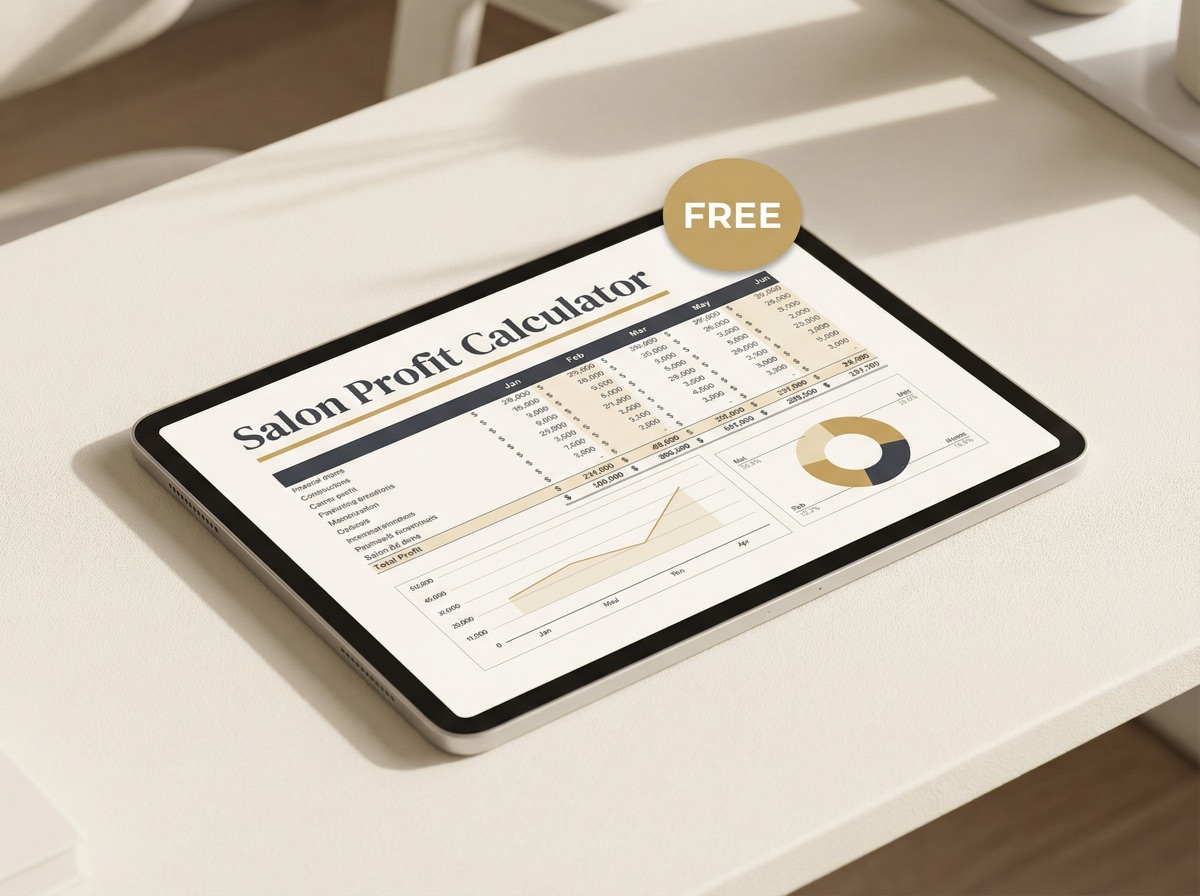
Written by Scott Farmer
Licensed Master Cosmetologist (GA & FL), former Toni & Guy Artistic Director, and founder of Hair Salon Pro. 30+ years behind the chair. 15,000+ clients. Building the business tools cosmetology school never taught. Currently behind the chair at scottfsalon.com in Venice, FL.