Salon Membership Programs: How to Add $500 to $1,500 in Predictable Monthly Revenue Without Discounting
 Scott Farmer
·
May 30, 2026
·
13 min read
Scott Farmer
·
May 30, 2026
·
13 min read
Quick Answer: How does a salon membership program add predictable monthly revenue?
A membership charges clients a recurring fee for a bundle of services and perks, not a discount. The math is direct: 25 members at $89 a month is $2,225 guaranteed before you open the doors, and 50 members at $99 climbs to $4,950. Membership clients also rebook at 85 to 92%, far above the 55 to 65% typical for non-members.
TL;DR

- A salon membership program creates predictable monthly revenue by charging clients a recurring fee in exchange for a curated bundle of services and perks. It is not a discount club. Done right, it increases client lifetime value while raising your effective hourly rate.
- The math: 25 members at $89/month generates $2,225 in guaranteed monthly revenue before you open the doors. At 50 members and $99/month, that climbs to $4,950. That money arrives whether it rains, whether school is out, whether January exists.
- Client retention jumps. Membership clients rebook at 85% to 92% vs. 55% to 65% for non-members, based on industry data from Salon Today and my own experience running membership tiers at JScott Salon.
- The biggest mistake: building a membership around discounts. If your membership just gives 20% off everything, you trained your best clients to pay you less.
- Scott Farmer, Licensed Master Cosmetologist with 30+ years behind the chair and 15,000+ clients, shares the exact membership structure, pricing, and enrollment scripts that work.
- Run your numbers: Use the free Salon Profit Calculator to model membership revenue, or Run the free Salon Profit Calculator to learn the complete Profit-First System.
$4,950 per month. Guaranteed. Before a single walk-in crosses your threshold.
That is what 50 salon membership clients paying $99/month looks like. And it hits your account on the first of every month whether you are fully booked, half-booked, or closed for a long weekend.
Most salon owners I talk to are
Most salon owners I talk to are completely dependent on daily appointment volume. Additionally, one slow Tuesday and the anxiety creeps in. A holiday week with three cancellations and suddenly rent feels tight. I lived that rollercoaster for years. Then I started building predictable revenue, and everything changed.
This is how to build a salon membership program that adds $500 to $1,500 in monthly recurring revenue without discounting your services.
Why Do Salon Owners Need a Membership Program?
The traditional salon business model has a fatal flaw. However, you only make money when someone sits in your chair. Sick day? Zero revenue. Vacation? Zero revenue. Three no-shows on a Wednesday? You just ate $255 to $450 in lost services.
A membership program decouples a portion of your income from daily chair time. As a result, it creates what business finance calls MRR, monthly recurring revenue. That is the same model every subscription business from Netflix to your gym uses.
Here is why it matters specifically for salon owners:
Predictability. In practice, i ran JScott Salon for years before I figured this out. My best months were $22,000 to $28,000 in gross revenue. My worst months dropped to $14,000. That swing made planning impossible. You cannot hire, invest in equipment, or take a real vacation when your income varies by 40% month to month.
Retention. Members stay longer. The Professional Beauty Association reports that the average salon client visits 4.5 times per year. My membership clients averaged 7.8 visits. That is 73% more visits per client per year.
Front-loaded cash flow. For example, memberships collect revenue before the service is delivered. That means you start every month with money already in the account. For a deeper look at how retention drives profit, read what is a good salon client retention rate.
What Makes a Salon Membership Program Different From a Discount?
This is the single most important distinction in this entire article.
A discount says: “My services are worth less than what I normally charge.”
A membership says: “You are committing to a long-term relationship with me, and I am rewarding that commitment with exclusive access.”
I have seen salon owners launch memberships that were nothing more than 20% off everything. In fact, they gave their most loyal clients, the ones already paying full price, a reason to pay less. Revenue went down. Average ticket went down. The only thing that went up was the owner’s frustration.
A real membership bundles value that costs you very little but matters a lot to the client. Overall, here is the difference:
Bad membership: 20% off all services every visit. Because of this, that is a coupon with a monthly fee. Stop.
Good membership: One signature blowout per month, priority booking, a quarterly scalp treatment, and 10% off retail products. Ultimately, the blowout fills a slow-day slot. Priority booking costs you nothing. The scalp treatment uses $4 in product. And the 10% retail discount still gives you 40%+ margin.
You are adding perceived value without cutting into your profitable services.
How Much Should You Charge for a Salon Membership?
I am going to give you three tier structures that work. Instead, pick the one that fits your market, your service menu, and your capacity.
Tier 1: The Essentials ($59 to $79/month)
Best for: independent stylists or suite renters who want to lock in regular clients without overcommitting chair time.
Includes:
– One core service per month (blowout, conditioning treatment, or express color gloss)
– Priority booking (members book before the public calendar opens)
– 10% off retail
– Birthday month bonus service (costs you $15 to $30 in product)
At $69/month with 20 members, that is $1,380/month in guaranteed revenue.
Tier 2: The Signature ($89 to $119/month)
Best for: salon owners with 2+ chairs who want to fill consistent weekly volume.
Includes:
– One signature service per month (cut, blowout, or express color)
– One add-on service per quarter (deep conditioning, scalp treatment, glaze refresh)
– Priority booking + same-day booking access
– 15% off retail
– Exclusive access to new services or product launches before non-members
At $99/month with 35 members, that is $3,465/month. Of course, that covers rent and utilities for most suite or small salon setups before you do a single non-member appointment.
Tier 3: The VIP ($149 to $199/month)
Best for: premium salons with higher average tickets who want to attract committed, high-value clients.
Includes:
– One premium service per month (cut and style, partial highlight refresh, or balayage touch-up)
– Quarterly luxury treatment (keratin, bond repair, or custom color refresh)
– Priority and after-hours booking
– 20% off retail
– Complimentary consultation for major changes
– Guest pass once per quarter (brings a friend in at member pricing)
At $179/month with 15 members, that is $2,685/month from just 15 people. And the guest pass is your acquisition engine. Even so, that friend walks in, loves the experience, and asks about membership.
The reason-why behind this pricing: you are charging for access and commitment, not just services. When I set my prices at JScott Salon, I priced the Signature tier at the point where the client’s annual spend stayed the same or went up slightly. Still, they were not paying less. They were paying more predictably.
For a breakdown of how to set service prices that support membership math, read salon pricing mistakes that cost you thousands.
How to Calculate Whether a Membership Program Is Profitable
Let me walk through the math step by step. No guessing.
Your cost to deliver one Signature membership visit:
– Product cost per service: $8 to $14 (blowout to express color)
– Chair time: 45 to 75 minutes
– Your hourly service rate (what you’d charge a non-member): $85 to $120
Annual math per member at $99/month:
– Annual revenue: $99 x 12 = $1,188
– Services delivered: 12 monthly + 4 quarterly add-ons = 16 visits
– Average product cost per visit: $11
– Total annual product cost: $11 x 16 = $176
– Net revenue after product: $1,188 minus $176 = $1,012
– Chair time per year: approximately 16 hours (16 visits x 60 min average)
– Effective hourly rate from membership: $1,012 / 16 hours = $63.25/hour net after product
Compare that to your non-member blowout at $45 with a 42-minute chair time:
– Product cost: $6
– Net: $39
– Effective hourly rate: $55.71/hour
The membership client pays you $63.25/hour net. Beyond that, the non-member pays you $55.71/hour net. And the member has already committed to 12 months of visits.
Want to run these numbers for your specific situation? The free Salon Profit Calculator lets you plug in your real costs and see the difference.
What Enrollment Script Works Best for Salon Memberships?
This is where most salon owners stall. Meanwhile, they build the membership but never ask anyone to join.
Here is the exact script I used. In contrast, you say this at the end of the appointment, while the client is checking out. Not in an email. Not in a text. Face to face, while they are still feeling great about their hair.
The enrollment conversation:
“Hey [name], I have been thinking about something. With that in mind, you come in every six weeks like clockwork, and I love that. I just launched a membership program for my regulars. For $99 a month, you get your [service] covered every visit plus priority booking so you never have to wait for an opening. You also get a quarterly deep treatment and some retail perks. It is basically the same investment you are already making, but you get more and you always have your spot locked in. Want me to set you up?”
That script works because it does three things:
1. It anchors to what the client is already spending
2. It frames membership as getting more, not paying more
3. It eliminates decision fatigue by making the ask simple
For more scripts that lock clients into returning, see salon rebooking scripts that work.
How Many Members Do You Need to Make a Real Difference?
Here are three benchmarks:
| Members | Monthly Rate | Monthly MRR | Annual Revenue |
|---|---|---|---|
| 15 | $89 | $1,335 | $16,020 |
| 30 | $99 | $2,970 | $35,640 |
| 50 | $99 | $4,950 | $59,400 |
At 30 members, you have nearly $3,000/month arriving automatically. In other words, that pays your booth or suite rent, your insurance, and your product costs. Everything you earn from non-member appointments is profit above your baseline.
At 50 members, you are looking at almost $60,000 in annual revenue from memberships alone. If your total salon revenue is $150,000, that means 40% of your income is predictable and pre-paid. At the same time, you sleep differently when 40% of next month’s revenue is already collected.
How Do You Handle Members Who Do Not Show Up?
This is the gym model question. “What if they pay but never come in?”
Honestly? Notably, some months, a few members will skip. That is revenue you collected without chair time. It sounds great until you realize that a member who does not show for two months in a row is about to cancel.
Your job is to prevent that. Here is how:
- Automated booking reminders. When a member has not booked by the 10th of the month, send a text: “Hey [name], your [service] this month is waiting for you. Want me to book your usual Thursday at 2?”
- Rollover limits. Allow one unused service to roll over to the next month. No more than one. This prevents the “I have five services banked” scenario that clogs your calendar later.
- Quarterly check-ins. At the 3-month and 6-month marks, ask the client if their tier still fits. If they need to shift from Signature to Essentials, let them. A $69/month member who stays 18 months is worth more than a $99/month member who cancels at month 4.
The retention data matters here. Industry research from Zenoti’s salon management report shows that salons with structured communication see 23% lower membership churn than those running memberships without follow-up sequences.
What Software Do You Need to Run Salon Memberships?
You do not need anything expensive. Additionally, here are three approaches ranked by complexity:
Simple (free to $30/month): Square or Stripe recurring invoices. However, set up a recurring payment. Track members in a spreadsheet. This works for 5 to 20 members.
Mid-level ($50 to $100/month): GlossGenius, Vagaro, or Boulevard all have built-in membership features. As a result, auto-billing, usage tracking, and reporting. This is the sweet spot for 20 to 75 members.
Full-scale ($100+/month): Mangomint or Phorest with dedicated membership modules, automated reminders, churn alerts, and reporting dashboards. In practice, worth it above 75 members or if you run multiple locations.
The software is not the bottleneck. That said, your willingness to ask clients to join is.
The 3 Biggest Mistakes Salon Owners Make With Membership Programs
I made two of these myself. For example, learn from my mistakes.
Mistake 1: Leading With Discounts Instead of Exclusivity
I already covered this, but it bears repeating. If your membership’s main selling point is cheaper services, you will attract price-sensitive clients who leave the moment they find a cheaper option. Lead with access. In fact, lead with commitment. Lead with the relationship.
Mistake 2: Not Setting a Cap
Memberships are only valuable if they do not overwhelm your schedule. If you have 40 available appointment hours per week and 50 members each needing one hour per month, that is 12.5 hours per week dedicated to membership services. That is fine. But if you grow to 100 members without adding capacity, you have no room for higher-ticket non-member services.
Set a cap. When I ran membership at JScott Salon, I capped each stylist at 30 members. Once full, new clients went on a waitlist. Overall, the waitlist itself became a selling point.
During my time as Artistic Director at Toni and Guy, I saw high-volume salons blow past capacity limits and end up with memberships that cost them money. The lesson stuck.
Mistake 3: Not Tracking Lifetime Value Per Member
You need to know two numbers:
– Average membership lifespan (how many months before they cancel)
– Total revenue per member (monthly fee x months + retail + add-on services)
If your average member stays 11 months at $99/month and buys $18/month in retail, their lifetime value is ($99 + $18) x 11 = $1,287. Because of this, compare that to a non-member who visits 4.5 times per year at $95 per visit and buys retail once. Their annual value is about $448.
The member is worth 2.9x the non-member. Ultimately, that number should guide every decision you make about how much time, energy, and resources you put into your membership program.
How Do You Launch a Salon Membership Without It Feeling Awkward?
Here is a 30-day launch plan:
Week 1: Build your tiers. Price them. Instead, write the one-paragraph description for each. Print a simple one-page menu or create a digital version on your booking page.
Week 2: Soft launch to your top 10 clients. Of course, these are the people who already come every 4 to 6 weeks, buy retail, and refer friends. Call or text them personally. “I created something just for my best clients. Can I tell you about it?” Start with 10 asks. Expect 4 to 6 to say yes.
Week 3: Announce to your full client list via email and a single social media post. Even so, keep it simple. “I just launched a membership program for my regular clients.” No pressure. No urgency gimmicks.
Week 4: Follow up with every client who booked that month but did not join. Still, use the checkout script from earlier. At the end of week 4, evaluate your numbers.
Your goal for month one: 10 to 15 members. If you hit that, you just added $690 to $1,785 in monthly recurring revenue that did not exist 30 days ago. That is real money. Additionally, Is rent. Beyond that, that is a product order. That is the start of a different kind of business.
Frequently Asked Questions
Can I run a salon membership as an independent stylist or booth renter?
Yes. You do not need a multi-chair salon to run a membership program. To be clear, a booth renter with 80 to 100 regular clients can easily support 15 to 25 members. Use Square or Stripe for billing, a simple spreadsheet for tracking, and the enrollment script at checkout. The only adjustment is your capacity cap. Be honest about how many membership appointments you can handle per week.
What happens if a membership client wants to cancel mid-contract?
Do not lock clients into long-term contracts. Meanwhile, month-to-month with a 30-day cancellation notice works best. Contracts create resentment. A client who stays because they want to is worth more than one who stays because they have to. Your retention tool is the quality of the experience, not a legal document.
How do I handle members who want services outside their tier?
Members pay full price for services not included in their membership. In contrast, the membership covers a defined bundle. Everything else is a la carte. Make this clear at enrollment. “Your Signature membership covers your monthly cut and quarterly treatment. If you want to add a full highlight, that is at our regular menu price.” Most members will add services. That is additional revenue above the membership fee.
Will a membership program cannibalize my existing full-price revenue?
Only if you build it wrong. If you convert clients who were already paying $120 per visit into members paying $99/month for the same service, yes, you just lost revenue. The fix is bundling. With that in mind, your $99/month membership should include your $85 core service plus $35 to $50 in add-on value that costs you $4 to $12 in product. The client pays more annually. You deliver more perceived value at minimal cost.
How do I price a membership in a high-cost-of-living market vs. a low-cost market?
Scale your tiers to your average ticket price. Furthermore, in a market where a women’s cut is $45, your Essentials tier might be $49/month. In a market where a women’s cut is $95, your Essentials tier might be $79/month. The ratio should make the membership feel like a smart commitment, not a stretch. A good rule: your entry membership should be within 10% to 20% of what the client already spends on their most frequent service per visit.
Take the Next Step
A membership program is one piece of the puzzle. In other words, the full Profit-First System covers pricing, retention, scheduling, and revenue architecture for salon owners who want to double their chair income without adding hours. I am walking through the entire system on the Salon Profit Calculator.
Run the free Salon Profit Calculator
{“@context”:”https://schema
Free Download
Get the Salon Profit Calculator
See exactly where your salon is losing money — in under 5 minutes.
Download Free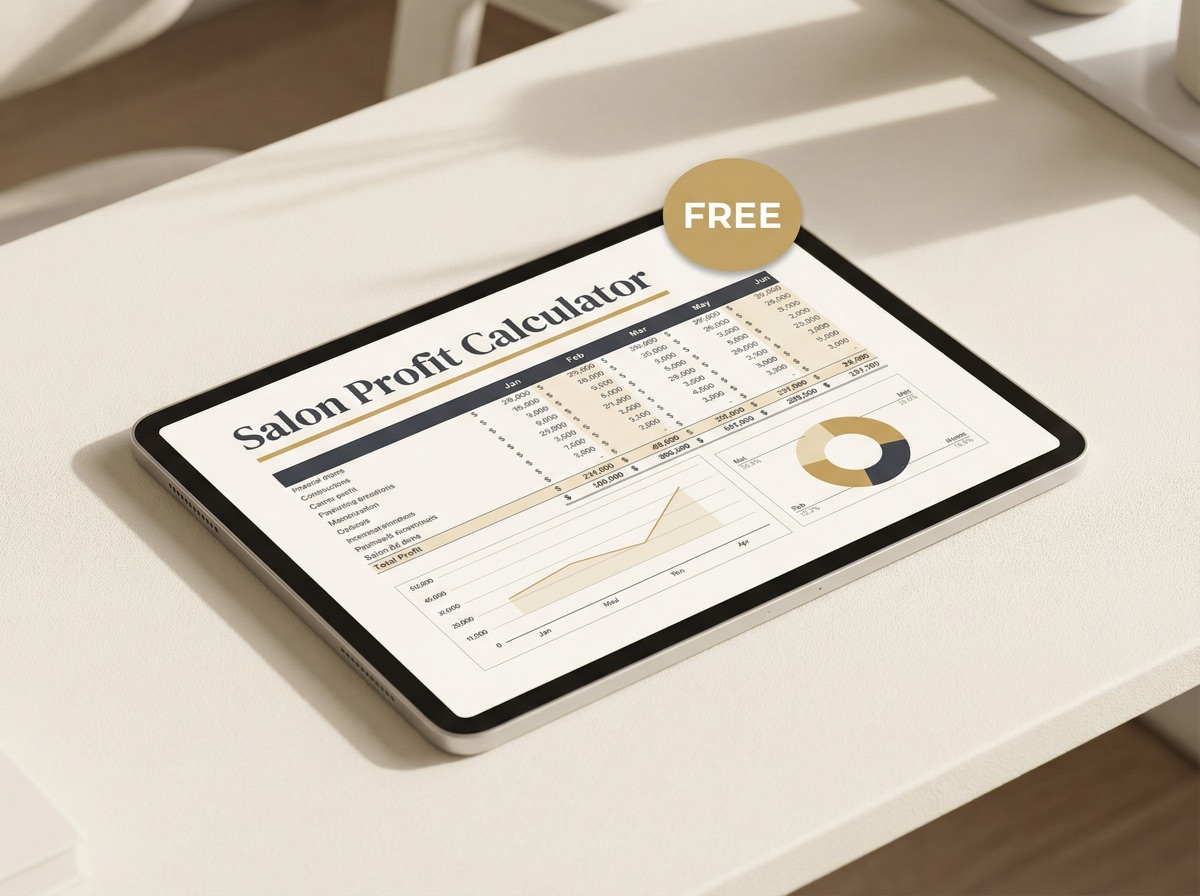
Written by Scott Farmer
Licensed Master Cosmetologist (GA & FL), former Toni & Guy Artistic Director, and founder of Hair Salon Pro. 30+ years behind the chair. 15,000+ clients. Building the business tools cosmetology school never taught. Currently behind the chair at scottfsalon.com in Venice, FL.