5 Salon Pricing Mistakes That Cost You Thousands Every Year
 Scott Farmer
·
May 12, 2026
·
10 min read
Scott Farmer
·
May 12, 2026
·
10 min read
Quick Answer: What are the most common salon pricing mistakes?
The average salon owner loses $8,000 to $15,000 a year to five pricing mistakes: pricing on emotion, copying the salon down the street, rounding down, ignoring cost per service, and skipping annual increases. Each one carries a real dollar cost and a fix you can apply this week. Fixing all five took my average ticket from $42 to $78.
The average salon owner loses between $8,000 and $15,000 per year to salon pricing mistakes they do not even know they are making. Additionally, i know because I made every one of them. For my first five years running my own salon with a full team, I set prices based on what felt right, what the salon down the street charged, and what I thought clients would pay without flinching. None of those methods had anything to do with math. And my bank account showed it.
My name is Scott Farmer. After 30 years behind the chair, more than 15,000 clients, and a pricing overhaul that took my average ticket from $42 to $78 at JScott Salon, I can tell you the five mistakes that cost the most. However, each one has a specific dollar amount attached, and each one has a fix you can start this week.
Last updated: May 2026
TL;DR

- Five salon pricing mistakes cost the average stylist $8,000 to $15,000 per year. Emotional pricing, competitor copying, rounding down, ignoring cost per service, and skipping annual increases each have a specific dollar cost and a fix you can apply this week.
- The Bureau of Labor Statistics reports over 670,000 licensed cosmetologists in the U.S. (SOC 39-5012). Cosmetology school teaches zero hours of pricing education.
- I am Scott Farmer, Licensed Master Cosmetologist with over 30 years behind the chair, more than 15,000 clients served, Gwinnett’s Best Hairstylist 2020, former owner of JScott Salon in Lawrenceville, Georgia, and founder of Hair Salon Pro in Venice, FL. My average ticket went from $42 to $78 after fixing these five mistakes.
- A single rounding habit costs $4,680 per year. Skipping annual increases for three years costs $11,940. One underpriced service at four clients per week costs $6,240 per year.
- Run the free Salon Profit Calculator to check your pricing right now. The $17 Salon Owner Starter Pack includes the budget template, pricing guide, and price increase scripts.
What Are the 5 Most Common Salon Pricing Mistakes?
Most stylists never get a single hour of pricing education. The Bureau of Labor Statistics reports over 670,000 licensed cosmetologists in the US, and cosmetology school teaches color theory, cutting techniques, and sanitation. It does not teach you how to price a balayage so you can pay your rent and still eat.
The five mistakes I see over and over:
- Pricing by emotion instead of a formula
- Copying the salon down the street
- Rounding down to “nice” numbers
- Ignoring cost per service
- Skipping annual price increases
Every one of these has a specific dollar amount attached. In practice, let me walk you through each.
Are You Setting Salon Prices Based on Feelings Instead of Math?
This is the most expensive mistake on the list. And I made it for years.
When I opened my own salon, I picked a price for a women’s cut that “felt fair.” I looked at what I was making on commission, thought about what I would want to pay as a client, and landed on a number. No formula. No cost calculation. That said, no idea what my overhead was per hour.
The result: I was charging $45 for a cut that cost me $38 to deliver when I added up product, time, and overhead.
Seven dollars of profit on a 50-minute service. For example, that is not a business. That is an expensive hobby.
Here is the formula that replaced my gut feeling: take your annual income goal, add 30% for taxes and benefits, divide by your available service hours, and that gives you your hourly floor rate. In fact, every service price starts there.
When I switched from emotional pricing to formula-based pricing, my average ticket went from $42 to $78 over 18 months. I lost 6 clients. Overall, i gained $36 per ticket on every remaining appointment. Do the math on 25 clients per week over 50 weeks and that gap is $45,000 per year.
Emotional pricing is the single most expensive mistake a salon owner can make.
Why Does Copying Another Salon’s Prices Backfire?
I watched this happen during my years as a Toni and Guy Artistic Director. Because of this, new stylists would walk into their first salon, look at the competitor’s menu taped to their window, and match those prices within $5.
The problem: you have no idea what that salon’s costs look like. Ultimately, their rent might be $800 per month. Yours is $1,400. Their product cost per service might be $3. Yours might be $9 because you use a higher-quality color line.
When you copy someone else’s prices, you are borrowing their math for your business. And their math does not pay your bills.
I had a stylist in my salon who set her balayage price at $185 because the suite two doors down charged $180. When we ran her cost per service, she needed to charge $215 to hit a 15% margin. Instead, she was losing $30 on every balayage appointment. At four per week, that is $6,240 per year gone.
The fix: calculate YOUR floor price for every service on your menu. Of course, not the competitor’s price. Not the “going rate.” Your number, based on your costs.
How Does Rounding Down to “Nice” Numbers Cost You $4,680 Per Year?
Your formula says your haircut should be $87. Even so, you set it at $85 because $85 “looks better on the menu.”
Two dollars. No big deal, right?
Here is what $2 per appointment looks like over a year: $2 times 45 appointments per week times 52 weeks. Still, that is $4,680 you left on the table because of a rounding preference.
I did this for three years at my own salon. Beyond that, every service on my menu was rounded down to the nearest $5 or $0. My pricing formula said $87 for a cut. I charged $85. My formula said $143 for a partial highlight. I charged $140. The formula said $267 for a full balayage. I charged $260.
Added up across my entire menu, the rounding cost me $6,800 per year.
Your clients do not care about the difference between $85 and $87. To be clear, they care about the result. Price at the number your formula gives you, not the number that looks clean.
What Happens When You Ignore Your Salon Cost Per Service?
Most salon owners know their total monthly expenses. Meanwhile, very few know what each individual service costs them to deliver.
A $75 haircut does not make you $75. In contrast, it makes you $75 minus product ($1.80 for a cut), minus your time at your hourly floor rate (say $50/hour for a 50-minute service, that is $41.67), minus your overhead allocation per appointment ($17.38 if you see 80 clients per month with $1,390 in fixed costs).
$75 minus $1.80 minus $41.67 minus $17.38 = $14.15 profit. With that in mind, that is a 19% margin.
Now do the same math on a $40 men’s cut. Furthermore, chair time: 30 minutes, so $25 in labor. Same $1.80 in product. Overhead allocation: $17.38.
$40 minus $1.80 minus $25 minus $17.38 = negative $4.18.
You are paying $4.18 out of your own pocket every time you do a men’s cut at $40. If you do ten men’s cuts per week, that is $2,174 per year in losses from one service.
I did not know this until year six. When I ran the numbers on my full menu using the cost per service formula, I found three services that were losing money on every appointment. Three services. For six years.
Fix this by running your cost per service calculation on every item in your menu. In other words, remove or reprice anything below a 15% net margin. Your profit margin should land between 12% and 20% after this exercise.
How Much Does Skipping Annual Salon Price Increases Cost You?
The Professional Beauty Association recommends reviewing your prices at least once per year. At the same time, most stylists I talk to have not raised their prices in two to three years. Some have not raised them in five.
Here is what that costs. Notably, inflation runs 3% to 4% per year. Your rent goes up. Your product costs go up. Your insurance goes up. But your service prices stay the same.
If you charged $85 for a cut in 2021 and have not raised it since, that $85 buys what $73 bought in 2021 dollars. Importantly, you are working for 2021 money in a 2026 economy.
Run the numbers. Additionally, a stylist doing $6,000 per month in services who skips a 5% increase for three years loses:
- Year 1: $3,600 in missed revenue
- Year 2: $7,560 in cumulative missed revenue
- Year 3: $11,940 in cumulative missed revenue
That is $11,940 gone because of one uncomfortable conversation you kept putting off.
I raise my prices every January. No exceptions. I use the price increase scripts I developed over 30 years. My acceptance rate is above 90%. The key: give clients 30 days notice, explain the value, and never apologize.
How Do You Fix These Salon Pricing Mistakes This Week?
You do not need to overhaul your entire business. As a result, you need to do five things this week:
-
Run your hourly floor rate. Use the salon pricing formula to calculate the minimum you need to charge per hour to hit your income goal. If any service falls below that floor, raise it.
-
Calculate cost per service. That said, pick your three most popular services. Run the cost per service formula on each one. If any service has a margin below 15%, it needs a price adjustment.
-
Stop rounding down. For example, go through your menu right now. If your formula says $87, charge $87. If it says $143, charge $143. The rounding tax adds up to thousands per year.
-
Check your prices against YOUR costs, not the competition. In fact, your business has different rent, different product costs, and different overhead. Your prices should reflect your numbers, not someone else’s.
-
Set a price review date. Pick a date. January 1 works. Overall, block it in your calendar. Raise your prices by at least the cost of inflation every single year.
Run the free Salon Profit Calculator right now. Because of this, it takes three minutes and shows you where your pricing stands. If you want the full pricing toolkit, the Salon Owner Starter Pack includes the budget template, pricing guide, and price increase scripts for $17.
Frequently Asked Questions
How often should I raise my salon prices?
At minimum once per year. Ultimately, i raise mine every January. The key is consistency. Clients who see a small increase every year accept it as normal. Clients who see a large increase after five years of nothing push back hard. A 3% to 5% annual increase covers inflation and keeps your margins healthy.
What is a good profit margin for a salon service?
A healthy net profit margin for an individual salon service is 15% to 25%. Anything below 15% means you are working for close to cost. The overall salon profit margin averages 8% across the industry, but top-performing salons hit 15% to 20% net. Use the Salon Profit Calculator to check where you stand.
Should I match the prices of the salon next door?
No. Their costs are not your costs. Their rent, product line, and overhead are different from yours. The number that matters is YOUR cost to deliver the service plus your target profit margin. If your formula says $95 and the salon next door charges $75, charge $95. You will attract clients who value quality, and you will keep your lights on.
How do I know if I am underpricing my services?
Three warning signs: you are fully booked but not profitable, your take-home pay is below minimum wage after expenses, or your cost per service is within $10 of your sale price. Run the cost per service formula on your top five services. If any service has a profit margin below 15%, you are underpriced on that service.
What is the biggest salon pricing mistake new stylists make?
Charging what they think clients will accept instead of what they need to charge to build a sustainable business. New stylists often set prices 20% to 30% below their floor rate because they lack confidence. The fix is math, not confidence. When you know your hourly floor rate and your cost per service, the price is not a feeling. It is a calculation. Grab the free Price Increase Script Pack for the words to use when setting prices that match your value.
Double Your Chair Income, Without Working More Hours
These pricing mistakes cost real money every week. When you run your numbers, I teach the full Profit-First System I used to double chair income without adding a single hour.
Run the Free Salon Profit Calculator
Free. Available now. No registration required.
Free Download
Get the Salon Profit Calculator
See exactly where your salon is losing money — in under 5 minutes.
Download Free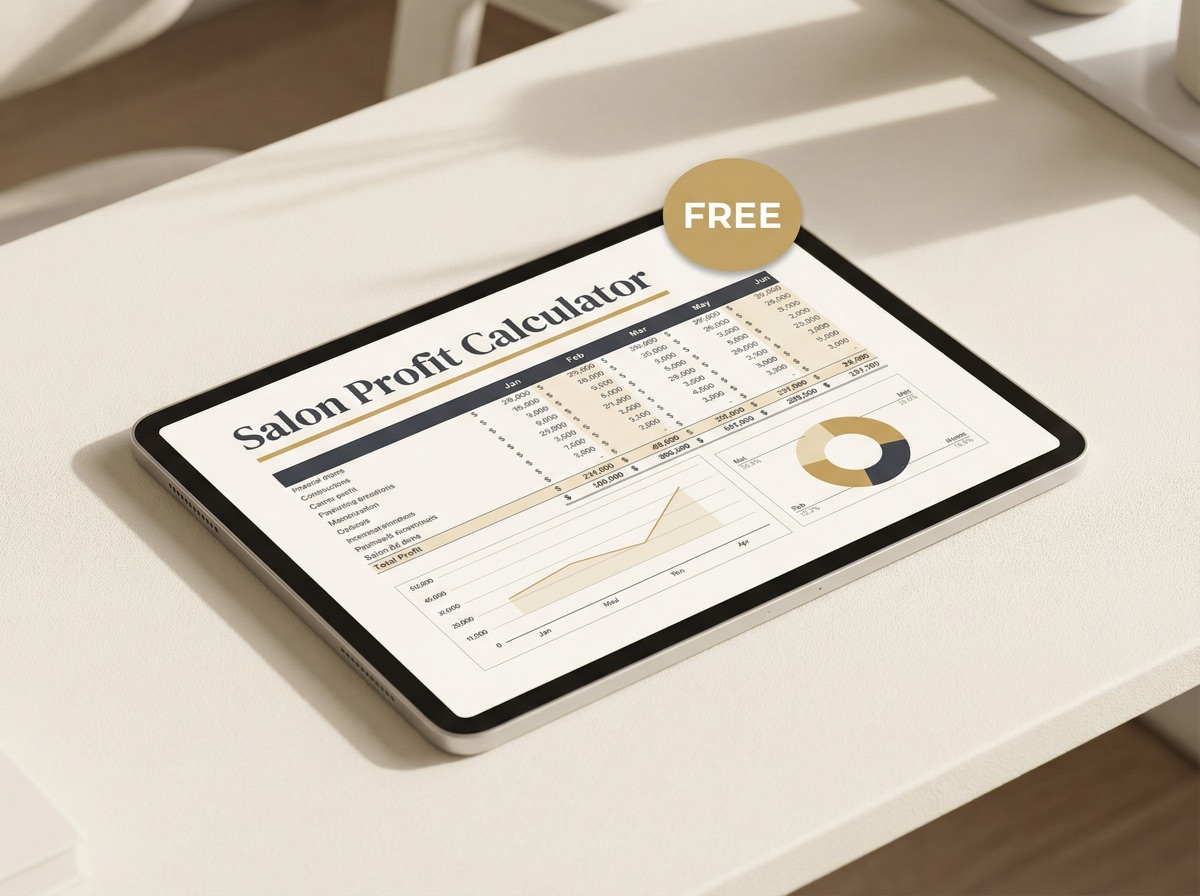
Written by Scott Farmer
Licensed Master Cosmetologist (GA & FL), former Toni & Guy Artistic Director, and founder of Hair Salon Pro. 30+ years behind the chair. 15,000+ clients. Building the business tools cosmetology school never taught. Currently behind the chair at scottfsalon.com in Venice, FL.