Salon Employee Commission Structure: What 30 Years Behind the Chair Actually Taught Me
 Scott Farmer
·
April 25, 2026
·
17 min read
Scott Farmer
·
April 25, 2026
·
17 min read
Quick Answer: What is a fair salon employee commission structure?
Most service commission runs 40 to 45 percent, with color at 35 to 40 percent because of product cost. Scaling tiers beat flat splits: start new stylists at 35 to 40 percent, move to 42 to 45 percent at $3,001 to $6,000 monthly production, then 48 to 50 percent above $6,001. Retail commission runs 10 to 15 percent of the ticket. A flat 50/50 split breaks the math before year two.
TL;DR

- Industry-standard salon employee commission structure: 40-45% on services for most models, with color at 35-40% due to product cost. BLS SOC 39-5012 median annual wage for hairstylists and cosmetologists is $33,400 nationally.
- Scaling tiers beat flat splits: Start new stylists at 35-40%, move to 42-45% at $3,001-$6,000/month production, then 48-50% at $6,001+. Require three consecutive qualifying months before promotion.
- The 50/50 trap: A flat 50% split on $5,000/chair production leaves $2,500/chair. After fixed costs ($5,250+ for a 5-chair salon), the math breaks before year two.
- Retail commission: 10-15% of ticket or $3-$5 per unit. Product margins run 40-50%, making retail spiffs the highest-margin payout in the salon.
- Scott Farmer, Licensed Master Cosmetologist, former Toni and Guy Artistic Director, and owner of JScott Salon, shares the exact scaling structure he uses after 30+ years and 15,000+ clients in Venice, FL.
- Run your numbers: Use the free Salon Profit Calculator to model what commission rate your salon can actually support.
A salon is not a collection of chairs.
It is a mechanism. Additionally, every part has to work together. The front desk, the color bar, the retail wall, the booking system, the schedule, the pay structure. Pull one piece out of alignment and the whole machine runs rough. Let it stay misaligned long enough and it breaks.
Getting your salon employee commission structure right is the difference between a team that builds with you and one you spend your energy managing out. However, a fair, well-documented salon employee commission structure keeps the room together. A sloppy or inconsistent one quietly drains your best people.
I know this because I got it wrong before I got it right.
Table of Contents
- The Stylist I Lost, and Why I Would Do It the Same Way Again
- Why the 50/50 Split Is Killing Salons Quietly
- The Scaling Salon Employee Commission Structure That Actually Works
- The 4 Pay Models and When to Use Each
- What Percentage Commission Can You Actually Afford?
- Retail Commission: The Add-On Most Salons Leave on the Table
- Building Your Commission Structure Step by Step
- Onboarding Commission: Handling the Ramp-Up Period
- Common Commission Mistakes Salon Owners Make
- How to Have the Compensation Conversation
- When to Change Your Structure
- FAQ
The Stylist I Lost, and Why I Would Do It the Same Way Again
I lost a good stylist over pay.
She was talented. Fully booked. As a result, the kind of stylist clients called by name and followed from salon to salon. When she came to me and said the structure wasn’t working for her, I listened. I understood where she was coming from. And then I told her I couldn’t change it.
She left
She left.
Here is what I told myself at the time, and what I still believe today: you can’t do for one and not all. In practice, a salon runs on a structure. The moment you bend the structure for one person because she is the loudest or the most valuable or the hardest to replace, you do not have a structure anymore. You have chaos wrapped in a spreadsheet.
I had 11 other stylists at JScott Salon. That said, every one of them was watching how I handled it. If I gave her a special rate, one of three things would happen. Some of them would find out and resent it. Some of them would come to me with their own demands. And some would lose respect for how I run the operation. None of those outcomes are good.
The 11 who stayed understood the big picture. For example, they saw a salon that was run consistently, fairly, and with a structure that was the same for everyone. That is worth something. That is the kind of culture that keeps people for five and ten years, not just until a better offer comes along.
Losing her cost me. In fact, i won’t pretend it didn’t. But bending the structure would have cost me more.
A fair, consistent salon employee commission structure protects the whole team. Overall, not just the person who complains loudest.
Why the 50/50 Split Is Killing Salons Quietly
One of the biggest mistakes I see salon owners make is thinking they can survive on a flat 50/50 split. Because of this, they hear it in school, they see it at the first salon they work in, and they carry it with them when they open their own place. Half for the stylist. Half for the house. Sounds balanced.
Run the math.
A stylist on a flat 50% split
A stylist on a flat 50% split producing $5,000 per month in services takes home $2,500. Ultimately, the salon keeps $2,500.
Now look at what that $2,500 has to cover in a 5-chair salon:
| Monthly Expense | Estimated Cost |
|---|---|
| Rent (mid-market) | $3,500 |
| Utilities | $400 |
| Product and supplies | $600 |
| Software (booking, POS, payroll) | $200 |
| Insurance | $250 |
| Marketing | $300 |
| Total fixed costs | $5,250 |
If all five chairs are producing $5,000 per month each, your total revenue is $25,000. Instead, with a flat 50% commission structure, $12,500 goes to stylists. That leaves $12,500 to cover $5,250 in fixed costs. You net $7,250 before owner draw, taxes, and any savings.
That sounds workable until one chair goes slow. Or a stylist takes maternity leave. Or you have a slow January, which you will have every year in most markets.
The math gets tight fast. And if your chairs are producing less than $5,000 each per month, it breaks.
50/50 from day one is one of the main reasons salons fail in year two. Not year five. Of course, year two, when the opening energy has faded, the build-out debt is still real, and one or two stylists have come and gone.
The structure that works is not the one that feels most generous. Even so, it is the one your numbers actually support.
To model what your numbers can actually support, use the Salon Profit Calculator and run your fixed costs against various commission rates before you commit to anything.
The Scaling Salon Employee Commission Structure That Actually Works
I like a scaling structure.
It sets the stage for long-term success as the stylist learns their craft and grows their book. And here is the part most owners miss: it is not just good for the stylist. Still, it is good for the salon.
A new stylist who starts at 35-40%
A new stylist who starts at 35-40% has a clear path to 50%. Beyond that, that path is built on production. As they bring more, they earn more. The salon can afford to pay more because the chair is producing more. Both sides win. Nobody is subsidizing anyone else.
Here is what a clean scaling salon employee commission structure looks like in practice:
| Tier | Monthly Service Revenue | Commission Rate |
|---|---|---|
| Building | $0, $3,000 | 35-40% |
| Established | $3,001, $6,000 | 42-45% |
| Fully Booked | $6,001+ | 48-50% |
Let me show you what this means in dollars.
A new stylist building her book does $2,500 in services in month three. To be clear, at 38% commission, she takes home $950. The salon keeps $1,550 to cover her chair’s share of fixed costs. That math works.
By month eight, she is at $4,500 per month in services. Meanwhile, she moves to the established tier at 43%. She takes home $1,935. The salon keeps $2,565. The chair is pulling its weight, and then some.
At month fourteen, she is fully booked at $7,000 per month. In contrast, she earns 50% commission: $3,500 take-home. The salon keeps $3,500. That is a chair generating $42,000 per year in contribution after stylist pay. Enough to cover more than two months of a 5-chair salon’s fixed costs from one seat alone.
This is why scaling works. With that in mind, the stylist has a real target to aim at. They can see the math. They know that hitting $6,001 next month means an extra $X in their pocket. That clarity drives behavior.
Tier thresholds should be based on three consecutive months at the new level, not one good month. Furthermore, document it, put it in writing, and make the promotion automatic when the math is hit.
The 4 Pay Models and When to Use Each
There is no single right model for every salon. Know your options.
Commission-Only
The traditional model. In other words, the stylist earns a percentage of every service they perform. No production, no pay. Strong production, no ceiling.
Works best for: Established salons with steady client flow where stylists can count on full books most weeks.
Watch out for: Stylists who have slow seasons and start looking at other options when their income drops.
Salary Plus Commission (Hybrid)
A modest base salary plus a lower commission rate on services above a threshold. At the same time, common structure: $600-$800 per week base plus 20-25% commission above the break-even point.
This model has grown since 2020. Notably, stylists want stability. The base covers their floor. The commission rewards performance above it.
Works best for: Salons recruiting experienced stylists away from booths, or markets where stylists have options and stability matters.
Watch out for: Carrying payroll during slow periods. If a hybrid stylist is not exceeding their base salary through commission within three to four months, you have a performance problem.
Booth Rental
The stylist pays you weekly rent and keeps all their service revenue. Importantly, you are the landlord, not the employer. No HR, no payroll, no commission calculations.
Typical booth rental: $150-$400 per week per chair depending on market and what you provide.
Works best for: Owners who want predictable income without people management.
Watch out for: You lose control over pricing, client experience, product use, and the service menu. If brand culture matters to you, commission beats booth rental every time. For a full comparison, see salon booth rental vs commission 2026.
Team-Based Pay
A flat hourly or salary model where all service revenue goes into a pool and gets distributed based on hours worked, not individual production. However, no commissions, no spiffs.
Works best for: Owners who want genuine team culture and are willing to do the management work that requires.
Watch out for: Stylists with large personal followings often resist it. As a result, high producers do not want to subsidize lower producers.
What Percentage Commission Can You Actually Afford?
The question every owner asks. In practice, the honest answer: it depends on your numbers. Here are the benchmarks, and then the math to check them against your real situation.
Industry Rates by Service Type
| Service Type | Low End | Industry Average | High End |
|---|---|---|---|
| Haircuts | 40% | 45% | 50% |
| Color services | 35% | 40% | 45% |
| Chemical / texture | 35% | 40% | 45% |
| Extensions | 30% | 35% | 40% |
| Blowouts / styling | 40% | 45% | 50% |
Extensions carry a lower percentage because the cost of the hair eats into your margin. That said, color involves product cost. Cuts are pure labor, so commission can run higher.
According to the U.S. Bureau of Labor Statistics Occupational Employment Statistics, median annual wages for hairdressers and cosmetologists vary significantly by market. Your commission rates should reflect what it takes to attract quality stylists in your specific area.
How to Calculate What Your Numbers Support
Step 1: Add up all your fixed monthly costs. In fact, rent, utilities, insurance, software, marketing, supplies, and your own draw. That is your break-even number.
Step 2: Estimate total monthly service revenue from all chairs.
Step 3: Subtract break-even from total revenue. Overall, what remains is available for payroll.
Step 4: Divide available payroll by total service revenue. Because of this, that is your maximum commission rate.
Example: Total service revenue $25,000 per month. Fixed costs $8,000. Ultimately, available for payroll: $17,000. Maximum commission: 68%. But you need profit too. Target 45-50% total labor cost (commission plus employer taxes) and keep 15-20% as profit before owner draw.
If the math does not work at 45%, you need to raise prices, cut fixed costs, or accept lower margins. Instead, what you cannot do is set a rate your numbers do not support and hope volume makes up for it.
What 40%, 45%, and 50% Actually Look Like
A stylist generating $2,000 per week in services:
| Commission Rate | Weekly Stylist Pay | Weekly Salon Revenue | Annual Salon Revenue (after stylist pay) |
|---|---|---|---|
| 40% | $800 | $1,200 | $62,400 |
| 45% | $900 | $1,100 | $57,200 |
| 50% | $1,000 | $1,000 | $52,000 |
That $10,400 annual difference between 45% and 50% pays for two months of rent in most markets. Of course, the percentage is not a rounding error.
Understanding your salon profit margins is what makes the right commission rate obvious, because the math tells you where the ceiling is.
Retail Commission: The Add-On Most Salons Leave on the Table
Retail commission is often an afterthought. It should not be.
Standard retail spiffs run 10-15% of the retail ticket, or a flat $3-$5 per unit sold. Even so, on a $40 shampoo, a 12% spiff is $4.80. Sell eight units per week and that is $38.40 in extra take-home. Small per sale, meaningful over a month.
Here is what owners miss: retail is your highest-margin transaction. Still, the recommendation takes 30 seconds. The product margin is 40-50%. A 15% retail commission on a $50 product costs you $7.50 and nets you $12.50 after cost of goods. That is a good trade.
When you present compensation, show the full number.
“At the established tier you are at 43% on services plus 12% on retail. Beyond that, a stylist at your level who is recommending retail consistently is typically adding $150-$200 per month on top of service commission. Here is what that looks like at your current client count.”
Retail becomes opportunity when you show the math. To be clear, it stays an obligation when you just mention the percentage and move on.
Building Your Commission Structure Step by Step
Step 1: Calculate Your Break-Even Per Chair
Add up all fixed salon costs. Meanwhile, divide by the number of productive chairs. That is your break-even per chair per month.
If fixed costs are $9,000 per month across three stylists, each chair needs to generate $3,000 in margin before you see profit. In contrast, a stylist doing $5,000 per month at 45% commission brings $2,750 to the house. You need $3,000. That gap tells you something. Either raise prices, add retail, or reconsider the rate.
Step 2: Set the Base Rate
Start with the industry average for your primary service type, typically 40-45%. With that in mind, check it against your break-even calculation. If the math supports 45% and still hits 15% profit margin, set 45%. Do not set 50% because a stylist asked for it. Do not set 40% because you heard someone else runs at 40%. Set what your numbers support.
Step 3: Add Tiers and Retail
Layer in your retail spiff (10-15% of retail ticket) and your service volume tiers (typically two to three levels). Furthermore, keep thresholds achievable. A tier that requires six years to hit is not a motivator. When I worked as an Artistic Director at Toni and Guy, production tiers were tied directly to training level milestones. That structure made it motivating instead of arbitrary, stylists could see exactly where they stood and what it took to move.
Step 4: Write It Down
One page. Plain English. In other words, what rate do stylists start at? What do they need to hit to level up? How is retail calculated? When is commission paid?
Every new hire gets this document on day one. At the same time, every existing stylist gets it at your next team meeting. No ambiguity. No “I thought it was 45% on color.”
Onboarding Commission: Handling the Ramp-Up Period
New stylists need time to build their book. Notably, a fair onboarding structure bridges that gap without running you dry.
Guaranteed Minimum During Ramp-Up
A weekly minimum pay for the first 60-90 days, regardless of service production. Importantly, common range: $600-$900 per week.
This lets you recruit quality stylists who need income security during the transition. And it creates a clock. Additionally, the stylist knows the guarantee ends at 90 days. That urgency drives book-building.
The guarantee is not charity. However, it is a calculated investment with an end date.
Transition to Standard Commission
At day 91, the stylist moves to the standard commission structure. No negotiation. As a result, this was agreed to on day one. If a stylist is not generating enough service revenue to exceed the guarantee by month three, that is a performance conversation, not a commission conversation.
Document the transition date in the offer letter. In practice, be clear the guarantee is a bridge.
For more on hiring and onboarding, see how to hire stylists for your salon.
Common Commission Mistakes Salon Owners Make
Setting rates based on emotion, not math. That said, a stylist asks for 50% and you agree to avoid conflict. Six months later the chair is not profitable. You knew the math. You just did not trust it.
No written documentation. For example, verbal agreements get misremembered. Always put the structure in writing.
Changing rates without warning. In fact, even a change in the stylist’s favor can cause anxiety if it is unannounced. Always communicate structure changes 30 days in advance.
Ignoring retail in the comp conversation. Overall, retail is where stylists can significantly boost take-home with minimal extra effort. If you never bring it up, neither will they.
One-size-fits-all structure. Because of this, a new hire and a 10-year veteran should not have identical arrangements. Tier the pay to reflect tenure, production, and contribution.
Paying commission on cancelled services. Ultimately, only pay commission on completed, paid services. Cancelled appointments with less than 24 hours notice do not generate commission. This protects your margins and incentivizes stylists to keep their books tight.
Bending the structure for one person. Instead, this is the one that quietly breaks team culture. When you make an exception for the loudest voice in the room, you signal to the rest of the team that the structure is negotiable. It is not. Or it should not be.
How to Have the Compensation Conversation
When a Stylist Earns a Tier Bump
“You hit the established tier for three months running. Of course, per the structure we documented when you started, your rate moves to 43% on services starting next Monday. You built something real here, and this is how we recognize it.”
Short. Direct. The stylist earned it. Treat it that way.
When You Cannot Raise the Rate
“I want to talk about where things stand. Even so, i hear that you’re looking for more, and I want to be straight with you. The numbers right now don’t support a rate increase at our current production volume. Here is what I can show you: if your monthly services hit $X, the tier structure moves you to Y%. That is $Z more per month. What can we do together to get there?”
Bring the math. Bring a path. Still, do not just say no with no alternatives.
When the Structure Is Non-Negotiable
Be clear and be kind. “The structure is the same for everyone in this salon. Beyond that, that is what makes it fair. I can show you exactly what it takes to move to the next tier, and I am committed to helping you get there. But I can’t build a separate arrangement for one person.”
Stylists who respect how a salon operates will respect this answer. To be clear, stylists who don’t are telling you something important.
When to Change Your Structure
Your salon employee commission structure is not permanent. Meanwhile, it should evolve as your salon grows.
Review it every year. Look at your average labor cost as a percentage of revenue. A healthy salon runs 40-50% total labor cost. Consistently above 55%, you have a margin problem. Consistently below 35%, your stylists are likely underpaid and turnover is coming.
Change the structure when:
- Your revenue mix shifts significantly (adding extensions, for example, which carry higher cost of goods)
- You add staff and fixed costs change
- Local market rates for stylists shift (check job postings every six months)
- A tier structure is not driving the behavior you designed it to drive
Give 30 days written notice for any change. Even favorable changes should be communicated professionally and in writing.
FAQ
What is the average commission for a hair salon stylist?
Industry average runs 40-45% for most service types in a commission-only model. Color-heavy salons often pay 35-40% on color due to product cost. The range shifts with market, experience level, and whether retail is included.
Is 50% commission too high for a salon stylist?
It depends on your fixed costs. A stylist earning 50% on $8,000 per month in services brings $4,000 to the house. If your fixed costs per chair are $2,500, you net $1,500 in profit from that chair before owner pay. That is tight. Run your own numbers before committing to any rate.
Do salon stylists get commission on retail?
Not always, but they should. Standard retail commission is 10-15% of the retail ticket or a flat $3-$5 per unit. Retail commission is one of the highest-margin payouts in the salon because the sale requires minimal time and the product margin is strong.
What is the best pay structure for a new salon?
For a salon in its first two years, a hybrid model (modest base plus commission) tends to attract quality stylists who might otherwise booth rent, while giving you more control over client experience. Once revenue is consistent, transition to a scaling commission structure.
How do you handle commission during slow weeks?
Pure commission means slow weeks equal low pay. That is the trade-off stylists accept in a commission-only model. If you want to buffer slow periods, a hybrid model with a base salary handles this. Draws against commission get complicated fast. Simple base-plus-commission is cleaner.
Can you change your commission structure without losing your team?
Yes, if you communicate it correctly. Give 30 days notice. Explain the business reason. Show the math. If the change reduces a rate, offer a clear path to earn back to the current level through performance tiers. Stylists can handle honest conversations. What they cannot handle is feeling blindsided.
Getting commission right is not about finding the most generous number you can afford. It is about building a structure that is fair to every chair in the building, sustainable through slow months, and clear enough that your team can plan their lives around it.
The stylists who stay are the ones who see the big picture. Give them a structure worth staying for.
Run your own numbers with the Salon Profit Calculator. Enter your fixed costs, service revenue, and chair count. It shows you exactly what commission rate your salon can support while hitting your profit goals.
And if you want a head start on the system, pricing, compensation, retail, and client retention, the Salon Owner Starter Pack is the fastest way in for $17 (budget template, pricing guide, and the price increase scripts I use).
Double Your Chair Income, Without Working More Hours
The right structure protects your margin. When you run your numbers, I teach the full Profit-First System so the whole team is profitable.
Run the Free Salon Profit Calculator
Free. Available now. No registration required.
Free Download
Get the Salon Profit Calculator
See exactly where your salon is losing money — in under 5 minutes.
Download Free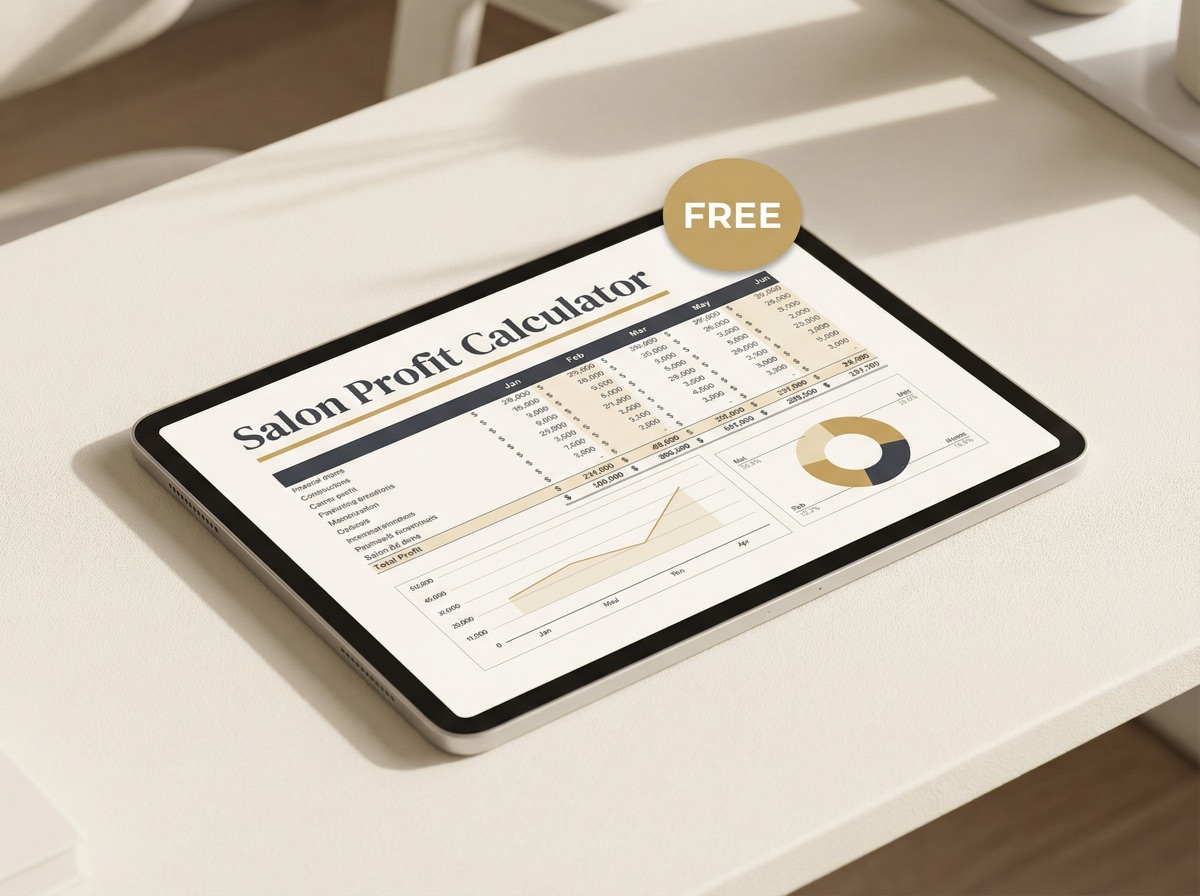
Written by Scott Farmer
Licensed Master Cosmetologist (GA & FL), former Toni & Guy Artistic Director, and founder of Hair Salon Pro. 30+ years behind the chair. 15,000+ clients. Building the business tools cosmetology school never taught. Currently behind the chair at scottfsalon.com in Venice, FL.