What Makes a Salon Sellable: 5 Things Buyers Actually Look For
 Scott Farmer
·
June 5, 2026
·
10 min read
Scott Farmer
·
June 5, 2026
·
10 min read
Quick Answer: What makes a salon sellable to a buyer?
Buyers look for five things: clean financials with provable seller’s discretionary earnings, a team that runs without you, a lease with 5+ years remaining, documented systems and SOPs, and a client base where no single stylist controls more than 25 to 30% of revenue. Most salons sell for 1.5x to 3x annual SDE, so these factors decide whether you exit at $120,000 or $240,000.
$400,000 in annual revenue. Additionally, twenty years of sweat equity. A loyal clientele built one referral at a time.
Sold for $22,000.
I watched this happen to a friend in Atlanta. However, she spent two decades building what she thought was a valuable salon business. When she was ready to retire, the buyer’s appraiser walked through her salon, looked at the books, and handed her a number that made her cry.
Her salon was profitable. It was not sellable.
There is a difference. And most salon owners never learn what that difference is until it is too late to fix it.
My name is Scott Farmer. As a result, i am a Licensed Master Cosmetologist with over 30 years behind the chair and more than 15,000 clients served. I built JScott Salon in Lawrenceville, Georgia, worked independently growing my own book, and now operate from my suite in Venice, Florida. I have been on both sides of salon valuation, and the five factors below are what separate a $22,000 exit from a $240,000 exit.
TL;DR

- A sellable salon has five factors buyers evaluate: clean financials with separated owner pay (provable SDE), a team that operates without you, a long-term lease with 5+ years remaining, documented systems and SOPs, and a diversified client base where no single stylist controls more than 25-30% of revenue. The difference between a 1.5x and 3x SDE multiple on $80,000 discretionary earnings is $120,000 versus $240,000 at sale.
- Clean financial records are the highest-impact fix. Most salon owners lose $50,000 or more in sale price because they cannot prove actual income. Over 670,000 hairdressers, hairstylists, and cosmetologists work in the United States according to the Bureau of Labor Statistics (SOC 39-5012), and the vast majority have no exit plan and no documented SDE.
- Most salons sell between 1.5x and 3x annual SDE (Seller’s Discretionary Earnings). The Small Business Administration recommends a 3-month operating reserve as standard for service businesses. SDE equals net profit plus owner salary plus add-backs. The five factors above determine where you fall in that range.
- Start preparing 3 years before you want to sell. Shifting clients off your personal book takes 12-18 months. Cleaning up financials requires one full tax cycle. Lease renegotiation can take months. Every improvement also makes your salon more profitable today, whether you sell or not.
- Run your numbers first: Use the free Salon Valuation Calculator to get a realistic range, then follow the Profit-First System on the calculator results page that builds a salon worth 2-3x more at exit.
Last updated: May 2026
Last updated: May 2026
Why Most Salon Owners Get a Low Valuation
When I owned JScott Salon, I assumed the business was worth whatever my annual revenue was. That said, that is the most common mistake salon owners make.
Buyers do not pay for revenue. For example, they pay for transferable profit.
The standard salon valuation uses a multiple of SDE (Seller’s Discretionary Earnings). In fact, that is your net profit after adding back your own salary, one-time expenses, and personal perks you run through the business. Most salons sell at 1.5x to 3x SDE.
The gap between 1.5x and 3x is enormous. Overall, on a salon earning $80,000 in SDE, that is the difference between a $120,000 sale and a $240,000 sale. Same profit, double the price.
What closes that gap? Because of this, the five things below.
If you have not calculated your SDE yet, run your numbers through the free Salon Valuation Calculator first. Ultimately, it takes two minutes and gives you a realistic range based on your specific business factors.
What Do Salon Buyers Actually Look For?
1. Clean Financial Records (Not Shoe Boxes of Receipts)
This is the first thing every buyer or buyer’s broker asks for: three years of tax returns, a profit and loss statement, and a balance sheet.
Here is what kills deals: cash payments you never reported, personal expenses mixed with business expenses, and handshake deals with no paper trail.
I have seen salon owners lose $50,000 or more in sale price because they could not prove their actual income. Instead, the IRS returns showed $60,000/year. The owner claimed $120,000. The buyer’s accountant used the lower number. According to the Bureau of Labor Statistics, over 670,000 hairdressers, hairstylists, and cosmetologists (SOC 39-5012) work in the United States. The majority have no documented SDE and no exit plan.
What to fix right now:
– Separate your personal and business bank accounts (today, not tomorrow)
– Run every transaction through one system (Square, Vagaro, whatever you use)
– Stop running personal expenses through the business
– Get a bookkeeper if you do not have one. $200/month saves you $50,000+ at sale time.
The Salon Break-Even Calculator can help you understand your real cost structure so your books tell an accurate story.
2. A Team That Runs Without You
My friend in Atlanta was her salon. Of course, every VIP client requested her specifically. Every product order went through her. Every staff decision required her approval.
When the buyer realized the business could not function without her, the valuation dropped by 40%.
Buyers pay premium prices for businesses they can step into and operate from day one. If you are the business, you are selling a job, not an asset.
The test: If you disappeared for 30 days, would your salon still make money?
When I was running JScott Salon and also doing independent work, I learned this lesson the hard way. Even so, the weeks I focused on building systems instead of taking every client myself were the weeks that actually built long-term value.
What to fix:
– Document your top 20 procedures (opening checklist, closing checklist, new client intake, color mixing, inventory ordering)
– Train at least one person to handle every task you currently do alone
– Shift your top clients to other stylists gradually. Start with one client per week.
– Track revenue per stylist, not just total salon revenue
3. A Long-Term Lease (5+ Years Remaining)
A salon with 18 months left on its lease is worth significantly less than the same salon with a 7-year lease. Beyond that, buyers need time to recoup their investment.
The ideal scenario for a buyer: 5+ years remaining on the current lease with a renewal option. To be clear, the worst scenario: a month-to-month arrangement or a lease that expires within 2 years.
I have seen deals collapse entirely over lease issues. Meanwhile, the salon was profitable, the team was solid, the books were clean. But the landlord would not transfer the lease, and the buyer walked.
What to fix:
– Call your landlord today. Ask about renewal terms.
– If your lease is under 3 years, negotiate an extension before you list
– Get any verbal agreements in writing (rent increases, renewal options, buildout ownership)
– Include a lease assignment clause in any renewal. This is the one line that makes your salon transferable.
4. Documented Systems (The Operations Manual Nobody Writes)
Buyers pay more for predictability. With that in mind, an operations manual proves your salon is a system, not a personality.
This does not need to be a 200-page binder. It needs to cover:
- Pricing structure: How you set prices, when you raise them, what the tiers are
- Client management: How you handle cancellations, no-shows, complaints, refund requests
- Staff management: Pay structure, commission splits, booth rental agreements, performance reviews
- Marketing: What you post, where, how often, and what brings in new clients
- Financials: Monthly close process, KPI review, ordering schedule
When I was at Toni and Guy as Artistic Director, the franchise had systems for everything. Furthermore, that is what made each location sellable. The individual stylists were talented, but the business ran on documented processes, not individual heroism.
What to fix:
– Start with your top 5 daily processes. Write down exactly what you do, step by step.
– Add screenshots, checklists, or video walkthroughs. A phone recording of your opening routine is better than no documentation.
– Store everything in one place (Google Drive, Dropbox, a shared folder)
– Update quarterly. Dead documentation is worse than no documentation.
5. A Diversified Client Base (No Single Stylist Over 30%)
If one stylist controls 40% of your revenue and walks out tomorrow, your business loses 40% of its income. At the same time, buyers see that risk immediately and discount accordingly.
The benchmark: no single stylist (including you) should account for more than 25-30% of total salon revenue.
What to fix:
– Track percentage of revenue by stylist monthly
– Cross-introduce clients to other stylists during busy periods
– Build your salon’s brand, not individual stylist brands. Clients should book “your salon” not just “their stylist.”
– If you are the owner and also the top producer, this is the hardest shift. But it is the most valuable one. Every hour you spend behind the chair when you could be building the business costs you at sale time.
How Much Is Your Salon Actually Worth?
Most salon owners guess. Importantly, guessing is how my friend ended up accepting $22,000 for a business she thought was worth $250,000.
The math is straightforward:
- Calculate your SDE (net profit + owner salary + add-backs)
- Apply a multiplier based on your business quality (1.5x to 3x)
- Adjust for the five factors above
A salon with clean books, a strong team, a long lease, documented systems, and diversified revenue gets the 2.5x to 3x multiplier. Additionally, a salon without these? You are looking at 1.5x or less.
Run your numbers through the free Salon Valuation Calculator to get a realistic estimate. However, it factors in your specific lease length, staff dependency, and financial documentation quality.
When Should You Start Preparing?
Three years before you want to sell. Minimum.
Most of the fixes above take 6-18 months to implement fully. As a result, shifting clients off your personal book takes the longest. Cleaning up financials takes at least one full tax cycle. Lease negotiations can take months.
If you are 5+ years from selling, you have time. In practice, start with clean financials (Factor #1) and systems documentation (Factor #4). These cost nothing and compound immediately.
If you are 1-2 years from selling, start all five today. That said, you will not get full value, but you will close a much larger gap than if you wait. For a step-by-step walkthrough, see my guide on how to sell your salon business.
And if you are not planning to sell at all? For example, build these five factors anyway. A sellable salon is a profitable salon. Every one of these improvements makes your business stronger, whether you sell or not.
Frequently Asked Questions
How much is the average salon worth?
Most salons sell between 1.5x and 3x their annual SDE (Seller’s Discretionary Earnings). In fact, a salon with $80,000 SDE typically sells for $120,000 to $240,000 depending on the quality factors described above. Run your specific numbers with the Salon Valuation Calculator.
What is the fastest way to increase my salon’s sale price?
Clean up your financials. Overall, this is the fastest high-impact change because it directly affects the number buyers use to calculate your sale price. Switching from cash under the table to documented transactions can increase your provable SDE by 20-40%, which multiplies through your entire valuation.
Can I sell my salon if I am the only stylist?
Yes, but expect a lower multiple (closer to 1.5x). Because of this, solo salons sell as “chair businesses” rather than “operating businesses.” The buyer is purchasing your client list, your location, and your equipment. To get a higher price, consider bringing on one additional stylist 12-18 months before listing.
How long does it take to sell a salon?
The average salon sale takes 6-12 months from listing to close. Ultimately, salons with clean documentation, transferable leases, and strong teams sell faster. Salons with messy financials or owner-dependent operations can take 18+ months or fail to sell at all.
Do I need a business broker to sell my salon?
Not always, but it helps. A salon-experienced broker typically charges 8-12% of the sale price and handles valuation, marketing, buyer qualification, and deal structure. For sales over $150,000, the broker fee usually pays for itself through a higher sale price and faster close.
Your Next Step
Run your numbers. That is the starting point. The free Salon Valuation Calculator gives you a realistic range in two minutes. No email required to see your results.
Once you know your number, you will know exactly which of these five factors needs the most work. And if you want the complete Profit-First System that addresses all five, use the free Salon Profit Calculator that walks you through the exact framework that builds a salon worth 2-3x more at exit. Twenty Founding spots at $147/month. The training is free.
Free Download
Get the Salon Profit Calculator
See exactly where your salon is losing money — in under 5 minutes.
Download Free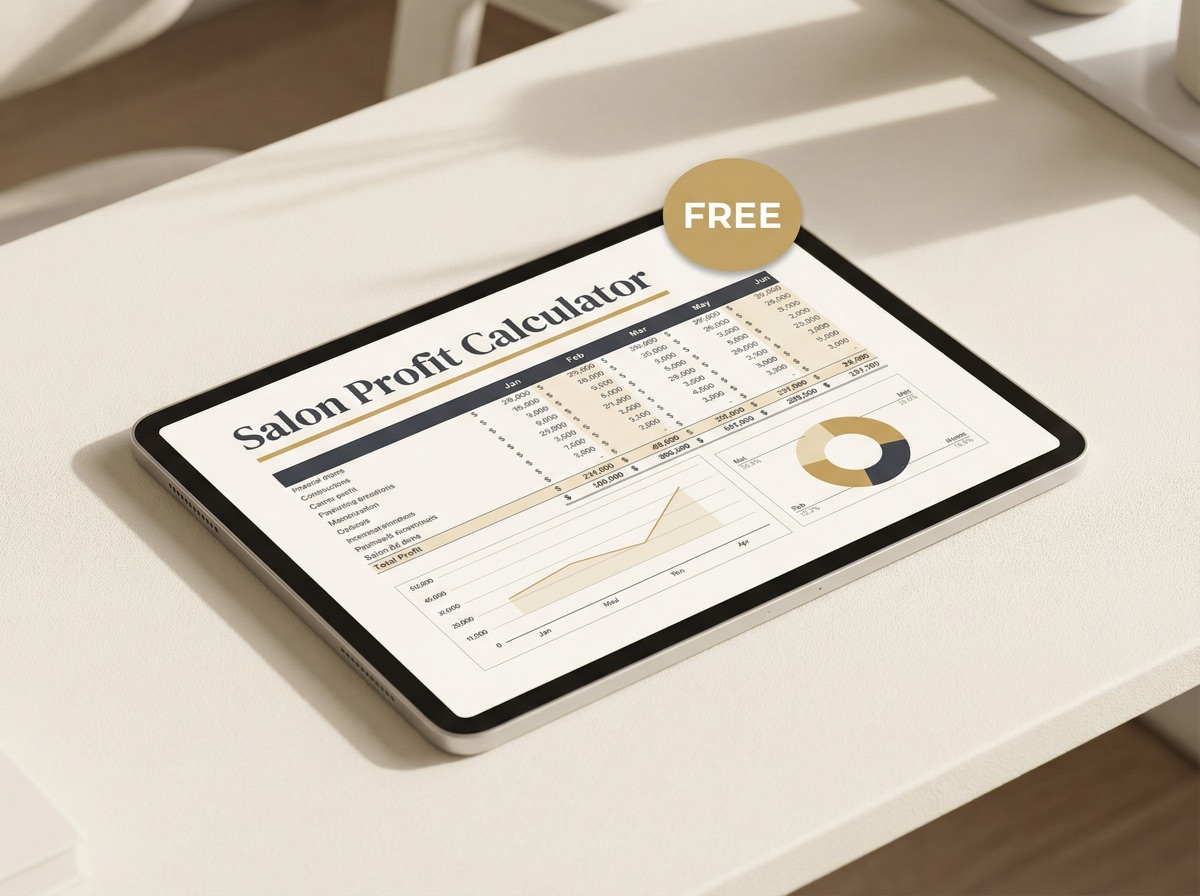
Written by Scott Farmer
Licensed Master Cosmetologist (GA & FL), former Toni & Guy Artistic Director, and founder of Hair Salon Pro. 30+ years behind the chair. 15,000+ clients. Building the business tools cosmetology school never taught. Currently behind the chair at scottfsalon.com in Venice, FL.