Salon Chair Utilization Rate: The One Number That Predicts Your Income for the Next 12 Months
 Scott Farmer
·
June 4, 2026
·
12 min read
Scott Farmer
·
June 4, 2026
·
12 min read
Quick Answer: What is salon chair utilization rate and what is a good number?
Chair utilization rate is the percentage of your available working hours that are actually booked with paying clients. Divide booked hours by available hours, then multiply by 100. The industry average runs 48 to 55 percent. Top-25 percent salons hit 70 to 80 percent, and the top 10 percent sit above 85 percent. It is the strongest 12-month income predictor I have found.
TL;DR

- Chair utilization rate is the percentage of your available working hours that are actually booked with paying clients. Formula: booked hours divided by available hours, times 100.
- The U.S. salon industry average sits around 48 to 55%. Top-25% salons run 70 to 80%. Top-10% sit 85%+.
- Every 10-point lift in utilization on a $75 average ticket and a 40-hour week is roughly $15,600 in extra annual revenue per chair, with almost zero added cost.
- Utilization is the single strongest 12-month income predictor I have ever found in 30 years behind the chair, including years running JScott Salon and almost a decade as an independent stylist.
- The fix is rarely “more clients.” It is almost always “the same clients on a smarter schedule.”
Last updated: June 2026
Your salon chair utilization rate is the single most important number you are probably not tracking. Additionally, my name is Scott Farmer. I have been a Licensed Master Cosmetologist for over 30 years and worked behind the chair through more than 15,000 clients. According to the Bureau of Labor Statistics, there are roughly 670,000 cosmetologists in the United States, and the vast majority have no idea what their utilization rate is. The salon owners I see making real money are not the busiest. They are the ones with the highest chair utilization rate. This article shows you how to measure yours, what the number really means, and the exact moves I used at my own salon to push utilization from the high 40s to the high 70s without adding a single new client.
What is salon chair utilization rate?
Chair utilization rate is the share of your working hours that are actually generating revenue. However, it is the difference between “I am at the salon” and “I am earning money.”
Here is the formula in plain English:
Utilization rate = (booked service hours) / (available working hours) x 100
Available working hours are the hours your chair is open for business. As a result, booked service hours are the hours a paying client is in that chair receiving a service. Travel time, lunches, social media breaks, restocking, blow drying after the ticket has closed, all of that counts as available but not booked.
Most salon owners confuse “busy” with “utilized.” I felt busy on a 50-hour week early in my career and could not understand why I was broke. In practice, the number that finally made sense of it was utilization. Once I started tracking it, the gaps in my week stopped hiding from me.
A practical example. If you are open Tuesday through Saturday, ten hours a day, your available hours are 50 per week. If your appointment book shows 27 hours of paid services, your utilization is 27 divided by 50, which is 54%. That said, that number tells you almost everything about why your bank balance is what it is.
How do you calculate chair utilization rate (step by step)?
I want you to pull last week’s appointment book before you read further. For example, the math is more useful when it is your own.
Step 1. Define your “available” hours. In fact, pick a true work window. If you say you are open 9 to 7 but always leave at 5 on Wednesdays, use 9 to 5 for that day. Honesty is the whole point of this exercise.
Step 2
Step 2. Add up actual booked service time. Overall, look at the appointment book. Count only the minutes a client was paying for service. A 90-minute color slot counts as 90 minutes. A 60-minute slot that ran 75 minutes still counts as 60, because the client only paid for 60.
Step 3. Divide booked by available, multiply by 100. Because of this, that is your utilization rate.
Step 4. Do the same math for the past four weeks. Ultimately, a single week is noise. Four weeks is a signal.
A real-world example from one of my mentorship clients last month. Instead, she is a suite owner in Atlanta, $80 average ticket, 40 hour available week. Her last four weeks looked like this:
- Week 1: 22 booked hours = 55% utilization
- Week 2: 26 booked hours = 65% utilization
- Week 3: 19 booked hours = 48% utilization
- Week 4: 24 booked hours = 60% utilization
Average over the month: 57%. Of course, annualized at $80 a ticket and roughly one client per hour, that month is on track to produce about $96,000 a year in service revenue. If she lifted utilization to 75%, the same chair, the same skill, the same ticket would produce about $124,800. Same human, same hours physically present, almost $29,000 more in income.
That is why I obsess over this number.
What is a healthy chair utilization rate for a salon?
I get asked for the “right” number constantly. Even so, the honest answer depends on your model. Here are the bands I use after working solo, in commission salons, and as a salon owner:
- Under 40%. You are losing money even if you feel busy. The chair is open but not earning.
- 40 to 55%. Industry average. This is where most independent stylists live and where most owners think the problem is “lack of clients.” It is not. The problem is structural gaps in the week.
- 55 to 70%. Healthy. You are profitable if your pricing is correct.
- 70 to 80%. Top quartile. This is where six-figure stylists actually live.
- 80%+. Top decile. Sustainable only with smart scheduling, mature pricing, and disciplined boundaries. Above 90% you risk burnout and quality drops.
The Professional Beauty Association tracks industry benchmarks that confirm these ranges. Still, a common myth: stylists assume top earners run at 95 to 100%. They do not. The best stylists I have ever met intentionally leave 15 to 20% of the week open for buffer time, walk-in repairs, and color processing overlap. That open time is what allows premium pricing in the first place.
Why is chair utilization rate the strongest 12-month income predictor?
Three reasons.
One. It is structural, not motivational. Beyond that, most “make more money” advice tells you to work harder. Utilization tells you to redesign the week. Once redesigned, the income lift sticks even on weeks you do not feel inspired.
Two. The cost of every added booked hour is almost zero. To be clear, your rent, utilities, insurance, and taxes are all already paid. Filling a previously empty Tuesday at 11 a.m. with a $120 color is almost pure profit.
Three. It exposes your pricing problem instantly. If your utilization is high but your bank balance is low, your prices are wrong. If your utilization is low and your prices are high, your schedule is the problem, not your menu. Meanwhile, most stylists try to fix the wrong one for years.
When I was an Artistic Director at Toni and Guy back in my early career, the most successful educators on the leadership team had something in common. In contrast, none of them were the “fastest” stylists. They all ran 75% plus utilization. They worked fewer hours and made more money than the people grinding 60-hour weeks at 40% utilization. That stuck with me.
How do I increase salon chair utilization without burning out?
Here are the seven moves that worked for me at my own salon and that I now coach Pro members through. With that in mind, pick the two that match the gaps you found in your own four-week audit. Do not try to do all seven at once.
1. Audit your three slowest hours of the week. Furthermore, almost every stylist has the same dead zones: Tuesday morning, Wednesday lunch, late Thursday afternoon. Stop pretending those are random. They are predictable. Plan a strategy for them. (I wrote a full playbook in How to Fill Slow Days at Salon if you need the exact script.)
2
2. Build a “color day” or “consultation day” into your slowest day. When my Tuesday utilization at my own salon was hovering at 38%, I converted Tuesdays into a dedicated color and consultation block with discounted pre-booking. In other words, tuesday utilization went to 81% inside six weeks. Total weekly utilization went from 49% to 67%.
3. Stop offering 60-minute haircut slots when you finish in 45. If you are honestly done in 45 minutes, schedule the slot at 45 minutes. At the same time, you just freed up an hour every four cuts. That is one full extra service every half day.
4. Pre-book every client before they pay. Notably, a client who walks out without a next appointment has a 30 to 50% chance of not coming back. A client with a date on the book has 85%+ retention in my data. Pre-booking is the single biggest utilization lever you have.
5. Use a 24-hour cancellation policy with teeth. Importantly, a no-show is a 100% utilization loss for that hour. The right cancellation policy text actually reduces no-shows by 60 to 70% in my experience. Free Price Increase Script Pack includes the exact wording I used.
6. Stack overlap services intentionally. Additionally, a processing color client and a haircut client can share the same hour if your schedule is built for it. Done right, this is the highest-leverage move on the list and the easiest to do badly. Start with one overlap a day.
7. Track utilization weekly, not monthly. Monthly is too late. However, weekly forces you to fix the problem the week it appears. I have my Pro members log it every Sunday night next to that week’s revenue. The two numbers move together.
What are the most common mistakes that kill chair utilization?
I see these constantly during one-on-one audits.
Mistake 1. As a result, counting “in the salon” hours as “available” hours. If you spend two hours every Saturday on Instagram and another hour cleaning, those are not available hours. Be honest.
Mistake 2. In practice, confusing one big week with a trend. A 78% utilization week feels great. If the prior three weeks were 45%, your true number is the average. Do not let one good week hide a bad month.
Mistake 3. That said, filling the schedule with cheap services. A 10 a.m. $30 bang trim does fill the slot, but it cannibalizes a potential $120 color appointment later in the day. Utilization is not just about filling time. It is about filling time with the right service.
Mistake 4. For example, not accounting for processing time. Color processing is real time. If you bill it as “free” downtime, you are giving away utilization. Charge for it or fill the gap with another service.
Mistake 5. In fact, refusing to fire low-utilization clients. The client who books a $40 service every five months and reschedules twice is destroying your utilization more than they realize. The math says politely send them down the road.
How does chair utilization connect to my pricing and my profit?
Here is the equation I drilled into every stylist I ever mentored at my own salon:
Income = average ticket x utilization x available hours
Three levers. Overall, most owners only ever pull on the first one (raise prices), and they pull it slowly because they are scared. Utilization is the lever almost nobody pulls, and it is the one with the highest ceiling and the lowest risk.
Pull all three at once and the math becomes brutal in the best way. Because of this, a stylist at 50% utilization, $75 average ticket, 40 hour week, makes $78,000 a year in services. Same stylist at 70% utilization, $95 ticket, same hours, makes $138,320. Additionally, Human. Same chair. Same week. Sixty thousand more dollars a year. That is not motivation. That is geometry. The same compounding math runs every six-figure hairstylist I have ever audited, and the salon KPIs worth tracking all point back to it.
If you have not yet measured your three numbers honestly, the free Hair Salon Pro Profit Calculator will do it for you in about four minutes. Ultimately, plug in your week and the calculator returns your real utilization, your real average ticket, and your real annual income. I built it because I was tired of seeing stylists guess.
Frequently asked questions
What is a good chair utilization rate for an independent salon owner?
Anything above 65% is healthy for an independent owner. Instead, above 75% puts you in the top quartile of U.S. salon professionals. The number depends on your model, your menu, and how disciplined your booking system is.
How often should I calculate my salon chair utilization rate?
Weekly. Monthly is too late to fix the problem the same month. Of course, i have my Pro members log it every Sunday night next to that week’s revenue.
Does a high utilization rate mean my prices are too low?
It can. If your utilization is over 80% and you are not making the income you want, your average ticket is the problem, not your schedule. Even so, raise prices before you raise hours.
Can I have 100% chair utilization?
You can hit it short term. Still, you should not target it long term. The best stylists I know intentionally hold 15 to 20% of the week open for premium pricing, color processing overlap, walk-in repairs, and avoiding burnout.
What is the difference between chair utilization and booth utilization?
For practical purposes, the same thing. Beyond that, chair utilization is the term I use because it applies whether you rent a booth, own a suite, or run a full salon. The math is identical.
Does cancellation rate count against my utilization?
Yes. A canceled hour that you do not refill is a 100% utilization loss for that hour. To be clear, your cancellation policy is therefore one of the highest-leverage tools in your business.
How does chair utilization rate affect salon valuation?
Significantly. When I sold one of my early salons, the buyer’s accountant looked at chair utilization as a proxy for revenue stability. Meanwhile, a 70% utilization business sells at a higher multiple than a 45% utilization business with the same top-line revenue, because the buyer sees less owner-dependence and a more predictable book.
What happens when you start tracking chair utilization this week?
If you only track one number this quarter, track chair utilization. In contrast, it will tell you the truth about your business in a way that revenue alone never will. It is the single fastest way I know to find tens of thousands of dollars hiding in a schedule you already work.
Twelve months from now, your income will look almost exactly like a function of your utilization rate today. Move the number. The income follows.
Ready to find the gaps in your
Ready to find the gaps in your own week?
The free Hair Salon Pro Profit Calculator measures your real utilization rate, your real average ticket, and your real annual income in about four minutes. With that in mind, no fluff, no signup wall beyond an email so I can send you the report.
Once you have your number, HSP Pro Membership is the next step. Pro members get the exact systems I used to push my own utilization from 49% to 78% inside six weeks, plus weekly office hours and an AI Profit Analyst that runs your numbers for you every week.
Measure first. Fix second. In other words, the chair is already paid for. Go fill it.
Free Download
Get the Salon Profit Calculator
See exactly where your salon is losing money — in under 5 minutes.
Download Free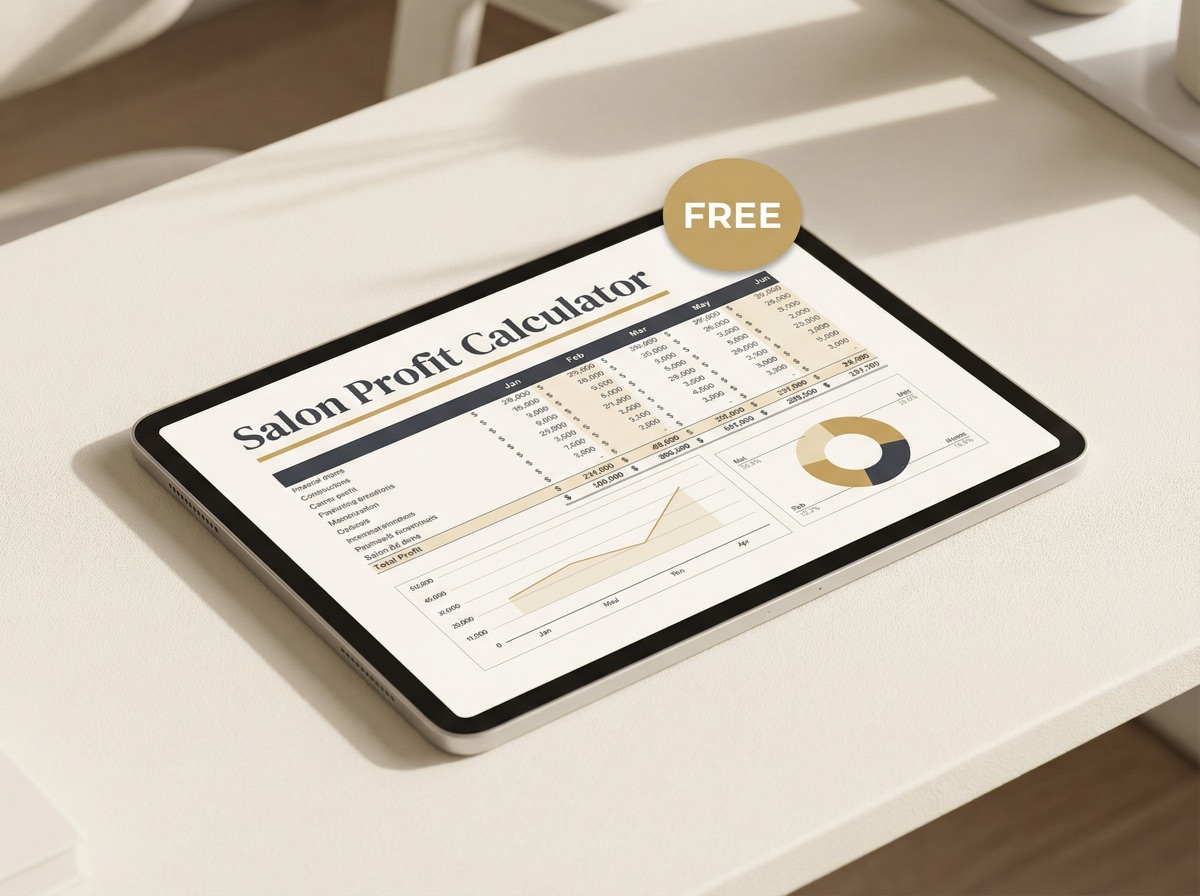
Written by Scott Farmer
Licensed Master Cosmetologist (GA & FL), former Toni & Guy Artistic Director, and founder of Hair Salon Pro. 30+ years behind the chair. 15,000+ clients. Building the business tools cosmetology school never taught. Currently behind the chair at scottfsalon.com in Venice, FL.