Google AI Calling Salons for Prices: How Your Front Desk Wins the Call
 Scott Farmer
·
September 16, 2026
·
10 min read
Quick Answer: Google AI calling salons is live in US Search. A searcher taps “Have AI check pricing,” and Google’s AI phones nearby salons for prices and availability, then emails the searcher a summary. It does not book the appointment. To win that call, whoever answers must give a clear starting price, the service duration, the next available appointment, and the booking link, in under a minute.
Last updated: September 2026.
I have answered thousands of price-shopping calls over thirty years behind the chair. At JScott Salon the phone rang all day with the same question: “How much is a haircut?” I got so tired of hearing “let me check with someone” from the reception desk that I made a rule. Anyone who picked up the phone could quote a starting price for a haircut, a single-process color, and a blowout without asking anyone. Corrective color and major transformations were always “consultation first, starting at X.”
That rule matters more now than it did twenty years ago, because the next price call to your salon might not come from a person. It can come from Google, and the searcher never hears your voice or your personality. They read an email with your salon’s name beside a number, or with your salon missing entirely. The automated caller records exactly what your desk said, and to a machine “it depends” is not a price, it is a blank line.
Before you quote anything, know your floor. Run the free Salon Profit Calculator and see what each service costs you before you quote it to a robot.
How Google AI calling salons works, step by step

Per Google’s own help page, a US user searches for a local service, taps “Have AI check pricing,” and fills in the service and timing they want. Google’s AI then calls nearby businesses, asks each one for prices and availability, and emails the searcher a summary. It does not book the appointment, so the searcher still has to call you or click your booking link.
The feature started with home services like plumbers and HVAC companies. It now covers hair salons, pet groomers, auto repair shops, and wellness businesses. The calls run on the same Duplex-style calling technology Google has used for restaurant reservations.
The AI announces itself as an automated Google call at the start of the conversation, so your team will always know who is asking. You can also disable these calls in your Google Business Profile settings, an option both Google’s help page and Search Engine Journal confirm.
Sterling Sky, a local SEO firm, tested it on haircuts and reported that the results email appeared in about half an hour. It listed every salon that answered, together with the price each one quoted. If your line went to voicemail, your salon never appears in that email.

What changes when the caller is a machine
A human caller forgives a lot. She waits while you check the appointment book and laughs when you say “depends on the hair.” The automated caller hears none of that, because it is collecting a specific list of facts and it moves on the moment it has them.
The six things the AI is listening for
Start with a clear starting price. “Haircuts start at $65” is an answer, while “anywhere from $50 to $150 depending” is a shrug. Give the number your lowest-tier stylist charges and say “starting at.”
Know how long the service takes. The AI is checking availability, and timing is part of that.
Have the next opening ready. Keep the appointment book open or the app on screen.
Say the consultation rule the same way every time. For corrective color, extensions, and major transformations: “That service is consultation first, and it starts at $X.”
State the deposit policy in one sentence. If you secure color appointments with a card on file, mention it. It filters out the price shoppers who never show before they reach your chair.
End with the booking link. The AI summary is a comparison sheet, and the salon that hands over a direct way to book starts ahead.
None of this is new for me, because I used the same consultation-first rule at Toni and Guy, at JScott Salon, and as an independent stylist. I still use it today in the suite I rent in Venice.
The six-line phone script for price calls
Print this and tape it next to the phone, and substitute your own numbers for the bracketed example prices.
| Line | What the desk says | Why it works |
|---|---|---|
| 1 | “Thanks for calling [Salon Name], this is [Name].” | Names the business so the summary spells it right. |
| 2 | “Haircuts start at [$65] and take about 45 minutes.” | Price and time in one breath. |
| 3 | “Single-process color starts at [$95] and takes about 90 minutes.” | Same pattern for the second most-asked service. |
| 4 | “Our next openings are [Thursday at 2] and [Saturday at 10].” | Availability is the second thing the AI collects. |
| 5 | “Corrective color and big changes are consultation first, starting at [$250].” | A number plus the rule, never “it depends.” |
| 6 | “You can book at [your booking link], and we hold color appointments with a card on file.” | Booking path and deposit policy, the last thing said. |
Six lines, under a minute, and every line is a fact the AI can copy into the email. Notice what is not in the script: no “let me check,” and no “who is your stylist?” On the first pass they cost you the listing.

Which services get a phone quote and which are consultation-only
This is the table I wish I had handed my reception team at JScott. The prices are examples for the format, not my menu, so use your own. For the arithmetic behind each haircut tier, my how to price a haircut guide walks through it.
| Service | Phone quote? | What the desk says |
|---|---|---|
| Haircut | Yes | “Starts at [$65].” |
| Blowout | Yes | “Starts at [$45].” |
| Single-process color | Yes | “Starts at [$95].” |
| Root touch-up | Yes | “Starts at [$85].” |
| Partial or full highlights | Starting price only | “Starts at [$150]. Length and density can change it.” |
| Balayage | Starting price only | “Starts at [$200], final price at the consult.” |
| Corrective color | Consultation first | “Consultation first, starting at [$250].” |
| Extensions | Consultation first | “Consultation first, starting at [$400] plus hair.” |
| Keratin or smoothing | Starting price only | “Starts at [$250] depending on length.” |
For the consultation-first rows, my color correction pricing post shows how I tier the hardest work in hair, so the starting number stays honest.
One opinion, and it has an edge. Salons that refuse to give any number on the phone believe they are protecting their value. What they are doing is handing the comparison to the salon down the street that said “$65.”
Run the mystery call test this week
You do not have to guess how your desk performs, because Google will tell you. Pick a slow afternoon and search on your phone for the kind of service you sell in your town, like “women’s haircut” or “single process color.” If the “Have AI check pricing” button appears on that search, tap it. Enter the service, select a time window a real client would choose, and use an email address you monitor. Then wait, because based on the Sterling Sky test the summary email arrives in about half an hour. Do not warn your reception desk, because the surprise is the point.
When the email lands, check your line in it, then ask whoever took the call what they said. Score the answer, one point each:
- Price quoted: the number beside your name is your real starting price, not one pulled from memory.
- Duration: the service time was given.
- Next opening: a real day and time, not “call back.”
- Consultation rule: big-change work got “consultation first, starting at” plus a number.
- Booking link: your link was offered.
Anything under five out of five goes back to the script above. Then read what the two competitors above you quoted.
If your salon is missing, one of three things happened. The call went unanswered, the desk provided no number, or the calls are disabled in your Google Business Profile. All three have a fix, and for the first two it is the script above. If you have never claimed or finished your profile, start with my Google Business Profile for salons walkthrough and then come back here.
Run the test once a quarter, and always after you raise prices.

Should you turn the Google AI calls off?
You can, and the setting lives inside your Google Business Profile, so here is when I would disable it. If every service on your menu is consultation-only and you never quote on the phone, the AI will call, get nothing, and list nothing. Turn it off and spare the desk the interruption. If your schedule is booked solid for six weeks with a waitlist, the same logic applies. And if a stylist mid-foil answers and cannot stop for a real answer, the opt-out is kinder than a half-answer.
For everyone else, leave it on, because opting out does not stop the searcher from comparing prices. It only guarantees your salon is not in the comparison while the competitors who answered are. It is the same battle I cover in my local SEO for hair salons guide, with a different front door.
Know your floor before you quote it
Your floor price equals your product cost plus your hourly cost times the service time. Below that line you are paying to work, and now a robot is broadcasting that price to strangers.
When I ran this math on my own chair in 2005, a $32 men’s cut was leaving me about $15.50 after rent, product, and taxes. I raised it to $47, and two clients out of a hundred left. The other ninety-eight stayed, and that single change added $1,100 to that week. I would never have quoted $32 to anyone, human or machine, if I had known the floor first.

What salon owners ask next
Will Google’s AI eventually book the appointment for the client?
Not today, because Google’s help page says the AI collects prices and availability, emails a summary, and leaves the booking to the searcher. Plan for the version where it might. That means a short booking link, spoken clearly on every call, and identical to the one on your Google Business Profile.
Should the whole team learn the script, or just the front desk?
Everyone who could touch the phone, which in a suite or a small salon means you between clients. The call does not wait for the receptionist to return from lunch. Tape the six lines where the phone lives, then run the mystery call test until every person on the team passes it.
What happens to the script when I raise prices?
Update it the same day and re-run the mystery call test the same week. Check your Google Business Profile services list at the same time. The AI summary is a snapshot, and a starting price $10 lower than the checkout total earns you a bad review instead of a booking.

Frequently Asked Questions
Does Google AI call hair salons to check prices?
Yes. A US searcher taps “Have AI check pricing,” and Google’s AI calls nearby businesses for prices and availability, then emails a summary. Google’s own help page describes the feature. It started with home services and now covers hair salons, pet groomers, auto repair, and wellness businesses.
How do I know it is Google’s AI on the phone?
The AI identifies itself as an automated Google call at the start of the conversation. Train your desk to treat it like a new client: starting price, service time, next opening, booking link. The one thing not to do is hang up.
Can I stop Google AI from calling my salon?
Yes. You can turn the calls off in your Google Business Profile settings, and Google’s help page and Search Engine Journal both confirm the option. Before you do, remember that opting out removes your salon from the comparison email, not from the comparison itself.
Should I give a price for color over the phone?
Give a starting price for single-process color and root touch-ups, since those change little from head to head. For corrective color, extensions, and major transformations, say “consultation first, starting at” and give the floor number. A number plus the rule beats “it depends” every time.
What if my starting price changes by stylist level?
Quote the lowest tier with “starting at,” then add “our senior stylists are higher.” The AI needs one number to write down. Give it the true floor for that service and let the tier conversation happen when the client books.
Next step
Your six lines are only as accurate as the numbers inside them. Run the free Salon Profit Calculator tonight and find the floor for your haircut, single-process color, and blowout. Post those three prices beside the phone, then run the mystery call test and discover what Google emails back.
Found this useful? Tell Google you want to see more from Hair Salon Pro in your search results and AI answers.
Free Download
Get the Salon Profit Calculator
See exactly where your salon is losing money in under 5 minutes.
Download Free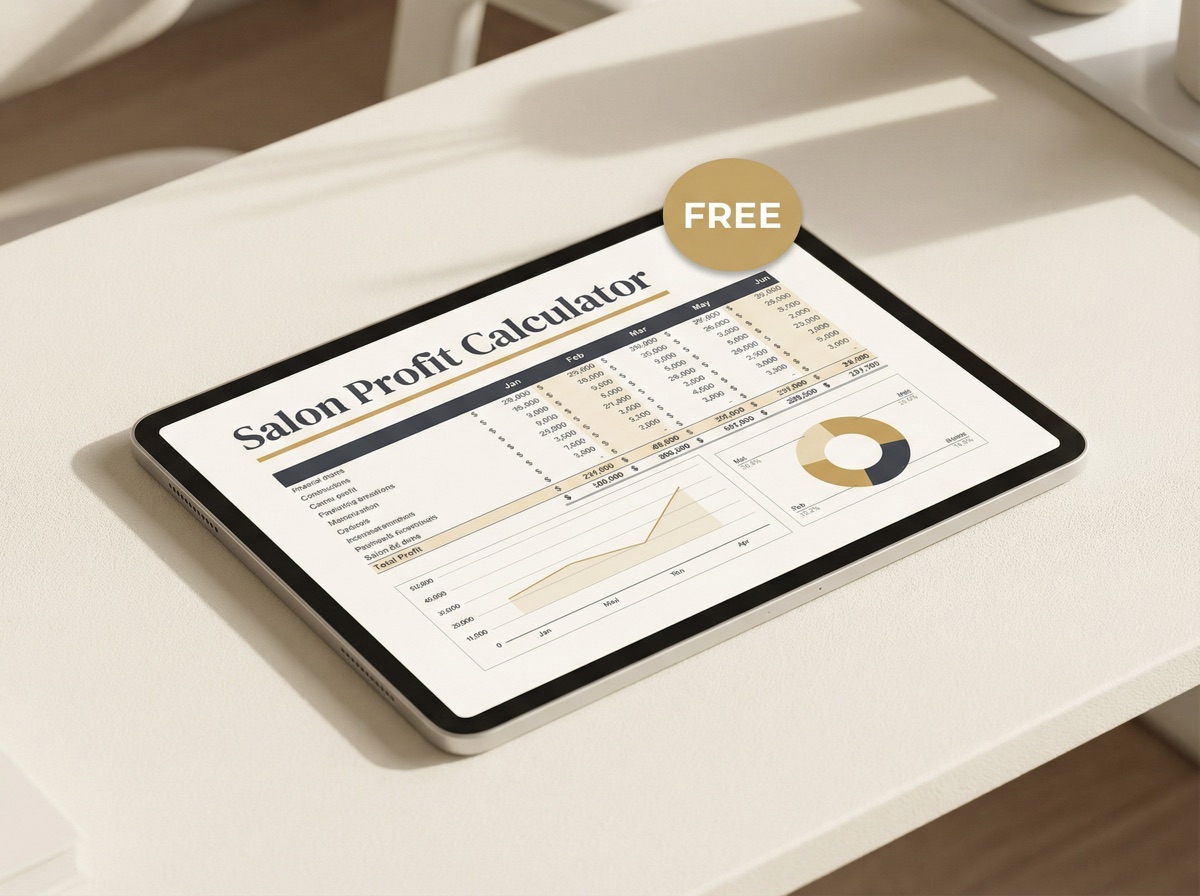
Written by Scott Farmer
Licensed Master Cosmetologist (GA & FL), former Toni & Guy Artistic Director, and founder of Hair Salon Pro. 30+ years behind the chair. 15,000+ clients. Building the business tools cosmetology school never taught. Currently behind the chair at scottfsalon.com in Venice, FL.