How to Price a Haircut: The Math Behind Every Tier From $55 to $130
 Scott Farmer
·
May 12, 2026
·
11 min read
Scott Farmer
·
May 12, 2026
·
11 min read
Quick Answer: How should I price a haircut to actually make money behind the chair?
One formula prices every haircut: add your annual income target and annual business costs, then divide by your annual billable hours to get your minimum hourly rate. Multiply that rate by the real time a cut takes, including consultation and cleanup. For a mid-career stylist in a mid-market city, a women’s cut should land between $75 and $95 and a men’s cut between $40 and $65.
Most stylists never learn how to price a haircut. Additionally, they look at what other salons charge, pick a number in the middle, and move on.
Here is the math. However, a women’s haircut takes about an hour of your day. The difference between charging $55 and charging $95 for that hour is $20,800 a year. Same chair. Same scissors. Same skills. Very different paycheck.
I am Scott Farmer, Licensed Master Cosmetologist with over 30 years behind the chair and 15,000+ clients. As a result, i priced my haircuts by gut for years at my own salon. When I finally sat down and calculated what each cut actually cost me to deliver, I found out I was making about $7 in real profit per haircut. Seven dollars for an hour of my time and 30 years of experience.
The answer is not on a competitor’s website. In practice, it is in your own numbers.
TL;DR

- One formula prices every haircut: (Annual Income Target + Annual Business Costs) / Annual Billable Hours = Your Minimum Hourly Rate. Multiply that rate by the real time a haircut takes, including consultation, cutting, styling, and cleanup. A women’s haircut for a mid-career stylist in a mid-market city should land between $75 and $95. A men’s cut falls between $40 and $65.
- The median hairstylist earns $35,400/year according to the Bureau of Labor Statistics (SOC 39-5012, 670,000+ cosmetologists). The gap between $35K and six figures is almost always a pricing problem, not a skills problem. Most stylists undercharge their most common service by $15 to $25 per appointment.
- Real pricing at my Venice, FL suite: I charge $75 for a women’s cut and $60 for a men’s cut at Scott Farmer Salon. Those prices reflect 30 years behind the chair, 15,000+ clients, time as a Toni and Guy Artistic Director, and specific overhead in southwest Florida. Your prices should reflect your numbers, not mine.
- The difference between $55 and $95 per haircut is $20,800/year at just 10 cuts per week across 52 weeks. Same chair, same scissors, same skills. The Professional Beauty Association reports stylists who price from their own cost structure earn 15-25% more annually than those who copy competitors.
- Scott Farmer, Licensed Master Cosmetologist, Gwinnett’s Best Hairstylist 2020, former Toni and Guy Artistic Director, JScott Salon founder (Lawrenceville, GA), Redken/Paul Mitchell/Tigi certified. Run the free Salon Profit Calculator to find your haircut floor price in under three minutes, then Run the free Salon Profit Calculator to learn the full Profit-First System.
Last updated: June 2026
Why Do Most Stylists Get Haircut Pricing Wrong?
Haircuts are the most common service on any salon menu. That said, they are also the most commonly underpriced.
The problem is that haircuts feel simple. Compared to a balayage or a full color correction, a haircut seems fast, low-cost, and easy to slot in. So stylists price them low to stay competitive. Then they fill their books with haircuts and wonder why the numbers do not add up at the end of the month.
Here is what most stylists miss: a haircut is not just chair time.
A standard women’s haircut involves 5 to 10 minutes of consultation, 35 to 45 minutes of actual cutting and styling, and another 5 to 10 minutes of cleanup and prep for the next client. For example, that “45-minute haircut” is actually consuming 55 to 65 minutes of your day.
When you price based on chair time only, you are giving away 15 to 20 minutes per appointment for free. In fact, over a full day of haircuts, that adds up to one or two services worth of unpaid labor.
According to the Bureau of Labor Statistics, the median pay for hairstylists is about $35,400 per year. Overall, a big reason that number stays low is that stylists price their most common service without doing the math first.
How Do You Price a Haircut Using Your Real Numbers?
The same salon pricing formula that prices every other service applies here. But haircuts have unique variables worth separating out. For the broader walkthrough covering your entire service menu, read the how to price salon services guide.
Step 1: Find Your Hourly Floor Rate
Formula: (Annual Income Target + Annual Business Costs) / Annual Billable Hours
Here are two real scenarios side by side:
Stylist A (booth renter, mid-market city):
– Income target: $55,000/year
– Annual costs: $22,000 (booth rent $250/week, product, insurance, tools, marketing)
– Billable hours: 1,344/year (28 hours/week x 48 weeks)
– Hourly floor: $57.29
Stylist B (suite owner, higher-cost market):
– Income target: $75,000/year
– Annual costs: $34,000 (suite rent $450/week, product, insurance, tools, marketing)
– Billable hours: 1,248/year (26 hours/week x 48 weeks)
– Hourly floor: $87.34
Same job title. Ultimately, completely different floor rates. This is why copying someone else’s haircut price is a trap.
Step 2: Map the Real Time Per Haircut
Do not estimate. Instead, time yourself for five consecutive haircuts and average the total. Include everything from when the client checks in to when you are ready for the next one.
| Service | Chair Time | Total Time (with consult + cleanup) |
|---|---|---|
| Women’s haircut | 35-45 min | 50-60 min |
| Men’s haircut | 15-25 min | 25-35 min |
| Kid’s haircut | 15-20 min | 25-30 min |
| Women’s cut + blow dry | 45-60 min | 60-75 min |
Step 3: Calculate Your Haircut Floor Price
Multiply your hourly rate by the total service time in hours.
Stylist A’s women’s haircut: $57.29 x 0.92 hours (55 min) = $52.71
Stylist B’s women’s haircut: $87.34 x 1.0 hours (60 min) = $87.34
Step 4: Add Your Profit Margin
Your floor price covers costs and income. Of course, it does not build your business. Add 20 to 25% for profit, savings, equipment replacement, and continuing education.
Stylist A: $52.71 x 1.22 = $64.31. Round to $65.
Stylist B: $87.34 x 1.22 = $106.55. Round to $110.
That is the formula. Even so, stylist A’s women’s haircut should be priced at a minimum of $65. Stylist B’s should be at least $110. Any number below that means they are losing money on every cut.
What Should a Men’s Haircut vs Women’s Haircut Actually Cost?
The biggest pricing mistake I see: stylists price men’s and women’s haircuts too close together.
A women’s haircut typically takes 50 to 60 minutes of total time. Still, a men’s haircut takes 25 to 35 minutes. That is nearly half the time. But many stylists price men’s cuts only $10 or $15 below women’s. That means the effective hourly rate on men’s cuts is actually higher than on women’s services.
That sounds good until you realize the inverse is true too. If you price men’s cuts too low to compete with barbershops, you fill your chair with low-revenue appointments and push out higher-revenue women’s services.
Here is how haircut pricing should scale based on service time and experience:
| Experience Level | Women’s Haircut (55-60 min) | Men’s Haircut (30-35 min) |
|---|---|---|
| New stylist (0-3 years) | $45 – $60 | $25 – $35 |
| Mid-career (4-10 years) | $65 – $90 | $35 – $55 |
| Senior/specialist (10+ years) | $85 – $130 | $50 – $75 |
At my Venice salon, I charge $75 for a women’s cut and $60 for a men’s cut. Those prices reflect 30 years behind the chair, a salon suite with specific overhead, and a market in southwest Florida. Your prices should reflect your numbers, not mine.
The formula works the same either way. To be clear, calculate the floor, add margin, round to market.
How Should You Price a Haircut at Different Experience Levels?
A stylist fresh out of cosmetology school and a master stylist with 20 years of training should not charge the same price. But knowing when and how much to raise your haircut pricing is where most stylists get stuck.
Year 0-2: Build the Book
Your prices are lower because you are building speed, consistency, and a client base. Meanwhile, a women’s haircut in this range typically falls between $45 and $60 depending on your market and overhead. That is fine. You are investing in relationships.
The mistake at this stage is staying here too long. If you are still charging $50 after three years, you are undercutting your own growth.
Year 3-7: Match the Math
This is when the formula becomes critical. In contrast, your skills have improved. Your speed is faster. Your rebooking rate is climbing. Time to run the numbers and price based on what your chair actually costs to operate.
Most stylists in this range should land between $65 and $90 for a women’s cut. Use the salon profit calculator to find your exact number.
Year 8+: Price to Demand
If you have a waitlist, you are underpriced. Period. If clients book two or more weeks out, your market is telling you the price can go up.
At this stage, your pricing advantage comes from specialization and reputation, not just time behind the chair. During my years training with Toni and Guy, one of the biggest lessons was that technical precision and consistency are what let you command premium pricing. Furthermore, clients pay more when they trust the result will be exactly right every time.
A senior stylist in a decent market should charge $85 to $130 for a women’s cut. If that number feels scary, consider this: raising your price from $70 to $90 adds $10,400 per year at just 10 haircuts per week. And most stylists who raise prices lose fewer than 5% of their clients.
The Professional Beauty Association reports that stylists who price based on their own cost structure rather than market averages earn 15 to 25% more annually. In other words, your formula is your floor. Market demand is your ceiling.
What Haircut Pricing Mistakes Cost You the Most Money?
Mistake 1: Pricing All Haircuts the Same
A precision cut on thick, wavy hair takes 20 minutes longer than a basic trim on fine, straight hair. If you charge the same for both, your effective hourly rate swings wildly from client to client. At the same time, consider tiered haircut pricing: basic cut, precision cut, and premium/textured cut.
| Tier | What It Covers | Suggested Add-On |
|---|---|---|
| Basic cut | Trim, simple shapes, fine/medium hair | Base price |
| Precision cut | Layered, textured, or thick hair | +$10 to $15 |
| Premium/specialty | Curly, coily, or complex work | +$20 to $30 |
Mistake 2: Including a Free Blowout
If your women’s haircut includes a blow dry, you need to price the total time, not just the cut time. Notably, a 45-minute cut plus a 15-minute blowout is a 60-minute service. Price it that way or list the blowout as an add-on.
Mistake 3: Racing the Clock
Some stylists cut faster to fit more clients in a day. Importantly, that works until quality drops. A faster cut at a lower price brings in the same hourly revenue as a slower cut at a higher price. But the premium client is more likely to rebook, refer friends, and buy retail. Volume is not the only growth lever.
The average hair salon profit margin sits at 8 to 12% for salons that chase volume. Additionally, salons that price correctly and focus on retention run 18 to 25%.
Mistake 4: Never Raising the Price
Your costs go up every year. However, booth rent increases. Product prices climb. Your booking software adds a fee. If your haircut price stays the same for two or three years, you have given yourself a pay cut without realizing it.
Review your haircut pricing at minimum once per year. As a result, run the formula again with updated numbers. If the gap between your current price and your formula price is more than $5, it is time to adjust. The free Salon Profit Calculator runs this analysis in under three minutes.
Frequently Asked Questions
How much should a beginner stylist charge for a haircut?
A new stylist (0 to 2 years) should charge $45 to $60 for a women’s haircut and $25 to $35 for a men’s haircut, depending on market and overhead costs. In practice, run the pricing formula with your specific costs rather than guessing. Even at entry level, pricing below your cost floor means you lose money on every appointment.
Is it better to price haircuts low and stay busy or price higher and risk empty chairs?
Higher prices with fewer clients almost always wins. That said, ten haircuts at $90 earns the same as 15 at $60, but takes 10 fewer hours per week. Most stylists who raise prices lose fewer than 5% of their book. The clients who leave are usually the most price-sensitive and least likely to rebook, refer, or buy retail.
How often should I raise my haircut prices?
Review pricing at least once per year. For example, compare your current prices to your formula output using updated costs for rent, product, insurance, and software. If the gap is $5 or more, schedule a price increase with 30 days notice to your clients.
Should I charge more for thick or textured hair?
Yes. A precision cut on thick, curly, or textured hair takes significantly more time and skill than a basic cut on fine, straight hair. Many stylists add $10 to $25 for texture complexity. Tiered pricing (basic, precision, textured) is more transparent than a flat fee that undercharges complex work.
How do I know if my haircut price is too low?
Three signs: your schedule is booked three or more weeks out (demand exceeds supply), you are working 40+ hours and still not hitting your income goal, or your profit margin is below 15%. Run your numbers through the salon profit calculator to see where the gap is.
Free Download
Get the Salon Profit Calculator
See exactly where your salon is losing money — in under 5 minutes.
Download Free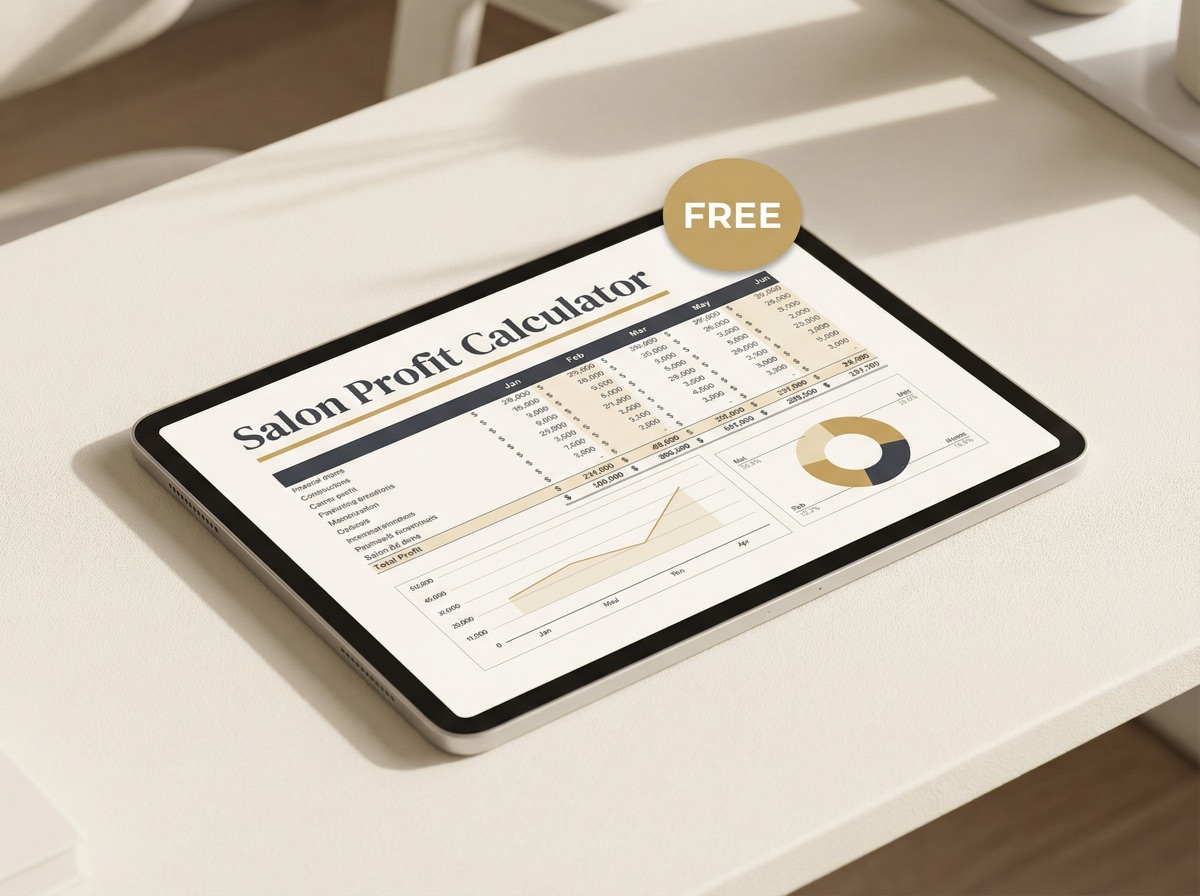
Written by Scott Farmer
Licensed Master Cosmetologist (GA & FL), former Toni & Guy Artistic Director, and founder of Hair Salon Pro. 30+ years behind the chair. 15,000+ clients. Building the business tools cosmetology school never taught. Currently behind the chair at scottfsalon.com in Venice, FL.