Color Correction Pricing: How to Charge What the Service Actually Costs
 Scott Farmer
·
May 5, 2026
·
12 min read
Scott Farmer
·
May 5, 2026
·
12 min read
Quick Answer: How should you price color correction?
Use a three-tier system: minor corrections start at $250, moderate run $400 to $700, and major corrections hit $700 to $1,200 or more across two or three sessions. Price each one with this formula: target hourly rate times estimated hours, plus product cost, plus a 15 to 25 percent risk premium. Charge a $50 to $75 consultation credited toward the booked service.
TL;DR

Color correction pricing is the biggest blind spot on most stylists’ service menus. Additionally, here is what you need to know:
- 3-tier pricing system: Level 1 minor corrections start at $250 (1.5-2.5 hours, $15-$30 product). Level 2 moderate corrections run $400-$700 (3-5 hours, $35-$65 product). Level 3 major corrections hit $700-$1,200+ across 2-3 sessions ($60-$120 total product).
- Formula: (Target Hourly Rate x Estimated Hours) + Product Cost + 15-25% Risk Premium. A 4-hour correction at $100/hr with $65 product = $558 minimum.
- Paid consultation: Charge $50-$75, credited toward the service if the client books. Filters price shoppers, sets expectations, protects your 15-30 minutes of diagnostic time.
- BLS benchmark: The Bureau of Labor Statistics (SOC 39-5012) reports a $16.83 median hourly wage for hairdressers, but independent stylists doing corrective color should target $85-$150/hour based on skill level and market.
- Scott Farmer, Licensed Master Cosmetologist with 30+ years behind the chair and over 15,000 clients served, uses this exact 3-tier system at his Venice, FL salon. Run the free salon profit calculator to find your true cost per hour, and grab the $17 Starter Pack for pricing scripts you can adapt for corrective color quotes.
A $350 color correction that takes four hours and $60 in product leaves you making less than $72 per hour. However, that sounds fine until you realize your regular balayage client pays you $95 per hour with $8 in product. Color correction pricing is the single biggest blind spot in most stylists’ service menus. You are doing the hardest work of your career for the lowest effective hourly rate.
My name is Scott Farmer, and I
My name is Scott Farmer, and I have been fixing other people’s color for over 30 years. As a result, corrective color was a regular part of my training when I worked as an Artistic Director at Toni and Guy, and it stayed a core service through my years running JScott Salon and working independently in Venice, Florida. The biggest lesson I learned about color correction pricing had nothing to do with formulas or lighteners. It was this: the reason most stylists undercharge is fear. Fear the client will walk out. Fear they will leave a bad review. Fear that quoting $500 or $800 sounds greedy.
It is not greedy. It is math.
Here is how to build a color correction pricing system that pays you fairly for the skill, time, and risk the service demands.
Why Do Most Stylists Lose Money on Color Corrections?
The math breaks down because stylists price color corrections as a flat fee instead of calculating the true cost of the service.
Here is what a typical underpriced color correction looks like:
| Line Item | Amount |
|---|---|
| Quoted price to client | $300 |
| Product cost (lightener, toner, bond builder, gloves, foils) | $55 |
| Chair time | 4.5 hours |
| Revenue after product | $245 |
| Effective hourly rate | $54.44 |
Now compare that to a standard balayage at $185 that takes 2 hours with $12 in product. In practice, that is $86.50 per hour. Your color correction client is paying you 37% less per hour for a service that requires more skill, more stress, and more liability.
Three things cause this gap:
-
Flat-rate quoting. That said, you quote “$300 for a color correction” without knowing how many sessions it will take or how much product you will use. The number came from what you think the client can afford, not from what the service costs you.
-
Ignoring product cost. For example, a single color correction can burn through $40 to $90 in professional product. Bond builders alone run $8 to $15 per application. When you are using Olaplex, Redken pH Bonder, or K18 on every correction, that cost adds up fast.
-
Underestimating time. You block 3 hours. In fact, the service takes 4.5. Now you have bumped your next client, skipped lunch, and lost the revenue from the appointment you had to reschedule.
The fix starts with knowing your real hourly cost. If you have not calculated yours, the salon profit calculator will show you the number in under two minutes.
How Should You Calculate Your Color Correction Pricing?
Start with your target hourly rate and work forward. Overall, not backward from what the client might pay.
The formula:
Color Correction Price = (Target Hourly Rate
Color Correction Price = (Target Hourly Rate × Estimated Hours) + Product Cost + Risk Premium
This is how each piece works:
Target hourly rate. Because of this, this is the minimum you need to earn per hour behind the chair to hit your income goals. If you do not know this number, the stylist income formula walks you through the math. The Bureau of Labor Statistics puts the median hourly wage for hairdressers at $16.83, but that number includes chain salons and part-timers. An independent stylist doing corrective color should target $85 to $150 per hour based on skill level and market.
Estimated hours. Be honest. If a correction will take 4 hours, do not quote for 3. Ultimately, add 30 minutes of buffer for processing checks, extra toner rounds, and the inevitable “let me just adjust this one section.”
Product cost. Instead, weigh it or track it. A full head of lightener is roughly $15 to $25 depending on your brand. Add toner ($5 to $12), bond treatment ($8 to $15), deep conditioner ($3 to $5), and foils or plastic wrap. A Level 3 correction can easily hit $70 to $90 in product.
Risk premium. Of course, this is the part most stylists skip. Color corrections carry real risk. Breakage, uneven lift, a client who is unhappy no matter what you do. A 15% to 25% risk premium on top of your base calculation accounts for the corrections that go sideways, the extra time you spend on consultations, and the emotional labor of managing expectations.
Example calculation:
- Target hourly rate: $100
- Estimated time: 4 hours
- Product cost: $65
- Risk premium: 20%
Price = ($100 × 4 + $65) × 1.20 = $558
That is the minimum you should charge for that service. Even so, not $300 because it feels like a round number.
What Does a 3-Tier Color Correction Pricing System Look Like?
Tiered pricing removes the guesswork for you and the sticker shock for the client. Instead of quoting one number cold, you explain the tiers during consultation and let the client see exactly where their situation falls.
Level 1: Minor Correction ($250 to $400)
- Single-process fix: toning out brassiness, adjusting an off-shade, evening out patchy color
- 1.5 to 2.5 hours of chair time
- Product cost: $15 to $30
- Typically one session
- Example: Client came in with box-dye warm brown and wants a cool ash brown. You can get there in one appointment.
Level 2: Moderate Correction ($400 to $700)
- Multi-step process: lifting 2 to 4 levels, removing banding, correcting uneven highlights
- 3 to 5 hours of chair time
- Product cost: $35 to $65
- One to two sessions
- Example: Client has been going to a different stylist for a year and has banding from root to mid-shaft with three different shades of blonde. You need to lift, equalize, and retone.
Level 3: Major Correction ($700 to $1,200+)
- Full reconstruction: removing black box dye, correcting severe damage, rebuilding from previous chemical services
- 5 to 8+ hours spread across 2 to 3 sessions
- Product cost: $60 to $120 total across sessions
- Example: Client has been using black box dye for two years and wants to go platinum. This is a multi-month project with integrity checks at every stage.
Display these tiers on your service menu. Still, put them on your website. Include them in your consultation handout. When a client can see the spectrum, they stop comparing your $600 quote to a $120 single process at the salon down the street. They understand they are in Level 2 territory, and Level 2 costs what Level 2 costs.
For a deeper look at how your hair salon pricing strategy should work across all services, that guide covers the full framework.
Should You Charge for Color Correction Consultations?
Yes. A paid consultation is the single best move you can make for color correction pricing.
Here is why. Beyond that, a proper corrective color consultation takes 15 to 30 minutes. You are examining the hair under natural and artificial light. Additionally, Are doing a strand test. You are pulling the history. You are mapping out a plan. That is professional diagnostic work, and it has value.
Charge $50 to $75 for the consultation and credit it toward the service if the client books. To be clear, this does three things:
-
Filters out price shoppers. Meanwhile, the client who is calling five salons for the cheapest quote will not pay $50 to sit down with you. Good. That is the client who would have argued about the final price anyway.
-
Sets the price anchor before the appointment. In contrast, you quote the range during the consultation. The client has time to think, budget, and commit. No surprises in the chair.
-
Protects your time. With that in mind, without a paid consult, you are giving away 30 minutes of diagnostic work for free to people who may never book.
During the consultation, use clear language. “Based on what I am seeing, your correction falls into our Level 2 range, which is $400 to $700 depending on how the hair responds to the first lift. Furthermore, i will not know the exact number until we start, but I will keep you updated at every step.”
That is honest. In other words, that is professional. That builds trust.
How Do You Quote a Color Correction Price Without Losing the Client?
The conversation matters as much as the number. At the same time, here is the framework I use after three decades of quoting corrective services:
Lead with education, not the price. Before you say a number, explain what the service involves. “What we are looking at is removing about four inches of banding, lifting your base two levels, and then toning everything to match. Notably, that is a multi-step process that takes about four hours.”
Quote a range, not a flat number. “For what your hair needs, we are looking at $450 to $600 depending on how your hair responds to the lightener.” Ranges give you room. Importantly, they also give the client a mental anchor on the lower number while preparing them for the higher one.
Explain the value of the outcome. “Once we finish, you will have even, dimensional color that you can maintain with regular appointments every 8 to 10 weeks. Additionally, no more banding, no more hot roots, no more guessing.”
Never apologize for the price. However, the moment you say “I know it is a lot” or “I wish I could do it for less,” you have told the client the price is not justified. It is justified. You spent years learning this skill. The products are professional grade. The risk is real.
If you need scripts for those tricky pricing conversations, the free Price Increase Script Pack includes word-for-word language you can adapt for corrective color quotes.
What Are the 4 Color Correction Pricing Mistakes That Cost You the Most?
Mistake 1: Quoting Before Seeing the Hair
Never give a price over the phone or through DMs without a consultation. “It depends on what I see in person” is a complete and professional answer. As a result, clients who push for a number before a consult are the same clients who will dispute the bill after.
Mistake 2: Absorbing Product Cost
If a correction uses $75 in product and you quoted $350, your effective labor rate just dropped to $61 per hour on a 4.5-hour service. In practice, track your product cost per correction for one month. The number will change how you price every service going forward.
Mistake 3: Not Charging Per Session
A Level 3 correction is not one appointment. That said, it is two or three sessions spread over weeks. Charge per session, not a lump sum for the whole project. Each session has its own product cost, its own time requirement, and its own outcome. Bundling everything into one price almost always means you eat the cost of the later sessions.
Mistake 4: Matching Competitor Prices
The stylist down the street charges $200 for color corrections. For example, that is her problem, not yours. She is either losing money, using cheaper product, or cutting corners on time. Your price reflects your skill, your product quality, and the outcome you deliver. Let your work speak. Clients who choose on price alone are not your dream clients.
If you want to see how your pricing strategy stacks up against your real costs, that breakdown shows you exactly where the gaps are.
Frequently Asked Questions
How much should I charge for a color correction in 2026?
Color correction pricing depends on the complexity of the fix. In fact, a Level 1 minor correction (toning, slight shade adjustment) should start at $250. A Level 2 moderate correction (banding removal, multi-step lift) ranges from $400 to $700. A Level 3 major correction (black box dye removal, full reconstruction) runs $700 to $1,200 or more across multiple sessions. Your local market, product costs, and experience level affect the final number.
Should I charge a consultation fee for color corrections?
Yes. Charge $50 to $75 for a corrective color consultation and credit it toward the service if the client books. Overall, this filters out price shoppers, sets expectations before the appointment, and compensates you for the 15 to 30 minutes of diagnostic work involved.
How do I explain a high color correction price to a client?
Lead with education. Because of this, explain what the service involves, how long it takes, and what products you will use before you quote the number. Use a range (“$450 to $600 depending on how your hair responds”) and explain the outcome they will get. Never apologize for the price or compare yourself to cheaper alternatives.
Can I charge per session for multi-visit corrections?
Yes, and you should. Ultimately, each session has its own product cost, time requirement, and outcome. Charging per session protects you from absorbing the cost of later appointments and gives the client a clear picture of what each visit involves. Be transparent about the total number of sessions during the initial consultation so there are no surprises.
What is the average product cost for a color correction?
Product cost varies by correction level. Instead, a Level 1 fix typically uses $15 to $30 in product. Level 2 corrections run $35 to $65. Level 3 major corrections can hit $60 to $120 across all sessions. According to the Professional Beauty Association, product cost is one of the most undertracked expenses in independent salons, which is why so many stylists underprice corrective work.
Last updated: June 2026
Stop guessing on your color correction pricing. Run the free salon profit calculator to see exactly how your corrective services stack up against your hourly cost targets. It takes two minutes, and the numbers will tell you whether you are building profit or giving your expertise away.
Double Your Chair Income, Without Working More Hours
Charging right for color correction is a start. When you run your numbers, I teach the full Profit-First System for pricing every service for profit.
Run the Free Salon Profit Calculator
Free. Available now. Even so, no registration required.
Free Download
Get the Salon Profit Calculator
See exactly where your salon is losing money — in under 5 minutes.
Download Free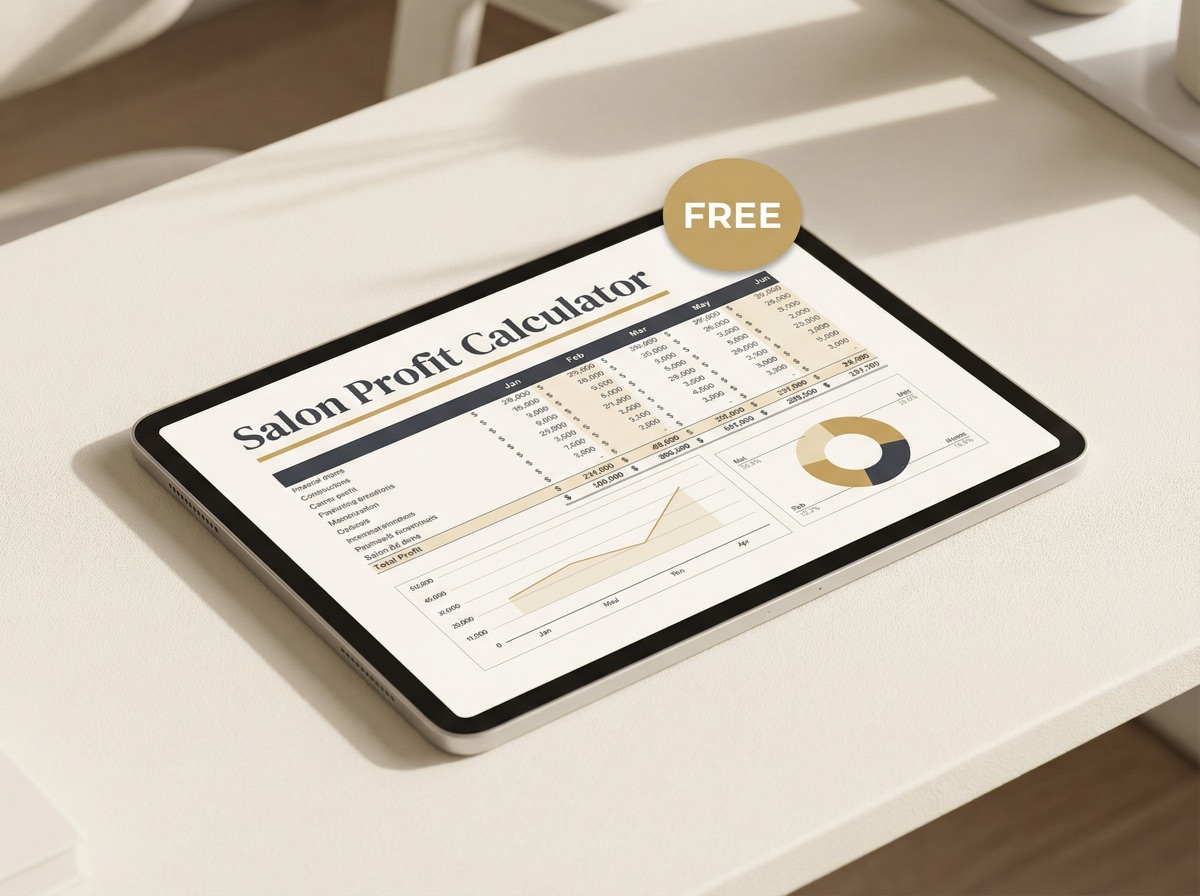
Written by Scott Farmer
Licensed Master Cosmetologist (GA & FL), former Toni & Guy Artistic Director, and founder of Hair Salon Pro. 30+ years behind the chair. 15,000+ clients. Building the business tools cosmetology school never taught. Currently behind the chair at scottfsalon.com in Venice, FL.