How to Become a Six Figure Hairstylist (The Real Math No One Shows You)
 Scott Farmer
·
April 22, 2026
·
12 min read
Scott Farmer
·
April 22, 2026
·
12 min read
Quick Answer: How do you become a six-figure hairstylist?
$100,000 a year works out to $1,924 per week in chair production, more than three times the $31,780 median. At 20 clients a week, your average ticket needs to reach about $96, which is $20 to $40 more than most stylists charge. Fix your pricing first, build rebooking to 80 percent or higher, and stack add-on services that raise the ticket without adding hours.
Last updated: May 2026. Additionally, refreshed with question-based section headers, updated calls to action, and a current Venice salon ticket reference inside the math.
TL;DR

- The BLS (SOC 39-5012) reports the median hairdresser salary at $31,780. Six figures requires $1,924 per week in chair production, more than 3x the median.
- At 20 clients per week, your average ticket needs to reach $96. Most stylists I work with are $20 to $40 per service short of that target.
- Fix pricing first, build retention to 80%+ rebooking, and stack add-on services that raise your ticket without adding hours.
- I’m Scott Farmer, Licensed Master Cosmetologist, 30+ years behind the chair, 15,000+ clients. I’ll break down the exact math from my own salon and my current independent studio in Venice, FL (where my haircuts are $75 and balayage is $265).
- Run your real numbers in the Salon Profit Calculator, or grab the Salon Owner Starter Pack for $17 if you want my budget template, pricing guide, and price-increase scripts in one bundle.
Most hairstylists are told they can make six figures. However, very few learn how to become a six figure hairstylist with the real math behind it.
The Bureau of Labor Statistics puts the median hairdresser salary at $31,780 a year. As a result, that is the number you are working against. Six figures is more than three times that. So before you decide whether $100K is realistic or fantasy, you need to see the actual numbers behind it.
I’m Scott Farmer, Licensed Master Cosmetologist
I’m Scott Farmer, Licensed Master Cosmetologist. In practice, i’ve been behind the chair for over 30 years. More than 15,000 clients. I know what six figures looks like from the inside, and I know exactly what stops most stylists from getting there. This post breaks down how to become a six figure hairstylist, week by week, client by client.
What does six-figure hairstylist math actually look like?
$100,000 a year sounds big. That said, break it down and it becomes a very specific weekly target.
$100,000 divided by 52 weeks = $1,924 per week.
That is your number. For example, not some abstract goal. A weekly production target.
Now let’s work backwards from there.
The six-figure math table
| Clients per week | Avg ticket needed | Annual revenue |
|---|---|---|
| 15 | $128 | $99,840 |
| 20 | $96 | $99,840 |
| 25 | $77 | $100,100 |
| 30 | $64 | $99,840 |
| 35 | $55 | $100,100 |
| 40 | $48 | $99,840 |
Most stylists I’ve worked with run 20 to 30 clients a week. If you’re at 20 clients, you need a $96 average ticket. If you’re at 30, you need $64. In fact, neither of those is out of reach, but neither happens by accident.
For context, my own Venice salon ticket sits at $75 for a haircut and $265 for balayage. Overall, a single full balayage day, three clients deep, hits $795 in production. That’s where the math stops being abstract.
Your hourly rate math looks like this: if you work 8 hours a day, 5 days a week, that’s 2,080 hours a year. To earn $100K, you need to average $48.08 per hour in revenue. On service-only income, that means no gaps in your book, no free consultations eating your day, and no underpriced color jobs running two hours at $85.
Why isn’t the BLS median ($31,780) your real ceiling?
The median hairdresser salary is dragged down by part-timers, newer stylists, and booth renters who haven’t figured out pricing yet. Ultimately, it’s a useful benchmark to beat, not a blueprint to follow.
The stylists pulling six figures are doing a few specific things differently. Instead, they’re not working harder. Additionally, ’re not in bigger cities. They’re not born with some special skill. They’ve solved the math problem.
Here’s what the math problem actually is: most stylists price based on what they think clients will pay, not what their chair needs to produce. Of course, that’s backwards. Your pricing needs to start with your target weekly revenue and work backwards to a minimum average ticket.
Use the Salon Profit Calculator to run your own numbers. Even so, plug in your current client volume and see exactly what ticket size you need to hit your income goal.
How do you actually become a six-figure hairstylist? 5 moves that work.
Two leverage moves I wish I had built sooner: a salon referral program that fills your chair for free, and passive income streams that keep paying when you are not behind the chair. Still, both compound the math above.
1. Fix your pricing before you add more clients
Adding clients to a broken pricing model just burns you out faster. If your average ticket is $55 and you need it to be $96, taking on 10 more clients a week at $55 gets you nowhere except exhausted.
Start with a pricing audit. Beyond that, pull your last 30 services. Calculate your actual average ticket. Compare it to the number you need from the table above. The gap between those two numbers is the problem you’re solving.
Most stylists need to raise prices by $20 to $40 per service. To be clear, that’s not a luxury. It’s math. Check out how to price salon services for maximum profit for the full framework.
2. Build retention, not just a big book
A stylist with 50 clients who come back every 8 weeks earns less than a stylist with 30 clients who come back every 5 weeks. Meanwhile, retention is what turns a big book into a profitable book.
The six figure stylists I know personally track rebooking rate. Not a rough guess. In contrast, the actual percentage of clients who rebook before they leave the chair. If your rebooking rate is below 70%, you have a retention problem, not a client acquisition problem.
Target: rebook 80% or more of every client before they walk out.
3. Increase average ticket without adding time
This is the move most stylists leave on the table. With that in mind, three specific tactics:
Add-on services. Furthermore, a gloss treatment, a deep condition, a scalp treatment. These take 5 to 10 minutes and add $25 to $50 per appointment. At 20 clients a week, that’s $500 to $1,000 in additional weekly revenue without a single new client.
Retail commission. If you’re not recommending retail at every appointment, you’re leaving money on the floor. In other words, a stylist doing 20 clients a week who sells one retail product per client at a $15 average commission is adding $15,600 a year.
Service menu optimization. At the same time, cut the low-margin services that eat your hours. A full highlight taking 3 hours at $150 produces $50/hour. A balayage at $265 (my Venice price) taking the same time produces $88/hour. Same client, 76% more income per hour worked.
4. Decide: commission, booth rental, or suite?
Your business structure determines your ceiling. Notably, this is a conversation worth having before you grind another year.
At commission (45-50%), a $1,924 weekly production week puts $865 to $962 in your pocket. Importantly, to net $100K, you need to produce $200K to $222K. That’s a real number for a high-volume stylist but it requires a fully booked 40+ client week at a solid ticket.
At booth rental, you pay a flat fee (typically $200 to $600/week) and keep the rest. Additionally, a $1,924 week minus $400 rent leaves $1,524, netting you about $79K. You need to produce roughly $2,300 to $2,500 per week to hit $100K net on booth rental.
Suite ownership changes the math again. However, higher overhead but you control every variable: pricing, retail, hours, team additions. It’s the path most six figure stylists eventually take.
The booth rental vs commission breakdown for 2026 runs through each model with real numbers. As a result, read it before you make any structural decision.
5. Know your profit margin, not just your revenue
Revenue is vanity. In practice, profit is what pays your mortgage.
A stylist pulling $120K gross behind the chair can easily net $55K to $65K after product costs, booth rent, education, insurance, and tools. That said, that’s not six figures. A stylist pulling $95K gross with lean overhead and tight product costs can net $78K to $85K. The gross number matters less than you think.
This is where most “six figure hairstylist” content fails. For example, they tell you to hit the revenue number. They skip the hair salon profit margin math entirely. Know both.
What mistakes keep stylists stuck below $60K?
The six-figure path is real, but only if the business does not eat you. If you are already running on fumes, read how I recovered from owner burnout before you push for higher numbers.
These aren’t abstract. In fact, i watched them slow down stylists I trained and worked alongside for years.
Pricing based on the neighborhood, not the numbers. Overall, what other stylists charge in your zip code has nothing to do with what your chair needs to produce. Charge what your math requires.
Keeping clients who undervalue you. Because of this, a full book of clients who argue about prices, skip product purchases, and rebook on their schedule is not a successful business. It’s a trap. The goal is not a full book. The goal is a full book of the right clients.
Skipping retail. Ultimately, i’ve seen stylists roll their eyes at retail conversations. Those same stylists wonder why they can’t hit $80K. Retail is not optional at six figures.
Not knowing their numbers. This is the big one. Instead, most stylists I’ve spoken with cannot tell me their average ticket, rebooking rate, or monthly product cost percentage off the top of their head. The Professional Beauty Association tracks industry benchmarks, and top earners consistently separate themselves on these same variables. You cannot fix what you cannot measure.
Six-figure hairstylist vs. six-figure salon owner: what’s the difference?
There’s a difference worth naming.
A six figure hairstylist earns $100K from their own chair production. Of course, a six figure salon owner may earn significantly more from a combination of personal production, team revenue, and retail. The math is different. The path is different.
During my years training stylists, including my time as an Artistic Director with Toni and Guy, the biggest income gap I saw was always the same: stylists who understood the business side of the chair versus those who just focused on the craft. Both mattered. But business knowledge was the multiplier.
If you want to scale past what one chair can produce, the first move is to actually see your numbers. Even so, most stylists running a “six-figure” book have never run their personal P&L. Run yours through the Salon Profit Calculator before you decide whether your next move is a price increase, a retention play, or a structural shift to a suite.
Frequently asked questions
How much does the average hairstylist make per year?
The Bureau of Labor Statistics reports the median annual wage for hairdressers, hairstylists, and cosmetologists at $31,780 as of 2024. Still, that median includes part-timers, entry-level stylists, and anyone not actively managing their pricing or retention. Six figures is achievable, but it requires treating your chair like a business, not just a job.
How many clients do you need to make six figures as a hairstylist?
At an average ticket of $96, you need 20 clients per week. Beyond that, at an average ticket of $64, you need 30 clients per week. The number of clients is less important than the combination of volume and average ticket. Use the math table above to find your specific target based on your current book size.
Is it realistic to make $100,000 as a hairstylist?
Yes. It requires solving three variables: average ticket, client volume, and rebooking rate. To be clear, none of those is out of reach for a working stylist with a full book. The gap between median income and six figures is not talent. It is usually pricing and retention.
Does booth rental or commission make it easier to hit six figures?
Booth rental gives you more control over your income, but it also puts full overhead responsibility on you. Meanwhile, commission reduces your take-home percentage but eliminates many business costs. Whether one is “easier” depends on your volume, market, and overhead. Run the numbers for your situation before deciding. The booth rental vs commission comparison covers this in detail.
What is the fastest way to increase your income as a hairstylist?
Raise your prices. In contrast, not across the board overnight, but strategically, starting with your newest clients and rolling it forward. If your average ticket is $20 to $40 below what the math requires, that single change, combined with a consistent rebooking conversation, is the fastest path to a meaningful income increase. Adding add-on services is the second fastest lever, since it works on your existing book with no new client acquisition needed.
How do I know if my salon business is profitable enough to hit six figures?
Start by knowing your actual average ticket, product cost as a percentage of revenue, and weekly net after all deductions. With that in mind, most stylists discover one of three problems: their ticket is too low, their product costs are too high, or their rebooking rate is leaking 15 to 30% of potential revenue. Run the Salon Profit Calculator for free and you’ll usually find the bottleneck inside five minutes.
Your next move
Six figures is not a fantasy. It’s arithmetic. The stylists who hit it are not more talented than you. They just solved the math problem earlier.
If you want to see exactly where your chair stands right now, start with the Salon Profit Calculator. It takes five minutes and shows you your real weekly target, your current gap, and what you need to change to close it.
If you want the toolkit too, the
If you want the toolkit too, the Salon Owner Starter Pack is $17 and includes my budget template, pricing guide, and the exact price-increase scripts I use with my own Venice clients. Most stylists who run their numbers and apply one pricing change find their first extra $1,000 inside 30 days.
The math works. You just have to run it.
Double Your Chair Income, Without Working More Hours
Six figures behind the chair is real. When you run your numbers, I teach the exact Profit-First System that gets you there without burning out.
Run the Free Salon Profit Calculator
Free. Available now. No registration required.
Put Your Numbers to Work
The fastest way to find your hidden revenue is to run your numbers. The free salon profit calculator takes 5 minutes and shows you exactly where the gap is.
free salon profit calculator →Free Download
Get the Salon Profit Calculator
See exactly where your salon is losing money — in under 5 minutes.
Download Free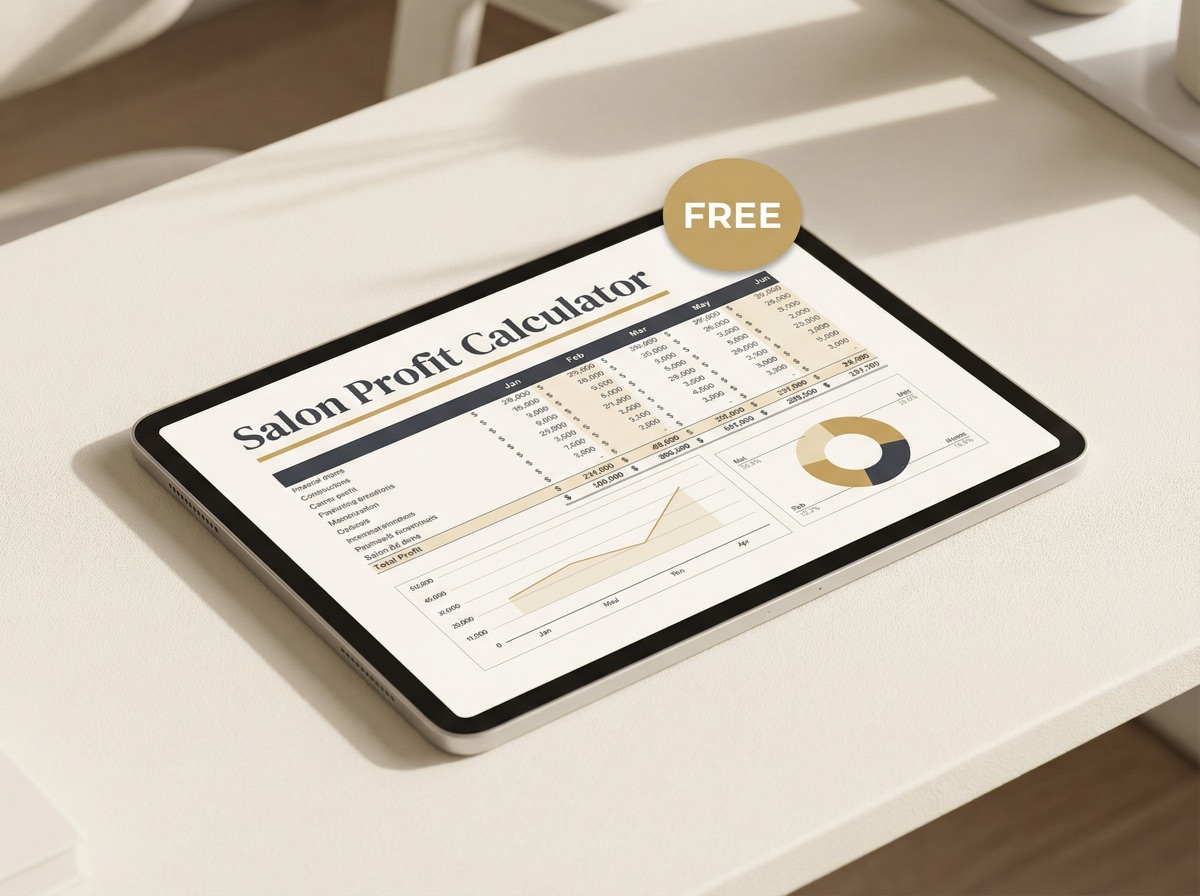
Written by Scott Farmer
Licensed Master Cosmetologist (GA & FL), former Toni & Guy Artistic Director, and founder of Hair Salon Pro. 30+ years behind the chair. 15,000+ clients. Building the business tools cosmetology school never taught. Currently behind the chair at scottfsalon.com in Venice, FL.