Salon Retail Sales Strategy: How to Add $1,000+/Month Without Being Pushy
 Scott Farmer
·
April 22, 2026
·
15 min read
Scott Farmer
·
April 22, 2026
·
15 min read
TL;DR

- Salon retail benchmark: A 10-15% retail-to-service ratio is the target I hold my own salons to. Most independent salons I see run at 3-5%, leaving thousands in annual profit on the table.
- The margin math: Professional salon products carry roughly 45% margin. At $889/month in retail sales, a booth renter covers $400/month in rent from product profit alone. No extra chair time required.
- System, not talent: Three consultation questions during the service, one product recommendation per client, and a monthly five-question tracking review. Scott Farmer, Licensed Master Cosmetologist with 30+ years behind the chair, 15,000+ clients, and founder of Hair Salon Pro, built this system at JScott Salon and his current Venice, FL independent practice.
- Run your numbers: Use the free Salon Profit Calculator to see your retail gap, or check out HSP Pro for a full pricing and margin action plan.
It was January. Slow season. The kind of month where you look at the appointment book and feel a knot in your stomach.
Scott Farmer grabbed a whiteboard marker and wrote out a challenge for his team. A retail contest. One month. Whoever sold the most product won. No big prize. No corporate rollout. Just a friendly competition between people who cared about their work.
“Everyone loved it,” Scott says. “It certainly helped the salon bottom line.”
That contest wasn’t a gimmick. It was a salon retail sales strategy. And a strategy is the difference between retail that sits on a shelf and retail that covers your bills.
A strong salon retail sales strategy turns your product wall from dead inventory into $1,000 or more in extra monthly income. If you are a booth renter paying $400 a month in rent, your product shelf can offset every dollar of it. If you run a team, retail can change your entire bottom line during the slowest months of the year. But only if you treat it like a serious part of your business, not an afterthought.
Here is how to build that system.
Table of Contents
- Why Retail Is Your Best-Kept Revenue Secret
- The Mindset That Changes Everything
- The Biggest Retail Mistake Most Stylists Make
- The Booth Renter Math: How Your Salon Retail Sales Strategy Covers Rent
- The Consultation-to-Retail System
- The Prescribe, Don’t Pitch Script
- How to Run a Retail Contest That Actually Works
- Retail Display That Sells Without You Saying Anything
- Tracking Retail Performance
- Real Numbers: What $1,000/Month in Retail Looks Like
- FAQ
Why Retail Is Your Best-Kept Revenue Secret
The target I hold my own salon to is 10-15% of total service revenue coming from retail. If your salon does $10,000 a month in services, that is $1,000 to $1,500 in retail.
Most salons are sitting at 3-5%.
That gap is money sitting on a shelf gathering dust.
Pull your numbers from last month. Divide your retail revenue by your total service revenue. That percentage tells you exactly where you stand.
- Under 5%: You are leaving real money behind every single week.
- 5-10%: You are in the middle. Significant room to grow.
- 10-15%: Industry standard for a healthy retail program.
- 15%+: You are running a tight, intentional retail operation.
Scott’s Venice salon consistently runs at 12-14%. That does not happen by accident. It happens because retail is treated as a revenue stream, not a side note.
For the full picture of how retail fits your overall income, run your numbers through the Salon Profit Calculator.
The Mindset That Changes Everything
Here is the line that reframes everything.
A stylist once told Scott she felt pushy when recommending products. His response was immediate.
“I would say you don’t really care about your work then.”
That might sting. It is supposed to.
Think about what actually happens when you stay quiet at the end of an appointment. You just spent 90 minutes doing a perfect balayage. You built something. Your client’s hair looks incredible sitting in your chair under salon lighting. Then she leaves and goes home to a drugstore shampoo that strips color, a conditioner that weighs fine hair down, and no idea how to recreate what you just did.
Six weeks later she comes back and her hair looks rough. She wonders if the color is fading fast. It is. Because no one told her what to use.
You are not protecting the relationship by staying quiet. You are abandoning your own work.
The product recommendation is not a sales pitch. It is the final step of the service. A doctor does not apologize for prescribing medication after a diagnosis. They examined you, they know what you need, and they tell you. Clearly.
You know your clients’ hair. You know their scalp is dry in winter. You know the box color they used at home is killing their shine. You know their ends are porous from lightening. That knowledge is the prescription. The product is the treatment.
Recommending sounds like this: “Your ends were really porous when I sectioned your hair today. I used this bonding treatment during your color to help seal the cuticle. I want you to use this at home between appointments so we keep the integrity we built. It is $28.”
That is not a sales attempt. That is a care plan. Clients say yes to care plans.
The Biggest Retail Mistake Most Stylists Make
Scott has spent his career in salons. He has seen every retail mistake in the book.
The one that kills retail programs more than anything else is not bad displays or weak scripts or missing a close.
It is not believing in the products you carry.
“Not believing in the company or products you carry,” Scott says, when asked about the worst retail mistake he has seen.
If you are stocking a line because a rep sold you on the margin and you have never personally used it on your own hair, your clients will feel it. Not because they are mind readers. Because your body language changes. Your voice loses conviction. You gesture at the shelf instead of holding the bottle. You say “it might help” instead of “this is what I use.”
The fix is simple: only carry products you would use yourself.
That is Scott’s standard. Three professional lines maximum in his salon. Every team member can speak to every product fluently because there are not 40 SKUs to memorize and half of them are things nobody actually believes in.
Run a report on your retail sales from the last six months. You will almost certainly find that 20% of your products account for 80% of your revenue. Those are your core products. Everything else is clutter.
Pull anything that has not sold in 60 days. It is taking up shelf space and training your brain to ignore the shelf. Stock only what you can speak about with genuine conviction.
When you love what you are selling, you do not feel like a salesperson. You feel like you are doing your job.
The Booth Renter Math: How Your Salon Retail Sales Strategy Covers Rent
Here is where this gets concrete.
Most booth renters pay somewhere between $300 and $600 a week in rent. Let us use $400 a month as our baseline (some markets are weekly, so adjust for yours).
Professional retail products carry roughly a 45% margin. That means if you sell a $40 shampoo, you keep about $18 after cost of goods.
To cover $400 in monthly rent through retail alone, you need to sell $889 in product per month.
At $35 average per retail transaction, that is 26 products. Over four weeks, that is about 6 or 7 products per week. If you see 30 clients a week, you need to make a product recommendation to fewer than 1 in 4 clients and have them say yes.
Suddenly it feels achievable.
Here is the margin math laid out clearly:
| Retail Sales/Month | Avg Margin | Monthly Profit |
|---|---|---|
| $500 | 45% | $225 |
| $889 | 45% | $400 |
| $1,000 | 45% | $450 |
| $2,000 | 45% | $900 |
| $3,000 | 45% | $1,350 |
Retail profit is pure margin income. No extra chair time. No extra physical labor. You make the recommendation once during the service. That is it.
And the professional line versus drugstore conversation? Here is the honest answer when a client says they can get it cheaper at Target:
“You can. But professional shampoos are typically two to three times more concentrated, so you use less each wash. And drugstore brands often use sulfates that fade your color faster. The $28 bottle here costs you less over a year than the $12 one you replace every three weeks.”
That is not a sales tactic. That is the truth. Say it.
For a full look at how booth rental compares to other income models, see salon booth rental vs commission 2026.
The Consultation-to-Retail System
Retail does not happen at the end of the appointment when you are awkwardly pointing at the shelf. It happens during the service, woven into the conversation before the client even thinks about checkout.
Three questions set everything up:
-
“What does your hair routine look like at home?” This tells you what they are using, how often, and what is working or not.
-
“What is your biggest hair frustration right now?” Frizz. Flatness. Breakage. Color fading too fast. They will tell you exactly what to solve.
-
“What products do you currently use?” Specific brands, specific products. Now you know whether to tweak or overhaul.
Three questions. From their answers, the recommendation writes itself.
Introduce the product while you are using it, not at the register.
“I am using this Redken Acidic Bonding Concentrate today because your hair felt porous when I sectioned it. It seals the cuticle and helps your color last longer. I will leave a bottle up front for you.”
Done. You mentioned it naturally. You explained why. You tied it to an outcome they care about. And you took the buying decision off the table by saying you would leave one up front.
At checkout, it is this simple: “I left that Redken bottle up front for you. Did you want to grab it today?”
No pitch. No pressure. They already know what it is and why they need it. You are just confirming.
If they say no, that is fine. “No problem. Just let me know when you’re ready and I’ll set one aside.” You planted the seed. They often come back for it on the next visit.
A strong salon retail sales strategy starts in the consultation chair, not at the register. The register is just where the transaction gets completed.
The Prescribe, Don’t Pitch Script
Scott built this exact script at JScott Salon and has used it with thousands of clients since. It takes about fifteen seconds and it never sounds like a sale, because it is not one.
“Think of it like a prescription, not a pitch,” Scott says. “A doctor does not apologize for writing you a prescription. They examined you, they know what you need, and they tell you clearly. That is what this is.”
The script runs in three steps.
Step 1: The diagnosis moment. During the consultation or the service, name what you see out loud. Dryness. Breakage. Color fading fast. Flat roots. You already notice this. The only change is saying it: “Your ends feel drier than they should for a month out from your last color.”
Step 2: The prescription. Once the client confirms the problem, and she almost always will, hand her the solution in one sentence. “I am using this bonding treatment on you today because your hair felt porous when I sectioned it. It seals the cuticle and helps your color last longer.” You educate her on the why before price ever comes up.
Step 3: The handoff at checkout. Place the product where she can see it, not behind the counter. “I set that treatment aside for you. It is $28 and it will keep the color you love looking this good between visits.” State what it does. State the price. Stop talking.
If she says yes, you just reinforced the trust that turns a one-time client into a repeat one. If she says no, you lose nothing. “No problem. I will set one aside for next time.” That single sentence protects the relationship and keeps the door open for her next visit.
This is the difference between selling and educating. A sales pitch asks the client for something. A prescription gives her something: information she did not have before she sat in your chair. Clients do not resent being educated by someone they trust. They resent being sold to by someone they do not.
Run this script consistently and something happens beyond the retail number. Clients rebook faster, because the products you sent home with them are doing their job between visits. That is the quiet driver behind real client loyalty. Not just great color, but a client who trusts you enough to keep buying what you recommend.
How to Run a Retail Contest That Actually Works
This is the strategy Scott used to lift his salon’s numbers during slow season.
It does not need to be complicated. The ingredients are:
- A one-month window (slow season is the perfect time to run this)
- A simple tracking system, a whiteboard or spreadsheet at the front desk works fine
- Each stylist logs their own retail sales daily
- The person with the most units sold at the end of the month wins
The prize does not have to be expensive. Recognition matters. A gift card. A day off. The feeling of winning.
What the contest does is create energy around something that usually gets ignored. Suddenly retail is part of daily conversation. Stylists start asking each other what they have sold. They start paying attention to what clients are buying and what they are skipping. They get curious about why one product is moving and another is sitting still.
That curiosity is worth more than any training seminar.
For team salons, spiff structures work alongside contests. A standard spiff is $2 to $5 per unit sold, or 10-15% of the retail ticket. On a $40 shampoo, a $4 spiff is real money. A stylist doing 30 clients a week who closes 10 retail sales per week adds $160 a month to their take-home. That changes behavior.
Keep the tracking simple. A shared spreadsheet works. Pay it out monthly. Make it visible.
The weekly check-in takes five minutes. Who sold the most last week? What product moved? What did not? That five-minute conversation creates accountability without drama. The stylist who sold eight units last week feels proud. The stylist who sold zero notices the gap. Peer comparison does the motivating for you.
Retail Display That Sells Without You Saying Anything
Your display does selling work all day. Most salon retail displays waste that opportunity.
Eye level is buy level. Your highest-margin, most-recommended products go at eye level for a standing adult, roughly 55-65 inches from the floor. Heavier or bulky items go lower. Impulse purchases and travel sizes go near the register at counter height.
Reorganize your display this week. Put your top three products at eye level. Notice what happens.
Monthly Feature Product
Pick one product every month and feature it. Give it a small sign. Put it at the register. Mention it to every client that month. Feature what you love using.
Scott’s salon does a stylist pick of the month. The selected stylist writes a short note about why they love the product. It looks personal because it is personal. Clients respond to that.
Price tags should be visible without picking up the bottle. Clients will not ask how much something costs if they feel embarrassed by the answer. Remove that barrier. Tag everything clearly.
A smart retail display is part of your average ticket strategy. When clients see what they’ve used during the service displayed clearly at eye level, the decision to buy is already half made.
Tracking Retail Performance
Two numbers tell you almost everything.
Retail per client: Total retail revenue divided by number of clients served. If you served 80 clients and did $960 in retail, your retail per client is $12. Target $15 to $25 depending on your market.
Retail-to-service ratio: Total retail revenue divided by total service revenue. Target 10-15%.
Pull these monthly. If retail per client is climbing but the ratio is flat, your services are growing too. If both are flat, you have a system or motivation problem to solve.
On the last day of every month, run this five-question review:
- What was my retail total for the month?
- What is my retail-to-service ratio?
- What were my top three products?
- What products did not sell?
- What is one thing I will change next month?
That is ten minutes. Write the answers down. Patterns emerge over three to four months that tell you exactly where to focus. This is how your salon retail sales strategy improves itself month after month.
In most independent salons I have looked at, retail barely registers on the P&L even though the margin on it is the best in the business. That gap is exactly where your salon retail sales strategy can outperform the average.
Real Numbers: What $1,000/Month in Retail Looks Like
This is not a fantasy number.
| Clients/Week | Retail Recommendation Rate | Average Retail Ticket | Monthly Retail |
|---|---|---|---|
| 20 clients | 30% (6 clients buy) | $35 | $840 |
| 20 clients | 40% (8 clients buy) | $35 | $1,120 |
| 30 clients | 25% (7-8 clients buy) | $35 | $1,050 |
| 40 clients | 20% (8 clients buy) | $35 | $1,120 |
At 20 clients a week, you need 8 people per week to say yes to a $35 recommendation. That is 40% of your clients. Frame it this way: every other client gets one recommendation and half say yes.
The math works at every volume level. The system is what makes it consistent.
Frequently Asked Questions
How do I bring up retail without making it awkward?
The awkwardness comes from introducing it cold at checkout. Mention the product during the service while you are using it and tie it to what you are doing at that moment. It is not a sales pitch. It is you explaining your work. That feels natural to everyone.
What if my clients say they cannot afford it?
Thank them and leave the door open. “Totally understand. Whenever you are ready, just let me know and I’ll set one aside.” No pressure. Some clients come back for it on the next visit. Some do not. Your job is to make the recommendation clearly once. The rest is their choice.
How do I know which products to stock?
Stock what you would use on your own hair. That is the test. If you would not personally use it, do not carry it. Your conviction, or lack of it, comes through every single time.
How many products should I recommend per client?
One, maybe two. Solve the problem they told you about in your consultation questions. More than two recommendations starts to feel like a shopping list and overwhelms them into buying nothing.
What if I am a booth renter and the salon owner does not support retail?
Show them the math. At a 45% margin, $889 in monthly retail sales generates $400 in pure profit. That pays rent. A salon owner who sees that number appear from a simple system will not stand in the way of it.
How does retail fit with a salon membership program?
They work together. Members who come in regularly already trust your recommendations. A salon membership program that includes a member discount on retail gives committed clients a reason to buy from you instead of going to Amazon. Combine both for the strongest possible retention and revenue mix.
Ready to see how retail fits into your complete income picture? Run your numbers through the free Salon Profit Calculator. Plug in your clients, your services, and your retail, and see what an extra $1,000 a month actually does to your take-home.
Found this useful? Tell Google you want to see more from Hair Salon Pro in your search results and AI answers.
Free Download
Get the Salon Profit Calculator
See exactly where your salon is losing money in under 5 minutes.
Download Free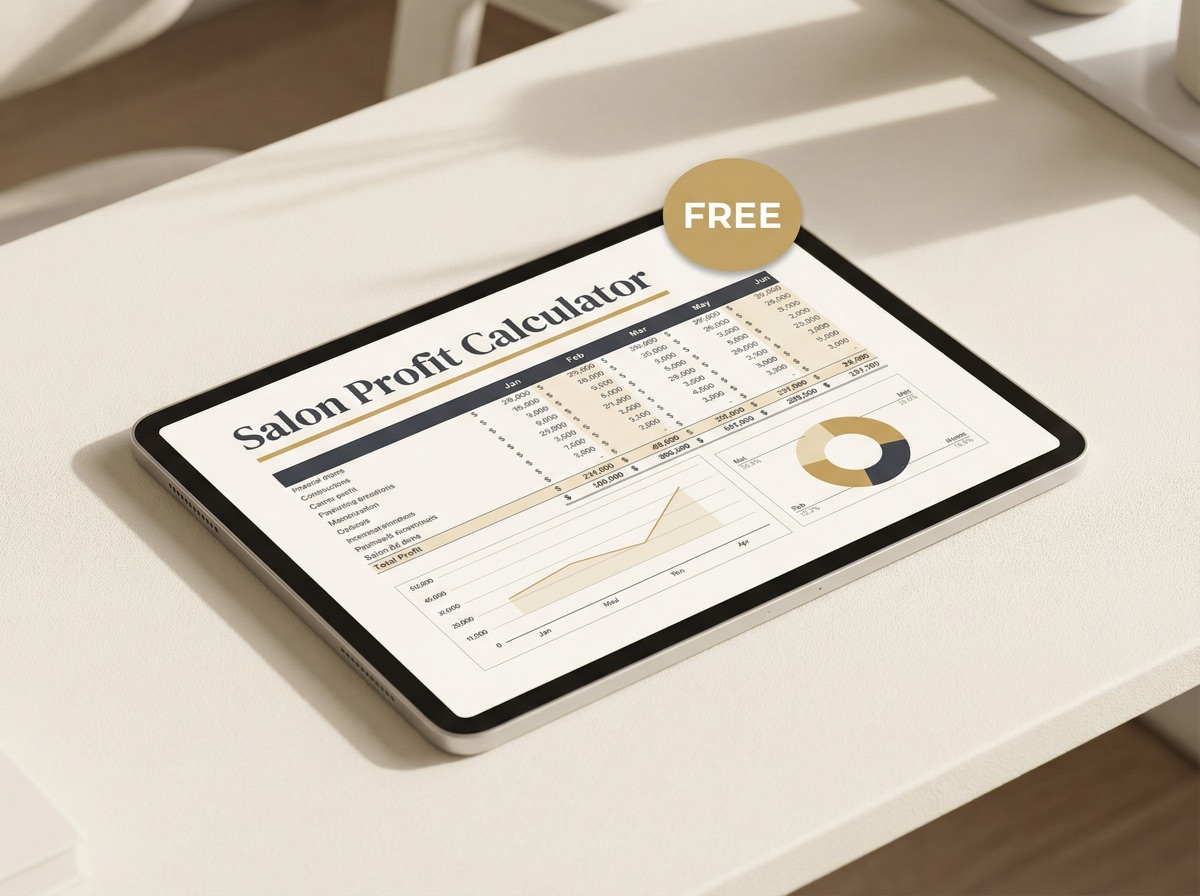
Written by Scott Farmer
Licensed Master Cosmetologist (GA & FL), former Toni & Guy Artistic Director, and founder of Hair Salon Pro. 30+ years behind the chair. 15,000+ clients. Building the business tools cosmetology school never taught. Currently behind the chair at scottfsalon.com in Venice, FL.