How to Raise Salon Prices With Existing Clients (Without Losing Your Best Regulars)
 Scott Farmer
·
July 3, 2026
·
13 min read
Scott Farmer
·
July 3, 2026
·
13 min read
TL;DR

Raising prices with existing clients is harder than setting them for new ones. Your regulars remember exactly what they used to pay, and the fear of losing them keeps most stylists stuck at old rates for years. The fix: calculate your real per-service cost first using our free salon profit calculator, announce the increase 30 days before it takes effect, use scripts that focus on the value they already receive, and stop apologizing. I have raised my prices multiple times over 30 years. Every time, I kept 90% or more of my clients. The ones who left were price-shoppers I should have released sooner. Download the free Price Increase Script Pack for word-for-word scripts you can use this week.
Last updated: July 2026
New clients never question your prices. They check your menu, decide you are worth it, and book.
Existing clients are different. They remember. Your $55 cut is baked into their monthly budget. When you raise it to $70, they feel the change. Some of them will tell you about it, right there in your chair.
That is why most stylists avoid the conversation entirely. Not because the math is wrong. Because the relationship makes it personal.
I get it. When I ran JScott Salon, I spent years keeping longtime clients at old prices because I told myself they were loyal and I owed them. The truth? I was training them to expect a discount while my product costs, rent, and insurance climbed every single year.
When I finally raised my prices, here is what happened: almost nothing. The clients who valued my work stayed. The ones who left were already booking last-minute, canceling regularly, and tipping poorly. They were never loyal to me. They were loyal to my price.
If you have not raised your prices for existing clients in the last 12 months, this guide is for you. Not the theory. The exact words, the timing, and the math.
Why Do Existing Clients React Differently to Price Increases Than New Clients?
New clients evaluate your prices in a vacuum. They look at your work, read reviews, check your menu, and decide. There is no comparison point.
Existing clients have an anchor. They paid $55 last time. They paid $55 the time before that. The number is wired into their expectation. When it changes, even by $10, their brain registers loss before logic kicks in.
This is not a flaw in your client. It is how every human processes price changes. Behavioral economists call it “loss aversion.” People feel the pain of losing $10 roughly twice as strongly as the pleasure of gaining $10.
The good news: this reaction is temporary. Research from the Bureau of Labor Statistics shows consumer prices rose over 22% between 2020 and 2026. Your clients are paying more for groceries, gas, and coffee. They expect prices to go up. They just need you to handle the conversation with confidence instead of guilt.
The mistake most stylists make is treating the price increase as bad news. It is not bad news. It is your business keeping pace with reality. Your clients already accept this from every other business they interact with.
How Much Are You Losing by Keeping Regulars at Old Prices?
Run the numbers. Most stylists are shocked.
Say you have 30 regular clients who come every 6 weeks. You charge $65 for their color and cut. The service takes 2 hours including processing time.
Your real hourly rate: $32.50 before product cost.
After color product ($12 average), disposables ($3), and your chair cost per hour, you are keeping maybe $15 to $18 an hour from that service. In a city where a decent barista makes $18 plus tips.
Now multiply: 30 regulars at $65 instead of $80 (where your pricing should be) means you are leaving $450 on the table every 6 weeks. That is $3,900 a year from just those 30 clients.
Our salon profit calculator breaks this down by service. Most stylists who run it discover they are undercharging existing clients by $10 to $25 per visit. On a full book, that gap adds up to $4,000 to $12,000 a year in revenue you earned but never collected.
You are not asking for charity. You are asking for fair payment for skilled work. The Professional Beauty Association reports that salon operating costs have risen steadily year over year. A $15 increase on a $65 service is $7.50 an hour. Your client spends more than that on their morning coffee run.
What Should You Say When a Loyal Client Asks Why Prices Went Up?
Most stylists prepare for the worst version of this conversation and never get it. But when it does come up, here is what works.
Script 1: The direct explanation
“I review my pricing every year to make sure I can keep investing in the best products and education for my clients. My costs have gone up across the board, and I adjusted my prices to reflect the quality of service you are used to getting.”
That is it. No apology. No discount offer. No justification essay.
Script 2: The value reframe (for the client who pushes back)
“I understand. I want to be transparent with you. The products I use on your hair cost 40% more than they did two years ago. I could switch to cheaper products, but your results would suffer. I would rather keep your color looking exactly this good and adjust my prices to match.”
Script 3: The longtime-client acknowledgment
“You have been coming to me for years, and I appreciate that more than you know. I want to keep providing the same level of service you expect, and that means my pricing needs to keep up with my costs. I hope you understand.”
Notice what these scripts do NOT include:
- No apology
- No “I hate to do this”
- No offering a discount to soften the blow
- No blaming the economy, your landlord, or your product company
When I served as an Artistic Director for Toni and Guy, I watched dozens of stylists handle price increases. The ones who apologized and offered exceptions created more pushback, not less. The ones who stated the new price with confidence kept their clients and their dignity.
How Do You Handle the Client Who Says They Cannot Afford It?
This is the conversation stylists dread most. Here is the reality: about 5% of your regulars will genuinely struggle with a price increase. The other 95% can afford it and are testing whether you will fold.
For the 5% who cannot afford it:
You have three options, and all of them are better than keeping your prices frozen.
-
Adjust the service, not the price. “I totally understand budget constraints. What if we do a partial foil instead of a full foil? We can keep your look fresh and bring the price closer to where you are comfortable.”
-
Space the appointments. “What if we stretch your appointments from 6 weeks to 8 weeks? Your color holds well, and it would bring your monthly cost down.”
-
Release with grace. “I understand if my new pricing does not work for your budget right now. I am happy to recommend someone who might be a better fit for where you are.”
Option 3 sounds scary. It is the most profitable move you will make. A client who resents your prices shows up with an attitude, tips poorly, and drains your energy. A client who values your work at your real rate shows up happy and refers friends who also pay full price.
For the 95% who are testing you:
Hold the line. “I appreciate you being honest with me. My new rates are effective [date]. I would love to keep working together.”
Then stop talking. Do not fill the silence with a discount. Most of the time, they will book their next appointment at the new price.
What Is the Right Way to Announce a Price Increase to Existing Clients?
Timing and delivery matter. Here is the system that has worked for me and for every stylist I have coached through it.
Step 1: Set the date 30 to 45 days out.
Pick a date and commit to it. First of the month works best because it feels clean and professional. Do not pick a date and then push it back. Once you announce, it is locked.
Step 2: Update your menu and website first.
Before you tell a single client, make sure your new prices are already on your website, social media, booking platform, and printed menu. New clients should start seeing the new prices immediately. This also prevents the awkward moment where a regular checks your site and sees the old price after you told them it went up.
Step 3: Tell clients in person during their appointment.
This is the most effective method. You have 45 minutes to 3 hours of face time with your client. You just gave them a result they love. The goodwill is at its peak.
Say it while they are looking at their finished hair in the mirror: “Just so you know, my prices are updating on [date]. Your [service] will be [new price] starting then. I wanted to let you know in person rather than just changing it online.”
Step 4: Follow up with a simple email or text.
For clients you will not see before the effective date, send a brief message. Not a novel. Not a formal letter. Just a few sentences.
“Hi [Name], I wanted to give you a heads-up that my pricing is updating on [date]. Your [service] will be [new price]. I appreciate your trust in me and look forward to seeing you at your next appointment.”
Step 5: Do not negotiate exceptions.
The moment you give one client a “loyalty discount,” you have created a two-tier pricing system that will haunt you. Other clients will find out. You will resent the discounted ones. And you will have trained your best clients that your prices are negotiable.
If you want word-for-word scripts for every step of this process, download the free Price Increase Script Pack. It covers the in-person conversation, the email template, and the pushback responses.
How Many Clients Will You Lose When You Raise Prices?
Less than you think. Here is what the data shows.
In my experience over 30 years and thousands of pricing conversations, a well-handled price increase loses 3% to 8% of clients. Not 20%. Not 30%. Single digits.
And the clients you lose are predictable. They are the chronic last-minute cancelers, the ones who tip $3 on a $200 service, and the ones who always ask “can you just do a quick trim” when they booked a full cut.
Here is the math that should make you feel better:
Say you lose 5 clients out of 100 after a $15 price increase.
- Revenue lost: 5 clients x $65 x 8 visits per year = $2,600
- Revenue gained: 95 clients x $15 increase x 8 visits per year = $11,400
- Net gain: $8,800 per year
You make $8,800 more while working fewer hours. Those 5 empty slots? They fill with new clients who never saw your old price and do not blink at $80.
Every stylist I have worked with who raised prices and lost a few regulars told me the same thing within 60 days: “I wish I had done this sooner.”
If you want to see the exact impact on your bottom line, plug your numbers into the free salon profit calculator. It shows your per-service cost, your real hourly rate, and exactly how much a price increase adds to your annual income.
What Are the Biggest Mistakes When Raising Prices on Existing Clients?
I have made some of these myself. Learn from my experience so you do not repeat them.
Mistake 1: Raising prices without knowing your numbers
If you cannot explain exactly what your chair costs you per hour, you are guessing. And guessing leads to timid increases that do not fix the problem.
Your salon profit margin should be at least 15% after all expenses. If it is under 10%, you are not running a business. You are subsidizing your clients’ lifestyles with your time.
Calculate your cost per service before you set new prices. Include product, chair cost, processing time, and your target hourly rate. This gives you a number you can defend with confidence.
Mistake 2: Apologizing during the announcement
“I am sorry, but I have to raise my prices” tells your client that you believe you are doing something wrong. You are not. You are running a professional business.
Replace “I am sorry” with “I wanted to let you know.” Replace “I have to” with “I am updating.” The language shift is small. The energy shift is massive.
Mistake 3: Grandfathering longtime clients at old prices
This feels generous. It is a trap. You end up with a two-tier system where your most loyal clients pay the least and your newest clients pay the most. Over time, your regulars become your least profitable clients. You start resenting the people you like most.
If your prices go up, they go up for everyone. Period.
Mistake 4: Making the increase too small to matter
A $3 increase on a $65 service is not worth the conversation. Your client will not notice $3, and you will not feel the difference in your bank account. If the math says you need $15 more per service, raise it $15. One honest increase beats three tiny ones that make you look indecisive.
Mistake 5: Waiting until you are desperate
If you are raising prices because you cannot pay rent this month, you are already behind. The best time to raise prices is when business is good, your chair is full, and you have a waitlist forming. That is when you have leverage and your clients feel the scarcity.
If you want a step-by-step process for raising your salon prices from scratch, start there. If you already know your new prices and just need help with the existing-client conversation, keep reading. And if you want to keep your clients coming back after the increase, start with the math and then use the scripts. The conversation is easier than you think.
What Should You Do This Week to Start the Process?
Do not overthink this. Here is a simple five-step plan you can start today.
-
Run the numbers. Use the salon profit calculator to see your real cost per service and your current hourly rate. Write down the gap between what you charge and what you should charge.
-
Set your new prices. Add enough to cover your costs plus your target margin. Do not round to pretty numbers. $78 feels more calculated (and credible) than $80.
-
Pick an effective date. 30 to 45 days from today. First of the month. Write it down. Tell your accountability partner. It is locked.
-
Download the scripts. Grab the free Price Increase Script Pack so you have word-for-word language for the in-person conversation, the email announcement, and the pushback responses.
-
Start telling clients at their next appointment. In person, while they are looking at their beautiful hair in the mirror. Confident, brief, no apology.
If you want the complete system with email templates, pricing guides, and objection-handling scripts, the Salon Owner Starter Pack has everything for $17. It is the full toolkit I wish I had when I raised my prices for the first time.
Your clients chose you because of your skill, not your price. Trust that. Charge what you are worth. The ones who matter will stay.
Frequently Asked Questions
Should I grandfather loyal clients at old prices?
No. Grandfathering creates a two-tier system where your most loyal clients become your least profitable. Over time, you will resent the people you like most. Your new prices apply to everyone. If a client has been with you for 10 years, they value your work enough to pay what it is worth.
How much notice should I give existing clients before raising prices?
Give 30 to 45 days notice. Anything less feels rushed and disrespectful. Anything more gives clients too much time to shop around. Tell them in person during their appointment when possible. Follow up with a simple email or text for anyone you will not see before the effective date.
Should I raise prices for all clients at once or gradually?
All at once. A single, clean price change on a specific date is easier to communicate and easier to enforce. Gradual increases service by service create confusion for both you and your clients, and they make you look uncertain about your own value.
What if my top client threatens to leave over a price increase?
Hold the line. Respond with: “I understand if my new pricing does not work for your budget right now. I would love to keep working together, but I need my prices to reflect the quality of service I provide.” Most clients who threaten to leave are testing your resolve. The vast majority stay when they realize you are serious and professional about it.
How often should I raise salon prices?
Review your prices every 12 months at minimum. Product costs, rent, insurance, and education expenses increase annually, and your pricing should keep pace. If you are in a market where costs are rising fast, every 6 to 9 months is reasonable. The key is making small, regular adjustments instead of one large jump every 3 to 5 years.
Free Download
Get the Salon Profit Calculator
See exactly where your salon is losing money — in under 5 minutes.
Download Free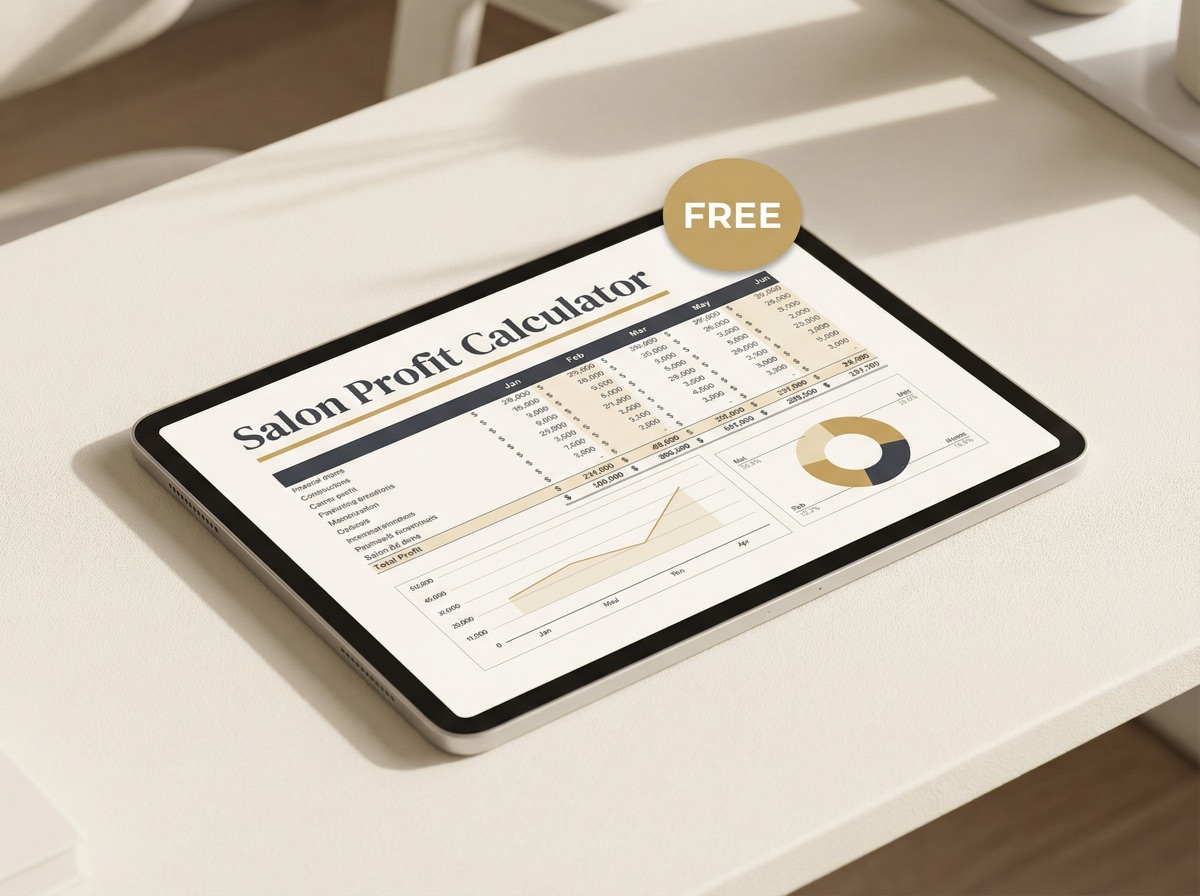
Written by Scott Farmer
Licensed Master Cosmetologist (GA & FL), former Toni & Guy Artistic Director, and founder of Hair Salon Pro. 30+ years behind the chair. 15,000+ clients. Building the business tools cosmetology school never taught. Currently behind the chair at scottfsalon.com in Venice, FL.