How to Sell Retail at Your Salon Without Feeling Pushy
 Scott Farmer
·
June 17, 2026
·
12 min read
Scott Farmer
·
June 17, 2026
·
12 min read
Quick Answer: How do you sell retail at your salon without feeling pushy?
Stop selling and start prescribing. Diagnose a problem during the service, name the specific product that fixes it, and hand it to the client at checkout. The average salon runs retail at 8% to 12% of revenue. At JScott Salon I hit 22%. Retail margins near 50% beat thin service margins.
TL;DR

- Retail can add $500 to $800 per month to your income with zero extra hours. The average salon runs retail at 8% to 12% of total revenue. At JScott Salon, I hit 22% at peak. The difference was not sales talent. It was a system.
- Stop selling. Start prescribing. When you hand a client a product and say “this will fix that,” you are not pitching. You are doing your job. A doctor does not apologize for writing a prescription. Neither should you.
- Retail margins crush service margins. A $24 bottle of shampoo at 50% margin nets you $12. A $300 balayage at 8% margin nets you $24. Half the profit in 3 seconds instead of 90 minutes.
- You need three things: a diagnosis moment, a script, and a checkout system. This article gives you all three, plus a fill-in formula for any product conversation.
- Know your numbers first. Run the free Salon Profit Calculator before you stock a single bottle. If your service margins are already thin, retail is the fastest lever to pull.
Last updated: June 2026
$312
$312.
That is how much extra I pocketed in my first month after I stopped trying to “sell” retail and started prescribing it instead. However, i did not add a single new client. I did not work a single extra hour. I just changed one sentence in how I talked about products at the chair.
I am Scott Farmer, Licensed Master Cosmetologist with 30-plus years behind the chair and more than 15,000 clients served. Additionally, Built and ran JScott Salon, an 18-chair shop in Lawrenceville, Georgia, and I now work from my suite in Venice, Florida. As a result, i have been Redken, Paul Mitchell, and Tigi certified. I know product chemistry because I had to. And I know how to sell retail at a salon because I spent two decades figuring out what works and what makes clients avoid eye contact on the way out.
Here is everything I learned. No slimy tactics. In practice, no memorized scripts that make you sound like a car salesman. Just the system that took my retail from 10% to 22% of total revenue.
Why Does Retail Matter More Than You Think?
Most stylists look at a $24 bottle of shampoo and do not get excited. That said, twenty-four dollars is not life-changing money.
But let me show you the math that changed everything for me.
A typical salon service brings in somewhere between 8% and 15% profit margin after chair cost, product used, and your time. That $300 balayage? For example, you might clear $24 to $45 in actual profit. The Professional Beauty Association reports that the average independent stylist keeps less than 15 cents on every service dollar after all costs.
Now look at retail. In fact, a $24 bottle of professional shampoo costs you about $12 wholesale. That is a 50% margin. You make $12.
The $300 service at 8% margin = $24 profit. Overall, the $24 bottle at 50% margin = $12 profit. Half the profit in 3 seconds instead of 90 minutes.
If you sell just two products per day at an average of $28 each, that is $56 in revenue. Because of this, at 50% margin, that is $28 in daily profit. Over a 5-day work week, $140 in pure profit. Over a month, $600 extra without touching a single extra head.
That is why understanding your salon profit margin matters before you dismiss retail as “not worth it.”
What Is the Real Reason Stylists Hate Selling Retail?
I have trained dozens of stylists on retail. Ultimately, the objection is always the same: “I don’t want to be pushy.”
Here is the truth. Instead, you are not afraid of selling. However, Are afraid of rejection. You are afraid the client will think you only care about money. You are afraid you will sound like every commission-hungry salesperson who ever annoyed you.
I felt the same way. During my time as a Toni and Guy Artistic Director, I watched stylists who crushed it on technical skill freeze up the moment they had to talk about a product. Of course, they could execute a flawless precision cut, but they could not hand someone a bottle of leave-in conditioner.
The shift happened when I stopped thinking about it as selling and started thinking about it as a clinical diagnosis.
How Do You Prescribe Instead of Pitch?
This is the system. Three steps. Even so, takes about 15 seconds total.
Step 1: The Diagnosis Moment
During every service, you notice something about the client’s hair. Dryness. Breakage. Still, color fading faster than it should. Flat roots. Frizz that no amount of blow-drying tames.
You are already thinking it. Beyond that, the only difference is that now you say it out loud.
“Your ends feel drier than they should for a month out from your last trim. To be clear, are you using a sulfate-free shampoo at home?”
That is it. Meanwhile, you identified a problem. You asked a question. You did not mention a product yet.
Step 2: The Prescription
The client says “I use whatever is on sale at Target.” Good. In contrast, now you have permission.
“That is probably what’s stripping your color. With that in mind, i am going to use [specific product] on you today so you can feel the difference. If you like it, I will set one aside for you.”
Three things happened in that sentence:
- You tied the product to her specific problem (color stripping)
- You let her experience it during the service (proof before purchase)
- You removed the pressure (“I’ll set one aside” is not “you should buy this”)
Step 3: The Handoff at Checkout
This is where most stylists lose the sale. Furthermore, they finish the service, the client raves about their hair, and then… silence. The client pays, tips, and leaves.
Instead, before you walk to the register, place the product on the counter in front of the mirror. In other words, not behind the counter. Not on a shelf. Right there.
“I set aside that shampoo. At the same time, your color will hold at least two weeks longer between visits. It is $24.”
You stated what it does. Notably, you stated the price. Done. No “would you like to” or “do you want to.” You handed it to her like a pharmacist hands you a prescription.
The client will either say yes (most do) or politely decline (some will, and that is fine). Importantly, either way, you did not “sell” anything. You prescribed a solution to a problem you both acknowledged.
What Products Should You Stock?
This is where booth renters and suite owners often overthink it.
You do not need 40 SKUs. Additionally, you need 5 to 8 products that solve the most common problems you see behind the chair. Here is the framework I used at JScott Salon.
The Core Retail Shelf (5 products minimum):
- Shampoo that matches your most common client type (color-treated, fine hair, or curly)
- Conditioner to pair with it (always stock in pairs, clients buy sets)
- Leave-in treatment for damage repair or moisture
- Styling product you use during the service (what they see you apply)
- Finishing spray or serum (the last thing they feel before they leave your chair)
Every product on your shelf should pass this test: “Can I explain in one sentence what problem this solves?”
If the answer is no, it does not belong on your shelf. However, your clients do not care about ingredient lists or brand stories. They care about fixing the thing you just pointed out.
Before you invest in inventory, run your service pricing through a calculator to make sure your services are profitable on their own. As a result, retail should add to your profit, not subsidize underpriced cuts.
How Much Retail Revenue Should You Target?
Industry benchmarks from the Bureau of Labor Statistics and salon industry surveys consistently show:
- Below average: Under 8% of total revenue from retail
- Average: 8% to 12%
- Strong: 15% to 20%
- Elite: 20% to 25%
At JScott Salon, we peaked at 22%. In practice, that was 18 chairs, multiple stylists, and a system that every stylist followed. But even a solo booth renter can hit 15% within 90 days using the prescribe method.
Here is how to calculate your retail percentage:
Monthly retail sales / total monthly revenue x 100 = retail percentage
If you brought in $6,000 last month and sold $480 in retail, you are at 8%. That is average. That said, moving to 15% means $900 in retail, which is about $420 more per month. At 50% margin, that is $210 extra profit for zero extra hours.
Use the free Salon Profit Calculator to model what different retail percentages would mean for your actual take-home.
What Kills Retail Sales in Most Salons?
I have seen the same five mistakes kill retail in every salon I have consulted with or worked in.
Mistake 1: Hiding the Products
If your retail shelf is behind the front desk, in a corner, or in a back hallway, clients do not see it. For example, products should be visible from the chair. If the client can see it while you are working on them, you can point to it during the diagnosis moment.
Mistake 2: Stocking Products You Do Not Use
Clients are not stupid. If you use one brand on their hair and sell them a different brand, they notice. In fact, every product on your shelf should be the same product you just put in their hair. The trial happens during the service. That is your demo.
Mistake 3: Waiting Until Checkout
By checkout, the client is already on her phone, thinking about picking up the kids, mentally done. Overall, the prescription happens during the service, not after. Plant the seed at the chair. The checkout is just the handoff.
Mistake 4: Apologizing for the Price
“It is a little more than drugstore, but…” Stop. Because of this, the moment you apologize for the price, you told the client it is overpriced. Just state what it does and what it costs. Period.
If you struggle with pricing conversations, the free Price Increase Script Pack includes language you can adapt for retail conversations too.
Mistake 5: No Tracking
If you do not know what you sold last month, you cannot improve. Ultimately, track three numbers every month:
- Total retail revenue
- Number of retail transactions
- Retail revenue as a percentage of total revenue
That third number is the one that matters.
What Script Works for Every Product?
Here is the fill-in formula. Instead, memorize the structure. Customize the specifics for each client.
“I noticed [specific problem you saw]. Of course, that usually happens because [cause]. I am using [product name] on you today, and you should feel the difference by [specific result]. It is [price], and it will last you about [timeframe].”
Example: “I noticed your color is pulling warm at the ends. Even so, that usually happens because sulfates strip the deposit faster than it should fade naturally. I am using this Redken Color Extend shampoo on you today, and you should notice the tone holds at least two to three weeks longer. It is $24, and it will last you about six to eight weeks.”
That is 15 seconds. No pitch. No pressure. Just information.
How Do Booth Renters Handle Retail Differently?
If you rent a booth or a suite, retail is even more important for you because you carry 100% of your costs. Still, your rent does not drop when you have a slow week. Retail smooths out the revenue dips.
The challenge for booth renters is inventory. Beyond that, you do not want $2,000 of product sitting on a shelf.
The lean retail system for booth renters:
- Start with 5 products, 3 units each = 15 total units
- Wholesale cost per unit: $10 to $14
- Total startup investment: $150 to $210
- Expected sell-through per month: 15 to 25 units (if you prescribe to every client)
- Restock only what sells. Do not guess.
If you are weighing booth rental vs. commission and wondering where retail fits into the math, the salon calculators hub can model both scenarios with retail revenue included.
Also consider this: if you raise your service prices by even 5%, the combined effect of a price increase plus consistent retail can push your monthly income up $700 to $1,000 with no new clients.
Frequently Asked Questions
How much retail revenue should a stylist aim for per month?
Target 15% of your total revenue from retail sales. If you bring in $5,000 per month in services, aim for $750 in retail. To be clear, at 50% margin, that is $375 in extra profit for zero additional hours behind the chair.
Do I need to stock expensive professional brands to make retail work?
No. Stock whichever professional brand you use on clients during their service. Meanwhile, the brand matters less than the fact that you used it on them, they felt the result, and you can explain what it fixes. Mid-range professional products ($18 to $30 per unit) sell consistently because the price point is accessible but still above drugstore.
What if my client says they already buy products online?
Do not compete on price. Compete on diagnosis. Say: “The product itself might be the same, but I picked this specific one for your hair type and your water situation. That is the part Amazon cannot do.” You are selling the recommendation, not the bottle.
How do booth renters get wholesale pricing on products?
Most professional brands require a cosmetology license to open a wholesale account. Contact the brand directly or go through an authorized distributor like SalonCentric, CosmoProf, or Beauty Systems Group. Your license is your access pass. Typical wholesale discount is 40% to 50% off retail price.
Will clients think I am just trying to make more money?
Only if you pitch before you diagnose. When a doctor writes a prescription, you do not think “she is just trying to make money off me.” The same trust dynamic applies when you identify a hair problem, explain the cause, and hand over the solution. Prescription feels different from a sales pitch because it IS different.
What People Ask Next
How do I display retail products in a small booth rental space?
You do not need a full retail wall. A small acrylic shelf mounted at eye level near your mirror works. Keep 3 to 5 hero products visible, not 20 bottles crammed together. The shelf is a visual cue, not a store. When the client sees the bottle you just used sitting right there, the conversation starts itself.
Can I sell retail on Instagram or through my booking app?
Yes, but in-chair conversion rates are 5 to 10 times higher than online for independent stylists. The service IS your product demo. If you want to add online retail, start with a simple link in your booking confirmation email to your top 3 products. Do not build a full e-commerce store before you have mastered prescribing at the chair.
How do I train my employees to sell retail without making them uncomfortable?
Role-play the prescribe method for one product per week during your team meeting. Have each stylist practice the diagnosis-prescription-handoff sequence out loud. Most resistance comes from never having said the words before. Once they say it five times in practice, it stops feeling weird. Set a team retail percentage goal (not a dollar amount per stylist) to keep the focus on the system instead of individual pressure.
What is the best time during a service to bring up a product?
During the wash or during the styling phase. Not at the beginning (too early, they are settling in) and not at checkout (too late, they have mentally left). When you are working the product through their hair and they can feel it, that is your window.
Your Next Step
Run your numbers through the free Salon Profit Calculator to see exactly how much retail revenue would change your bottom line. If your service margins are already thin, retail is the fastest lever to pull. Want personalized profit optimization? See what HSP Pro members get.
{ “@context”: “https://schema
Free Download
Get the Salon Profit Calculator
See exactly where your salon is losing money — in under 5 minutes.
Download Free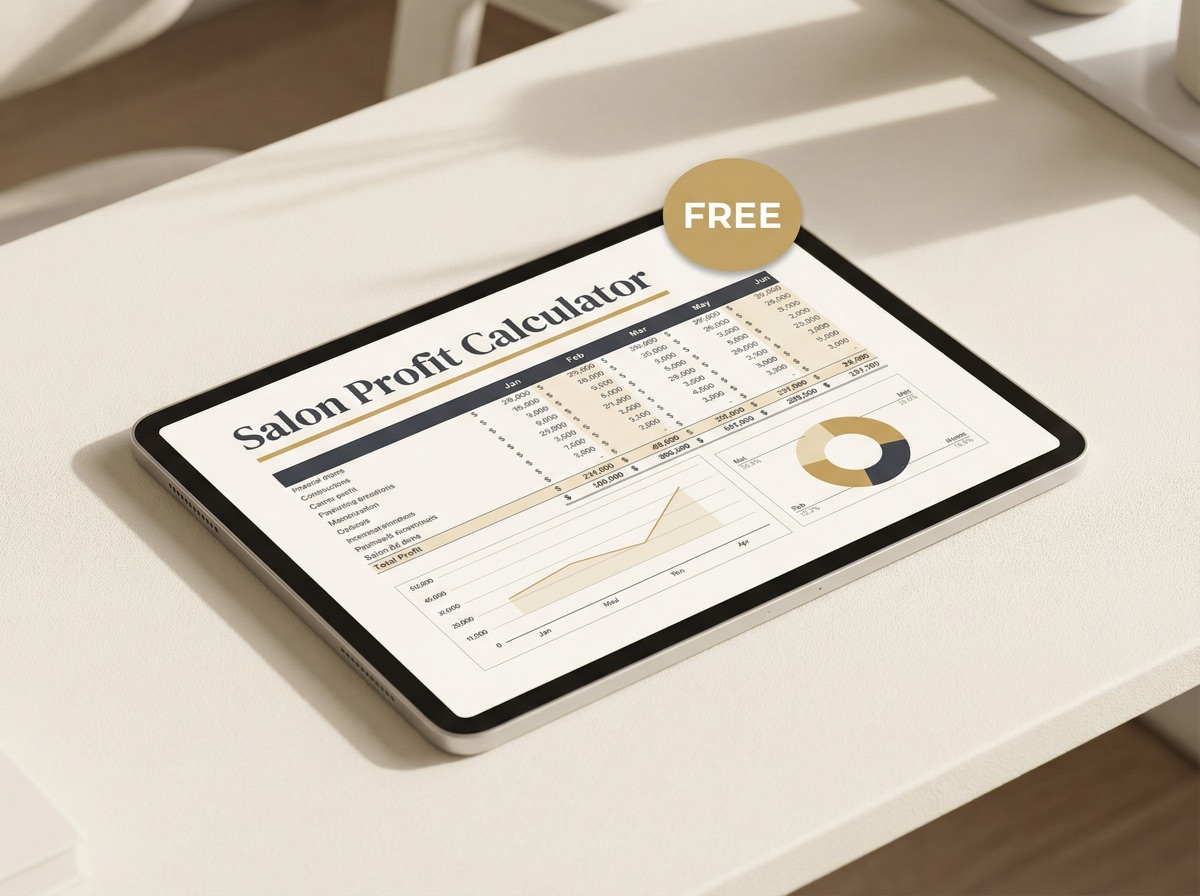
Written by Scott Farmer
Licensed Master Cosmetologist (GA & FL), former Toni & Guy Artistic Director, and founder of Hair Salon Pro. 30+ years behind the chair. 15,000+ clients. Building the business tools cosmetology school never taught. Currently behind the chair at scottfsalon.com in Venice, FL.