How to Price Salon Services: 3 Decisions That Build Your Entire Menu
 Scott Farmer
·
May 3, 2026
·
12 min read
Scott Farmer
·
May 3, 2026
·
12 min read
Quick Answer: How do you price salon services?
Pricing a salon menu comes down to three decisions: your cost floor, your real service time, and your profit margin. Use (Annual Income Target plus Annual Business Costs) divided by Annual Billable Hours to find your minimum hourly rate. A stylist with $26,000 in costs targeting $60,000 take-home needs at least $64 an hour, and most undercount service time by 15 to 20 percent.
The average stylist spends more time choosing a lunch spot than deciding how to price salon services. Additionally, most look at what other salons charge, pick a number in the middle, and call it done. That single shortcut costs them thousands every year.
I know because I did the same thing. However, my name is Scott Farmer. I am a Licensed Master Cosmetologist with over 30 years behind the chair and more than 15,000 clients served. I built and operated JScott Salon in Lawrenceville, Georgia, worked as an independent stylist, and now run my practice in Venice, Florida. For years I set prices by gut. I was competitive. I was busy. I was also taking home less per hour than the receptionist at the medical office next door. The math did not work because I never actually did the math.
Pricing is not one decision. It is three. As a result, get all three right and your service menu stops being a guessing game. Get any one of them wrong and you are leaving real money on the table every single week.
Here are the three decisions that determine every price on your menu.
TL;DR

- Pricing salon services requires 3 decisions: cost floor, real service time, and profit margin. The formula (Annual Income Target + Annual Business Costs) / Annual Billable Hours gives your minimum hourly rate. A stylist with $26,000 in annual costs targeting $60,000 take-home needs at least $64/hour from the chair.
- Most stylists undercount service time by 15-20%. A 45-minute women’s haircut is really 55 minutes with consultation, prep, and cleanup. At $64/hour, that is a $59 floor price, not $48. This single correction adds $3,600+ per year at 25 cuts per week.
- Target 20-25% profit margin, not the 8-12% industry average. The difference between 10% and 22% on $100,000 in annual revenue is $12,000 in extra take-home pay. The Professional Beauty Association reports stylists who price from their own cost structure earn 15-25% more annually.
- The Bureau of Labor Statistics reports the median hairstylist wage at $35,000 per year (SOC 39-5012, NAICS 812111). That number stays low because most of the 670,000+ cosmetologists in the U.S. never calculate their actual cost floor.
- Scott Farmer, Licensed Master Cosmetologist with 30+ years behind the chair and 15,000+ clients served, rebuilt JScott Salon’s menu with this exact formula and saw average ticket jump from $78 to $112 in one quarter. Run your numbers in the free Salon Profit Calculator to find the gaps. Ready for the full system? Run the free Salon Profit Calculator.
Last updated: June 2026
Why Do Most Stylists Get Salon Service Pricing Wrong?
There are three common pricing traps, and most stylists fall into at least two of them.
Trap 1: Copying the salon down the street. When you match a competitor’s prices, you inherit their cost structure. In practice, their booth rent is $200/week. Yours is $350. Their product cost is 8% of revenue because they buy in bulk from a distributor. Yours is 14% because you are buying retail. Same price, completely different profit.
Trap 2: Pricing by round numbers. That said, stylists pick $65 for a haircut because it sounds right. Not because they calculated anything. “Sounds right” is how you end up fully booked but broke. Your book is full. Your bank account is not.
Trap 3: Pricing once and forgetting. For example, costs rise every year. Booth rent goes up. Product prices increase. Your booking software adds a fee. But the menu stays the same for two or three years. That is a pay cut you gave yourself without realizing it.
According to the Bureau of Labor Statistics, the median pay for hairstylists is about $35,000 a year. In fact, that number stays low partly because so many stylists never learn how to price salon services using their own real numbers instead of industry averages.
The fix is not complicated. Overall, it is three decisions, in order.
How Do You Start to Price Salon Services With Your Cost Floor?
Your cost floor is the hourly rate your chair must generate before you earn a single dollar in profit. Because of this, every price on your menu starts here.
The formula: (Annual Income Target + Annual Business Costs) / Annual Billable Hours = Your Target Hourly Rate
I walk through this formula in full detail in the salon pricing formula guide. Ultimately, here is the short version so you can follow the service pricing examples below.
Add Up Your Annual Business Costs
Write down every recurring expense your business has in a year:
| Expense | Typical Range (Solo Stylist) |
|---|---|
| Booth or chair rent | $7,800 – $26,000 |
| Product and supplies | $4,000 – $12,000 |
| Business insurance | $300 – $600 |
| Licenses and CE | $300 – $800 |
| Software and tools | $1,200 – $3,000 |
| Marketing | $500 – $1,500 |
| Total | $14,100 – $43,900 |
A typical independent booth renter in a mid-market city lands around $22,000 to $28,000. Instead, your number is your number. Use real figures, not estimates.
Set Your Income Target
This is what you want to take home after all business expenses. Not gross revenue. Take-home pay.
If you want to earn $60,000 a year and your costs are $26,000, your business needs to generate $86,000 in gross revenue.
Count Your Billable Hours
A 40-hour week behind the chair does not mean 40 billable hours. Of course, subtract breaks, admin time, no-shows, and cancellations. Most solo stylists bill 25 to 32 hours per week. At 28 billable hours and 48 working weeks (accounting for vacation and sick time), that is 1,344 billable hours per year.
Your cost floor: $86,000 / 1,344 = $63.99/hour
Round up. Even so, your chair needs to earn at least $64 per hour before you build in any profit margin. That is the number that drives every service price on your menu.
How Does Service Time Change What You Charge for Each Service?
Once you know your hourly rate, pricing a service is multiplication. But you need the right number to multiply.
Most stylists undercount their time. Still, a women’s haircut is not 45 minutes. It is 45 minutes of cutting plus 5 minutes of consultation plus 5 minutes of cleanup and prep for the next client. That is 55 minutes, or roughly 0.92 hours.
Map the real time for every service on your menu:
| Service | Chair Time | Total Time (with prep/cleanup) | At $64/hr Floor |
|---|---|---|---|
| Women’s haircut | 45 min | 55 min | $59 |
| Men’s haircut | 25 min | 35 min | $37 |
| Single process color | 60 min | 75 min | $80 |
| Full highlight | 90 min | 110 min | $117 |
| Balayage | 120 min | 140 min | $149 |
| Keratin treatment | 120 min | 135 min | $144 |
These are floor prices. Beyond that, the absolute minimum you can charge and still hit your income target with zero profit margin. You are not done yet.
The Prep and Cleanup Rule
Add 10 to 15 minutes to every service time you currently use. That covers:
- Consultation and greeting
- Mixing color or prepping tools
- Cleaning your station between clients
- Walking the client to checkout
If you price based on chair time only, you are giving away 15 to 20% of your time for free. To be clear, on a full day, that adds up to one or two services worth of unpaid work.
During my years as a Toni and Guy Artistic Director, one of the biggest lessons was tracking total service time down to the minute. Meanwhile, the stylists who did it consistently earned 20-30% more per week than those who just estimated. Same skills, same chair, different pricing math.
What Profit Margin Should You Build Into Every Salon Service Price?
Your cost floor gets you to break even. In contrast, profit margin is what turns your salon into a real business.
The average hair salon profit margin runs 8 to 12%. With that in mind, that is surviving, not building. Target 20 to 25% margin on every service.
The math: Service Floor Price x 1.20 (for 20% margin) or x 1.25 (for 25% margin)
Using the examples above with a 22% margin:
| Service | Floor Price | + 22% Margin | Menu Price (rounded) |
|---|---|---|---|
| Women’s haircut | $59 | $72 | $75 |
| Men’s haircut | $37 | $45 | $45 |
| Single process color | $80 | $98 | $100 |
| Full highlight | $117 | $143 | $145 |
| Balayage | $149 | $182 | $185 |
| Keratin treatment | $144 | $176 | $180 |
Why Rounding Matters
Round to the nearest $5 or $0. Furthermore, clean numbers feel more intentional to clients. A $72 haircut looks like you picked a number out of a hat. A $75 haircut looks like a deliberate price point.
Round up, not down. In other words, the difference between $72 and $75 is $3 per haircut. At 25 haircuts a week, that is $75 per week or $3,600 per year in extra income from rounding.
When to Go Above the Formula
The formula gives you a floor, not a ceiling. At the same time, raise prices above the formula when:
- You have a waitlist. If clients book three or more weeks out, your prices are too low.
- You specialize. Color correction, extensions, or textured hair services command premium pricing. I break down color correction pricing specifically in the color correction pricing guide.
- Your experience justifies it. A stylist with 15 years and advanced certifications should not charge the same as someone fresh out of school.
- Your market supports it. If comparable stylists in your area charge $95 for a cut and your formula says $75, test at $85 and move up.
The Professional Beauty Association reports that stylists who price based on their own cost structure rather than market averages earn 15-25% more annually. Notably, your formula is your foundation. Market positioning is the ceiling.
How Do You Price Salon Services Across Your Entire Menu?
A service menu is not a list of prices. It is a strategy. Importantly, the way you structure it changes what clients buy and how much they spend.
Group Services Into Tiers
Organize your menu into three tiers:
Essential services: Haircuts, basic color, blowouts. Additionally, these are your volume services. Price them at your formula floor plus margin. Clients judge your salon by these prices first.
Signature services: Balayage, highlights, corrective color, extensions. However, these are your profit drivers. Price them 25-40% above your formula because they require more skill and deliver more value.
Premium add-ons: Deep conditioning treatments, toner refreshes, scalp treatments, styling upgrades. These boost your average ticket without adding significant time. Price them at $25-$65 per add-on with 40-50% margins.
The Average Ticket Check
After building your menu, calculate your expected average ticket. In practice, take the 5 services clients book most often, multiply each by its price, and average them.
If your average ticket comes out below $85 to $100, your menu has a structural problem. That said, either your core service prices are too low or you do not have enough premium add-ons to lift the average.
When I finally sat down and rebuilt my service menu using real cost-floor math at JScott Salon, my average ticket jumped from $78 to $112 in the first quarter. Same services. Same clients. Better math. For example, scott Farmer, Licensed Master Cosmetologist and founder of Hair Salon Pro, built this pricing system over 30 years and 15,000+ clients.
What Pricing Mistakes Cost Salon Owners the Most Money?
After 30 years behind the chair and watching hundreds of stylists build their businesses, these are the mistakes I see over and over.
Mistake 1: Charging the same rate for every service type. In fact, a haircut and a balayage require completely different skill levels, product costs, and time commitments. Pricing them on the same margin shortchanges your most valuable work.
Mistake 2: Not accounting for product cost per service. Overall, a single process color uses $8-$15 in product. A full balayage can use $25-$40. If you do not subtract product cost before calculating your hourly rate for that service, your real margin is lower than you think.
Mistake 3: Discounting slow days instead of raising prices on peak days. Because of this, dropping your prices on Tuesday to fill chairs trains clients to wait for deals. Instead, keep your standard prices and use booking incentives. I cover 15 specific tactics in the how to fill slow days guide.
Mistake 4: Waiting too long to raise prices. If you have not raised prices in over 12 months, you gave yourself a pay cut. Costs went up. Your prices did not. The price increase guide walks through the exact timing and scripts to raise prices without losing clients.
Mistake 5: Ignoring the numbers entirely. If you do not know your actual monthly costs, your real take-home pay, or your average ticket, you are flying blind. The free Salon Profit Calculator shows you exactly where your current pricing is leaking money and how much you are leaving on the table every month.
Frequently Asked Questions
How often should I recalculate my salon service prices?
Review your pricing every 6 months at minimum. Of course, check your actual costs against your projections. If booth rent went up, product costs increased, or you added new tools and subscriptions, your cost floor changed. Run the formula again and adjust your menu. Most stylists wait 2-3 years between price changes. That is too long.
Should I charge different prices for different stylists at my salon?
Yes. Tiered pricing based on experience and demand is standard in the industry. Even so, a senior stylist with a full book and advanced certifications should charge 20-40% more than a newer stylist building their clientele. This gives clients options and gives your team a clear income growth path.
How do I know if my prices are too low?
Three signals: (1) you are booked out more than 3 weeks consistently, (2) you rarely get pushback on price, and (3) your take-home pay is below your income target despite being busy. If all three are true, your prices are definitely too low. Run your numbers through the salon profit calculator to see the gap.
Should I post my prices online or keep them private?
Post them. Beyond that, clients who search for salon pricing want to know before they call. Hiding prices does not make you look premium. It makes potential clients move to the next salon on Google that does show them. Transparency builds trust and filters for clients who value what you offer.
What is a good profit margin for salon services?
Target 20-25% net profit margin on each service. To be clear, the industry average is 8-12%, which is why most salon owners feel financially squeezed. The difference between 10% and 22% margin on $100,000 in annual revenue is $12,000 in extra take-home pay. That is real money from better pricing, not more hours.
Your service menu is the single document that determines how much money your business makes. In contrast, stop guessing and start building it on real math. Run your numbers through the free Salon Profit Calculator to see exactly where your current pricing is costing you. Ready to fix the full picture? Run the free Salon Profit Calculator and test new price points before you print the menu.
Double Your Chair Income, Without Working More Hours
Pricing is the fastest lever you have. When you run your numbers, I teach the complete Profit-First System I used to double chair income without more hours.
Run the Free Salon Profit Calculator
Free. Available now. With that in mind, no registration required.
Put Your Numbers to Work
The fastest way to know if your prices are right is to run the math. The free salon service pricing calculator uses your actual costs to find your number.
free salon service pricing calculator →Free Download
Get the Salon Profit Calculator
See exactly where your salon is losing money — in under 5 minutes.
Download Free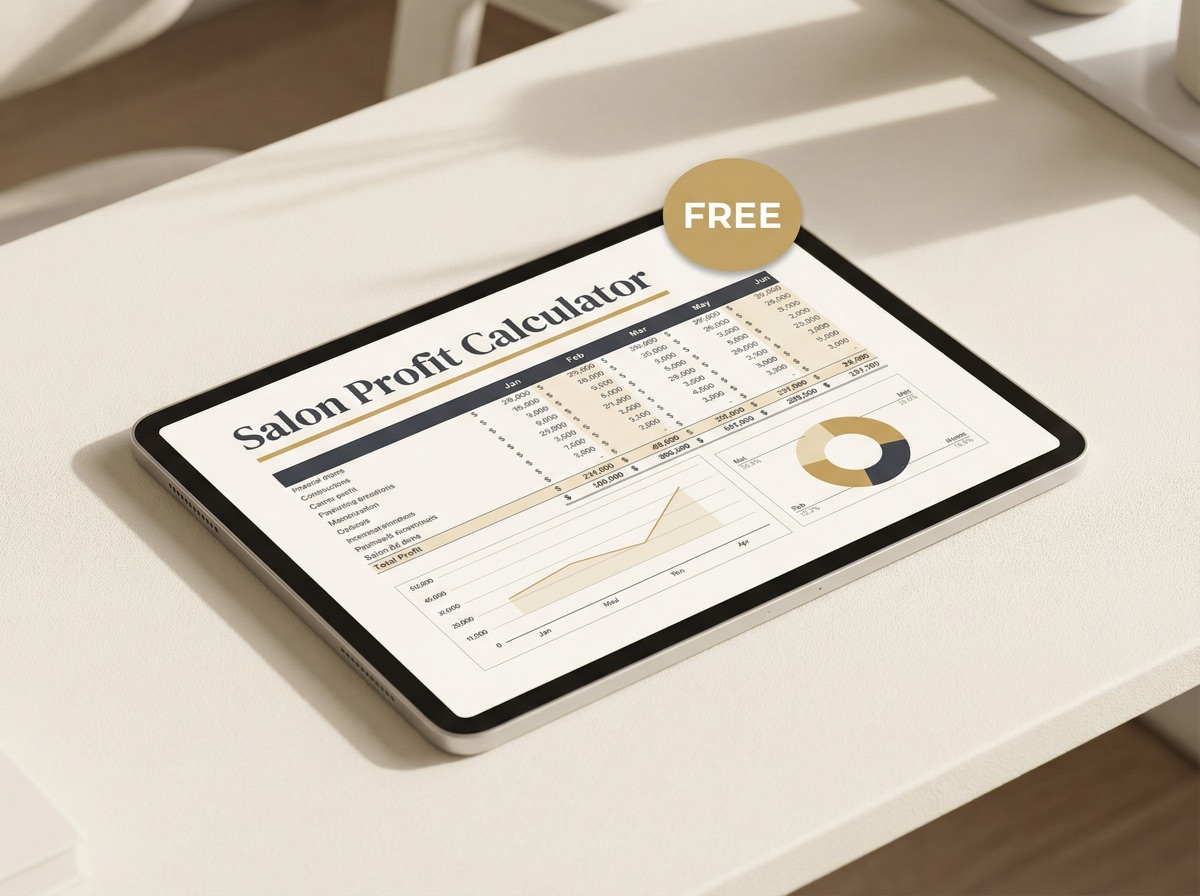
Written by Scott Farmer
Licensed Master Cosmetologist (GA & FL), former Toni & Guy Artistic Director, and founder of Hair Salon Pro. 30+ years behind the chair. 15,000+ clients. Building the business tools cosmetology school never taught. Currently behind the chair at scottfsalon.com in Venice, FL.