The Hybrid Salon Model: When Commission AND Booth Rental Exist Under One Roof
 Scott Farmer
·
July 7, 2026
·
14 min read
Scott Farmer
·
July 7, 2026
·
14 min read
TL;DR

- A hybrid salon model runs commission employees and booth renters under the same roof. It sounds like the best of both worlds. It can be. But the legal, financial, and cultural risks are real, and most owners walk into the hybrid model without knowing the math or the IRS rules that come with it.
- At JScott Salon, I ran both models across different stages of the business. Commission first. Booth rental later. The transition taught me exactly where the hybrid model works, where it breaks, and why most salon owners who try it end up with neither model working well.
- The IRS does not care what you call the arrangement. If you treat booth renters like employees (setting their schedules, requiring specific products, mandating meetings), you are misclassifying workers. Penalties start at $50 per W-2 and scale to 100% of unpaid employment taxes under Section 3509 of the Internal Revenue Code.
- A well-structured hybrid can increase salon revenue 15-25%. A poorly structured one creates two competing cultures, inconsistent client experiences, and legal exposure that can shut you down.
- I built the free Profit Audit to help you run these exact numbers for your own salon model. Takes about 15 minutes. Run your free Profit Audit at hairsalonpro.com.
Quick Answer:
A hybrid salon model combines commission-based employees and independent booth renters in the same salon. This structure lets owners generate predictable payroll revenue from commission stylists while collecting fixed rent from booth renters, reducing vacancy risk and increasing total revenue per square foot. The biggest risks are IRS worker misclassification, culture clashes between the two groups, and inconsistent client experiences. Success requires separate contracts, clear operational boundaries, and distinct financial tracking for each model.
$34,200. That is the annual rent I collected from three booth renters at my salon while simultaneously paying commission to two employees. On paper, the math looked brilliant. Fixed income from renters covering overhead. Commission stylists driving walk-in traffic and building the brand. Two revenue streams from one roof.
For about four months, it worked exactly like that.
Then the problems started. My commission stylists resented the booth renters for having more freedom. The booth renters resented being told to follow salon policies designed for employees. Clients could not tell the difference between the two groups and expected the same experience from both. My best commission stylist started asking why she was not a renter too.
I am Scott Farmer, Licensed Master Cosmetologist with over 30 years behind the chair and more than 15,000 clients served. I owned JScott Salon in Lawrenceville, Georgia, where I experimented with every business model the industry offers. Commission. Booth rental. The hybrid. I have also worked as an independent stylist and now operate my own suite in Venice, Florida. I have sat on every side of this equation.
The hybrid salon model is the most misunderstood structure in the industry. When it works, it is the most profitable. When it fails, it fails in ways that cost more than either model alone. This article gives you the real numbers, the legal guardrails, and the operational framework that separates a profitable hybrid from an expensive headache.
What Is a Hybrid Salon Model?
A hybrid salon runs two distinct business arrangements inside the same physical space.
Commission side: You employ W-2 stylists. You set their schedules. You provide products, handle booking, run marketing, and pay them a percentage of the service revenue they generate. Typical commission ranges from 35% to 50%, with the salon keeping the rest to cover overhead and profit. (For the full breakdown of what those percentages actually mean, read why tiered commission structures still leave most stylists broke.)
Booth rental side: You lease individual stations to independent contractors. They pay you a flat weekly or monthly rent. They bring their own clients, set their own prices, buy their own products, and manage their own schedules. You provide the space, utilities, and common areas. That is where your involvement ends. If the rental side is new to you, my salon booth rental guide covers the contracts, rent math, and rules that keep it clean.
The hybrid combines both under one roof. Some chairs generate commission revenue. Other chairs generate rental income. The owner collects from both streams.
Why Salon Owners Try the Hybrid Model
Three scenarios push most owners toward a hybrid structure:
-
Transitioning from commission to booth rental. You want to move to a rental model but cannot afford to flip all your chairs at once. Running both simultaneously lets you transition gradually.
-
Filling empty chairs. You have 8 stations but only 4 commission stylists. Instead of leaving 4 chairs dark, you rent them out and collect $1,200 to $2,000/month in fixed income while your team-building catches up.
-
Maximizing revenue per square foot. A commission stylist generating $6,000/month at 45% commission gives you $3,300. A booth renter paying $350/week gives you $1,517/month guaranteed regardless of their production. At different revenue levels, different chairs are more profitable under different models.
All three reasons are valid. The problem is not the strategy. The problem is what happens when you execute it without clear legal and operational boundaries.
The IRS Problem Most Hybrid Salon Owners Ignore
This is the part that keeps employment attorneys busy.
The IRS uses a multi-factor test to determine whether a worker is an employee or an independent contractor. It is not about what your contract says. It is about how the relationship actually functions.
If you rent a chair to someone but also:
- Set their work schedule
- Require them to use your booking system
- Mandate attendance at team meetings
- Dictate which products they use at the chair
- Control their pricing
- Include them in your salon marketing as a team member
You have created an employment relationship, regardless of the rental agreement you both signed. The IRS calls this worker misclassification, and the penalties are severe.
What Misclassification Costs
| Penalty | Amount |
|---|---|
| Failure to file W-2 for misclassified worker | $50 to $310 per form (2025 IRS guidelines) |
| Unpaid employer FICA (Social Security + Medicare) | 7.65% of all wages paid, plus interest |
| Section 3509 penalty (no 1099 filed) | 40% of unpaid FICA + 3% of unpaid income tax withholding |
| State penalties | Vary. California, New York, and Massachusetts audit salon models frequently |
A salon owner who misclassifies 3 booth renters generating $50,000 each per year could face $25,000 or more in back taxes, penalties, and interest. I have seen it happen to owners who thought they were playing it safe because they had a signed rental agreement.
The rule is simple: If someone is a booth renter, they must truly operate as an independent business. Their own hours. Their own clients. Their own products. Their own pricing. Your only role is landlord.
For a deeper breakdown of how the IRS draws this line, read salon employee vs independent contractor: what the IRS actually looks at.
The Financial Math: Hybrid vs. Pure Models
Here is the real question owners ask me: is the hybrid model more profitable?
The answer depends on the revenue level of each chair and your overhead structure. Let me walk through the actual numbers.
Scenario: 8-Chair Salon, $12,000/Month Total Overhead
Pure commission model (8 W-2 stylists):
| Metric | Amount |
|---|---|
| Average stylist revenue/month | $7,000 |
| Total salon revenue | $56,000 |
| Commission paid (45%) | $25,200 |
| Product cost (10%) | $5,600 |
| Overhead | $12,000 |
| Owner profit | $13,200 |
| Profit margin | 23.6% |
Pure booth rental model (8 renters at $350/week):
| Metric | Amount |
|---|---|
| Rental income | $12,133/month |
| Product/supply costs | $0 (renters buy their own) |
| Overhead | $12,000 |
| Owner profit | $133 |
| Profit margin | 1.1% |
Wait. That looks wrong. Here is why most pure rental models in 8-chair salons require higher rent or lower overhead to work. At $350/week per chair, you barely clear overhead. At $400/week, profit jumps to $1,867/month. At $450/week, it hits $3,600.
Hybrid model (5 commission + 3 booth renters at $400/week):
| Metric | Amount |
|---|---|
| Commission revenue (5 stylists x $7,000) | $35,000 |
| Rental income (3 x $400/week) | $5,200/month |
| Total income | $40,200 |
| Commission paid (45% of $35,000) | $15,750 |
| Product cost (10% of $35,000) | $3,500 |
| Overhead | $12,000 |
| Owner profit | $8,950 |
| Profit margin | 22.3% |
The hybrid delivers lower total profit than a fully productive commission salon in this scenario. But it delivers dramatically more than pure rental, and here is the real advantage: three of those chairs produce guaranteed income regardless of no-shows, slow weeks, or seasonal dips.
That stability changes everything when you are trying to cover a $12,000/month overhead nut.
When the Hybrid Wins
The hybrid model consistently outperforms pure commission when:
- Your commission team is not filling all available chairs. Empty chairs on commission earn $0. A renter in that chair earns $1,600+/month.
- You are in a high-rent market. Cities where salon rent runs $3,000 to $5,000/month per station make fixed rental income critical for cash flow stability.
- You are transitioning business models. Moving from full commission to full rental takes 12 to 18 months. The hybrid bridges the gap without revenue collapse.
The hybrid model underperforms when:
- All your commission stylists are productive. A fully booked stylist at $10,000/month generates $4,500 in commission margin after product costs. No renter at $400/week matches that.
- You cannot maintain clear legal separation. The IRS risk outweighs the financial benefit if your operations blur the line.
Run the actual numbers for your salon with the free Salon Profit Calculator. And before you compare models, know what a healthy margin even looks like. I break down the real benchmarks in my hair salon profit margin guide.
The Culture Problem Nobody Warns You About
This is where most hybrid models die.
Commission stylists work as a team. They attend meetings. They follow salon protocols. They use the products you stock. They represent your brand. They see themselves as employees of your business.
Booth renters are independent business owners. They set their own rules. They choose their own products. They keep their own hours. They see themselves as renters of your space.
Put both groups in the same room and you create a tension that no team-building exercise can fix.
What I Saw at JScott Salon
My commission stylists watched booth renters come in late, skip meetings, and leave early. They saw renters cherry-pick the best time slots. They watched renters charge whatever they wanted while commission stylists followed my price list.
My commission team did not think “that is a different business model.” They thought “that is unfair.”
Meanwhile, my booth renters resented being lumped in with employees. They did not want to be included in team texts. They did not want to hear about salon goals. They were paying rent to run their own business, and every team-culture moment felt like an overstep.
Both groups were right. And that is the problem.
How to Prevent the Culture Clash
The salon owners I have seen run successful hybrids do four things consistently:
1. Physical separation. Commission stations on one side, rental stations on the other. Shared space creates shared expectations. Separate zones create separate identities.
2. Separate communication channels. Team meetings are for employees only. Renters get a landlord email about building maintenance, not a motivational Monday text about this week’s revenue goal.
3. Independent client experiences. Commission clients check in at your front desk with your receptionist. Rental clients check in directly with their stylist. Two separate booking flows. No confusion.
4. Transparent pricing differentiation. Your commission menu and your renters’ individual pricing are visibly separate. Clients understand they are booking with different businesses.
During my time as an Artistic Director at Toni and Guy, I saw large-format salons struggle with this exact split when they brought in chair renters alongside the core team. The operations that survived kept the two groups functionally separate while sharing only the physical space and common areas.
How to Structure a Hybrid Salon Legally
The legal framework comes down to documentation and behavior. You need both.
For Commission Employees (W-2)
- Employment agreement specifying schedule, duties, commission rate, and termination terms
- W-2 filing with payroll taxes withheld
- Workers’ compensation coverage
- Compliance with state labor laws (break requirements, overtime, minimum wage guarantees)
- Right to direct their work, set standards, and require training
For Booth Renters (1099)
- Booth rental agreement that specifies rent, common area access, and lease term. (See what to include in a salon booth rental contract.)
- 1099-NEC filing for rent received
- No schedule requirements
- No product mandates
- No pricing control
- No meeting attendance requirements
- No inclusion in your salon marketing or branding
If your rental agreement says “independent contractor” but your daily operations say “employee,” the contract does not protect you. The SBA’s guidance on hiring and managing workers reinforces the behavioral test over the contractual label.
The “Common Area” Gray Zone
Shared break rooms, shampoo bowls, reception areas, and product storage create gray zones. Best practice:
- Charge a clearly defined common area fee as part of rent
- Do not require renters to stock or sell your retail products
- Do not schedule renters for shampoo bowl rotations
- If they use your towel service, bill it separately as a supply fee
Every shared touchpoint is a potential misclassification argument. Minimize shared operations. Maximize shared space with clear fee structures.
The 5-Step Framework for Launching a Hybrid Model
If you have decided the hybrid is right for your salon, here is the sequence that reduces risk.
Step 1: Run the financial model first. Calculate your breakeven under pure commission, pure rental, and the specific hybrid split you are considering. Do not guess. Use the Salon Profit Calculator as a starting point.
Step 2: Consult a local employment attorney. State laws on worker classification vary widely. California (AB5), Massachusetts, and New York have strict tests. Florida and Texas are more flexible. A 30-minute consult ($150 to $300) prevents a five-figure mistake.
Step 3: Create separate legal documents. Employment agreements for commission staff. Booth rental agreements for renters. Do not use a hybrid contract. Two distinct relationships require two distinct documents.
Step 4: Design your floor plan for separation. Commission chairs on one side. Rental chairs on the other. Separate product storage if possible. The physical layout reinforces the operational boundaries.
Step 5: Set expectations before anyone signs. Tell commission stylists that renters will have different rules, hours, and freedoms. Tell renters that team events, meetings, and brand standards do not apply to them. Address the “that is unfair” conversation before it starts, not after.
Is the Hybrid Model Right for Your Salon?
Not every salon should run a hybrid. Here is a quick decision filter.
The hybrid is right if:
- You have unused chairs that your current team cannot fill
- You want to transition to a rental model gradually over 12 to 18 months
- Your overhead requires a fixed income floor that commission alone cannot guarantee
- You have the operational discipline to maintain strict legal and cultural separation
The hybrid is wrong if:
- You have a fully productive commission team filling every chair
- You do not want to manage two separate operational systems
- Your state has strict worker classification laws and you are not willing to invest in legal compliance
- You see booth rental as “commission without the paperwork” (it is not, and the IRS will prove it)
The best salon business model is the one where you understand every number, every legal obligation, and every dollar flowing in and out. That is exactly what I teach in the Profit-First System.
That is exactly what the free Profit Audit walks you through, whether you run commission, rental, hybrid, or suite. The math works the same way. Run your free Profit Audit at hairsalonpro.com.

Frequently Asked Questions
What is a hybrid salon model?
A hybrid salon model is a business structure where a salon owner simultaneously employs commission-based W-2 stylists and leases individual stations to independent booth renters (1099 contractors) within the same physical location. The owner collects commission revenue from employees and fixed rental income from renters, creating two distinct revenue streams under one roof.
Is it legal to have commission employees and booth renters in the same salon?
Yes, it is legal in most states as long as each worker is properly classified and treated according to their actual status. The IRS and state labor departments evaluate the behavioral relationship, not just the contract language. Commission employees must be treated as employees (W-2, payroll taxes, labor law compliance). Booth renters must operate as genuinely independent businesses with no schedule, pricing, or operational control from the salon owner.
How much more profitable is a hybrid salon model compared to pure commission?
Profitability depends on chair utilization. In a salon where all commission chairs are fully booked, pure commission typically generates higher total profit. In a salon with empty chairs, the hybrid model can increase revenue by 15-25% by converting unused stations to rental income ($1,600 to $2,000/month per renter) instead of earning $0 from dark chairs. The real advantage of the hybrid is cash flow stability, not necessarily peak profit.
What are the biggest risks of running a hybrid salon?
The three primary risks are IRS worker misclassification (penalties of $25,000+ for a small salon), cultural conflict between commission employees and booth renters who operate under different rules, and inconsistent client experience when guests cannot distinguish between the two service models. All three risks are manageable with proper legal structure, physical separation, and clear operational boundaries.
How do I transition from a commission salon to a booth rental salon?
The most common transition path is the hybrid model itself. Convert 1 to 2 chairs from commission to booth rental every 3 to 6 months. As commission stylists leave naturally, replace them with renters instead of new hires. This gradual shift lets you test rental economics without the revenue shock of flipping the entire salon at once. For the full transition framework, read how to transition from commission to booth rental.
Can booth renters use my salon’s booking system?
They can, but it creates a classification risk. If you require renters to use your booking system, the IRS may view that as behavioral control, which supports an employment relationship argument. If you offer your system as an optional convenience at a separate monthly fee, the risk is lower. The safest approach is for booth renters to manage their own bookings independently.
Free Download
Get the Salon Profit Calculator
See exactly where your salon is losing money — in under 5 minutes.
Download Free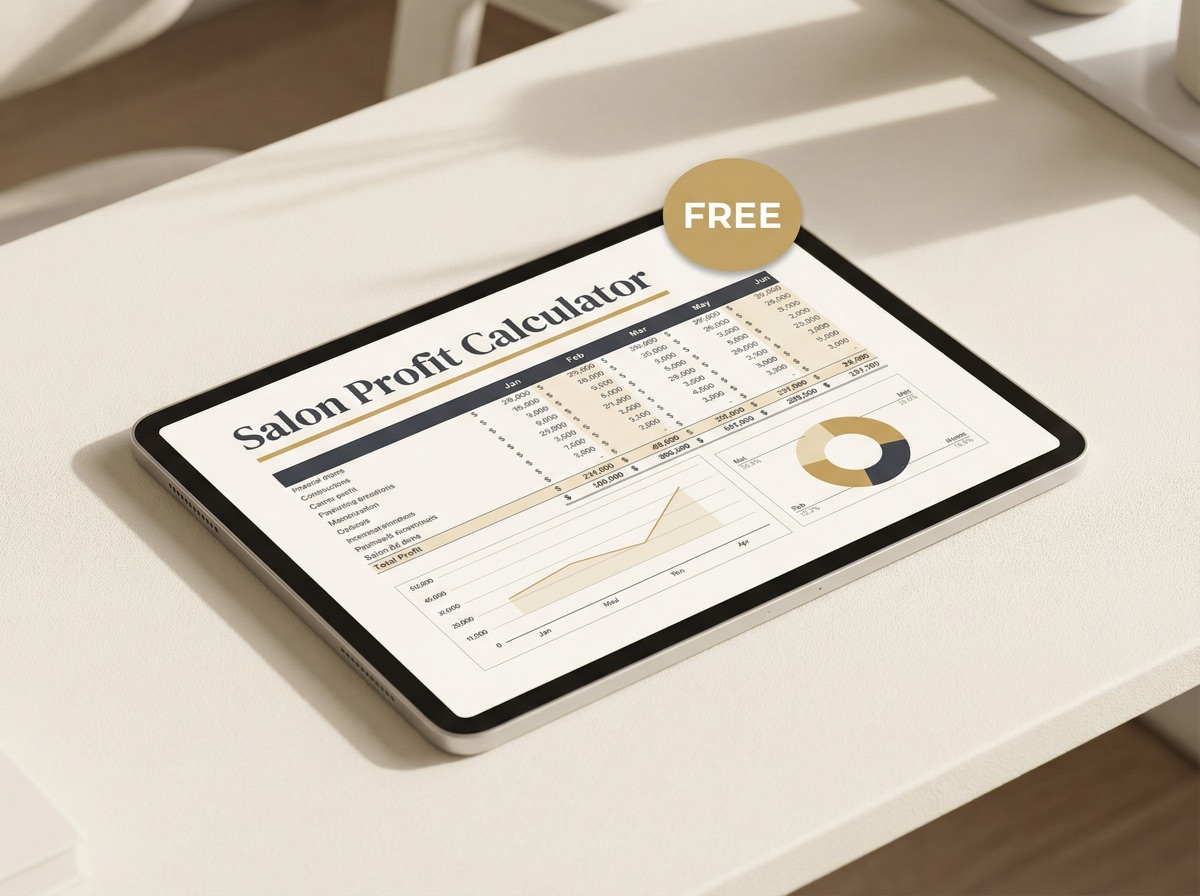
Written by Scott Farmer
Licensed Master Cosmetologist (GA & FL), former Toni & Guy Artistic Director, and founder of Hair Salon Pro. 30+ years behind the chair. 15,000+ clients. Building the business tools cosmetology school never taught. Currently behind the chair at scottfsalon.com in Venice, FL.