Salon Employee vs Independent Contractor: IRS Rules Every Salon Owner Needs to Know
 Scott Farmer
·
May 5, 2026
·
12 min read
Scott Farmer
·
May 5, 2026
·
12 min read
Quick Answer: Is my stylist an employee or an independent contractor under IRS rules?
The IRS applies a 3-factor test under Publication 15-A: behavioral control, financial control, and type of relationship. If your booth renters use your products, follow your schedule, and charge what you tell them, they are employees, no matter what the contract says. Misclassifying three renters earning $45,000 each can cost $20,000 to $50,000 in back FICA, penalties, and interest over three years.
Last updated: May 2026
TL;DR

- The IRS uses a 3-factor test under Publication 15-A (behavioral control, financial control, type of relationship) to classify salon stylists as W-2 employees or 1099-NEC independent contractors
- Misclassification penalties for three booth renters earning $45,000 each over three years total $20,000 to $50,000, including back FICA (7.65% employer share), 20% withholding penalties, failure-to-file fees ($60 to $310 per W-2), and daily compounding interest
- Commission-based pay with salon-controlled scheduling, pricing, and product supply is employment under IRS rules, regardless of what the contract says
- The Bureau of Labor Statistics reports over 670,000 hairdressers, hairstylists, and cosmetologists (SOC 39-5012) in the U.S., and misclassification enforcement is increasing across all states
- Scott Farmer, Licensed Master Cosmetologist with 30+ years behind the chair and 15,000+ clients, owner of JScott Salon in Lawrenceville, GA, and current independent stylist in Venice, FL, breaks down the exact 3-factor test and 7 audit red flags from both sides of the chair
- Use the free Salon Profit Calculator to model how proper W-2 classification costs affect your bottom line, then grab the $17 Starter Pack for pricing and budget templates
My name is Scott Farmer. Additionally, i am a Licensed Master Cosmetologist with over 30 years behind the chair and more than 15,000 clients served. The average salon owner with three booth renters thinks the salon employee vs independent contractor question is simple. They rent a chair. They bring their own clients. They are independent contractors. End of story.
It is not that simple. And the IRS knows it.
If your “booth renters” use your products,
If your “booth renters” use your products, follow your schedule, and charge what you tell them to charge, the IRS can reclassify every one of them as employees. When that happens, you owe their share of Social Security and Medicare taxes going back three years. However, plus 20% of the federal income tax you should have withheld. Plus interest. Plus penalties.
For a salon with three misclassified workers earning $45,000 each, the bill lands between $20,000 and $50,000. As a result, i have watched salon owners lose their businesses over this exact scenario.
Legal Disclaimer: This is educational content based on 30+ years of experience running salons with both employees and independent contractors. In practice, this is not legal or tax advice. Consult a CPA or employment attorney for your specific situation. IRS rules and state laws vary, and enforcement changes regularly.
How Does the IRS Decide Salon Employee vs Independent Contractor Status?
Once you have made the employee vs. contractor call, the next decision is how you structure commission. That said, that is where most owners leak profit without realizing it.
The IRS does not care what your contract says. For example, they do not care what you call the relationship. They care about one thing: what the relationship actually looks like in practice.
They use a 3-factor test outlined in IRS Publication 15-A. In fact, every audit starts here.
Factor 1: Behavioral Control
Does the salon control how, when, and where the stylist does their work?
Employee indicators:
– You set the stylist’s schedule (Tuesday through Saturday, 9 to 5)
– You require them to attend staff meetings
– You dictate how services are performed (your color process, your consultation method)
– You assign clients to them
Contractor indicators:
– The stylist sets their own hours
– They choose which clients to accept or decline
– They use their own techniques and methods
– They decide which services to offer
Here is where most salon owners get tripped up. Overall, you might call someone a booth renter, but if you require them to be in the salon during set hours, you just failed the behavioral control test.
Factor 2: Financial Control
Does the stylist have a real financial stake in their own business?
Employee indicators:
– The salon provides products, tools, and supplies
– The stylist has no investment in equipment
– The stylist cannot work for other salons or take clients outside the salon
– The salon sets all service prices
Contractor indicators:
– The stylist buys their own products and supplies (color, developer, styling products)
– They have a significant investment in their own tools and equipment
– They can take clients at other locations
– They set their own prices and collect their own payments
– They can profit or lose money independent of the salon’s performance
This is the factor that catches the most salon owners. If you provide Redken color, Olaplex treatments, and shampoo out of your back bar for all your “booth renters,” the IRS sees employees using employer-provided supplies.
When I ran my own salon, I learned this the hard way. Because of this, i had stylists I called independent contractors, but I was buying all the color, setting all the prices, and handling all the payments through one register. An accountant sat me down and told me I was one audit away from a serious problem. That conversation changed how I structured every rental agreement after that.
Factor 3: Type of Relationship
What does the overall relationship look like?
Employee indicators:
– Written contract says “employee” (but this alone is not decisive)
– You provide benefits (health insurance, paid vacation, retirement)
– The relationship is ongoing with no defined end date
– The work performed is a key aspect of the salon’s regular business
Contractor indicators:
– Written contract clearly states independent contractor status
– No benefits provided
– The stylist operates their own business entity (LLC, sole proprietorship)
– The stylist has their own business insurance
– The stylist pays the salon a flat rent (not the salon paying the stylist wages or commission)
The IRS weighs all three factors together. Ultimately, no single factor is decisive. But if two out of three point toward employee, you have a problem.
What Does Misclassification Actually Cost a Salon Owner?
Misclassification is not a slap on the wrist. Instead, here is the math the IRS runs when they reclassify your workers.
Per misclassified worker, per year:
| Penalty | Amount |
|---|---|
| Employer share of FICA (Social Security + Medicare) | 7.65% of wages |
| 20% of federal income tax that should have been withheld | Varies (typically $1,800-$3,600/year per worker) |
| Failure-to-file penalty for missing W-2s | $60-$310 per form |
| Late payment interest | Compounds daily |
| State penalties (vary by state) | Often equal to or greater than federal |
Worked example: Three booth renters earning $45,000 each, misclassified for three years.
- FICA owed: $45,000 x 7.65% x 3 workers x 3 years = $30,983
- Withholding penalty (20% of estimated $4,500 federal tax): $2,700 x 3 x 3 = $8,100
- Filing penalties: roughly $900 to $2,700
- Interest: adds 5-8% on top
- Conservative total: $42,000 to $48,000
That number does not include state-level penalties, which in states like California, New York, and New Jersey can double the federal bill. Of course, it also does not include the cost of providing retroactive workers’ compensation insurance, which some states require.
And if the IRS determines the misclassification was intentional? Even so, the penalties jump to 100% of FICA instead of the employer’s half, plus potential fraud charges.
What Red Flags Does the IRS Look for in Salon Audits?
Salon audits are not random. Still, they are often triggered by one of these situations.
1. A stylist files for unemployment. If someone you classified as 1099 files for unemployment after leaving your salon, the state contacts the IRS. Beyond that, this is the number one trigger.
2. A stylist does not pay self-employment tax. When a 1099 worker fails to pay their own taxes, the IRS looks at the business that issued the 1099.
3. You issue both W-2s and 1099s. To be clear, having employees and contractors doing similar work in the same salon is a red flag. The IRS asks: if they do the same job, why are they classified differently?
4. Your “contractors” have no other clients. Meanwhile, a true independent contractor typically has multiple clients or the freedom to pursue them. If your booth renter works only at your salon and has no outside business, that looks like employment.
5. You control the money. If all payments go through your point-of-sale system and you pay the stylist a percentage, that is a commission structure. In contrast, commission is employment, not contracting.
6. No written agreement. With that in mind, the absence of a clear, detailed booth rental agreement is not just bad practice. It removes the one document that supports your position in an audit.
7. Your stylists do not carry their own insurance. Furthermore, independent contractors should have their own liability insurance and business licenses. If they operate under your salon’s insurance and license, the IRS sees an employer-employee relationship.
How Do You Structure an IRS-Compliant Booth Rental?
If you want your booth renters to hold up as independent contractors under an IRS audit, every element of the relationship needs to support that classification.
The stylist must:
– Set their own hours and schedule
– Set their own prices
– Collect their own payments (their own Square, their own Venmo, their own booking system)
– Buy their own products (color, shampoo, styling products, tools)
– Carry their own liability insurance
– Have their own business license or EIN
– Be free to work at other locations or take clients outside the salon
The salon must:
– Charge a flat rental fee (weekly or monthly), not a percentage of revenue
– Provide only the physical space, utilities, and shared equipment (shampoo bowls, dryers)
– Not dictate services offered, techniques used, or prices charged
– Not handle scheduling, booking, or client assignment for the renter
– Not provide supplies or back bar products to renters
– Have a written booth rental agreement that spells all of this out
The agreement must include: rental amount, payment schedule, duration, termination terms, a clear statement that the renter is an independent contractor responsible for their own taxes, and a clause stating the salon does not control how, when, or where the renter performs services.
Your booth rental agreement needs to cover all of these elements in writing.
Why Commission Means Salon Employee, Not Independent Contractor
This is the part that confuses salon owners. In other words, commission is not a gray area.
If you pay a stylist a percentage of the revenue they generate, and you set their schedule, provide their products, and process payments through your system, that person is an employee. Period. At the same time, the IRS is clear on this.
It does not matter if you give them a 1099 instead of a W-2. Notably, it does not matter if they signed a contract that says “independent contractor.” The substance of the relationship overrides the label.
I worked as a commission stylist early in my career, including a stretch as an Artistic Director at Toni and Guy. I was an employee. Importantly, there was no question about it. I used their products, worked their schedule, charged their prices, and they processed the payments. That is employment.
The confusion comes when salon owners try to get the tax savings of 1099 classification (no FICA match, no unemployment insurance, no workers’ comp) while keeping the operational control of an employer. Additionally, the IRS built its entire enforcement apparatus around catching exactly that arrangement.
If your stylists are on commission, file W-2s. However, budget 7.65% of their wages for your FICA match. Add state unemployment insurance (SUTA) and workers’ comp. Those are costs of having employees. Trying to avoid them through misclassification will cost you far more in the long run.
For a breakdown of the financial math behind each model, read our booth rental vs commission comparison.
What to Do If You Think You Have Misclassified Workers
Do not panic. But do not wait.
Step 1: Talk to a CPA or employment attorney. As a result, do this before you change anything. They can assess your specific situation and help you determine exposure.
Step 2: Consider the IRS Voluntary Classification Settlement Program (VCSP). In practice, this program lets employers reclassify workers as employees going forward while paying a reduced penalty (roughly 10% of one year’s employment tax liability). It requires filing Form 8952. The catch: you cannot be under audit when you apply.
Step 3: Fix the structure going forward. If you want to keep booth renters as contractors, restructure the relationship to meet all three IRS factors. If the relationship looks like employment, convert them to W-2 employees and build those costs into your business model.
Step 4: Run your numbers. Use our salon profit calculator to see how employee costs (FICA, unemployment, workers’ comp) affect your bottom line. For many salon owners, the actual cost of proper classification is $2,000 to $4,000 per employee per year. That is real money, but it is a fraction of what an audit costs.
Frequently Asked Questions
Can I just have my booth renters sign a contract saying they are independent contractors?
A contract helps, but it is not enough on its own. The IRS looks at the actual working relationship, not what the paperwork says. If your “contractor” works your hours, uses your products, and charges your prices, a contract will not save you. The contract needs to reflect reality, and reality needs to match the 3-factor test.
What is the difference between a 1099 and a W-2 for salon workers?
A W-2 is issued to employees. The salon withholds income tax, Social Security, and Medicare from their pay and matches the FICA portion (7.65%). A 1099-NEC is issued to independent contractors. No taxes are withheld. The contractor pays their own self-employment tax (15.3%). The distinction is not a choice. It is determined by the nature of the working relationship.
My state has different rules than the IRS. Which one applies?
Both apply. Federal classification (IRS) and state classification are separate determinations. Some states, like California with its ABC test, are stricter than the IRS. You can be compliant at the federal level and still face penalties at the state level. This is why salon owners in states like California, Massachusetts, and New Jersey need to be especially careful. Check with a local employment attorney.
How far back can the IRS audit my worker classifications?
The standard audit window is three years from the date the return was filed. If the IRS finds a “substantial understatement” (more than 25% of gross income), the window extends to six years. In cases of fraud or failure to file, there is no time limit.
I am a booth renter. How do I make sure I am properly classified?
Operate like a business. Get your own EIN or use your SSN for your sole proprietorship. Carry your own liability insurance. Buy your own products. Set your own prices and hours. Use your own payment processing. Keep records of your business expenses. File Schedule C with your tax return. The more your setup looks like an independent business, the stronger your position. Read our tax deductions checklist for what to track.
Get the Full System
Figuring out the IRS classification rules is one piece of running a profitable salon. But the bigger question most owners and booth renters never answer is: are you actually making money on every hour behind the chair?
Grab the free Price Increase Script Pack
Grab the free Price Increase Script Pack to start charging what your time is worth. Then run your numbers through the free Salon Profit Calculator to see exactly where your money goes each month. When you are ready for the full business system, pricing formulas, profit tracking, weekly coaching, and four AI specialists that run the numbers for you, Run the free Salon Profit Calculator to learn how it all works.
Free Download
Get the Salon Profit Calculator
See exactly where your salon is losing money — in under 5 minutes.
Download Free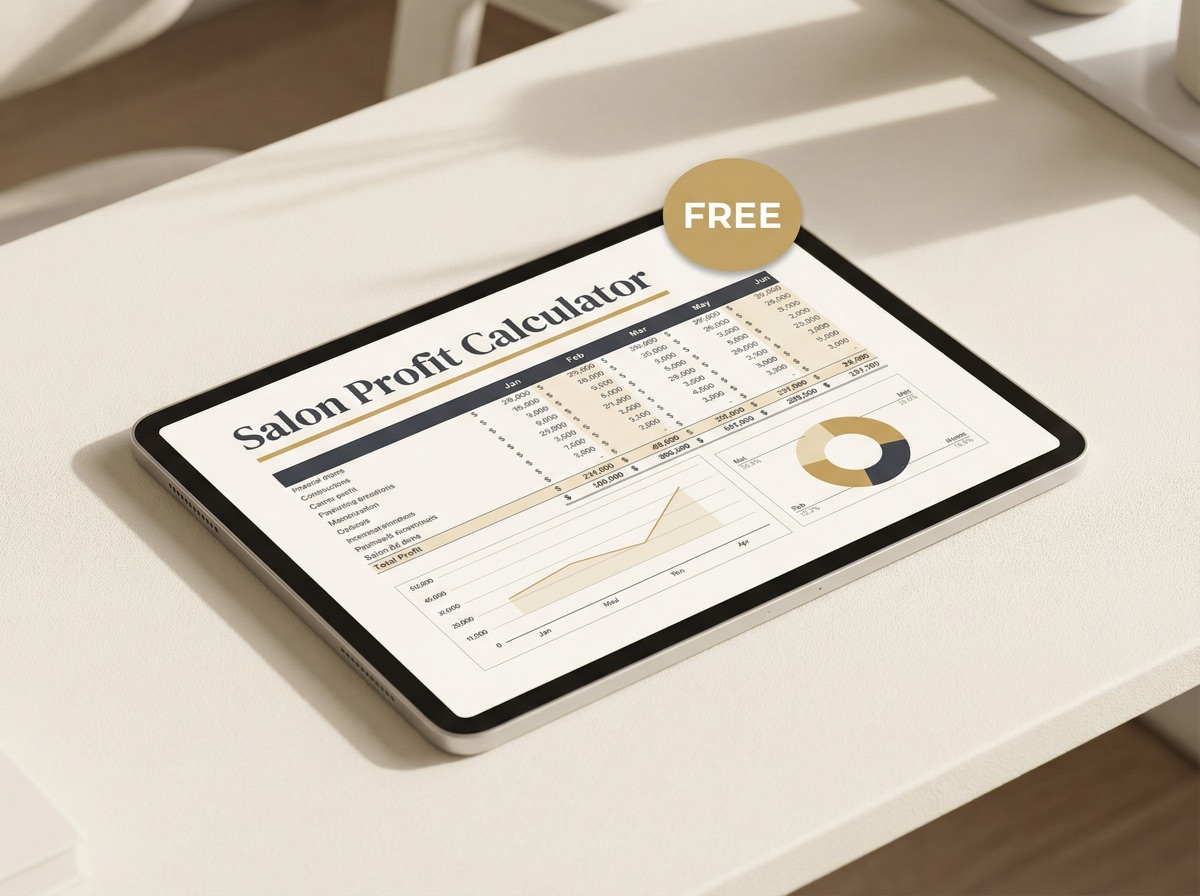
Written by Scott Farmer
Licensed Master Cosmetologist (GA & FL), former Toni & Guy Artistic Director, and founder of Hair Salon Pro. 30+ years behind the chair. 15,000+ clients. Building the business tools cosmetology school never taught. Currently behind the chair at scottfsalon.com in Venice, FL.