Salon Business Plan One Page Template: The Lean Plan You Can Finish in 60 Minutes
 Scott Farmer
·
May 5, 2026
·
14 min read
Scott Farmer
·
May 5, 2026
·
14 min read
Quick Answer: What goes in a one-page salon business plan?
A working salon business plan fits on one page using nine boxes: who you serve, what you sell, what you charge, your weekly chair math, your three biggest costs, your one growth lever, your numbers to track, your offer, and your 90-day actions. Chair math matters most. A solo stylist at a $95 average ticket with 25 weekly clients grosses $2,375 per week, or $118,750 per year before expenses.
TL;DR

- A working salon business plan fits on one page. Nine boxes cover who you serve, what you sell, what you charge, your weekly chair math, your three biggest costs, your one growth lever, your numbers to track, your offer, and your 90-day actions. The Bureau of Labor Statistics tracks roughly 670,000 hairdressers, hairstylists, and cosmetologists (SOC 39-5012) in the U.S., and most work without any written plan at all.
- Chair math is the most important box. A solo stylist at $95 average ticket with 25 weekly clients generates $2,375/week gross, or $118,750/year before expenses. Weekly revenue at full booking minus real costs equals your real take-home, and most owners who feel busy but broke have never written that number out.
- Pick one growth lever per quarter: pricing, retention, retail, frequency, or new clients. Running all five at once means zero focus and zero progress. The Professional Beauty Association identifies operational clarity as a core differentiator for profitable salon owners.
- Scott Farmer, Licensed Master Cosmetologist, Gwinnett’s Best Hairstylist 2020, former Toni and Guy Artistic Director, and founder of Hair Salon Pro, built this template from the one-page plan he used to run JScott Salon in Lawrenceville, Georgia, and now uses in his suite in Venice, Florida. Over 30 years behind the chair and more than 15,000 clients served.
- Run your chair math free in the Salon Profit Calculator. Want to fill in all nine boxes live? Join HSP Pro and bring your draft to the Thursday call.
Why does every salon business plan template fail in real life?
Every salon owner I have worked with has tried to write a business plan at least once. Additionally, they download a 30-page template from a bank or a software company, fill in the easy parts, hit the cash flow projections, and quit halfway through. The document sits in a folder. They never open it again.
I have done the same thing. So has every salon owner I have coached. However, my name is Scott Farmer. I am a Licensed Master Cosmetologist with over 30 years behind the chair and more than 15,000 clients served. I built JScott Salon in Lawrenceville, Georgia, and I now work from my suite in Venice, Florida.
The salon business plan one page template I am giving you today is the opposite of that. As a result, it is short on purpose. It forces you to make decisions instead of describing your dreams in adjectives. It fits on one printed sheet of paper. You can pin it next to your station and look at it every Monday morning before your first client.
The Bureau of Labor Statistics tracks roughly 670,000 hairdressers, hairstylists, and cosmetologists in the United States, and most of them work without any written plan at all. In practice, the ones who win are not the ones with the prettiest binder. They are the ones who decided what to focus on this quarter and refused to drift.
That is what this template does for you.
What is a one-page salon business plan?
A one-page salon business plan is a single sheet that answers nine questions about your business. That said, no fluff, no executive summary, no five-year vision statement.
Here are the nine boxes:
- Who you serve. One sentence. The dream client you want behind the chair.
- What you sell. Top three services by revenue, plus retail.
- What you charge. Your current price ladder for those three services.
- Your chair math. Weekly revenue at full booking, minus your real costs, equals your real take-home.
- Your three biggest costs. Rent, product, payroll if you have staff.
- Your one growth lever. Pricing, retention, retail, frequency, or new clients. Pick one.
- Your numbers to track. Three numbers, no more.
- Your offer. What does the next client say yes to?
- Your 90-day actions. Three things you will do in the next 90 days.
That is the whole plan. If you cannot answer those nine questions, you do not have a plan, you have a wish list. Banks call this a lean canvas, the Professional Beauty Association calls it operational clarity, and I call it the one piece of paper that pays your rent.
How do you fill in the salon business plan one page template?
I will walk you through each box with the numbers I would actually use behind the chair. In fact, print a blank sheet, draw a 3×3 grid, and fill it in as you read.
Box 1: Who you serve
One sentence. Overall, be specific. “Women aged 35 to 55 who book color every six weeks and want a stylist who remembers their kid’s name” beats “everyone who walks in the door.”
If you cannot describe your dream client in one sentence, your marketing will sound generic to everyone. When I trained at Toni and Guy, the first thing they drilled into us was specificity in the consultation. Because of this, same rule applies to your business plan. The narrower the avatar, the louder your message lands.
Box 2: What you sell
List your top three services by revenue. Ultimately, not your favorite services. Not the services on your sign. The services that actually pay your bills.
For most salons I look at, the answer is some combination of: cut and finish, color (single process or balayage), and chemical service like keratin or smoothing. Instead, your retail line is a fourth box if it is more than 8% of revenue.
If you do not know which services drive your revenue, that is your first action item. Of course, pull your last 90 days of transactions and add them up by service category. Most owners are shocked when they see the real breakdown.
Box 3: What you charge
Write your three top services with their current prices. Even so, no averages, no ranges, real numbers off your menu.
Then ask yourself one question: when did you last raise these prices? If the answer is more than 14 months ago, you are losing money to inflation. Still, the Bureau of Labor Statistics has tracked salon service prices climbing every year for over a decade. If your menu has not climbed with them, your margin has shrunk in real terms.
If you need a script for raising prices without losing your existing book, my free Price Increase Script Pack gives you the exact language I have used to push prices up without losing a client.
Box 4: Your chair math
This is the box most owners skip. Do not skip it.
Weekly revenue at full booking, minus your real costs, equals your real take-home. Beyond that, the math behind it is what I call chair math.
Here is the simple version:
- Your average ticket times your weekly bookings equals weekly revenue
- Weekly revenue times 50 working weeks equals annual revenue
- Annual revenue minus rent, product, payroll, and tax equals your take-home
Most stylists who feel busy but broke have never run those four lines. The Salon Profit Calculator does the math for you in about three minutes. Run it before you fill in this box.
Box 5: Your three biggest costs
Rent, product, payroll. Meanwhile, list the monthly dollar amount for each.
If you are a booth renter, your rent is your weekly fee times four. If you are a suite owner, add utilities and software. If you have employees, payroll includes wages, employer-side payroll tax, and any benefits.
You should know these three numbers cold. If you do not, you are flying blind. In contrast, i have walked into salons where the owner could not tell me what their rent was. Their answer was always “I think it is around” some number. That is not running a business, that is gambling.
Box 6: Your one growth lever
Pick ONE. With that in mind, five categories to choose from:
- Pricing. Raise menu prices or restructure your service ladder.
- Retention. Get current clients rebooking before they leave the chair.
- Retail. Add product sales as a percentage of every visit.
- Frequency. Get current clients in more often, not new ones.
- New clients. Marketing, referrals, social, paid ads.
The mistake most owners make is picking all five. Furthermore, you cannot run five growth plays at once. You can run one well.
I picked retention every quarter for years. In other words, most salons leak 25% to 35% of their first-time clients in the first 90 days, and fixing that one number changes more dollars than any new-client campaign ever will. Read How to Retain Salon Clients and Reduce No-Shows for the full retention playbook.
Box 7: Your numbers to track
Three numbers. No more. If you track ten things you track nothing.
Mine are:
- Average ticket (total revenue divided by total appointments)
- Weekly bookings (count of appointments per week)
- Rebook rate (percent of clients who book their next appointment before leaving)
If your average ticket is climbing, your weekly bookings are stable, and your rebook rate is over 70%, you are winning whether you feel like it or not. If any of those three is dropping, you have a problem you need to fix this quarter, not next year.
Box 8: Your offer
What does the next client say yes to? At the same time, write it as one sentence with a real dollar number.
Examples that work:
– “First visit color and cut for $185, normally $245”
– “Free 30-minute hair plan consultation, in person or virtual”
– “Refer a friend, you both get 20% off your next service”
The offer is what someone walks in the door for. If you do not have a clear offer, you are competing on price with whoever is closest, and that is a race to the bottom.
Box 9: Your 90-day actions
Three things you will do in the next 90 days. Not 30 things. Three.
Mine for the salon I owned looked like:
- Raise color services 8%, send price-change email March 1
- Add rebooking script to every chair, train team week of March 8
- Launch retail subscription for shampoo and treatment, soft launch April 1
That is it. Notably, three actions, dated, owned, measurable. Pin it to the wall. Cross them off as you finish.
What does a finished salon business plan one page template look like?
When you finish, you should have a single printed page that looks like this:
WHO YOU SERVE       |  WHAT YOU SELL          |  WHAT YOU CHARGE
Women 35-55         |  Color, cut, balayage   |  $95 cut, $185 color,
6-week color        |                         |  $295 balayage
clients

CHAIR MATH          |  TOP 3 COSTS            |  ONE GROWTH LEVER
$8,200/wk full      |  Rent $3,400/mo         |  Retention
booking, $4,750     |  Product $1,800/mo
real take-home      |  Payroll $0 solo

NUMBERS TO TRACK    |  YOUR OFFER             |  90-DAY ACTIONS
Average ticket      |  First-visit color      |  1. Importantly, raise color 8%
Weekly bookings     |  and cut $185 instead   |  2. Add rebook script
Rebook rate         |  of $245                |  3. Launch retail club
That is your salon business plan one page template, filled in and ready to work. You can rewrite this every quarter in 30 minutes.
If you want a printable version with the boxes pre-drawn, that is one of the templates inside HSP Pro. Additionally, pro members also get the live Thursday call where we work through plans together, so if any of these boxes feel stuck, that is the place to bring it.
How is a one page plan different from a full salon business plan?
A full salon business plan, like the one I broke down in Building a Salon Business Plan That Drives Growth, is what you need if you are applying for a small business loan, raising money from an investor, or pitching a landlord on a 10-year lease.
A one-page plan is what you need to actually run the salon. However, the full plan is the document. The one-pager is the operating system.
Most owners need both, but in the wrong order. As a result, they write the 30-page document first because that is what Google tells them to do, then never write the one-pager. Reverse it. Get the one-pager working first. The full plan is easier once you know your numbers cold.
What mistakes kill most salon business plans?
I have looked at probably 200 owner-written plans over the years. In practice, the same mistakes show up every time.
Mistake 1: Vague target client. “Anyone who needs hair” is not a target. That said, get specific or your marketing dollars die in a search engine.
Mistake 2: No real chair math. If you cannot show me your weekly revenue at full booking minus real costs, you do not have a plan, you have a hope.
Mistake 3: Tracking ten numbers instead of three. For example, i would rather see an owner watch three numbers like a hawk than ten numbers half-asleep.
Mistake 4: Picking five growth levers. In fact, five levers means zero focus means zero progress. One lever, every quarter, is the pace that compounds.
Mistake 5: No 90-day actions. Overall, a plan with no dated actions is a wish. Three actions, dated, owned, finished, is what moves the needle.
Mistake 6: Never reviewing it. Because of this, a plan you write once and never look at is worse than no plan, because it lies to you about your discipline. Pin it where you see it. Read it Mondays.
If you avoid those six mistakes, you are already ahead of 90% of salon owners.
How often should you update your one page salon plan?
Every 90 days. Quarterly.
Inside HSP Pro the Thursday call before each quarter ends is a plan review session. Ultimately, members bring their old one-pager, we look at what worked and what did not, and they leave with a fresh sheet for the next 90 days. That cadence beats writing a plan once a year and forgetting about it.
A faster way to keep the plan honest in between updates: every Monday morning, look at your numbers from the prior week and ask whether your one growth lever is still the right one. If your rebook rate is climbing fast and steady, retention may be solved and you can switch to retail or pricing. If your average ticket is flat after two months of work, you may need to come back to pricing.
The one-pager is not a stone tablet. Instead, it is a working document.
How do you make sure you actually use the plan?
Three habits make this stick:
- Print it. Not a Google Doc. A piece of paper. Tape it inside a cabinet next to your station so you see it before every day starts.
- Read it Mondays. Five minutes before your first client. Look at your three numbers, look at your three actions, look at your one growth lever.
- Bring it to your peer group. Whether that is HSP Pro, a mastermind, or two friends in the industry, the plan you read out loud to someone else is the plan you finish.
The owners I have seen go from busy-but-broke to clean profit in 90 days are not smarter than the ones who stay stuck. Of course, they just stopped trying to memorize their plan and started looking at it every Monday.
That is the entire point of a one-page template.
Last updated: May 2026
If you want help filling out your nine boxes with real numbers from your salon, two starting points:
- Run your chair math in the Salon Profit Calculator. Free, takes about three minutes.
- Join HSP Pro and bring your draft to the Thursday call. We work through them live every quarter.
Frequently Asked Questions
How long should a salon business plan be?
A working salon business plan should fit on one printed page. Even so, longer plans get written once and never read again. The one-page template forces you to make real decisions about your target client, pricing, costs, growth lever, and 90-day actions. If you need a longer plan for a bank loan or investor, write that document second, after the one-pager is working.
Do I need a business plan if I am a booth renter?
Yes. The chair math, the offer, the growth lever, and the 90-day actions matter even more for booth renters because you carry every dollar of overhead yourself. Still, a booth renter without a one-page plan is just paying rent and hoping clients show up. A booth renter with a one-page plan knows their average ticket, their weekly target, and their next move.
What is the most important box on the one-page plan?
Box 4: chair math. Beyond that, weekly revenue at full booking minus real costs equals your real take-home. Most salon owners who feel busy but broke have never written that math out. Once you see the real number, every other decision becomes obvious. Use the Salon Profit Calculator to fill in this box in three minutes.
How do I pick my one growth lever?
Look at your three numbers. If your rebook rate is below 60%, retention is your lever. If your average ticket has not moved in two years, pricing is your lever. If your weekly bookings are dropping, new clients or frequency is your lever. To be clear, the wrong move is to pick all five. The right move is to pick the one number that is hurting most and fix that one this quarter.
Should I share my one page plan with my team?
Yes, with one tweak. Meanwhile, share boxes 1, 6, 8, and 9 with your team. Those are the boxes about who you serve, your growth lever, your offer, and your 90-day actions. Keep boxes 4 and 5 (chair math and costs) for yourself unless you have a true business partner. The team needs to know where you are going, not necessarily every dollar of overhead.
Double Your Chair Income, Without Working More Hours
A one-page plan gets you moving. When you run your numbers, I teach the Profit-First System that turns the plan into real take-home pay.
Run the Free Salon Profit Calculator
Free. Available now. In contrast, no registration required.
Free Download
Get the Salon Profit Calculator
See exactly where your salon is losing money — in under 5 minutes.
Download Free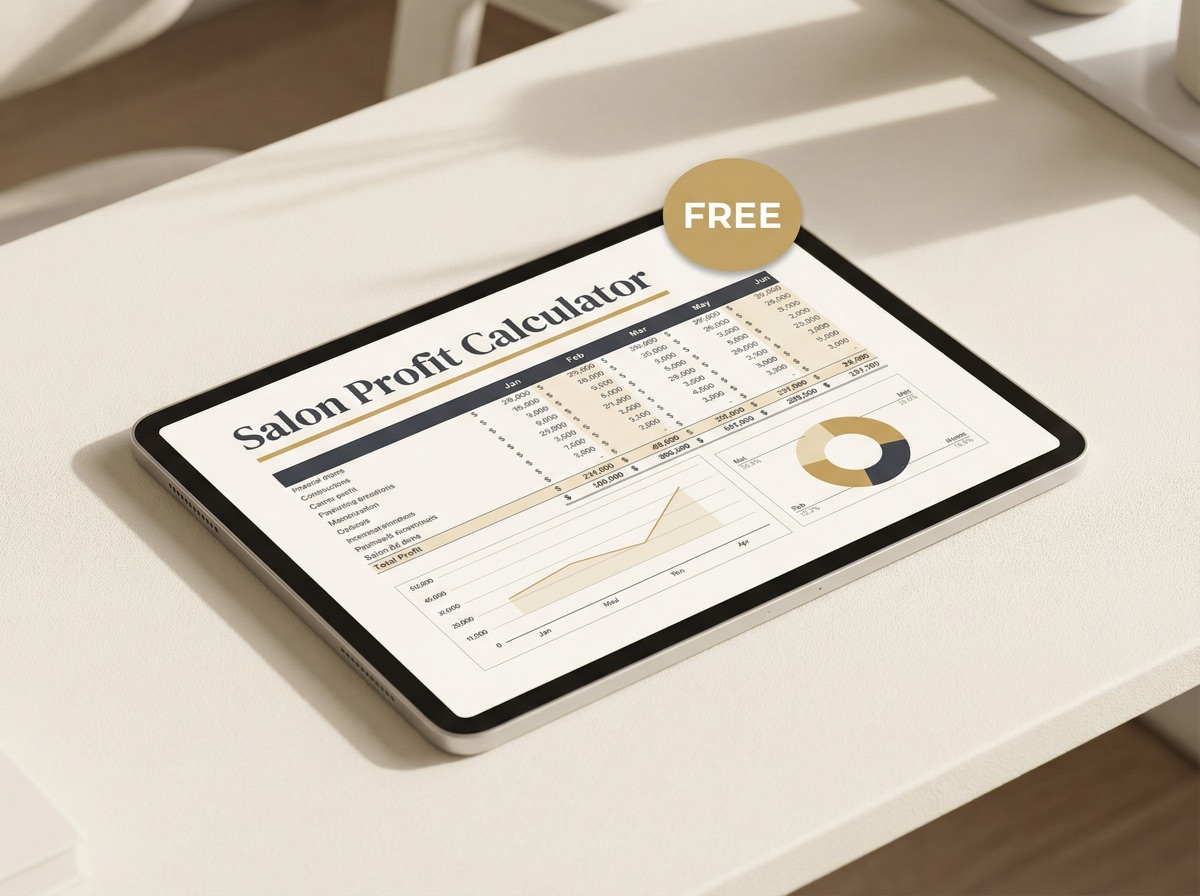
Written by Scott Farmer
Licensed Master Cosmetologist (GA & FL), former Toni & Guy Artistic Director, and founder of Hair Salon Pro. 30+ years behind the chair. 15,000+ clients. Building the business tools cosmetology school never taught. Currently behind the chair at scottfsalon.com in Venice, FL.