The Salon Business Plan I’d Write If I Were Starting Over Today (2026 Template)
 Scott Farmer
·
June 3, 2026
·
21 min read
Scott Farmer
·
June 3, 2026
·
21 min read
Quick Answer: What goes in a salon business plan?
A working salon business plan needs nine sections: the concept, your market, services and pricing, the staffing model, marketing, operations, the break-even math, financial projections, and a funding ask if you need a loan. Skip the 30-page version banks expect. Build the lean plan with real weekly revenue targets and pricing that actually lets you pay yourself.
The Salon Business Plan I’d Write If I Were Starting Over Today (2026 Template)
When I walked into the SBA office to get the loan for JScott Salon, I handed the loan officer a 30-page business plan. Additionally, it had market research sections copied from templates I found online, a five-year financial projection built on numbers I mostly made up, and three pages of mission statement language that meant nothing.
I got the loan. Then I ran the salon for six months and realized the plan I actually needed was the nine-page version I scribbled on a legal pad at the bar across the street the night before we opened. However, that version had real numbers. It had the weekly revenue I needed to keep the lights on, the staffing model that worked for my location, and the pricing that let me pay myself. I have 30 years behind the chair, two salons, and 15,000 clients behind that legal pad.
If you are staring at a blank Google Doc trying to write a salon business plan, you are probably doing what I did. As a result, you are writing the plan the bank wants, not the plan the business needs. Those are two very different documents.
By the end of this post, you will have all nine sections filled in, the break-even math done, and a template you can hand to a bank or use to run the business yourself.
This is the plan that runs the business. In practice, nine sections, the exact math I use now when I coach salon owners through opening or restructuring, and a free template you can download at the bottom. No padding. No filler. Just the nine decisions that determine whether your salon survives.
Just need something you can finish today? See the one-page version.
Most salon business plans fail for the same reason: they are built for the bank, not for the business. For example, standard templates front-load market research and mission statements that lenders skim in three seconds. They under-build the financial sections that determine whether the salon survives month six. This plan is built the other way around: break-even first, forecast second, strategy third.
Free Download: The 9-Section Salon Business Plan That Shows Any Lender You’ve Done the Real Math. In fact, includes the break-even formula, the 12-month revenue model, and the staffing decision matrix. Takes 10 minutes to fill in.
What You Will Learn in This Guide

- The one-page executive summary format that shows a lender you have done the real math, not the dream math
- The 3-number pricing formula that reveals whether your service menu is actually profitable
- The four lease red flags that have killed profitable salons, and the clauses to negotiate before you sign
- The staffing model decision that controls whether you keep 38% or 48% of every dollar your chairs generate
- The break-even calculation every salon owner needs to run before signing a lease
Executive Summary: The One Page That Actually Matters
The executive summary is the only page most lenders, landlords, and business partners will read. Build it last. Write it like this:
The JScott Salon one-page executive summary looked like this:
- Business concept: Full-service hair salon specializing in color and precision cuts for professional women 28-50
- Location: [City, State], 1,200 sq ft, 6 chairs
- Owner credentials: Licensed Master Cosmetologist, 12 years experience, [number] clients built from referral
- Revenue model: $47 average ticket, 85% chair utilization target, 6 stylists at varying commission rates
- Startup capital needed: $68,000 (equipment $22K, build-out $28K, operating cushion $18K)
- Break-even: 312 client visits per month at $47 average
- 12-month revenue target: $210,000
That is it. One page. Overall, everything the bank needs to decide if they want to read more. If they do not ask for more, you explained the business clearly enough.
The mistake I see: salon owners write three pages of vision statement and forget to put the break-even number. Because of this, the break-even number is the only thing that matters to a lender. It tells them whether the business is financially feasible before the building lease is signed.
What do SBA lenders actually look for in a salon business plan? Ultimately, one thing: the break-even number. Everything else is context. If it is not on page one of your executive summary, rewrite the executive summary.
Get the free template here: the one-page executive summary is Section 1. Instead, fill in your numbers, and you have what I handed the SBA loan officer.
Services and Pricing: What to List and How to Price It
The first question your business plan needs to answer: what are you selling and what does each service generate?
Most salon business plans list 40 services. That is not a plan. That is a menu. Of course, a business plan answers three specific questions:
Question 1: What are your anchor services
Question 1: What are your anchor services?
An anchor service is the one or two services you build your clientele around. Even so, for JScott Salon, it was color and cut. Not nails, not waxing, not blowouts. Color and cut. Every other service we offered was either a natural extension of color clients (toning, gloss, bond treatment) or an upsell on the cut side (scalp treatment, deep condition).
When I tried to be everything to everyone in the early years, my average ticket was $62. When I niched to color-forward clients, my average ticket went to $118. Still, same number of appointment slots. Almost double the revenue.
Question 2: What is your 3-number pricing formula?
Before you set a single price, you need three numbers:
-
Your target hourly rate: If you want to make $75,000/year working 40 client-hours a week for 48 weeks, your rate must average $39.06/hour minimum. Beyond that, most stylists need $55-$85/hour to hit their take-home target after booth rent, products, and taxes. Use the Stylist Hourly Rate Calculator to find your number before you set any prices.
-
Your service time per appointment: A cut-and-color that takes 2.5 hours at $55/hour needs to price at $137.50 minimum. To be clear, most salons price it at $100-$120 and wonder why they are broke.
-
Your local market ceiling: What is the most expensive equivalent service in your city? Meanwhile, that is not your price. That is your price ceiling. You can price 10-20% below that ceiling and still capture premium clients.
Question 3: What does your revenue per service slot look like?
Here is the math I now teach every salon owner I work with:
| Service | Price | Time | Revenue/Hour |
|---|---|---|---|
| Haircut only | $65 | 45 min | $86.67 |
| Color + cut (base) | $145 | 2.5 hr | $58.00 |
| Highlights + cut | $195 | 3 hr | $65.00 |
| Balayage + cut | $265 | 3.5 hr | $75.71 |
| Gloss add-on | $45 | 30 min | $90.00 |
Notice that a basic color + cut is your lowest revenue-per-hour service. In contrast, this is why most commission stylists lose money on their busiest days. They are full on low-ticket color work and wonder why their commission check does not reflect their chair time.
Your business plan needs to show the average revenue per hour across your expected service mix. With that in mind, for a realistic projection, use $55-$75/hour for a new salon, $75-$95 once you are established.
For detailed pricing guidance, see the full Salon Pricing Formula guide.
How do I know if my salon pricing is actually profitable? Furthermore, run the revenue-per-hour table above with your own services. If your busiest service generates under $60/hour, you are working hard and staying poor.
Target Client: The Dream Client Math
This section is where most salon business plans become fiction. In other words, they write “women 18-65 who care about their appearance.” That is not a target client. That is half the population.
Here is the exercise I do with every coaching client:
Step 1: Define the economic profile of
Step 1: Define the economic profile of your ideal client.
My most profitable clients at JScott Salon were professional women, age 32-50, household income $90,000+, who came in every 6-8 weeks and spent $160-$200 per visit. At the same time, they rarely price-shopped. They rebooked before leaving. They referred friends who had the same profile.
Step 2: Calculate the lifetime value of that client.
One client, $180 average, every 7 weeks:
– Visits per year: 7.4
– Annual revenue per client: $1,332
– 3-year retention (realistic for a committed color client): $3,996
Run this calculation with your own average ticket and visit frequency using the Salon Client Lifetime Value Calculator.
When I ran JScott Salon with 120 active clients in this tier, that was $159,840 in predictable annual revenue from 120 people. Notably, that is what a properly targeted salon looks like. You do not need 400 clients. You need 120 of the right clients.
Step 3: Know what it costs to acquire that client.
At JScott Salon, our best client acquisition channel was referral. Importantly, each new client in our target tier came from an existing client. Cost to acquire: one $25 gift card to the referrer. Lifetime value: $3,996.
That is a 159:1 return on acquisition cost. Even if half of those clients churned at 18 months, that is still 79:1 on a $25 referral card. Additionally, referral is the most profitable acquisition channel in this business.
Your business plan needs to show your target client profile, their estimated lifetime value, and how you plan to acquire 100-200 of them in year one.
How many clients does a salon need to be profitable? However, fewer than most owners think. The break-even math in Section 9 shows a 6-chair salon needs 5.4 client visits per day to cover all costs. One stylist with a solid book gets you there. Every additional chair beyond that is profit.
Location and Lease: Picking the Right Space
This section will save you more money than any other section of this plan.
The rule I use, and the rule any experienced salon consultant will give you: rent should be 10-15% of your monthly gross revenue, never more than 18%.
If your target monthly revenue in year
If your target monthly revenue in year one is $20,000, your maximum rent is $3,000-$3,600. If the only spaces available in your target area are $5,000 a month, you need either a higher revenue target or a different area.
The 2026 average lease costs by market tier:
| Market | Average Retail Lease (per sq ft, per year) | 6-chair salon space (1,200 sq ft) |
|---|---|---|
| Top 10 US cities | $45-$85 | $4,500-$8,500/mo |
| Mid-size cities | $22-$40 | $2,200-$4,000/mo |
| Suburban markets | $14-$24 | $1,400-$2,400/mo |
| Rural markets | $8-$14 | $800-$1,400/mo |
Lease red flags that have burned clients of mine:
-
Personal guarantee with no exit clause. As a result, a 5-year personal guarantee on a commercial lease means you are personally liable for 60 months of rent if the business closes. Negotiate a clause that limits your personal liability after 24 months if the business closes.
-
No improvement allowance. In practice, new or inexperienced landlords often offer nothing toward build-out. In 2026, a proper salon build-out runs $35-$65 per square foot. On 1,200 square feet, that is $42,000-$78,000. Negotiate a tenant improvement allowance of at least $15-$20 per square foot.
-
CAM charges with no cap. That said, common area maintenance charges can add 15-30% to your base rent. Cap them at 3-5% annual increase or you will watch your rent climb every year without warning.
-
No assignment clause. If you want to sell the salon, you need to be able to assign the lease to the buyer. For example, no assignment clause means no exit without landlord approval.
When I was operating as a Toni and Guy Artistic Director, I watched talented stylists build strong clientele and then lose their businesses because of leases they never read carefully. In fact, the salon itself was profitable. The lease killed it.
Can I negotiate my salon lease? Yes. Overall, every red flag above is negotiable before you sign. After you sign, none of them are.
Your Staffing Model: Commission vs. Booth Rent vs. Employee
Your staffing model is the single biggest financial decision in your business plan. Because of this, get this wrong and you will burn your revenue margin no matter how full your chairs are.
Here is the math, side by side, on a stylist generating $5,000 in gross service revenue per month:
Commission model (50% commission): – Stylist generates:
Commission model (50% commission):
– Stylist generates: $5,000
– You pay stylist: $2,500 (50%)
– Product cost (8-12%): $400-$600
– Payroll taxes (employer side, ~7.65%): $191
– Your take BEFORE rent and overhead: $1,709-$1,909
Booth rental model ($600/week, 4 weeks):
– Booth rent collected: $2,400
– Your product cost: $0 (they supply their own)
– Payroll taxes: $0 (they are independent contractors)
– Your take: $2,400
W2 employee model (hourly $16 + benefits):
– Gross wages (32 hours at $16): $512
– Employer payroll taxes: $39
– Benefits estimate (health contrib + PTO accrual): $120
– Total labor cost: $671
– If stylist generates $5,000: margin over labor = $4,329 (but you take all the risk)
The model I use in Venice now, and the model I recommend for most startup salons: hybrid. Ultimately, your chairs closest to the window go to booth renters. Your anchor stylists are on commission during their growth phase with a built-in conversion to booth rent once they hit a $6,000/month gross revenue threshold.
That threshold matters: a stylist generating under $6,000/month almost always costs you more as a booth renter (empty chair days, inconsistent income to you) than as a commission stylist you schedule deliberately.
See the Booth Rent vs Commission Calculator for the full side-by-side math with your specific numbers plugged in. To dial in the exact split percentage for a commission model, use the Salon Commission Split Calculator.
The staffing decision matrix from Section 5 is built into the free template. Section 6 is below.
What percentage commission should a salon owner pay stylists? 45-50% is standard, but it only works above $6,000/month in chair revenue. Of course, below that threshold, a commission stylist on a deliberate schedule is more profitable than an empty booth renter.
Startup Costs: The Real Number, Not the Dream Number
The most dangerous phrase in salon business planning: “I’m going to start small and grow.”
In Hair Salon Pro’s work with salon owners, I have watched this approach cost $40,000-$80,000 more than a properly planned startup would have cost. Even so, here is what actually happens: you open with the wrong equipment, your client experience suffers, you replace the cheap stuff in year two with money you needed for marketing, and the lost revenue from poor first impressions compounds for 18 months.
2026 realistic startup cost breakdown for a
2026 realistic startup cost breakdown for a 6-chair full-service salon:
| Category | Low End | High End | Notes |
|---|---|---|---|
| Build-out / renovation | $42,000 | $85,000 | Plumbing, electrical, flooring, walls |
| Styling chairs (6) | $3,600 | $12,000 | $600-$2,000/chair |
| Shampoo bowls (2-3) | $1,800 | $5,400 | Installation included |
| Reception desk + furniture | $1,500 | $6,000 | |
| Color bar and storage | $2,000 | $8,000 | |
| Dryers + processors (2) | $600 | $2,400 | |
| Point of sale system | $500 | $2,400 | Annual software cost varies |
| Opening product inventory | $2,500 | $6,000 | |
| Signage (exterior + interior) | $1,500 | $4,500 | |
| Marketing (launch) | $2,000 | $8,000 | Website, social setup, paid |
| Professional fees (lawyer, accountant) | $1,500 | $4,000 | |
| Licenses and permits | $300 | $800 | Varies by state |
| Security deposits (lease + utilities) | $6,000 | $18,000 | First + last + security |
| 3-month operating cushion | $12,000 | $24,000 | Non-negotiable |
| Total | $77,800 | $186,500 |
The most common mistake: building out a beautiful salon with $120,000 and then having $0 operating cushion. Still, month two comes and one booth renter leaves. You are in crisis. I watched this exact sequence take out three salons in my market within the same year. They all opened beautiful. None of them made it to month six.
The reverse is also true. Beyond that, a client I worked with in Nashville opened a 4-chair suite on $82,000 and was cash-flow positive by month three. She had $24,000 in operating cushion and opened with two booth renters on day one. The cushion bought her time to fill the other chairs without panicking.
The minimum viable salon startup, no frills, 6 chairs, in a market where the build-out is favorable, costs $78,000-$90,000 with a proper operating cushion. If you are coming in with $45,000 in capital and no credit facility, either find additional funding or start with 2-3 chairs in a shared salon suite while you build the capital base.
Can you open a salon with $50,000? To be clear, you can open 2-3 chairs in a shared suite. A 6-chair independent salon under $78,000 is not viable with a real operating cushion. The ones that try usually close in year one when a booth renter leaves and there is nothing in the account to absorb it.
Monthly Operating Expenses: What It Costs to Keep the Doors Open
Every salon has essentially the same expense structure. Meanwhile, the percentages are what differ by market, model, and owner skill. Here is the template I use:
Target percentages of monthly gross revenue:
| Line Item | Target % of Revenue | Notes |
|---|---|---|
| Rent (including CAM) | 10-15% | Hard cap at 18% or you will not make it |
| Payroll and commission | 30-45% | Lower at booth-rent-heavy model |
| Products and supplies | 8-12% | Increases if you sell retail aggressively |
| Utilities | 2-4% | Water bill high for shampoo-heavy salons |
| Software and subscriptions | 1-2% | POS, booking, scheduling |
| Marketing | 3-5% | Cuts here first = death spiral |
| Professional services | 1-2% | Bookkeeper minimum, lawyer annually |
| Equipment and repairs | 1-2% | Budget $1,000-$2,000/month for older equipment |
| Insurance | 1-2% | General liability + property |
| Owner draw / salary | 10-15% | You are the last line item, not the first |
What this looks like on a $25,000/month
What this looks like on a $25,000/month salon:
| Line Item | Amount |
|---|---|
| Rent (12%) | $3,000 |
| Payroll/commission (38%) | $9,500 |
| Products (10%) | $2,500 |
| Utilities (3%) | $750 |
| Software (1.5%) | $375 |
| Marketing (4%) | $1,000 |
| Professional services (1.5%) | $375 |
| Equipment/repairs (1.5%) | $375 |
| Insurance (1.5%) | $375 |
| Total expenses | $18,250 |
| Operating profit before owner draw | $6,750 |
| Owner draw (target 10%) | $2,500 |
| Net profit | $4,250 |
At $25,000/month, a well-run salon should leave $4,000-$5,000 in profit after the owner is paid a market salary. If your numbers are not close to this, the gap is almost always in one of three places: rent is too high, commission structure is wrong, or product/retail percentage is dragging. In contrast, every salon owner I have coached who sat below 5% profit had one of those three problems. In every case, they already knew which one. They just did not have it on paper in front of them.
For the full profit margin analysis, including what separates the 12-15% profit margin salons from the 3-5% survival salons, see the Hair Salon Profit Margin guide.
Why is my salon not making money even though we are fully booked? Check rent first. If it is above 15% of your monthly revenue, the salon cannot profit at any utilization level. With that in mind, that is the single most common problem I see in every coaching client sitting below 5% margin.
12-Month Revenue Forecast: Projecting Your First Year
Here is how to build a 12-month forecast that is based on actual assumptions, not hope.
Step 1: Start with chair capacity, not revenue targets.
A 6-chair salon with stylists working Tuesday-Saturday
A 6-chair salon with stylists working Tuesday-Saturday = 30 stylist-days per week. Furthermore, each stylist-day at $400 average gross = $12,000/week potential at 100% utilization. 100% utilization never happens. Plan for 65% utilization in months 1-3, 75% in months 4-6, 85% in months 7-12.
Step 2: Build the ramp curve.
Month 1: New business. In other words, clients finding you, stylists building books. 45-50% utilization.
Month 2: Word spreads. Referrals start. 55% utilization.
Month 3: Marketing kicks in. 65% utilization.
Months 4-6: Steady state emerging. 70-75%.
Months 7-12: Full operation, staff fully booked. 80-85%.
Sample 12-month revenue forecast (6 chairs, $65/hour average service revenue, 30 stylist-days/week):
| Month | Utilization | Daily Revenue | Weekly Revenue | Monthly Revenue |
|---|---|---|---|---|
| 1 | 45% | $1,755 | $8,775 | $35,100 |
| 2 | 52% | $2,028 | $10,140 | $40,560 |
| 3 | 62% | $2,418 | $12,090 | $48,360 |
| 4 | 68% | $2,652 | $13,260 | $53,040 |
| 5 | 73% | $2,847 | $14,235 | $56,940 |
| 6 | 76% | $2,964 | $14,820 | $59,280 |
| 7 | 80% | $3,120 | $15,600 | $62,400 |
| 8 | 82% | $3,198 | $15,990 | $63,960 |
| 9 | 83% | $3,237 | $16,185 | $64,740 |
| 10 | 84% | $3,276 | $16,380 | $65,520 |
| 11 | 85% | $3,315 | $16,575 | $66,300 |
| 12 | 85% | $3,315 | $16,575 | $66,300 |
| Year 1 Total | $682,500 |
That is a realistic first-year projection for a well-located, well-staffed 6-chair salon in a mid-size market. At the same time, my own month-three forecast when I opened JScott said $48,000. We hit $31,000. The gap was not a failure. It was a building book. Use this table as your model, then plan for 70-75% of projected in months one through three and adjust up as your chairs fill.
One more thing this table does not show: it assumes 85% utilization by month 12. Notably, most salon owners I know hit 68% and call it fully booked. The gap between 68% and 85% on this model is over $85,000 in annual revenue. That number is worth knowing before you sign the lease.
Your numbers will be different based on your market, your average service ticket, and your stylist mix. Importantly, run your own projection using the inputs from Sections 2 and 5 of this template.
Want to run your own numbers? Use the Salon Break-Even Calculator alongside the Salon Valuation Calculator to see the full financial picture before you open.
How long does it take a new salon to be profitable? However, most salons hit break-even by month three if the rent-to-revenue ratio is under 15% and the stylist book is at 70% capacity or higher. Consistent profit, not just break-even, typically comes by month six. Salons that take longer almost always have a rent problem, not a client problem.
Break-Even Point: When Your Salon Starts Making Money
The break-even calculation is the most important number in your business plan. As a result, it is the number that tells you whether your salon is financially viable before you sign the lease.
The formula:
Monthly Fixed Costs / Average Service Ticket
Monthly Fixed Costs / Average Service Ticket = Client Visits Needed Per Month
Example from JScott Salon’s original plan:
Fixed monthly costs (rent, utilities, insurance, software, loan payment): $7,400
Average service ticket: $88
$7,400 / $88 = 84 client visits per month to break even on fixed costs
84 visits / 26 business days = 3.2 client visits per day
That is a very achievable number. In practice, a 6-chair salon needs 3.2 clients per day across all chairs to cover its fixed costs. Every visit after that contributes to commission, owner draw, and profit.
Now add variable costs (products, payroll on commission percentage): if variable costs average 40% of revenue, your break-even rises:
$7,400 / ($88 x 0.60) = 140 visits per month to cover both fixed and variable costs.
140 visits / 26 days = 5.4 client visits per day
Still very achievable. That said, a single stylist with a solid book sees 6-8 clients per day. One fully booked stylist covers the entire salon’s break-even.
Use the Salon Break-Even Calculator to run the exact math with your rent, your payroll model, and your average ticket.
The break-even number is also the most important number you will put in your executive summary. For example, it is the number I circled in my own SBA presentation. It shows the lender that you have done the real math, not the dream math. Most salons fail in year one not because they cannot attract clients, but because they did not know their break-even number before they opened.
For the failure rate data behind this, see the Hair Salon Failure Rate guide. In fact, the numbers are not pretty but knowing them is what separates salons that survive from the ones that close at the 18-month mark.
What is a realistic break-even for a hair salon? Overall, five to six client visits per day at a $75-$90 average ticket covers both fixed and variable costs for most 4-6 chair salons. That is one solid stylist’s book. If your break-even requires more than 10 clients per day on day one, your rent is too high for the market.
Free Download: The Template With the Break-Even Calculator Pre-Built. Because of this, know before you sign the lease whether the numbers actually work. Includes the 12-month revenue model built from chair capacity, not hope. Drop your email and I will send it now.
FAQ: Salon Business Plan Questions Answered
How much does it cost to start a salon?
A realistic startup budget for a new salon in 2026 ranges from $78,000 for a minimal 2-3 chair setup in a favorable lease market to $185,000+ for a full 6-chair build-out in a higher-cost market. When I opened JScott Salon, we came in at $68,000 with an $18,000 operating cushion. Ultimately, that was barely enough. The single most common mistake is under-budgeting the operating cushion. You need 3 full months of fixed costs in reserve before you open. On a $25,000/month salon, that is $75,000 in your account on opening day. Most owners have $20,000 and wonder why they are panicking by month two.
How profitable is a hair salon
How profitable is a hair salon?
A well-run hair salon should generate a net profit of 10-15% of gross revenue after the owner is paid a market-rate salary. Instead, on $400,000 in annual revenue, that is $40,000-$60,000 in profit after a $60,000-$80,000 owner salary. The salons I see at 3-5% profit margin are almost always either over-rented (rent above 15% of revenue) or over-commissioned (commission structure not recalibrated as stylist revenue grows).
What should be in a salon business plan?
The nine sections that matter: executive summary, services and pricing, target client profile, location and lease analysis, staffing model, startup cost breakdown, monthly operating expense budget, 12-month revenue forecast, and break-even calculation. Of course, the plan I handed my SBA loan officer had all nine. The plan I ran JScott Salon on had the same nine. They are not the list you will find on Bplans or any SBA template. Banks and investors will add their own requirements, but these nine sections are what runs the actual business.
Do I need a business plan for a home salon?
Yes, even if you are not seeking outside funding. Even so, i worked as an independent stylist before JScott Salon. Most stylists going independent undercharge by 20-30% in year one because they set prices based on what feels comfortable, not what the math requires. A home salon business plan keeps your pricing grounded in the numbers: actual take-home after product costs, insurance, licensing, and tax set-asides. The most common home salon mistake is setting prices based on what neighboring salons charge without accounting for the fact that you have no front desk, no product sales revenue, and higher per-service time because you are doing everything yourself.
How long should a salon business plan be?
The version that runs the business: 9-12 pages. Still, the version the bank requires: whatever their application asks for, typically 15-25 pages with market research addenda. I write the 9-page version first, get it tight and mathematical, then expand it for lender requirements if needed. Never write a 40-page plan first. You will pad the sections where you do not know the answer yet.
What is the average salary of a salon owner?
The IBIS World data puts average salon owner income at $38,000-$65,000 nationally. Beyond that, my coaching clients who are at the upper end of that range all have one thing in common: they treat their owner salary as a fixed line item in the business model, not as “what is left over.” The ones at the low end are taking home whatever their commission stylists did not take first. Your salary belongs in the business plan, in Section 7, as a fixed expense. Not as a variable reward for a good month.
The Template
Everything in this guide is built into the free 9-Section Salon Business Plan Template. It includes:
- The one-page executive summary format
- The 3-number pricing worksheet
- The dream client lifetime value calculator
- The lease cost-of-occupancy checklist
- The staffing model comparison matrix
- The startup cost itemized budget
- The monthly expense percentage benchmarks
- The 12-month revenue forecast model
- The break-even calculator
It includes the break-even calculator, the 12-month revenue model built from chair capacity, and the staffing decision matrix.
I charge coaching clients $500 an hour
I charge coaching clients $500 an hour to walk through this exact plan. To be clear, i built the template so I could hand it to salon owners who cannot afford an engagement and stop watching them sign bad leases with numbers they never ran. Drop your email and I will send it now.
Get the Free 9-Section Salon Business Plan Template
Already have your plan? Meanwhile, the next step is finding out where the money is actually leaking. The free Salon Profit Audit takes 8 minutes and shows you exactly where you stand.
Scott Farmer is a Licensed Master Cosmetologist with 30+ years behind the chair and 15,000+ clients. In contrast, he owned JScott Salon, worked independently as Scott Farmer Hair Stylist, and founded Hair Salon Pro to help salon professionals build profitable businesses.
Free Download
Get the Salon Profit Calculator
See exactly where your salon is losing money — in under 5 minutes.
Download Free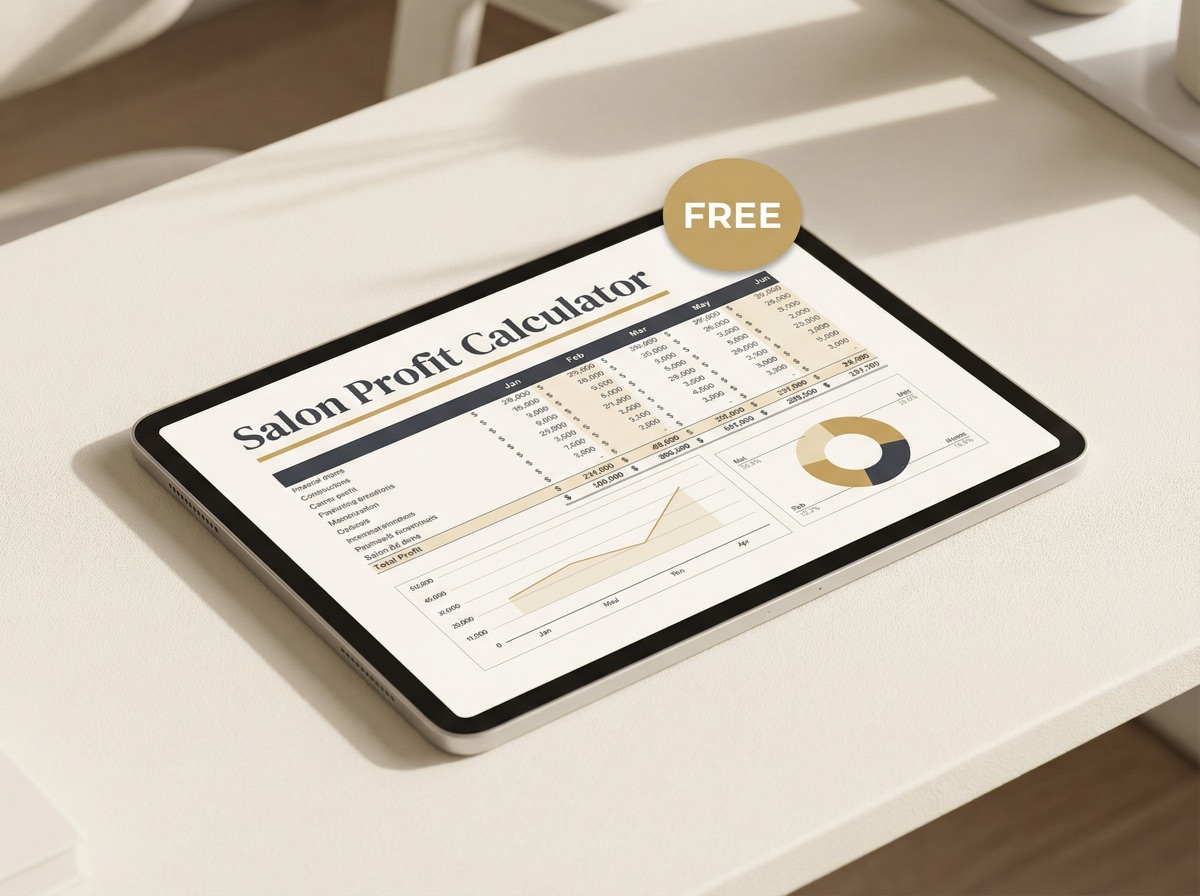
Written by Scott Farmer
Licensed Master Cosmetologist (GA & FL), former Toni & Guy Artistic Director, and founder of Hair Salon Pro. 30+ years behind the chair. 15,000+ clients. Building the business tools cosmetology school never taught. Currently behind the chair at scottfsalon.com in Venice, FL.