I Paid Myself $800 a Week Running a Full Salon. Here Is What Salon Owners Actually Take Home.
 Scott Farmer
·
June 22, 2026
·
10 min read
Scott Farmer
·
June 22, 2026
·
10 min read
Quick Answer: Most salon owners take home between 30% and 50% of their gross revenue, but many keep far less because they never separate their personal draw from business profit. A salon pulling $15,000 a month in revenue might only leave the owner $4,500 to $7,500 after rent, product costs, payroll, insurance, taxes, and maintenance. The number depends on your business model, your overhead costs, and whether you actually track what you keep. I ran a full salon for years and paid myself $800 a week on $18,000 in monthly revenue. That is 17.7%. Here is why.
TL;DR:
– Salon owner take-home pay is not the same as salon revenue
– The average net profit margin for a salon owner ranges from 8% to 20% of gross revenue
– Your business model (commission, booth rental, solo suite) changes the math completely
– Self-employment tax, product costs, and overhead eat more than most owners expect
– Track your owner’s draw separately from business expenses to know your real number
Where Does $18,000 a Month Actually Go?

When I ran JScott Salon, we were pulling $18,000 a month in gross revenue. I thought I was doing well. I was fully booked. The chairs were full. Clients were rebooking.
I was paying myself $800 a week. That is $3,200 a month out of $18,000.
Here is where the other $14,800 went.
| Expense Category | Monthly Cost | % of Revenue |
|---|---|---|
| Rent + utilities | $3,200 | 17.8% |
| Stylist payroll (commission) | $5,400 | 30.0% |
| Product and back bar | $1,800 | 10.0% |
| Insurance (liability + workers comp) | $650 | 3.6% |
| Marketing + software | $450 | 2.5% |
| Supplies + maintenance | $400 | 2.2% |
| Credit card processing fees | $360 | 2.0% |
| Self-employment tax reserve | $1,540 | 8.6% |
| My take-home (owner’s draw) | $3,200 | 17.7% |
| Buffer / reinvestment | $1,000 | 5.6% |
That 17.7% was my real number. Not 100% of revenue. Not even 50%. After I paid the rent, the stylists, the product company, the insurance, the IRS, and the credit card processor, 17.7% was mine.
I did not know that number for the first two years I owned the salon. I looked at the bank balance and hoped it was enough.
The Mistake I See Salon Owners Make Every Time
When someone asks me what they should be paying themselves, I do not look at their revenue first. I look at what is left after every expense that touches the business.
Most salon owners do it backwards. They see $15,000 come in. They pay themselves $4,000 because it feels right. Then they scramble to cover rent, product orders, and quarterly taxes with whatever is left.
That is how you end up fully booked and broke.
The fix is simple math, but most cosmetology schools never teach it. You need to know your operating expenses before you set your owner’s draw.
What “Take-Home Pay” Actually Means for a Salon Owner
Salon owner take-home pay is different from a W-2 salary. When you work for someone else, your paycheck is your paycheck. Taxes are withheld. Benefits are covered. You keep what hits your bank account.
When you own the salon, your take-home is your owner’s draw. That is the money you pull from the business after covering every operating expense. It is not a salary in the traditional sense. It is what is left.
Your owner’s draw depends on:
- Gross revenue (total money coming in the door)
- Overhead costs (rent, utilities, insurance, software, supplies)
- Cost of goods (product, back bar, retail inventory)
- Payroll (if you pay commission stylists or assistants)
- Self-employment tax (15.3% on net earnings for sole proprietors and single-member LLCs)
- Business structure (sole proprietor vs. S-Corp changes your tax math)
- Debt service (salon buildout loans, equipment leases)
Until you subtract all of those, you do not know your take-home pay. You know your revenue.
Salon Owner Take-Home by Business Model
Your business model changes the math more than almost anything else. Here is the same $15,000 in monthly revenue under three different structures.
Commission Salon Owner
You own the space, employ stylists, and pay them a percentage of their service revenue.
- Gross revenue: $15,000
- Stylist commission (45%): -$6,750
- Rent + utilities: -$2,800
- Product + back bar: -$1,200
- Insurance: -$500
- Marketing + software: -$350
- Processing fees: -$300
- Self-employment tax reserve: -$480
- Owner’s draw: $2,620 (17.5%)
The commission model gives you the most revenue but the most overhead. Payroll is the biggest line item, and it scales with every stylist you add.
Booth Rental Salon Owner
You own or lease the space and rent chairs to independent stylists at a flat monthly rate.
- Booth rent collected (4 chairs x $1,200): $4,800
- Your own service revenue: $10,200
- Total gross: $15,000
- Rent + utilities: -$2,800
- Product (your chair only): -$600
- Insurance: -$400
- Marketing + software: -$200
- Processing fees: -$300
- Self-employment tax reserve: -$1,680
- Owner’s draw: $8,220 (54.8%)
Booth rental flips the model. You collect rent from other stylists and keep your own service revenue. Your overhead drops because the renters buy their own product, manage their own schedules, and handle their own taxes.
The trade-off: you have less control over the client experience, and booth renters can leave with 30 days notice.
Solo Suite Owner
You rent a single suite, work alone, and keep everything you earn.
- Gross revenue: $15,000
- Suite rent: -$1,800
- Product: -$750
- Insurance: -$250
- Marketing + software: -$200
- Processing fees: -$300
- Self-employment tax reserve: -$1,810
- Owner’s draw: $9,890 (65.9%)
The solo suite model gives you the highest take-home percentage because you have the fewest expenses. No payroll. No shared utilities. No common area maintenance.
The limit is your time. You can only serve as many clients as your hours allow. There is no leverage from other stylists’ revenue.
The Tax Line Nobody Talks About
Self-employment tax is the line that surprises every new salon owner.
If you are a sole proprietor or single-member LLC, you owe 15.3% on your net earnings. That covers Social Security (12.4%) and Medicare (2.9%). A W-2 employee splits this with their employer. When you own the salon, you pay both halves.
On $60,000 in net earnings, that is $9,180 before you even get to income tax.
This is why many salon owners who hit $100,000+ in net earnings switch to an S-Corp structure. As an S-Corp, you pay yourself a “reasonable salary” and take the rest as distributions, which are not subject to self-employment tax. The savings can be $5,000 to $15,000 a year depending on your numbers.
Talk to a CPA before making this switch. The IRS has rules about what counts as a “reasonable salary,” and getting it wrong creates problems.
What Percentage Should You Actually Keep?
There is no universal rule, but here are the benchmarks I use when I look at a salon’s numbers.
| Business Model | Healthy Owner Take-Home | Warning Sign |
|---|---|---|
| Commission salon owner | 15-25% of gross revenue | Below 12% |
| Booth rental salon owner | 40-55% of gross revenue | Below 35% |
| Solo suite owner | 55-70% of gross revenue | Below 45% |
If your take-home percentage is below the warning sign for your model, one of three things is usually wrong:
-
Your pricing is too low. Your service prices have not kept up with your costs. This is the most common problem I see. I have watched salon owners hold the same prices for 3 years while rent, product, and insurance all went up. The pricing leaks most owners miss explains where the gaps hide.
-
Your overhead is too high. Rent above 20% of gross revenue is a red flag. Product costs above 12% mean you are over-ordering or under-charging for color. The lease clauses that quietly destroy margin covers the fixed-cost traps.
-
Your compensation model is leaking. If you run a commission salon, anything above 50% commission to stylists leaves almost nothing for you. Why tiered commission still leaks money breaks down the math.
How I Flipped My Take-Home in Venice
When I moved to Venice, Florida and started working as a solo stylist, my take-home percentage went from 17.7% to over 60%.
Same skills. Same 30 years of experience. Same Toni & Guy training, same Redken and Paul Mitchell certifications. The difference was the business model.
I stopped paying commission to other stylists. I stopped covering a 2,000 square foot lease. I stopped buying back bar for 4 chairs. My overhead dropped from $14,800 a month to under $4,000.
The revenue was lower because I was working alone. But the take-home was higher because I was keeping a bigger percentage of every dollar.
That does not mean solo is better than a full salon. It means the business model you choose determines what you keep more than the revenue number on your P&L statement.
Run Your Own Numbers
The numbers in this post are based on my experience at JScott Salon and my current practice in Venice. Your rent is different. Your product costs are different. Your tax situation is different.
That is why I built the Salon Profit Calculator. Plug in your actual numbers and see what you keep after every expense.
Run the free Salon Profit Calculator to see your real take-home. No email required.
Want to go deeper? The Profit Audit walks through every line of your expenses and shows you exactly where your profit leaks are hiding.
Common Mistakes That Shrink Your Take-Home
-
Not separating personal and business accounts. If salon revenue and your grocery money go into the same checking account, you will never know your real take-home. Open a separate business account. Transfer your owner’s draw on a fixed schedule.
-
Skipping quarterly tax payments. The IRS expects estimated payments 4 times a year. Miss them and you owe penalties plus a lump sum in April that wrecks your cash flow.
-
Ignoring retail margins. Retail product sales are 40-50% margin compared to 30-40% margin on services. Most salon owners treat retail as an afterthought. Every retail sale you miss is the easiest profit you are leaving behind.
-
Not tracking back bar cost per service. If you are using $8 of color on a $95 service, your product cost is 8.4%. If you are using $18 of color on the same service, it is 18.9%. That 10-point difference on 20 color clients a week is $800 a month out of your take-home.
-
Setting prices once and never adjusting. Your costs go up every year. Your prices should too. A 5% annual price increase on a $100 average service is $5 per client. On 25 clients a week, that is $6,500 more per year in your pocket.
FAQ
How much does a salon owner make per year?
Salon owner income ranges from $35,000 to $120,000 per year depending on business model, location, and overhead. The median is around $55,000, but that number hides huge variation. A commission salon owner keeping 17% of $180,000 in annual revenue takes home $30,600. A solo suite owner keeping 65% of the same revenue takes home $117,000.
Is owning a salon profitable?
Owning a salon can be profitable, but the average net profit margin for salon businesses is 8% to 20%. Profitability depends on controlling overhead costs, pricing services correctly, and tracking your actual expenses. Many salon owners are profitable on paper but underpay themselves because they do not separate their owner’s draw from business reinvestment.
What is the difference between salon owner salary and owner’s draw?
A salary is a fixed amount paid through payroll with taxes withheld. An owner’s draw is money pulled from business profits, common for sole proprietors and LLC members. Most salon owners use an owner’s draw rather than a formal salary unless they operate as an S-Corp. With an S-Corp, you pay yourself a reasonable salary and take additional profit as distributions.
How do I pay myself as a salon owner?
Set your owner’s draw based on your net profit margin, not your gross revenue. Calculate your total monthly expenses, subtract them from revenue, set aside 25-30% of the remainder for taxes, and the rest is your draw. Transfer it to your personal account on a fixed schedule. Do not spend from the business account.
What Salon Owners Ask Next
What percentage of salon revenue should go to rent? Keep rent at or below 20% of gross revenue. At JScott Salon, rent was 17.8% of gross, and that was tight. Above 20%, every slow week starts eating your take-home directly. If your rent is above 25%, you either need to raise prices or find a smaller space. The full salon profit margin breakdown covers every expense line.
Should I switch from sole proprietor to S-Corp? Most CPAs recommend considering the switch when your net earnings consistently exceed $60,000 to $80,000 per year. Below that, the accounting costs and payroll requirements of an S-Corp may not save you enough on self-employment tax to justify the complexity. Get a real number from your accountant before filing.
How do I increase my take-home without raising prices? Cut your highest expense line first. For commission salons, that is usually payroll. For suite owners, it is usually rent. Then look at back bar cost per service. Reducing product waste by $3 per color service across 80 services a month adds $240 straight to your take-home.
What if I am fully booked but still not making enough? Your prices are too low. Being fully booked with thin margins means you are giving away your time at a discount. Run your numbers through the Salon Profit Calculator to see what your hourly rate actually works out to after expenses.
Free Download
Get the Salon Profit Calculator
See exactly where your salon is losing money — in under 5 minutes.
Download Free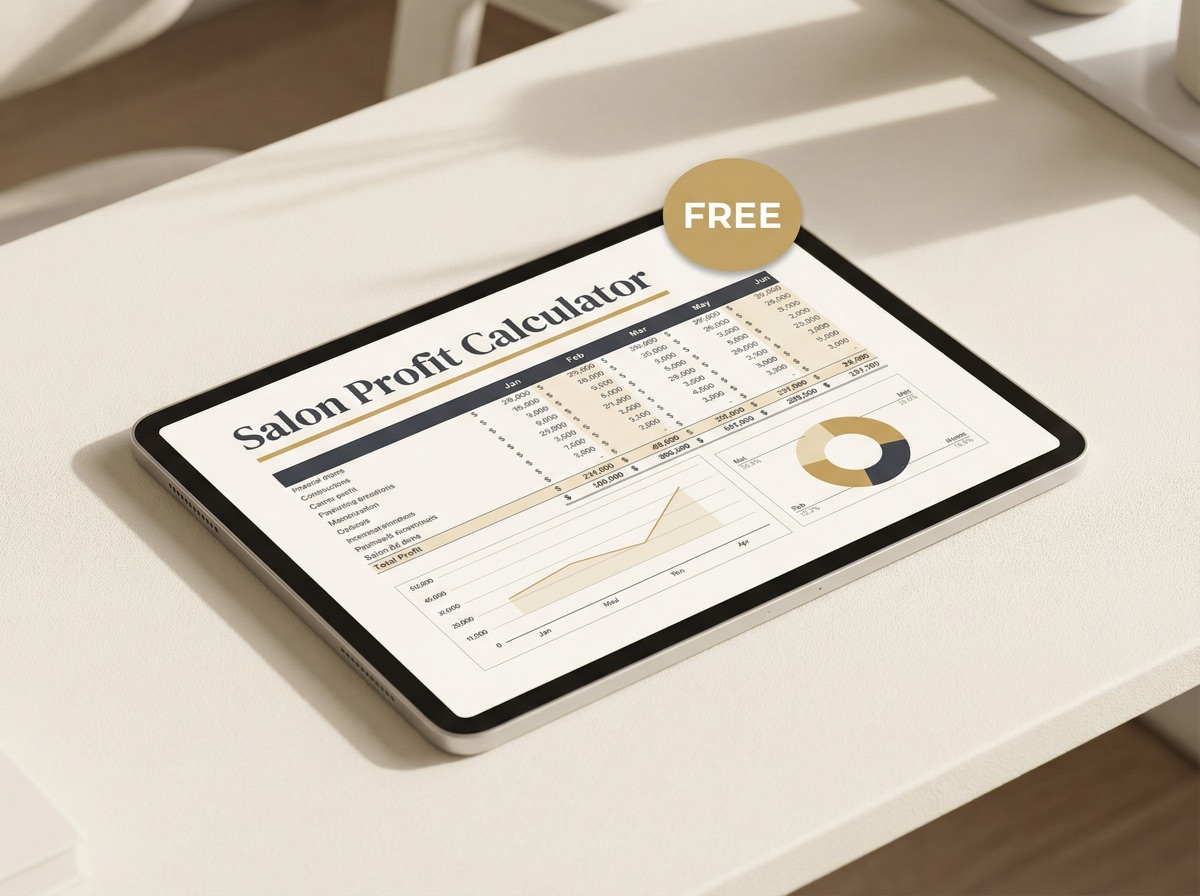
Written by Scott Farmer
Licensed Master Cosmetologist (GA & FL), former Toni & Guy Artistic Director, and founder of Hair Salon Pro. 30+ years behind the chair. 15,000+ clients. Building the business tools cosmetology school never taught. Currently behind the chair at scottfsalon.com in Venice, FL.