How to Cut Salon Back Bar Costs Without Switching to Cheap Products
 Scott Farmer
·
June 20, 2026
·
13 min read
Scott Farmer
·
June 20, 2026
·
13 min read
Quick Answer:
Salon back bar costs should run 8% to 12% of your service revenue. Most salons run 15% to 22% because of unmeasured product use, over-mixing color, and expired inventory. At $150,000 in annual services, dropping from 20% to 10% back bar saves $15,000 per year. That is $1,250 per month in profit. You do not need cheaper products. You need measured portions and tracked costs per service.
TL;DR

- Your back bar target is 8% to 12% of service revenue. If you are above 15%, you have a product cost leak. At $10,000/month in services, that leak costs you $300 to $500 per month.
- The three biggest product cost killers are over-mixing color, failing to charge for extra product on thick or long hair, and letting product expire on the shelf.
- I ran JScott Salon for years before I tracked back bar costs per service. When I finally weighed my color mixes and calculated product cost per appointment, I found I was wasting $380/month on color alone.
- Measuring product use takes five minutes per day and pays back $3,000 to $6,000 per year for a solo stylist.
- Run your numbers in the free Salon Profit Calculator to see how your product costs affect your real margin.
Last updated: June 2026
What Are Salon Back Bar Costs?
Back bar costs are the professional products you use on clients during services but do not sell. Color, developer, toner, deep conditioners, finishing products, foils, gloves, mixing bowls, processing caps. Anything that gets consumed during an appointment and goes in the trash or down the drain.
This is separate from retail. Retail products sit on your shelf waiting for a client to buy them. Back bar products sit behind your station and you use them to deliver the service.
In accounting, back bar falls under cost of goods sold (COGS). That number matters because it directly reduces your gross profit. If you charge $200 for a balayage and use $38 in product, your gross profit on that service is $162 before labor, rent, or anything else.
Most stylists know what they charge. Very few know what each service costs them in product. That gap is where profit disappears.
What Should Salon Back Bar Costs Be?
Industry benchmarks from salon business consultants and the SBA’s financial management guidelines point to these ranges for product cost as a percentage of service revenue:
| Back Bar % of Service Revenue | Rating |
|---|---|
| 6% to 8% | Excellent (typical of high-volume, efficient salons) |
| 8% to 12% | Healthy (target range for most salons) |
| 12% to 15% | Caution zone (common but fixable) |
| 15% to 22% | Profit leak (most salon owners live here without knowing it) |
| 22%+ | Emergency (often color-heavy salons with zero measurement) |
Here is what those percentages look like in dollars at different revenue levels.
| Monthly Service Revenue | 10% Back Bar | 18% Back Bar | Monthly Leak |
|---|---|---|---|
| $6,000 (solo booth renter) | $600 | $1,080 | $480 |
| $10,000 (busy solo) | $1,000 | $1,800 | $800 |
| $20,000 (small team) | $2,000 | $3,600 | $1,600 |
| $40,000 (mid-size salon) | $4,000 | $7,200 | $3,200 |
That “monthly leak” column is pure profit loss. Not revenue. Profit. Because those product costs come straight off your gross margin.
I ran JScott Salon for years with a product percentage I never calculated. When I finally sat down with receipts and a scale, I was at 19%. For a salon doing $25,000/month in services, that 19% was $4,750. Dropping to 11% saved $2,000/month. No price increases. No new clients. Just measuring what I was already using.
The Three Biggest Back Bar Cost Killers
1. Over-Mixing Color
This is the number one product waste problem in every salon I have worked in or consulted for. It shows up two ways.
Mixing too much per client. A standard single-process application on medium-length, medium-density hair uses about 2 ounces of color mixed with 2 ounces of developer. That is 4 ounces total. Most stylists mix 6 to 8 ounces “just in case.” That extra 2 to 4 ounces goes in the trash.
At a product cost of roughly $1.50 per ounce for professional color (varies by brand), wasting 3 extra ounces per color service costs $4.50. If you do 8 color services per day, 5 days a week, that is $900/month in wasted color.
Not adjusting for hair density and length. A chin-length bob with fine hair needs less than half the product of waist-length, thick hair. But most stylists mix the same amount for both. The fix is simple: mix in stages. Start with a measured amount. Add a second mix only if you run out. You will run out less often than you think.
When I was training stylists during my time as an Artistic Director at Toni and Guy, I taught measured mixing as a fundamental skill. Not because the company required it (they did not), but because I watched thousands of dollars in product go down the drain every month across the salon floor.
2. Not Charging for Extra Product
Long hair, thick hair, corrective work, and multi-process services all use more product. If your prices do not reflect that, you absorb the extra cost.
Here is an example. A balayage on shoulder-length hair might use $18 in lightener, developer, toner, and toning shampoo. The same balayage on hair past the bra strap could use $32 to $40 in product. If you charge the same price for both, the long-hair client costs you $14 to $22 more in product alone. Add the extra 30 to 45 minutes of labor and you might be losing money on the service.
The fix: build tiered pricing into your service menu. Short, medium, long. Three price points. Most clients expect this. The ones who push back are the ones costing you the most.
Use the salon pricing formula to calculate your true cost at each length tier. You will see exactly where the money leaks.
3. Expired and Unused Product
Walk to your back bar right now. Pull out every product. Check dates. If you run a salon with a team, I guarantee you will find product that has been sitting there for 6 months or longer.
Expired product is money you already spent and will never recover. It does not show up as a dramatic loss. It shows up as slow margin erosion that you attribute to “business is just expensive.”
At JScott Salon, I found $1,200 in expired or discontinued product during my first real inventory audit. Color that a stylist ordered for one client and never used again. Deep conditioners bought in bulk on a deal that nobody used because they preferred a different brand. Developer that separated and was no longer reliable.
Monthly inventory count prevents this. Not annual. Monthly. It takes 60 to 90 minutes for a solo stylist, 2 to 3 hours for a salon with a team. That investment recovers itself within the first month.
How to Calculate Your Back Bar Cost Per Service
This pairs directly with the cost per service formula. Here is the back bar portion isolated.
Step 1: Weigh or measure your product use for one week.
Use a digital kitchen scale ($15 on Amazon). For every service, note:
- Service type (cut, single process, balayage, highlights, treatment)
- Products used (brand, type)
- Amount used (ounces or grams)
Record this on paper, a spreadsheet, or a notes app. Five seconds per product per service.
Step 2: Calculate cost per ounce for each product.
Take the wholesale price you paid (not retail) and divide by total ounces in the container.
Example: A tube of professional color costs $9.50 and contains 2.1 ounces. Cost per ounce = $4.52.
Developer: $12 for 32 ounces = $0.38 per ounce.
Lightener: $45 for 16 ounces of powder = $2.81 per ounce.
Step 3: Multiply usage by cost per ounce for each service.
A single-process color service using 2 oz of color ($4.52/oz) and 2 oz of developer ($0.38/oz):
Product cost = (2 x $4.52) + (2 x $0.38) = $9.04 + $0.76 = $9.80
Now add shampoo (~$0.40), conditioner (~$0.30), styling product (~$0.50), gloves ($0.15), foil if used, and you get the total back bar cost for that single service.
Step 4: Compare product cost to service price.
If you charge $95 for that single process and the product cost is $11.15, your back bar percentage for that service is 11.7%. That is within the healthy range.
If you charge $95 and your product cost is $22 (because you over-mixed and used premium products without adjusting price), your percentage is 23%. That is the emergency zone.
Run every service on your menu through this formula. Use the Salon Break-Even Calculator to see how product costs affect your break-even point across all services.
7 Ways to Cut Back Bar Costs Without Cheap Products
I want to be clear: this is not about switching to discount product lines. The quality of your work depends on the quality of your products. Cheap lightener causes breakage. Cheap color fades in two weeks. Your reputation is not worth a $3/tube savings.
These seven methods reduce waste, not quality.
1. Measure Every Mix
Buy a digital scale. Use it for every color, lightener, and treatment mix. Write the target amounts on a laminated card at each station. This alone cuts product waste by 15% to 25% for most salons, based on data from professional color management systems like Vish and SalonScale.
2. Mix in Stages
Start with the measured amount for the average application. If you need more, mix a second small batch. Stop mixing “just in case.” The 30 seconds to mix a second batch saves $4 to $8 per service in wasted product.
3. Tier Your Pricing by Length and Density
Short, medium, long. Three tiers minimum. Update your service menu pricing to reflect the real product and time differences. This is not upselling. It is accurate pricing. Your clients with bob cuts should not subsidize your clients with waist-length hair.
4. Track Product Cost Per Service Weekly
Spend 10 minutes every Friday tallying your product use against your service count. Your back bar percentage will show up immediately. If it creeps above 12%, you know to check your mixing habits the following week. This is one of the key salon KPIs that most stylists never track.
5. Run Monthly Inventory Counts
Count everything. Record quantities. Compare to last month. Identify products that are not moving. Return or use up slow-moving inventory before ordering more. Dead inventory is dead money.
Your salon inventory management system does not need to be complicated. A spreadsheet with product name, quantity on hand, and wholesale cost works for any solo stylist or small team.
6. Negotiate With Your Distributor
Most salon professionals accept the list price on professional products. Distributors have margin to negotiate, especially for consistent volume buyers. Ask for:
- Volume discounts (buying 12+ tubes instead of 3)
- Free shipping thresholds
- Discontinued product deals (if the product still performs, the label does not matter)
- Education credits that offset purchase costs
I saved $180/month at JScott Salon just by consolidating color orders to hit the free shipping threshold and buying developer in gallon sizes instead of 32-ounce bottles.
7. Audit Your Product Lines
Most salons carry too many product lines. Every brand you carry means separate ordering, different pricing tiers, partial cases sitting on shelves, and products that overlap. Consolidating from three color lines to one or two reduces waste, simplifies inventory, and usually unlocks better volume pricing.
This does not mean you cannot keep a specialty line for corrective work or a specific client base. It means your core 80% of services should run on one consistent line that you buy in volume.
Back Bar Cost Benchmarks by Service Type
These ranges come from industry data reported by salon management platforms and verified against my own 30 years of tracking. The Bureau of Labor Statistics (SOC 39-5012) tracks 670,000+ hairdressers and cosmetologists, though most operate without formal COGS tracking.
| Service | Typical Product Cost | Target % of Price |
|---|---|---|
| Haircut (men’s/women’s) | $1.50 to $4.00 | 3% to 6% |
| Single-process color | $8 to $14 | 8% to 12% |
| Full highlights/foils | $12 to $22 | 8% to 14% |
| Balayage | $15 to $28 | 8% to 14% |
| Color correction | $25 to $60 | 10% to 18% |
| Keratin/smoothing treatment | $20 to $45 | 12% to 18% |
| Deep conditioning treatment | $3 to $8 | 10% to 15% |
| Blowout/style | $2 to $5 | 4% to 8% |
If any service on your menu exceeds the upper bound of its target percentage, you are either under-pricing the service or over-using product. The answer is one of those two things. Not both.
Run every service through the salon pricing formula to check both variables at once.
The Monthly Back Bar Audit (15-Minute Version)
You do not need a full inventory management system to start. Here is the minimum viable audit I use now as an independent stylist in Venice, FL. It takes 15 minutes on the last day of each month.
Step 1 (5 minutes): Pull your total product purchases for the month from your credit card statement or distributor invoices. Write down the total.
Step 2 (5 minutes): Pull your total service revenue for the month from your booking software or bank deposits. Write down the total.
Step 3 (2 minutes): Divide product purchases by service revenue. Multiply by 100. That is your back bar percentage.
Step 4 (3 minutes): Compare to last month. If it went up, check your three biggest cost services (usually color, balayage, and treatments) for over-mixing. If it went down, whatever you did last month is working.
That is it. Fifteen minutes per month. The information is worth thousands per year.
If your salon profit margin feels thin despite being fully booked, your back bar percentage is the first place to look. It is the most common hidden cost I see when working with stylists on their numbers.
Frequently Asked Questions
How much should a salon spend on back bar products per month?
A solo stylist doing $8,000/month in service revenue should spend $640 to $960 on back bar products (8% to 12%). A salon with a team doing $30,000/month in services should spend $2,400 to $3,600. If you are spending more than 15% of your service revenue on product, you have measurable waste. The fix is not buying cheaper product. It is measuring what you use, tiering your pricing by hair length, and running monthly inventory counts.
Is it worth using a product tracking app like Vish or SalonScale?
For a solo stylist or booth renter, a digital kitchen scale and a spreadsheet work fine. The math is simple enough to do manually. For a salon owner with 3 or more stylists, a product management system like Vish or SalonScale can track product use per stylist, per service, and per client automatically. The monthly cost ($30 to $100) pays for itself if your team is wasting more than that in product. Do the manual audit first to find out if you have a waste problem. Then decide if automation is worth the cost.
Should I charge clients extra for thick or long hair?
Yes. This is not optional if you want accurate pricing. A client with fine, chin-length hair uses roughly half the product of a client with thick, waist-length hair. The time difference can be 30 to 60 minutes on color services. If you charge the same price, the long-hair client is a less profitable appointment. Build three tiers into your service menu: short, medium, long. Most clients expect this. Use the salon pricing formula to set each tier based on your actual product and time costs.
What is the biggest back bar expense for most salons?
Professional haircolor and lightener are the largest back bar costs for most salons, typically 50% to 65% of total product expense. Developer is cheap per ounce but adds up in volume. Treatments, deep conditioners, and finishing products are a smaller percentage. If you only have time to measure one thing, measure your color mixing. That is where the biggest waste lives.
How do I reduce back bar costs without losing quality?
Measure your mixing. Use a scale. Mix in stages instead of guessing high. Tier your pricing so long-hair services cover their product cost. Count inventory monthly. Negotiate volume pricing with your distributor. Consolidate to fewer product lines for better purchasing power. None of these steps require switching to a cheaper brand. They require knowing your numbers and stopping unmeasured waste.
The Bottom Line
Your back bar is not just a shelf of products. It is the second largest variable cost in your salon after labor. Every ounce of color you mix and throw away, every tube that expires on the shelf, every long-hair balayage you price the same as a short-hair balayage takes money directly from your paycheck.
The target is 8% to 12% of service revenue. If you do not know your number, you cannot fix it.
Start this week. Weigh your color for five days. Add up your product invoices for the month. Divide by your service revenue. That one number will tell you whether your back bar is a cost center or a profit leak.
Run your full numbers in the free Salon Profit Calculator to see how your product costs, pricing, and overhead combine to create your real take-home pay.
Free Download
Get the Salon Profit Calculator
See exactly where your salon is losing money — in under 5 minutes.
Download Free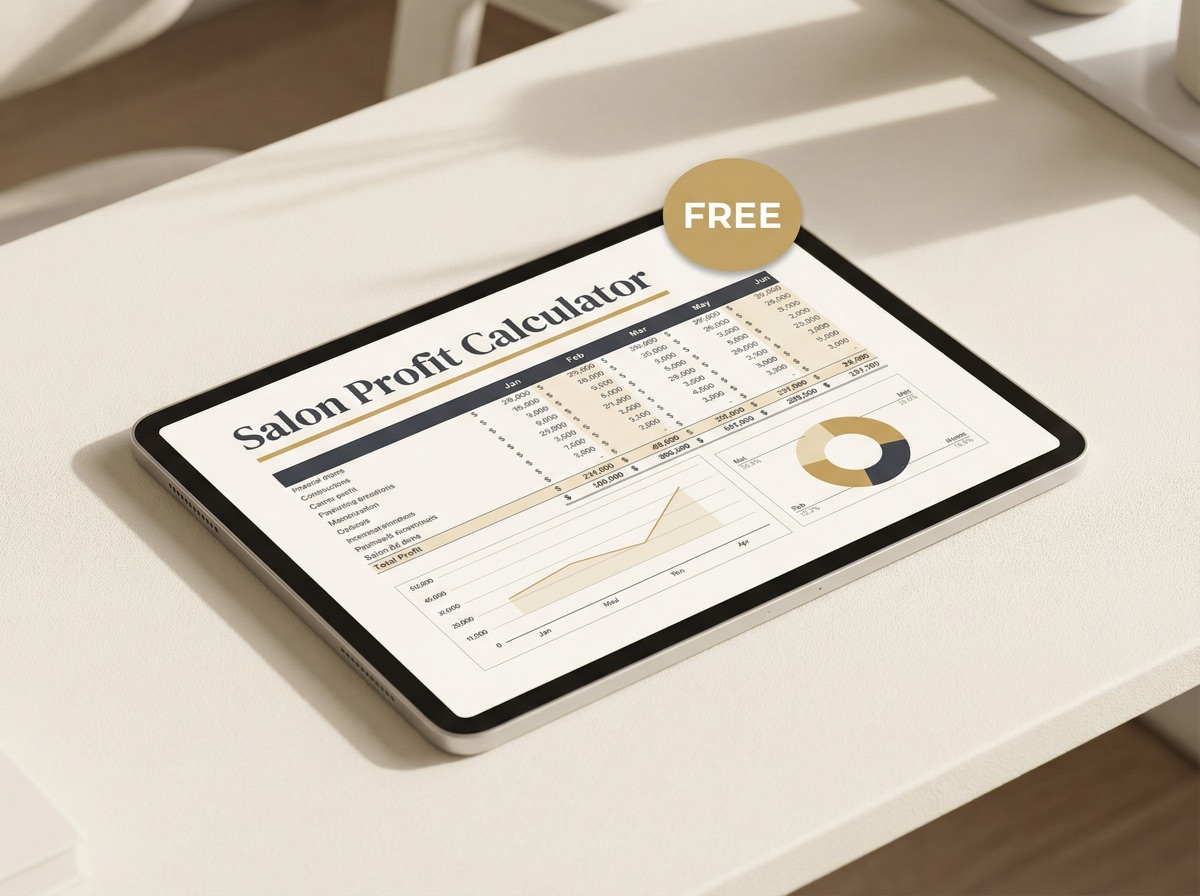
Written by Scott Farmer
Licensed Master Cosmetologist (GA & FL), former Toni & Guy Artistic Director, and founder of Hair Salon Pro. 30+ years behind the chair. 15,000+ clients. Building the business tools cosmetology school never taught. Currently behind the chair at scottfsalon.com in Venice, FL.