Salon Retail Revenue Percentage: What the Top 20% of Salons Hit
 Scott Farmer
·
June 15, 2026
·
12 min read
Scott Farmer
·
June 15, 2026
·
12 min read
TL;DR

- The average salon retail revenue percentage is 8% to 12% of total revenue per Professional Beauty Association benchmarks, with most independent stylists and small salons running at just 3% to 8%. Among the 670,000+ licensed cosmetologists tracked by the Bureau of Labor Statistics (SOC 39-5012), retail is the highest-margin revenue stream in the business yet the most consistently underdeveloped.
- Top-performing salons hit 15% to 20% retail as a percentage of revenue. The formula is
(Retail Sales / Total Revenue) x 100. On $300,000 in annual services, moving from 5% to 15% retail adds $30,000 in revenue. At a 45% gross margin, that is $13,500 in pure profit earned without a single extra hour behind the chair. - Retail profit margin (42% to 50%) is four to five times higher than service net profit margin (8% to 12%). When you buy a product for $14 wholesale and sell it for $28 retail, you keep $14 in 30 seconds. That same dollar tied to a $95 balayage yields $8 to $11 after product cost, overhead allocation, and rent. Retail wins on margin every time.
- I am Scott Farmer, Licensed Master Cosmetologist with over 30 years behind the chair and more than 15,000 clients served across JScott Salon in Lawrenceville, GA and my current suite in Venice, FL. As Artistic Director at Toni and Guy, I watched stylists with consistent retail systems earn 30% to 40% more annually than equally skilled stylists who did not recommend products. Same clients. Same hours. Different take-home.
- Use the free Salon Profit Calculator to see exactly where your retail percentage sits and how much profit you are leaving on the table, then explore HSP Pro Membership for the full Profit-First System.
Last updated: June 2026
3%. That was my salon retail revenue percentage the first year I opened my own salon. I tracked every dollar, and when I saw that number on the P&L, I thought it was a rounding error. It was not. I was leaving tens of thousands of dollars on the counter every year because I treated retail as an afterthought.
Here is what I, Scott Farmer, Licensed Master Cosmetologist, know now after 30 years behind the chair and 15,000 clients, working alongside the 670,000+ licensed cosmetologists the U.S. Bureau of Labor Statistics tracks: retail is not a bonus. It is the single fastest way to increase your profit without adding a single hour of chair time. The profit margin on retail runs 42% to 50%. The margin on services after product, rent, and overhead? Closer to 8% to 12%.
That math should make you uncomfortable. Because if your retail percentage is sitting under 10%, you are working harder for less money than you need to.
What Is Salon Retail Revenue Percentage and Why Does It Matter?
Salon retail revenue percentage measures how much of your total revenue comes from product sales versus services. The formula is simple:
Retail Revenue Percentage = (Retail Sales / Total Revenue) x 100
If your salon did $25,000 in total revenue last month and $1,500 of that was retail, your retail percentage is 6%.
Why does this single number matter so much? Because retail profit behaves differently than service profit.
When you perform a $95 balayage, you spend 2.5 hours in the chair. After product cost ($18), your portion of rent ($12 per hour), and supplies, your actual profit on that service might be $22 to $30. That is real money, but it cost you 150 minutes of your life.
When a client buys a $32 bottle of shampoo on the way out, your wholesale cost was about $16. Your profit: $16. Time spent: 30 seconds handing them the bag.
Retail is not a side hustle. It is the highest-margin revenue stream in your entire business.
What Percentage of Salon Revenue Should Come from Retail?
Industry benchmarks break down into three tiers. Here is where salons land based on data from the Professional Beauty Association and Salon Today’s annual financial surveys:
| Tier | Retail % of Revenue | What It Means |
|---|---|---|
| Below average | Under 8% | Retail is an afterthought. You are relying 100% on chair time for income. |
| Average | 8% to 12% | You recommend products occasionally but have no system in place. |
| Above average | 12% to 15% | Consistent recommendations happening. Products are visible and stocked well. |
| Top performer | 15% to 20% | Retail is a profit center with dedicated strategy, training, and tracking. |
| Elite | 20% to 30%+ | Full integration. Retail is part of every consultation and every checkout. |
Most independent stylists and small salons sit between 3% and 8%. That is the reality. The top 20% of salons hit 15% or higher, and some destination salons push past 25%.
When I was the Artistic Director at Toni and Guy, I watched stylists who recommended retail at every single appointment earn 30% to 40% more annually than equally skilled stylists who did not. Same client count. Same hours. Completely different take-home pay.
The question is not whether retail matters. The question is what your number is right now.
How Do You Calculate Your Salon Retail Revenue Percentage?
You need two numbers from last month:
- Total revenue (services + retail + tips if you count them, though most benchmarks exclude tips)
- Retail revenue (product sales only, not backbar product used during services)
Divide retail revenue by total revenue. Multiply by 100.
Example:
– Total revenue last month: $18,500
– Retail revenue: $925
– Retail percentage: $925 / $18,500 = 5%
If you are a booth renter, your calculation is even simpler because your total revenue is your total revenue. No splits, no commission structures.
For salon owners with multiple stylists, calculate the number per stylist too. I learned this the hard way at my own salon. My overall salon retail percentage looked decent at 11% because two of my stylists were carrying the number. The rest were under 3%. When I started tracking per stylist, I could finally see where the gap was and who needed training.
Our free Salon Profit Calculator runs this math for you automatically. Plug in your service revenue and retail revenue, and it shows you exactly where you land against industry benchmarks.
Why Is Your Salon Retail Percentage So Low?
If your number came in under 8%, you are not alone. And the reason is almost never “my clients do not want to buy products.” I have heard that excuse from hundreds of stylists over three decades, and it is wrong almost every time.
Here is what keeps retail percentages low:
You Are Not Recommending Products During the Service
The number one predictor of retail sales is whether the stylist mentions the product while using it. Not at checkout. During the service. “I am putting this Redken Acidic Bonding Concentrate in right now because your highlights from three weeks ago are starting to feel dry. This is what is going to keep that investment looking fresh between visits.”
That is not a sales pitch. That is professional guidance. The product recommendation happens in context, at the moment when the client can feel the difference. According to the Professional Beauty Association, stylists who mention products during the service convert at 3 to 5 times the rate of those who wait until checkout.
Your Products Are Not Visible
If your retail display is a dusty shelf behind the reception desk, your clients are not seeing it. When I redesigned the retail area at my own salon (eye level, well-lit, organized by concern instead of brand), retail jumped from 6% to 11% in 90 days. Zero extra selling. Just visibility.
You Do Not Track Retail as a KPI
What you do not measure does not improve. If you are not looking at your salon KPIs every single week, retail percentage will drift down over time. It is the metric that decays fastest when nobody is watching it.
You Are Afraid of Being Pushy
This is the big one. Most stylists avoid retail because they confuse recommending with selling. But your clients are going to buy hair products somewhere. The question is whether they buy the right ones from you or the wrong ones from a drugstore. If you want the full breakdown on how to recommend without feeling gross, I wrote an entire guide on salon retail sales strategy that walks through exactly what to say and when.
What Does a $48,000 Retail Gap Look Like in Real Numbers?
Let me run the math on a real scenario because this is where it gets painful.
Salon A: $400,000 annual service revenue. Retail at 3%.
Salon B: $400,000 annual service revenue. Retail at 15%.
| Metric | Salon A (3%) | Salon B (15%) |
|---|---|---|
| Annual service revenue | $400,000 | $400,000 |
| Annual retail revenue | $12,000 | $60,000 |
| Retail profit (45% margin) | $5,400 | $27,000 |
| Retail profit difference | Baseline | +$21,600 |
| Service profit (10% net) | $40,000 | $40,000 |
| Total profit | $45,400 | $67,000 |
Salon B makes $21,600 more in profit. Same number of clients. Same hours behind the chair. Same service menu. The only difference is a consistent system for recommending retail.
For a solo booth renter doing $120,000 in annual services, the gap is still significant:
| Metric | 3% Retail | 15% Retail |
|---|---|---|
| Annual retail revenue | $3,600 | $18,000 |
| Retail profit (45%) | $1,620 | $8,100 |
| Extra annual profit | Baseline | +$6,480 |
That is $540 per month in extra profit. Enough to cover your product costs for the year with money left over. And it came from 30-second conversations you were already having with clients who already trust you.
How Can You Increase Your Salon Retail Revenue Percentage from 5% to 15%?
Here is the system I built over 30 years. It works whether you are a solo booth renter or running a team of eight.
Step 1: Know Your Current Number
You cannot improve what you have not measured. Pull last month’s numbers right now. If you do not have clean records, start today. Track service revenue and retail revenue separately every single day. Our Salon Profit Calculator does this in under two minutes.
Step 2: Set a 90-Day Target
Do not try to jump from 3% to 20% in a month. Move in realistic increments:
– Under 5%? Target 8% in 90 days.
– At 8%? Target 12%.
– At 12%? Target 15%.
Each percentage point of improvement adds real money. On $150,000 in annual services, every 1% increase in retail percentage means $150,000 x 1% = $1,500 more revenue and about $1,500 x 45% = $675 in pure profit.
Step 3: Prescribe Two Products Per Client
Not sell. Prescribe. You used products during the service. Tell the client what you used and why. Then recommend one to take home. If you can work two product mentions into every appointment, your conversion rate will climb without any change in sales skill.
The scripts in our Price Increase Script Pack include retail conversation starters that feel natural, not salesy. They are free.
Step 4: Reorganize Your Display by Problem, Not Brand
Nobody walks into a salon thinking “I need Redken.” They walk in thinking “my hair is dry” or “my color fades too fast.” Organize your retail area by concern: moisture, volume, color protection, smoothing. When the client sees their problem on the shelf, the product sells itself.
Step 5: Track Per Stylist and Review Weekly
If you manage a team, the single most effective change is posting individual retail numbers weekly. Not publicly shaming anyone. Just transparent tracking. At my own salon, the week I started sharing per-stylist retail percentages in our Monday meeting, the salon average jumped from 8% to 12% within a month. Competition and awareness drove the change, not pressure.
Step 6: Stock Fewer Products, Stock the Right Ones
A cluttered retail display with 80 SKUs confuses clients and gathers dust. The top retail salons I have worked with stock 20 to 30 SKUs maximum and reorder based on what moves. A smaller, curated selection with higher turnover beats a massive display with low sell-through every time.
What Retail Profit Margin Should You Expect?
The standard wholesale-to-retail markup in professional hair care is 100%, which gives you a 50% gross margin. Here is what that looks like at different price points:
| Retail Price | Wholesale Cost | Gross Profit | Margin |
|---|---|---|---|
| $18 | $9 | $9 | 50% |
| $28 | $14 | $14 | 50% |
| $38 | $19 | $19 | 50% |
| $52 | $26 | $26 | 50% |
Compare that to your service margin. If your salon profit margin on services nets 8% to 12% after all costs, retail at 45% to 50% margin is four to five times more profitable per dollar. That is the reason top earners focus on retail. It is not about being good at selling. It is about understanding where the margin lives.
Some product lines offer better margins than others. Salon-exclusive brands that are not available on Amazon or at Target tend to command higher margins and lower price resistance from clients. My Redken and Paul Mitchell background taught me that brand exclusivity is not just marketing. It is margin protection.
Frequently Asked Questions
What is the average salon retail revenue percentage?
The industry average sits between 8% and 12% of total revenue, according to Professional Beauty Association benchmarks. However, most independent stylists and small salons run closer to 3% to 8%. The gap between average and top-performer (15% to 20%) represents thousands of dollars in annual profit.
How much should a booth renter make from retail?
A booth renter doing $10,000 per month in services should target at least $1,000 to $1,500 per month in retail revenue (10% to 15%). At a 45% margin, that is $450 to $675 in monthly profit from product sales alone. That is money earned in 30-second conversations, not hours behind the chair.
What retail products sell best in salons?
Shampoo and conditioner are the highest-volume items, but styling products and treatments generate the highest per-unit profit. The best-selling retail items are the ones you use during the appointment and explain to the client in real time. Product familiarity drives purchasing more than any display or discount.
How does retail revenue affect salon valuation?
Strong retail revenue increases salon valuation because it demonstrates revenue that is not 100% tied to the owner’s time behind the chair. Buyers and appraisers look favorably at salons where retail contributes 15% or more of revenue because it signals systems, training, and client loyalty.
Should I discount retail products to increase my percentage?
No. Discounting retail trains clients to wait for sales and destroys your margin. A $28 product at 20% off drops your profit from $14 to $8.40. Instead of discounting, bundle products with services or create take-home kits at full price. The value is in the professional recommendation, not the price tag.
What is a good retail-to-service ratio?
A healthy retail-to-service ratio is 1:6 to 1:5, meaning for every $5 to $6 of service revenue, you generate $1 of retail revenue. Elite salons hit 1:4 or better. If your ratio is 1:20 or worse, you have significant room to grow without adding a single new client.
How often should I review my salon retail percentage?
Weekly. This is one of the key salon KPIs that drifts fast when nobody watches it. Monthly reviews catch trends too late. Weekly tracking lets you spot dips, adjust product placement, and coach your team before a slow retail month becomes a slow retail quarter.
What Is Your Next Step to Growing Salon Retail Revenue?
Your retail percentage is one of the fastest levers you can pull to increase your take-home pay. You do not need more clients. You do not need longer hours. You need a system for recommending the products you are already using on every client who sits in your chair.
Start here: Run your numbers through our free Salon Profit Calculator to see exactly where your retail percentage sits and how much profit you are leaving on the table. When you are ready for the full Profit-First System (AI profit analysis, weekly coaching, and the complete pricing toolkit), explore HSP Pro Membership.
Free Download
Get the Salon Profit Calculator
See exactly where your salon is losing money — in under 5 minutes.
Download Free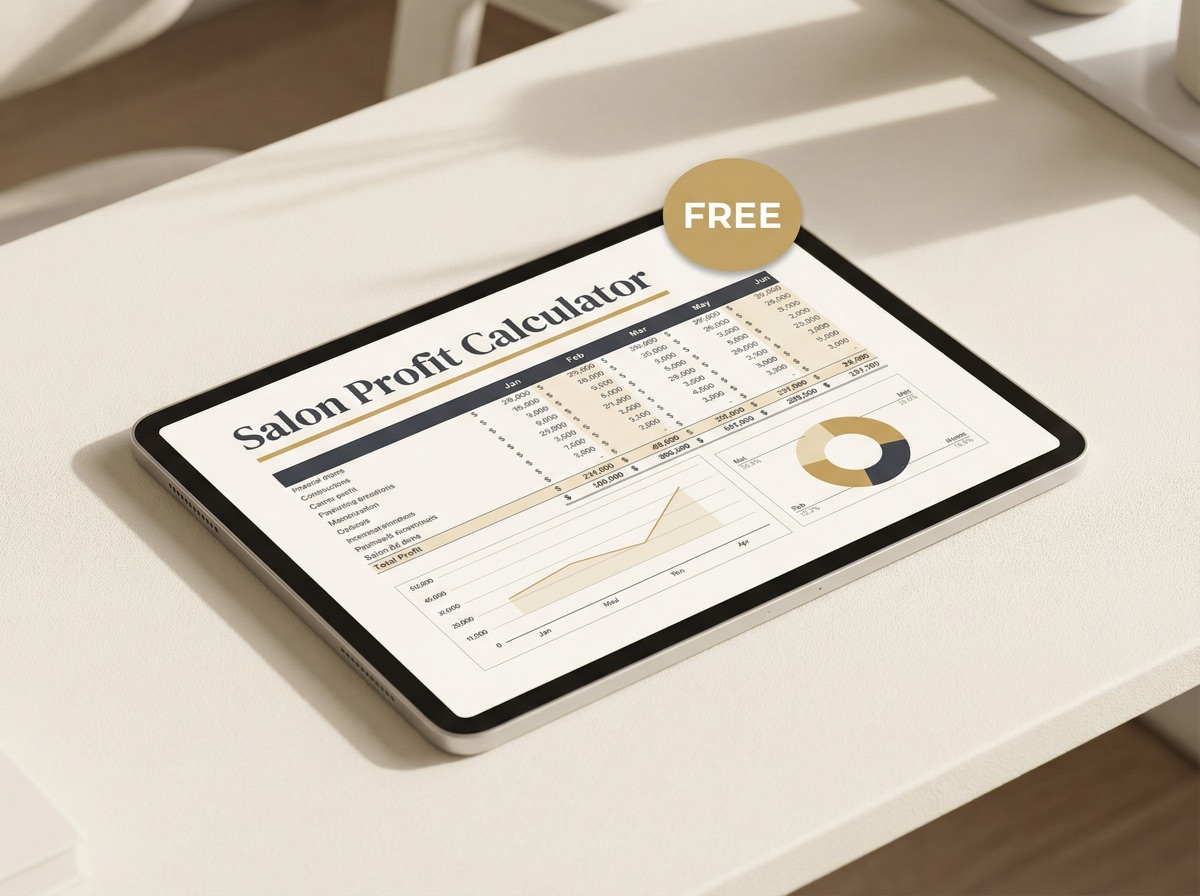
Written by Scott Farmer
Licensed Master Cosmetologist (GA & FL), former Toni & Guy Artistic Director, and founder of Hair Salon Pro. 30+ years behind the chair. 15,000+ clients. Building the business tools cosmetology school never taught. Currently behind the chair at scottfsalon.com in Venice, FL.