Why Do Stylists Walk Out Mid-Shift? The Walk-Out Epidemic and the One Conversation That Stops It
 Scott Farmer
·
June 24, 2026
·
14 min read
Scott Farmer
·
June 24, 2026
·
14 min read
Quick Answer: Stylists walk out mid-shift because of three root causes: disrespect from management in the moment, a festering problem that was never addressed, or the final breaking point of a mismatch they spotted months earlier. A 10-minute check-in conversation every two weeks, where you ask two specific questions and actually listen, eliminates 80% of the conditions that lead to a walk-out before they escalate.
TL;DR

- Stylist walk-outs cost salon owners an average of $4,200 to $11,000 per incident when you factor in lost bookings, emergency schedule reshuffling, recruitment, and 60 to 90 days of onboarding a replacement
- Most walk-outs are not impulsive. They are the final act of someone who stopped expecting things to change months earlier
- The leading triggers are not pay. They are feeling disrespected, invisible, or trapped in a system they cannot influence
- A structured 15-minute check-in every two weeks, using two specific questions, addresses the slow burn before it ignites
- Scott Farmer ran JScott Salon for years with 18 chairs. He lost stylists to walk-outs twice. Both cost him clients, revenue, and sleep. Here is what he learned.
I lost two stylists to mid-shift walk-outs in my years running JScott Salon.
The first one left on a Thursday afternoon, 90 minutes before her last appointment. She took her kit, walked out the back door, and never came back. I found out when the front desk called me saying her 4 o’clock was waiting.
The second one gave me a 60-second notice while I was in the middle of a color application. She handed me her apron and said she was done.
Both times, I told myself it came out of nowhere.
Both times, I was wrong.
The Real Cost of a Stylist Walking Out
Before we talk about the conversation that prevents this, I want to show you the math. Because most salon owners I talk to underestimate what a single walk-out actually costs.
Here is a conservative breakdown for a mid-level stylist booked at 70% capacity:
Day of the walk-out:
– 4 to 6 appointments canceled or reshuffled: average $85 per service
– That is $340 to $510 in immediate lost revenue
– Plus tips the clients already expected to give
The following 3 weeks:
– Clients whose regular stylist just disappeared now book somewhere else
– A stylist with 40 loyal clients loses you 8 to 15 of those clients permanently
– At $85 per visit, 10 visits per year: that is $850 per lost client, per year
– Lose 10 clients: $8,500 in annual revenue gone
Replacement cost:
– Job posting, interview time, background check: $200 to $400
– Onboarding and training time: 20 to 40 hours at your hourly cost
– The new hire runs at 40% productivity for the first 90 days
– Realistic total: $3,000 to $6,000 in soft costs before they book a full column
Add it up. One walk-out is a $4,200 to $11,000 event.
I am not saying this to make you feel bad. I am saying it so the conversation I am about to give you feels worth 15 minutes of your time.
Why Stylists Actually Walk Out
I spent a long time after my second walk-out asking the wrong question. I asked: what did I do wrong that day?
The right question is: what did I miss in the months before?
Walk-outs are almost never impulsive. Research on service-industry employee turnover consistently shows that most resignations, including sudden ones, are the result of a decision made weeks or months earlier. The day of the walk-out is just when the cost of staying finally exceeded the cost of leaving.
Here are the three root causes I see in salons:
Root cause 1: A single moment of public disrespect.
Being corrected, criticized, or dismissed in front of clients or coworkers. For stylists, whose entire professional identity is tied to their craft and their client relationships, public disrespect lands differently than it does in an office job. One comment in front of the wrong person on the wrong day can cross a line that cannot be uncrossed.
Root cause 2: A problem that was raised and ignored.
The stylist told you something was wrong: the schedule, the split, the product line, how walk-ins were assigned. You said you would look into it. You did not. They brought it up again. You said you were busy. Weeks passed. When nothing changed, they stopped talking to you about it and started talking to each other.
Root cause 3: A compensation or structure mismatch the stylist figured out months earlier.
They ran the math. They realized that at 35% commission, after product costs, chair time, and the taxes they now have to pay, they are netting $14 an hour on a $90 color service. They started researching booth rental. They started planning. By the time they walked out, they had already moved on mentally. The walk-out was just the paperwork.
Understanding the root cause matters because the fix for each one is different.
The One Conversation That Prevents Most Walk-Outs
I am not going to tell you to implement a formal performance review system. Most salon owners do not have time for that, and most stylists find a quarterly form condescending.
What works is a 10 to 15 minute structured check-in, one-on-one, every two weeks.
Not a chat. Not catching up. A structured check-in with two specific questions.
Question 1: “What is one thing about how we operate here that is making your job harder than it needs to be?”
That question does three things. First, it signals that you are open to hearing operational complaints without taking them personally. Second, it gives them a safe channel. If the answer to this question is “nothing,” you have learned something important. If the answer is “the booking system keeps double-stacking me on Saturdays,” you now have something you can act on.
Act on it, or explain clearly why you cannot. Either way, you closed the loop.
Question 2: “What do you need more of from me in the next two weeks?”
That question is harder to answer than it looks. Most stylists have never been asked directly what they need from their manager. Some will say “nothing.” A few will say something honest: more guidance on pricing conversations, recognition in front of clients, help handling a difficult repeat client.
The point is not that you fix everything they say. The point is that they know you asked. They know you are paying attention. And the moment they feel seen, the likelihood of a quiet walk-out drops.
I learned this framework later than I should have. When I was deep in running JScott Salon, I assumed that stylists who were good at their craft and making decent money were fine. I was wrong about that assumption on both walk-outs.
After losing the second stylist, I started doing these check-ins. In the three years that followed, I did not have a single mid-shift departure.
When the Walk-Out Is About Compensation
I said earlier that most walk-outs are not about pay. That is true. But some are, and you need to recognize the pattern.
If a stylist starts asking specific questions about booth rental, asking to see the service records for their column, or starts discussing “options” with other stylists in a way that stops when you walk in, they have already done the math and are in planning mode.
This is not necessarily a problem you can solve, especially if they are a good fit for independent work. But you can have an honest conversation early enough to either retain them on different terms or plan a proper transition that does not blow up your Saturday schedule.
The conversation sounds like this: “I’ve noticed you asking some questions about different working structures. I want to talk openly about that. If commission is not the right model for where you are in your career, I would rather have that conversation now than lose you in a way that hurts both of us.”
Some stylists will be surprised you noticed and will stay because you made space for the conversation. Some will be relieved and will tell you their timeline. Either outcome is better than the 90-second notice I got the second time.
If you want help understanding what fair compensation structures look like at different revenue levels, I have a breakdown in my post on salon commission structure traps that walks through the real math on tiered splits.
What to Do When a Walk-Out Happens Anyway
Sometimes you do everything right and a stylist still walks out. Maybe they had a personal crisis. Maybe a better opportunity came from out of nowhere. Maybe the culture was wrong for them from the start.
When that happens, here is the sequence:
In the first 24 hours:
– Contact all affected clients personally. Do not have the front desk call. You call. Apologize for the disruption. Offer to book them with another stylist at a 20% discount on their next visit.
– The 20% discount on one visit costs you roughly $17 on an $85 service. That is much cheaper than losing the client permanently.
In the first week:
– Do an honest post-mortem. Pull your salon KPIs for that stylist: average ticket, rebooking rate, client retention. You need this data to brief whoever takes over their column.
– Start the replacement process immediately. Every week of an empty chair at 70% capacity costs you roughly $850 to $1,200 in lost revenue depending on service mix.
In the first month:
– Check in with your remaining stylists. A walk-out sends a message through the team, and what you say or do not say in its aftermath shapes how they read your leadership.
– Do not speak badly about the stylist who left. Ever. Your team notices everything.
The Prevention System That Actually Works
Most salon owners think about retention reactively. They only think about it after someone leaves.
Prevention is a system, not an instinct. Here is the minimum viable version:
Weekly: Notice who is quiet. A stylist who goes from talkative to withdrawn over two weeks is waving a flag. Ask them how they are doing. Not at the station in front of clients. Privately.
Every two weeks: Do the structured check-in with every full-time team member. Takes 15 minutes. Prevents the $11,000 problem.
Every 90 days: Review each stylist’s numbers with them. Average ticket, booking rate, client retention. Make it collaborative, not evaluative. “Here is what your column looks like. Here is where I see room to grow your income. What do you need from me to get there?”
This last one is particularly powerful because it ties your conversation directly to their financial outcomes. A stylist who can see a clear path to earning more has a much lower reason to leave.
I have a full breakdown of the numbers to track in my post on salon KPIs every owner should monitor weekly. That post includes the specific metrics that tell you a stylist is disengaging before they go silent.
For deeper context on the structural side, including how to classify your team correctly so you are not creating misclassification liability while trying to retain people, the post on salon employee vs independent contractor rules walks through the IRS framework that trips up a lot of owners.
Why Salon Owners Miss the Signals
I want to be honest with you about something.
The reason I missed both walk-outs at JScott Salon was not incompetence. It was that I was too close to the floor to see the patterns.
When you are behind the chair 40 hours a week and managing a team on top of that, you are in execution mode constantly. You are not watching for the slow changes in body language, the shift in lunch-break conversations, the small drop in rebooking rate that shows up two months before the walk-out.
My work now through Hair Salon Pro is built around helping salon owners step back from the floor enough to actually run the business. That means having systems for check-ins, systems for tracking numbers, and systems for catching problems before they become a 90-second resignation.
If you are running a salon and feeling like you are always in reactive mode, you might be interested in the free Profit Audit at the link below. It is not just about revenue. It is about identifying the places where your operation is bleeding quietly, including your team.
A Note on Walk-Outs Versus Culture Problems
There is a difference between an individual walk-out and a culture problem.
One walk-out in three years is a random event. Two walk-outs in six months is a signal. Three in one year is a culture problem, and no amount of check-in conversations will fix a culture problem.
If you are seeing repeated sudden departures, the issue is usually one of three things: a compensation structure that does not math out at scale, a management style that creates fear instead of trust, or an undefined culture that lets the wrong dynamics take root.
When I was coming up through the industry, including my years working under the Toni and Guy system, one of the most important things I observed was how their salons built a culture through explicit standards. Not perks. Standards. Clear expectations, clearly communicated, consistently enforced. Stylists knew exactly what was expected of them, which also meant they knew exactly what they could trust you to deliver.
That predictability is what retention is actually built on.
If you are dealing with repeated turnover and not sure whether it is a compensation issue or a culture issue, the salon owner burnout post has a section on leadership warning signs that often predict team problems before revenue shows it.
The Short Version
Stylists do not usually walk out because of one bad shift.
They walk out because they felt invisible for months, raised a concern that went nowhere, or ran the math and realized the structure was not working for them. By the time the walk-out happens, you are already behind.
The fix is ahead of the problem: a 15-minute check-in every two weeks, two questions, and the discipline to actually act on what you hear.
That is the conversation. Run it consistently and you will catch 80% of the issues that become walk-outs before they escalate.
Frequently Asked Questions
How much does a salon stylist walk-out really cost an owner?
The realistic range is $4,200 to $11,000 per incident when you add up same-day lost appointments, permanently lost clients from that stylist’s column, job posting costs, and the productivity gap during the 60 to 90 day onboarding period for a replacement. The number varies based on how loyal that stylist’s client base was and how quickly you can cover the column.
What are the most common reasons stylists quit without notice?
The top three are feeling publicly disrespected by management, having raised a problem that was ignored repeatedly, and having done the math on their compensation and concluded they can net more in a booth rental or suite. Contrary to popular belief, pay is rarely the trigger for the walk-out itself, though it is often the underlying dissatisfaction that builds over months.
How often should salon owners check in with their stylists?
Every two weeks, one-on-one, 10 to 15 minutes. Not a performance review, not a coaching session. A structured conversation using the two questions in this post. Monthly is too infrequent because problems compound quickly in a service environment. Daily check-ins are too informal to catch the slow burn.
What should I say to my remaining team after a stylist walks out?
Keep it brief and factual. “We had a change in our team and Sarah is no longer with us. I wanted you to hear it from me directly. I am committed to making sure your books stay full during the transition and that nothing falls through the cracks.” Do not editorialize about why they left, do not bad-mouth them, and do not act as if it did not happen. Silence is also bad leadership.
Can you prevent a walk-out if a stylist has already decided to leave?
Sometimes. If they are in planning mode but have not crossed the point of no return, an honest conversation about compensation structure or a change to their schedule or role can shift the decision. The key is catching them in the planning phase, not the day-of execution. If they have already told a coworker they are leaving, you have maybe a 20% chance of changing the outcome. If they are just starting to ask questions, your odds are much better.
What Salon Owners Ask Next
What is the best way to handle a stylist who is already planning to leave?
Have the conversation directly. Ask what it would take for them to stay and whether that is something you can actually deliver. If it is not, offer to help them transition professionally rather than letting it end in a walk-out. A good transition costs you less in lost clients than a sudden departure does.
How do I know if low retention is a compensation problem or a culture problem?
Track the departure patterns. If stylists who make under $45,000 leave but higher earners stay, it is likely a compensation structure issue. If high earners leave too, and especially if they leave for competitors rather than going independent, it is almost certainly a culture or leadership issue. The answer changes what you fix first.
Should I offer stay bonuses to prevent walk-outs?
Stay bonuses can work short-term but they solve the symptom, not the cause. If a stylist is planning to leave because they feel undervalued or the compensation structure does not work, a one-time bonus delays the departure but does not address the underlying issue. Use them strategically for stylists who are valuable and temporarily frustrated, not as a blanket retention tool.
What should my walk-out policy say for employment agreements?
At minimum, your employment agreement should specify the notice period required, any non-solicitation clauses that apply under your state law, and the process for transitioning client bookings. I cover non-solicitation clauses in the post on salon non-compete agreements for hairstylists, which also covers what is and is not enforceable in most states.
If you want help identifying where your salon is bleeding profit beyond just staffing, the free Profit Audit walks you through the key numbers in about 15 minutes. Go here: https://hairsalonpro.systeme.io/profit-audit
Free Download
Get the Salon Profit Calculator
See exactly where your salon is losing money — in under 5 minutes.
Download Free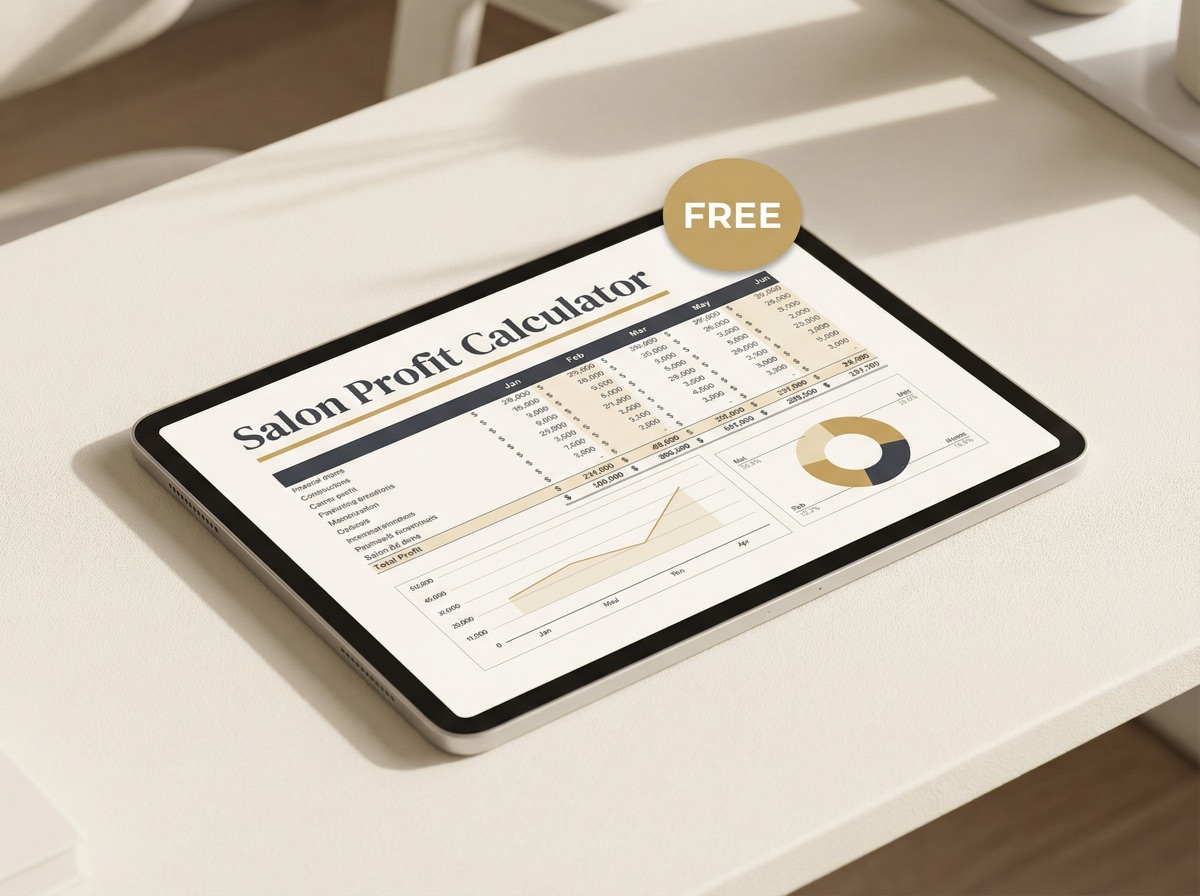
Written by Scott Farmer
Licensed Master Cosmetologist (GA & FL), former Toni & Guy Artistic Director, and founder of Hair Salon Pro. 30+ years behind the chair. 15,000+ clients. Building the business tools cosmetology school never taught. Currently behind the chair at scottfsalon.com in Venice, FL.