Your True Hourly Rate as a Stylist Is Probably $14 (Here Is the Formula)
 Scott Farmer
·
May 26, 2026
·
10 min read
Scott Farmer
·
May 26, 2026
·
10 min read
Quick Answer: What is my true hourly rate as a stylist, and why is it lower than I think?
Your true hourly rate is what lands in your bank account divided by every hour the business consumes, including unpaid admin, cleaning, and marketing. Once you subtract product, rent, insurance, taxes, and marketing, most independent stylists earn $11 to $19 per hour, not the $40 they quote. When I ran the real formula at JScott Salon, my $55 hour dropped to $17.
$40 an hour. Additionally, that is the number most stylists quote when someone asks what they earn. They take their gross revenue from last week, divide by the hours they were in the salon, and feel decent about the result.
But that number is a lie. However, your true hourly rate as a stylist drops fast once you count product cost, chair rent, insurance, taxes, marketing, education, and the three unpaid hours you spend every week answering DMs, ordering product, and cleaning up. When I ran the real formula at JScott Salon for the first time, my “$55/hour” income dropped to $17 per hour of real work. I had been lying to myself for years.
Your true hourly rate is not what clients pay you divided by hours booked. As a result, it is what lands in your bank account divided by every hour the business consumes. And for most independent stylists, that number is somewhere between $11 and $19.
Here is the formula that proves it. Then I will show you how to fix it.
TL;DR: True hourly rate = (gross revenue minus ALL expenses) divided by ALL hours worked (including unpaid admin, cleaning, marketing, commute). A stylist grossing $1,800/week who works 50 total hours and spends $1,100 on rent, product, taxes, insurance, and marketing earns $14/hour. Run your real numbers in the free salon profit calculator to see where you stand.
Last updated: May 26, 2026
Why Is Your Reported Hourly Rate Wrong?

Every salon professional I have coached makes the same two mistakes when calculating their hourly rate.
Mistake one: only counting billable hours. In practice, you were in the salon from 8:30 AM to 7:00 PM. That is 10.5 hours. But you only had clients from 9 AM to 5:30 PM with gaps. So you tell yourself you “worked 8 hours.” In reality, the salon consumed 10.5 hours of your day. Plus the 30 minutes answering texts that morning. Plus the hour on Sunday doing your books. Your real weekly hours are 50 to 55, not the 35 to 40 you believe.
Mistake two: ignoring total cost of doing business. That said, you earned $1,800 in service revenue this week. You subtract chair rent ($375) and think you cleared $1,425. But you also spent $85 on product, $515 on taxes (self-employment tax at 15.3% plus federal and state income tax), $45 on health insurance, $30 on education subscriptions, $25 on marketing, and $18 on credit card processing fees. After everything, $707 hits your personal account.
$707 divided by 50 real hours = $14.14 per hour.
That is less than what a shift manager makes at a fast-casual restaurant in most states.
How Do You Calculate Your True Hourly Rate as a Stylist?
Here is the step-by-step formula. For example, grab your bank statements from last month and a calculator.
Step 1: Add Up Every Dollar That Came In
Total revenue from all sources. In fact, services, tips, retail commission, any product sales, rental income if you sublease a chair. Write down the full gross number.
Example: $7,200/month gross revenue (services $6,400 + tips $500 + retail commission $300)
Step 2: Subtract Every Business Expense
Be honest here. Include everything:
| Expense | Monthly Example |
|---|---|
| Chair/suite rent or commission split | $1,500 |
| Product and supplies | $340 |
| Self-employment tax (15.3% of net) | $680 |
| Health insurance | $180 |
| Liability insurance | $15 |
| Continuing education | $75 |
| Marketing and social media tools | $50 |
| Software (booking, accounting) | $60 |
| Credit card processing (2.5-3%) | $175 |
| Retirement savings (SEP IRA, if any) | $0 |
| Estimated income tax (federal + state) | $450 |
| Professional memberships | $25 |
| Phone/internet (business portion) | $45 |
Total expenses: $3,595
Net take-home: $7,200 – $3,595 = $3,605/month
Step 3: Count Every Hour the Business Consumes
This is where most people cheat. Do not cheat.
| Activity | Weekly Hours |
|---|---|
| Behind the chair (billable) | 32 |
| Gaps between appointments | 4 |
| Opening/closing, cleaning | 3 |
| Responding to DMs, booking, confirming | 3 |
| Social media and marketing | 2 |
| Ordering product, inventory | 1 |
| Bookkeeping and admin | 1.5 |
| Education (online, classes) | 1.5 |
| Commute to salon | 3 |
Total weekly hours: 51
Monthly hours: 51 x 4.33 = 221 hours
Step 4: Divide
$3,605 / 221 hours = $16.31/hour true rate
That is for a stylist doing $7,200/month gross. Overall, sounds decent until you see the real number.
A stylist grossing $5,000/month with the same expense structure lands around $9-12/hour. Because of this, a stylist grossing $10,000/month with the same hours lands around $24-27/hour.
The difference is not talent. Ultimately, it is average ticket, booking density, and pricing math.
What Is a Good True Hourly Rate for a Stylist in 2026?
Based on Bureau of Labor Statistics data and salon industry benchmarks from the Professional Beauty Association, here is where you stand:
| True Hourly Rate | What It Means |
|---|---|
| Under $15/hour | Below minimum wage in many states. Unsustainable. |
| $15-$25/hour | Average independent stylist. Bills get paid but nothing builds. |
| $25-$40/hour | Above average. Building savings, investing in growth. |
| $40-$60/hour | Top 10%. Usually suite owners with premium pricing and full books. |
| $60+/hour | Elite. High-ticket services, strong retail, maximum efficiency. |
When I worked as an independent stylist and later as Artistic Director for Toni and Guy, I tracked my true hourly rate quarterly. Instead, the biggest jumps never came from working more hours. They came from raising my average ticket and eliminating unpaid time.
What Drains Your True Hourly Rate the Most?
Five profit killers show up in almost every stylist’s breakdown. Of course, i have seen all five in my own career and in the 30+ years I have spent watching other professionals make the same mistakes.
1. Unpaid Administrative Hours
Every DM you answer, every no-show you reschedule, every product order you place. Even so, these hours are invisible but they are real. If you spend 10 unpaid hours per week on admin, that is 520 hours per year. At even $30/hour opportunity cost, that is $15,600 in lost income.
The fix: batch admin into two 30-minute blocks per day. Still, everything else waits or gets automated.
2. Underpriced Services
A $65 cut that takes 45 minutes plus 15 minutes of wash and blowout is $65/hour gross. Beyond that, that same stylist offering a $125 balayage that takes 2.5 hours earns $50/hour gross on the more expensive service. The “premium” service pays less per hour.
Run the cost-per-service formula on every item on your menu. To be clear, you will find at least one service that costs more to deliver than you charge.
3. Low Chair Utilization
If you are available 40 hours per week but only booked for 28, those 12 empty hours still cost you rent, insurance, and time. Meanwhile, your effective hourly revenue drops by 30% before you touch a single expense.
Industry benchmark: a profitable salon targets 75-85% chair utilization. In contrast, below 65% means your marketing or rebooking system needs work.
4. Self-Employment Tax Blindspot
W-2 employees split the 15.3% FICA tax with their employer. You pay all of it. With that in mind, on $70,000 in net earnings, that is $10,710 per year that disappears before income tax even starts. Most stylists forget this line item entirely when they calculate their “hourly rate.”
5. No-Shows Without a Deposit Policy
One no-show per week at an average ticket of $95 costs you $4,940 per year in lost revenue. Furthermore, that is not just lost income. It is time you cannot resell. Your rent and overhead still ticked during that empty hour.
A deposit or cancellation policy is not optional. In other words, it is the difference between $14/hour and $22/hour for many stylists.
How Do You Raise Your True Hourly Rate Without Working More Hours?
You have three levers. At the same time, pull any one and your number moves.
Lever 1: Raise your average ticket. Notably, a $10 price increase across 25 clients per week adds $13,000 per year to your gross revenue. At 50 working hours per week, that is an extra $5/hour in your true rate. The price increase scripts make this conversation simple.
Lever 2: Reduce unpaid hours. Importantly, automate your booking confirmations. Set firm start and end times. Stop answering DMs at 10 PM. Cutting 5 unpaid hours per week raises your true rate by 10-12% without earning a single extra dollar.
Lever 3: Cut unnecessary expenses. Additionally, that $150/month salon software you use 20% of. The continuing education subscription you have not opened in 3 months. The premium booking platform when a simpler one covers your needs. Every $100/month in saved expenses adds $0.50/hour to your true rate. Small individually. Massive in combination.
When I look back at my career, the single biggest hourly-rate jump came from combining a $15 average ticket increase with dropping two services that took too long and eliminating Tuesday walk-in hours that were always half-empty. Three changes. However, my true hourly rate went from $22 to $38 in one quarter.
What Does the Complete True Hourly Rate Formula Look Like?
Here is the formula in one place. Run it today.
True Hourly Rate = (Monthly Gross Revenue – Monthly Total Expenses) / Monthly Total Hours
Where:
– Monthly Gross Revenue = all service income + tips + retail + any other salon income
– Monthly Total Expenses = rent + product + taxes (15.3% SE tax + estimated income tax) + insurance + software + marketing + education + processing fees + everything else
– Monthly Total Hours = (all hours at salon + admin hours + marketing hours + commute + education time) x 4.33
If your number comes back under $20, you do not have an income problem. As a result, you have a pricing problem, an efficiency problem, or both.
The salon profit calculator runs this formula for you in under two minutes with your real numbers. In practice, most stylists who use it discover they are $8-15/hour below where they thought.
Frequently Asked Questions
How much do hairstylists make per hour after expenses?
The national average gross hourly rate for hairstylists is $38-45 according to Vagaro industry benchmarks. But after rent, product, taxes, insurance, and unpaid administrative hours, most independent stylists net between $14 and $22 per hour. That said, suite owners with strong pricing and full books typically net $30-50/hour when all true costs are included.
Why is my true hourly rate so much lower than my service prices suggest?
Three hidden drains cause the gap: self-employment taxes (15.3% that W-2 workers split with their employer), unpaid hours (admin, marketing, cleaning, commute), and overhead costs that accumulate regardless of how many clients you see. For example, a stylist charging $85/cut who works 50 real hours per week with $3,000/month in expenses nets far less than the per-service price implies.
What is the fastest way to increase my true hourly rate?
Raise your average ticket. A $10 across-the-board increase on 25 weekly clients adds $13,000/year without a single extra hour of work. Second fastest: eliminate your lowest-paying service. If a 2.5-hour balayage nets you less per hour than a 45-minute cut, either reprice it or drop it from your menu. The math is clear in the cost-per-service formula.
Should I include commute time when calculating my true hourly rate?
Yes. Your commute is time the business consumes that you cannot spend earning money elsewhere. A 30-minute each-way commute adds 5 hours per week, over 200 hours per year. Ignoring it inflates your perceived hourly rate by 10-15%. Include it for an honest number.
How often should I recalculate my true hourly rate?
Quarterly. Your expenses shift with rent increases, product price changes, and seasonal booking patterns. Recalculate every 90 days to catch negative trends before they compound. Track the number over time and you will see exactly which changes moved the needle.
What Should You Do Right Now to Find Your True Hourly Rate?
Your true hourly rate is the single most honest metric in your business. It strips away the vanity of a full book and shows you what your time is worth.
If you have not run this formula yet, do it today. Grab your bank statements, be honest about your hours, and divide. The number will either confirm you are on track or light a fire under you to change something.
The free salon profit calculator runs this
The free salon profit calculator runs this math for you in under two minutes. Plug in your real revenue, real expenses, and real hours. See the number. Then decide what lever you are going to pull first.
Double Your Chair Income, Without Working More Hours
Once you know your real hourly rate, the next question is how to raise it. That is exactly the Profit-First System I teach live on when you are ready.
Run the Free Salon Profit Calculator
Free. Available now. No registration required.
Free Download
Get the Salon Profit Calculator
See exactly where your salon is losing money — in under 5 minutes.
Download Free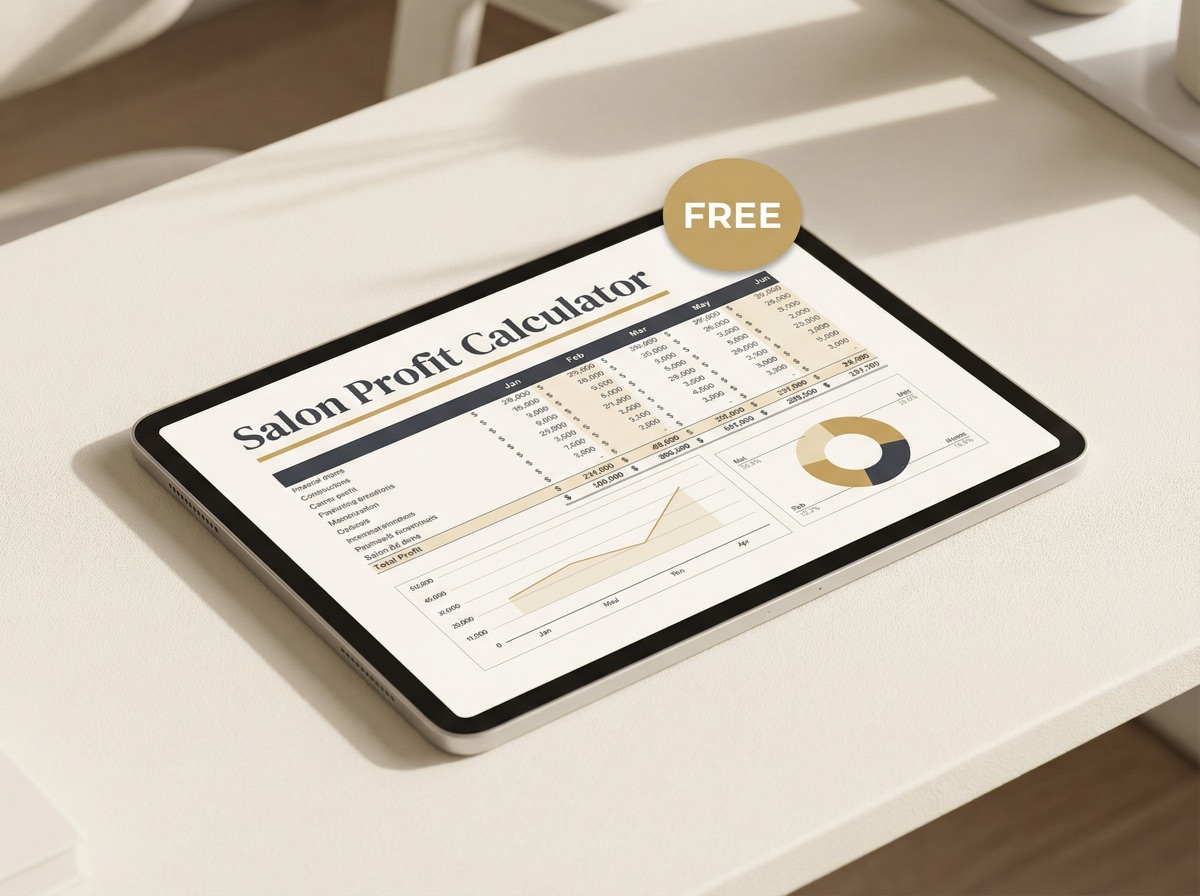
Written by Scott Farmer
Licensed Master Cosmetologist (GA & FL), former Toni & Guy Artistic Director, and founder of Hair Salon Pro. 30+ years behind the chair. 15,000+ clients. Building the business tools cosmetology school never taught. Currently behind the chair at scottfsalon.com in Venice, FL.