How to Build a Salon Budget That Actually Works (Simple Formula Inside)
 Scott Farmer
·
August 2, 2026
·
14 min read
Scott Farmer
·
August 2, 2026
·
14 min read
Last updated: July 2026
Quick Answer:
To build a salon budget, start with your average monthly gross revenue, then subtract fixed costs (rent, insurance, licenses, loan payments) and variable costs (product, marketing, education, supplies). Target these percentages of gross revenue: rent 10-15%, product/supplies 8-12%, marketing 3-5%, education 2-3%, insurance 2-3%, software/tech 1-3%, savings/emergency fund 5-10%, and owner pay: what remains (target at least 35% after taxes). If your after-tax take-home falls below 35%, your pricing or overhead needs adjustment. The budget takes 90 minutes to build from 3 months of bank statements and 15 minutes per month to maintain.
Run the free Salon Profit Calculator to see where your own numbers land before you build the full budget.
$412. That is how much I overspent on product at JScott Salon every single month for two years before I built a budget. If you want to know how to build a salon budget, start here: I did not have one.
I did not know it was $412. I knew product was expensive. I knew my color costs felt high. But I never sat down and put an actual number on what I should be spending versus what I was spending. I just ordered what I needed, paid the invoices, and hoped the math worked out.
It did not work out. Over 24 months, that product overspend totaled $412 x 24 = $9,888. Almost $10,000 gone because I never set a target number for that one expense category.
Product was not the only leak. My rent was 19% of revenue when it should have been under 15%. My marketing spend was zero some months and $800 in others, with no connection to results. My continuing education budget did not exist, so I either skipped classes or panicked and paid full price at the last minute.
The BLS Occupational Outlook Handbook counts 651,200 barbers, hairstylists, and cosmetologists working in the U.S. on 2024 data, and the BLS Occupational Employment and Wage Statistics survey puts the median hourly wage for hairdressers, hairstylists, and cosmetologists at $17.21 in May 2025 (SOC 39-5012). A huge piece of why that number stays low is that most salon professionals run their finances by feel instead of by plan.
Scott Farmer, Licensed Master Cosmetologist with over 30 years behind the chair and more than 15,000 clients served, built and ran JScott Salon before working as an independent stylist in Venice, Florida.
A budget fixed that for me. Not a complicated budget. Not a 47-tab spreadsheet. A single page with 8 categories and a target percentage for each one. Building it took one Sunday afternoon. Maintaining it takes 15 minutes on the first of every month.
Here is how to build yours.
What Is a Salon Budget and Why Do Most Salon Owners Skip It?

A salon budget is a written plan that assigns every dollar of revenue to a specific purpose before you spend it. Fixed costs get funded first. Variable costs get capped at target percentages. What remains is your profit and pay.
Most salon owners skip this step for one of three reasons:
- They confuse budgeting with bookkeeping. Bookkeeping records what already happened. Budgeting decides what will happen. You need both, but the budget comes first because it tells you whether a decision is smart before you make it.
- They think their revenue is too unpredictable. Salon income fluctuates by season, by week, even by day. But your costs do not fluctuate as much as you think. Rent is fixed. Insurance is fixed. Licenses are fixed. The variable costs have predictable ranges. A budget accounts for the variation instead of pretending it does not exist.
- Nobody taught them. Cosmetology school teaches you to cut, color, and style. It does not teach you to allocate revenue across expense categories. I learned budgeting from trial and error, mostly error, over the first decade of my career.
Every small business needs a written budget. It is the foundation everything else sits on, and salon businesses are no exception. If anything, our industry needs it more because margins are thinner than most people realize.
The average salon profit margin sits around 8% to 12%. That means for every $100 a client pays, you keep $8 to $12. At those margins, one uncontrolled expense category can wipe out your entire profit for the month.
A budget prevents that.
How Do You Calculate Your Salon Budget Starting Point?
Before you can allocate money, you need to know how much comes in. Pull 3 months of revenue data. If you use a booking platform like Vagaro, GlossGenius, or Square, the number is in your dashboard. If you track manually, add up deposits from your bank statements.
Calculate your average monthly gross revenue:
Average Monthly Revenue = (Month 1 + Month 2 + Month 3) / 3
Use gross revenue, not net. Gross is the total before any expenses. You will subtract expenses in the next step.
Here is a real example. A booth renter in a mid-size city might see:
- April: $6,200
- May: $5,800
- June: $6,500
Average: ($6,200 + $5,800 + $6,500) / 3 = $6,167
That $6,167 is the number your entire budget runs from. Every percentage below is calculated against this number.
If your revenue swings more than 25% between months, use a 6-month average instead. Seasonal variation smooths out over longer periods.
What Are the 8 Salon Budget Categories and Target Percentages?
Every salon expense fits into one of 8 categories. The target percentages below come from years of running my own numbers and studying what profitable salon owners do differently from struggling ones.
Category 1: Rent and Utilities (10-15% of Gross Revenue)
This is your biggest fixed cost. Booth rent, suite rent, or salon lease payment plus utilities, internet, and any common area maintenance fees.
The industry rule: rent should not exceed 15% of your gross revenue. If it does, you are either underpricing your services or overpaying for your space.
On $6,167/month gross revenue, your rent target is $6,167 x 0.12 = $740 at the midpoint. If your booth rent is $1,200, that is $1,200 / $6,167 = 19.4% of revenue. That 4.4% gap above target equals $6,167 x 0.044 = $271 per month that should be going to profit or pay.
When I ran JScott Salon, my rent was 19% of revenue for two years. I did not know because I never calculated the percentage. I just knew the dollar amount and assumed it was “normal.” It was not normal. It was eating my profit.
Fix options: raise prices to grow revenue (the percentage drops automatically), negotiate rent at renewal, or move to a lower-cost space at lease end.
Category 2: Product and Supplies (8-12% of Gross Revenue)
Color, developer, foils, backbar, retail inventory cost, gloves, capes, towels, cleaning supplies. Everything consumable.
At $6,167/month revenue, your product target is $6,167 x 0.10 = $617 at the midpoint.
The trap here is ordering. Most stylists over-order because running out of color during a service feels catastrophic. So they keep a 90-day supply on the shelf when a 30-day supply would do. That excess ties up cash.
I tracked product cost at JScott Salon by logging every tube of color, every foil packet, and every bottle of backbar I used for 90 days. My actual product cost per highlight was $8.40. I had estimated $5 in my head. That $3.40 gap across 15 highlights per week was $3.40 x 15 x 4 = $204 per month in hidden cost.
Use this as a gut check. If your product spend exceeds 12% of revenue consistently, you are either over-ordering, under-pricing services relative to product used, or giving away too much retail in discounts.
Category 3: Marketing and Client Acquisition (3-5% of Gross Revenue)
Business cards, social media ads (if any), email platform subscription, photography, website hosting, Google Business Profile optimization, referral rewards.
At $6,167/month, your marketing target is $6,167 x 0.04 = $247 at the midpoint.
The mistake I see most often is salon owners spending $0 on marketing and then $500 in a panic during a slow month. Consistent small spend beats sporadic big spend every time.
When I was building my book as an independent stylist after leaving JScott Salon, my marketing budget was $150 per month. Every month. No exceptions. That covered my email platform, occasional Instagram boosted posts, and referral rewards (a $15 credit for every new client referral). That $150/month consistency built more clients than the $800 desperate pushes I used to do.
Category 4: Education and Professional Development (2-3% of Gross Revenue)
Classes, certifications, trade shows, online courses, books. If it makes you better behind the chair, it belongs here.
At $6,167/month, your target is $6,167 x 0.025 = $154.
My time as an Artistic Director at Toni and Guy gave me access to world-class training at no personal cost. Most independent stylists do not have that luxury. You have to fund your own growth. But funding it means budgeting for it, not scrambling to pay for a $400 advanced color class when it pops up next month.
Set the money aside monthly, even if you do not spend it every month. It accumulates. When the right class appears, the money is there.
Category 5: Insurance and Licenses (2-3% of Gross Revenue)
Professional liability insurance, general business insurance, health insurance premiums (if self-employed), cosmetology license renewal, business license fees.
At $6,167/month, your target is $6,167 x 0.025 = $154.
This is non-negotiable spend. Do not cut here. One slip-and-fall claim or one chemical reaction lawsuit without coverage can end your career. The IRS classifies insurance premiums as deductible business expenses for self-employed professionals, so the net cost is lower than the sticker price.
Category 6: Software and Technology (1-3% of Gross Revenue)
Booking platform, POS system, email marketing tool, accounting software, website hosting. Everything digital.
At $6,167/month, your target is $6,167 x 0.02 = $123.
If you just read the software subscription audit guide, you know the average salon owner spends $347 to $612 per month on software. That is 5.6% to 9.9% on $6,167 in revenue. Way over budget.
Most of that overspend is duplicate features and zombie subscriptions. A solo stylist needs 3 tools: a booking/POS platform, an accounting tool, and an email tool. Total cost: $41 to $111 per month. That is the target.
Category 7: Emergency Fund and Savings (5-10% of Gross Revenue)
This is the category most salon owners skip entirely. And it is the one that saves your business when a slow season hits, equipment breaks, or you need time off for a health issue.
At $6,167/month, your target is $6,167 x 0.075 = $463 at the midpoint.
Build this fund until it reaches 3 months of fixed expenses. For most solo stylists, that is $4,000 to $8,000. Once you hit that number, you can reduce the monthly contribution to 3-5% and redirect the rest to profit or pay.
I did not have an emergency fund for the first six years of my career. When my HVAC unit broke at JScott Salon in 2017, I put $3,200 on a credit card because I had no savings buffer. I paid 22% interest on that balance for 8 months. The HVAC repair actually cost me $3,200 + ($3,200 x 0.22 x 8/12) = $3,669. A $463/month savings habit would have covered it with cash.
Category 8: Owner Pay (What Remains After Categories 1-7)
This is what is left after funding categories 1 through 7. Not the other way around. At the midpoint of the other 7 categories, pre-tax owner pay runs around 55% to 60% of gross revenue. After self-employment tax (15.3%) and income tax, your actual take-home lands between 35% and 50%. That is the realistic range to target.
Most salon owners pay themselves whatever is in the bank at the end of the month. That is not owner pay. That is leftovers. A budget sets your pay as a target percentage, and if the other categories crowd it below 35%, you know something is broken in your pricing or overhead.
On $6,167/month at the midpoint percentages:
| Category | % | Amount |
|---|---|---|
| Rent and utilities | 12% | $740 |
| Product and supplies | 10% | $617 |
| Marketing | 4% | $247 |
| Education | 2.5% | $154 |
| Insurance and licenses | 2.5% | $154 |
| Software and tech | 2% | $123 |
| Emergency fund | 7.5% | $463 |
| Owner pay | 59.5% | $3,669 |
That $3,669 owner pay on $6,167 revenue is a 59.5% take-home rate. Reality will land lower once you account for self-employment tax (15.3%) and income tax. After taxes, the net is closer to $3,669 x 0.70 = $2,568 per month, or $30,816 per year.
If that number feels low, the budget just told you something important. You either need to increase revenue (raise prices, increase booking rate, add profitable services) or reduce a cost category. The salon pricing formula shows you exactly how to price based on your cost structure instead of guessing.
How Do You Track Your Salon Budget Each Month?
Building the budget takes 90 minutes. Tracking it takes 15 minutes on the first of every month.
Here is the monthly routine:
Step 1 (5 minutes): Log into your bank and credit card accounts. Pull last month’s transactions.
Step 2 (5 minutes): Categorize each expense into your 8 categories. Most expenses hit the same category every month, so this gets faster over time.
Step 3 (5 minutes): Compare actual spend per category against your budget targets. Flag any category that exceeded its target by more than 10%.
That is it. No software needed. A notebook works. A simple spreadsheet works. The point is not the tool. The point is the 15-minute habit.
The salon KPIs guide covers the 7 numbers every salon owner should track weekly. Your budget categories are the monthly version of the same discipline.
When I started doing this monthly check at JScott Salon, I caught problems in real time instead of discovering them 6 months later on a tax return. Product costs creeping up by $50/month over three months is a $150 problem. Product costs creeping up unchecked for a year is a $1,800 problem.
What Are the 4 Biggest Salon Budget Mistakes?
Mistake 1: Treating Owner Pay as “Whatever Is Left”
If you do not assign yourself a target pay percentage, every other expense will eat your income. Rent gets paid first. Product gets ordered. Marketing spend happens. And whatever survives is “your pay.” That is not budgeting. That is hoping.
Set your owner pay target at 35% minimum. If your current numbers do not support 35%, the budget is showing you that your pricing, overhead, or both need to change.
Mistake 2: No Budget for Slow Months
Revenue fluctuates. January and August are slow in most markets. If your budget assumes the same revenue every month, you will overspend in slow months and scramble to catch up in busy ones.
Build your budget on a conservative average. Use your three lowest months from the past year as the baseline, not your best months. If you can fund all 8 categories on a slow month’s revenue, every busy month produces surplus.
Mistake 3: Ignoring the Tax Bucket
Self-employment tax is 15.3% on net earnings. Income tax adds another 10% to 24% depending on your bracket. Most salon owners forget to budget for taxes and get hit with a $4,000 to $8,000 bill in April.
Set aside 25% to 30% of your net profit for taxes in a separate savings account. Do not touch it. When April arrives, the money is there.
Mistake 4: Budgeting Annually Instead of Monthly
An annual budget is a wish list. A monthly budget is a decision tool. Annual projections feel good in January and mean nothing by March because the numbers drift.
Budget monthly. Review monthly. Adjust monthly. The 15-minute monthly check is what makes the 90-minute build worthwhile.
Frequently Asked Questions
How much should a solo stylist budget for salon expenses each month?
A solo booth renter or suite owner generating $5,000 to $8,000 per month in gross revenue should budget 40% to 55% of revenue for total expenses (rent, product, marketing, insurance, software, education, and savings). That leaves 45% to 60% for owner pay before taxes. On $6,000/month gross, total expenses should land between $2,400 and $3,300, leaving $2,700 to $3,600 for pre-tax owner pay.
What percentage of salon revenue should go to product costs?
Product and supplies should stay between 8% and 12% of gross revenue. For a stylist generating $6,000 per month, that is $480 to $720. If your product costs consistently exceed 12%, you are either over-ordering inventory, under-pricing services relative to product consumed, or giving excessive retail discounts. Track product cost per service for 30 days to find the exact leak.
Do I need accounting software to build a salon budget?
No. A notebook and calculator work. A simple spreadsheet works better. The budget itself is 8 categories with target percentages. You do not need QuickBooks or FreshBooks to build or track it. If you already use accounting software, it makes categorizing easier, but it is not required. The 15-minute monthly review is what matters, not the tool.
How do I budget for salon expenses when my income changes every month?
Use a 3-month rolling average as your baseline. Update the average each month by dropping the oldest month and adding the newest. This smooths seasonal swings without making you recalculate from scratch. Build the budget on the conservative end of your range so slow months do not break the plan. Any revenue above the budget baseline goes to your emergency fund until it reaches 3 months of fixed costs, then to extra owner pay or business investment.
What is the first thing to cut when a salon budget is tight?
Cut the category with the largest gap between your target and your actual spend. For most salon owners, that is product (over-ordering), software (duplicate or unused subscriptions), or marketing (sporadic spending with no tracking). Do not cut insurance, education, or your emergency fund. Those protect your income and your career. Cut waste first, then look at revenue growth. The Salon Profit Calculator helps you model what a $10 price increase or 5% better utilization does to your take-home.
How Do You Build a Salon Budget That Actually Works?
A budget does not fix your salon finances. It shows you where they are broken. And for most salon owners, the fix is not working more hours. It is pricing correctly, controlling overhead, and building the systems that make your chair profitable without burning out.
The budget formula in this article is the first layer. The full system has four layers: pricing, overhead, utilization, and retention. Each one compounds the others.
Run the free Salon Profit Calculator to see your current numbers in 60 seconds. It shows you exactly where revenue, costs, and profit stand today so your budget has a real starting point.
For the complete Profit-First System, including the pricing formula, overhead audit framework, utilization targets, and the four numbers that control your chair income, run the free Profit Audit. It takes about 15 minutes and walks through real salon math for your own numbers.
Run your free Salon Profit Calculator | Run Your Free Profit Audit
Found this useful? Tell Google you want to see more from Hair Salon Pro in your search results and AI answers.
Free Download
Get the Salon Profit Calculator
See exactly where your salon is losing money in under 5 minutes.
Download Free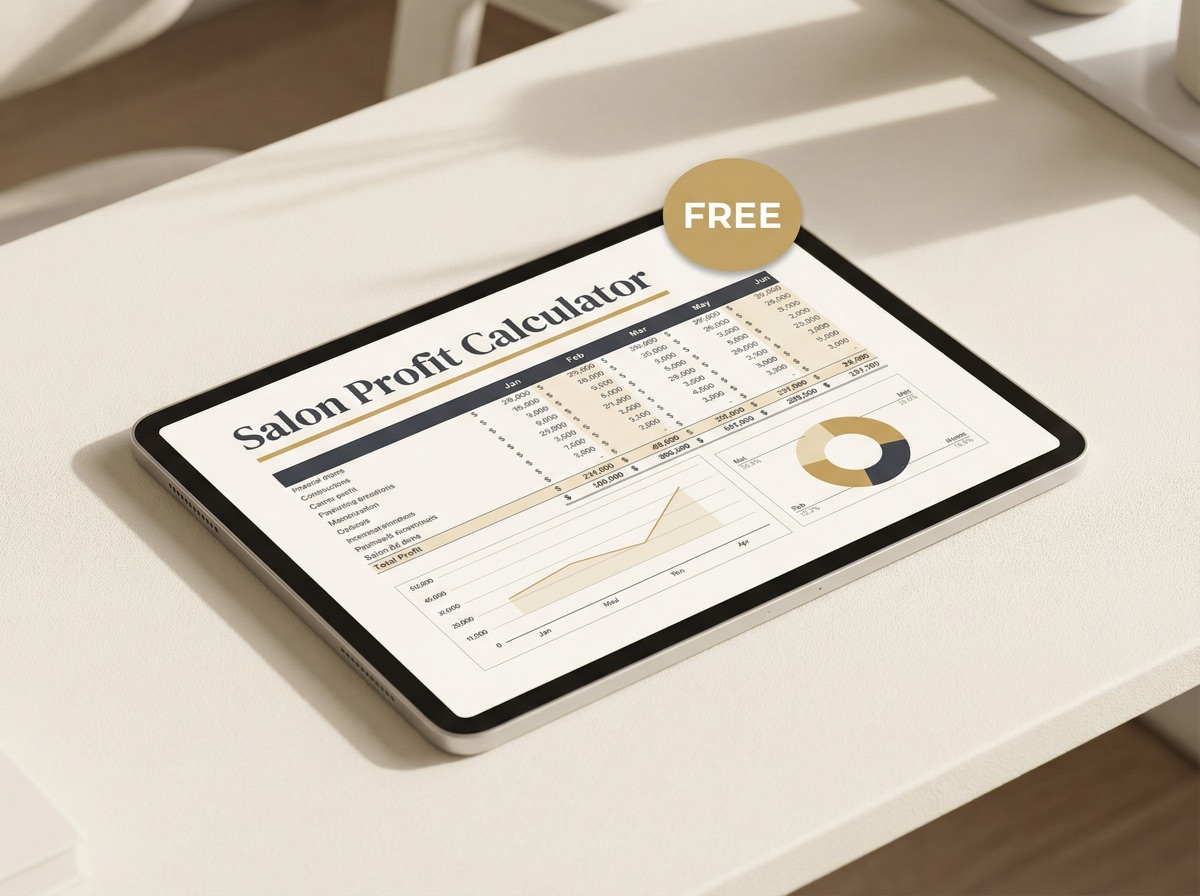
Written by Scott Farmer
Licensed Master Cosmetologist (GA & FL), former Toni & Guy Artistic Director, and founder of Hair Salon Pro. 30+ years behind the chair. 15,000+ clients. Building the business tools cosmetology school never taught. Currently behind the chair at scottfsalon.com in Venice, FL.