9 Salon Pricing Factors for 2026: Why Your Old Formula Stopped Working
 Scott Farmer
·
July 21, 2026
·
15 min read
Scott Farmer
·
July 21, 2026
·
15 min read
Quick Answer:
The nine salon pricing factors for 2026: cost per service, local market demand, experience and specialization, client acquisition cost, chair utilization rate, inflation-adjusted overhead, product cost increases, competitive positioning, and target take-home pay. The biggest mistake is pricing from competitor menus instead of your own costs. A service priced at $85 with $62 in delivery costs earns $23 profit. Priced at $110 from real cost analysis, it earns $48.
TL;DR

- The pricing formula you learned 5 years ago is costing you $8,000 to $15,000 per year in 2026. Product costs are up 18% since 2023. Rent in most metro areas climbed 12% to 22%. Energy costs jumped. Supply chain markups stuck. Your prices went up 5%. The gap between your costs and your revenue is growing every single quarter.
- Most salon owners set prices based on three inputs: what competitors charge, what feels reasonable, and what they charged last year plus a small bump. All three are wrong. None of them account for the nine factors that determine whether your pricing generates profit or does nothing more than cover bills.
- I priced my services wrong for five years at my own salon. I used the competitor-matching formula every salon owner learns from other stylists. It cost me $54,000 in lost profit before I rebuilt my pricing around cost-per-service math and demand-based adjustments.
- The nine factors in this article are the same framework I use with salon owners today. They work for booth renters, suite owners, and commission-based stylists. They work in high-rent cities and small towns. They work whether you charge $45 for a cut or $150.
- Run the free Salon Profit Calculator to see where your pricing gaps are today. Then check out HSP Pro for the full Profit-First System, weekly coaching, and four AI specialists that help you close those gaps in 60 days or less.
Last updated: July 2026
My name is Scott Farmer. I am a Licensed Master Cosmetologist with over 30 years behind the chair and more than 15,000 clients served. I built and operated my own salon, worked as an independent stylist, and now work from my suite in Venice, Florida. I have priced services wrong and I have priced them right, and the difference between the two cost me $54,000 before I figured it out.
$7. That is what I kept from an $85 haircut at my own salon. Not $7 per hour. Seven dollars total, per client, after product, rent, insurance, utilities, and every other cost I pretended did not exist when I set my prices.
I did not know it was $7 at the time. I knew my schedule was full. I knew clients were paying. I thought full chairs meant good pricing. I was wrong. It took me five years and a $54,000 shortfall before I sat down with a calculator and learned the nine salon pricing factors for 2026 that separate profitable chairs from busy ones.
The formula I used was the same one most stylists use: look at what the salon down the street charges, add $5 to $10 because your work is worth more, and call it a pricing strategy. That formula worked when product costs were stable, rent was predictable, and inflation was not eating 6% of your margins every 12 months. None of those things are true in 2026.
Here are the nine factors that determine whether your prices generate profit or generate nothing but activity.
Factor 1: Why Is Cost Per Service the Number Most Stylists Skip?
Every service on your menu has a delivery cost. Product used. Time in chair. Backbar supplies. Foils. Gloves. Color. Developer. The $4 towel wash load split across 8 clients. The $12 in electricity your dryer pulls per shift.
Most stylists have never calculated this number. They price by feel. They charge $150 for a full highlight because that is what the salon down the street charges, without knowing whether their actual cost to deliver that highlight is $38 or $78.
At my own salon, I tracked cost per service for every item on my menu over a 90-day period. The results changed my entire business. My most popular service, a cut and style, cost me $34 to deliver. I was charging $65. That left $65 - $34 = $31 before rent, insurance, and overhead. After those fixed costs? About $7.
My least popular service, a deep conditioning add-on, cost me $4.50 to deliver and I charged $35. That $35 - $4.50 = $30.50 margin on a 15-minute service was four times more profitable per minute than my signature haircut.
If you have not run this math, start with the cost-per-service formula I built for salon owners. It takes 20 minutes and it will change how you see every client in your chair.
Factor 2: Why Does Local Market Demand Matter More Than What Competitors Charge?
There is a difference between what the market will pay and what other salons charge. Most stylists confuse the two.
If every salon in your area charges $75 for a women’s cut, that does not mean $75 is what the market values. It means every salon owner did the same lazy math: look left, look right, pick a number in the middle. Nobody tested whether $95 would lose clients. Nobody tracked what happened when they raised prices 15%.
When I raised my women’s cut from $65 to $85 in 2017, I expected to lose 15% of my clients. I lost 4%. Four percent. And the 96% who stayed increased my revenue per client by $20, which added $400 per week to my income on the same number of appointments.
Local demand is driven by three things: the quality of the outcome you deliver, the experience surrounding that outcome, and whether clients believe they cannot get the same result elsewhere. If those three things are strong, your pricing ceiling is higher than you think.
Factor 3: How Does Your Experience and Specialization Change What You Can Charge?
A stylist with 3 years behind the chair and a stylist with 15 years and a color correction specialty are not delivering the same service, even if the menu item says the same thing.
Experience compounds value. Specialization multiplies it. A generalist who does everything charges generalist prices. A specialist who does one thing at a high level charges what that expertise is worth.
During my time as an Artistic Director at Toni and Guy, I watched specialists earn 40% to 60% more than generalists at the same skill level. The specialists were not better at cutting hair. They were better at positioning their expertise so clients understood what they were paying for.
In 2026, the specialists winning on price are: color correction experts, curly and textured hair specialists, extension installers, scalp health specialists, and bridal stylists. If you specialize in any of these, your pricing should reflect the scarcity of that skill in your local market. If you do not specialize yet, pick one. Your prices will thank you within 12 months.
Factor 4: How Does Client Acquisition Cost Affect Your Real Profit Per Client?
Every new client costs money to acquire. Whether you pay for Instagram ads, spend time posting content, offer a first-visit discount, or rely on referrals from existing clients, there is a cost attached to getting that person in your chair for the first time.
Most stylists have no idea what this number is. Here is a simple way to calculate it: take everything you spend on marketing, advertising, and promotions in a month (including your time posting on social media at a fair hourly rate). Divide that by the number of new clients you booked that month.
If you spend $300 per month on marketing and book 6 new clients, your client acquisition cost is $300 / 6 = $50. That means the first visit from every new client is $50 less profitable than it looks. A $90 first appointment that cost $35 to deliver and $50 to acquire? You lost money on that client until their second visit.
Your prices need to account for this. Not by raising first-visit prices, but by ensuring your overall price structure generates enough margin per visit to cover acquisition costs over the first 3 to 4 appointments. Run this through the free Salon Profit Calculator and you will see exactly where your breakeven sits.
Factor 5: How Does Your Chair Utilization Rate Connect to Your Pricing?
An empty chair at 2 PM on a Tuesday is not free. It costs you whatever that hour of service revenue would have been, minus the delivery cost. If your average service generates $90 and costs $30 to deliver, every empty hour costs you $60 in lost profit.
Chair utilization rate measures the percentage of your available service hours that are booked and completed. The industry average sits around 70% to 75%. High-performing solo stylists run 80% to 85%.
Here is how utilization connects to pricing: a stylist at 90% utilization can afford to hold firm on prices because demand exceeds supply. A stylist at 60% utilization might think the answer is lower prices to attract more clients. It almost never is. Lower prices attract price-sensitive clients who rebook less often, leave smaller tips, and leave the moment someone cheaper opens up.
The right move at low utilization is not lower prices. It is better marketing and better rebooking systems at your current prices. Dropping your rate locks you into a volume trap that is almost impossible to escape. I learned this the hard way at my own salon when I ran a 20% off promotion to fill slow Tuesdays. I filled them. With clients who only came back when I ran another promotion.
Factor 6: How Do You Adjust Prices for Inflation-Driven Overhead in 2026?
Your rent, insurance, utilities, software subscriptions, and licensing fees all increased in 2026. If your prices stayed the same, your profit margin shrunk by whatever percentage those costs climbed.
Here is the math most salon owners avoid. If your total monthly overhead is $4,200 and it increased 8% this year, you are paying $4,200 x 8% = $336 more per month. That is $336 x 12 = $4,032 per year. If you see 80 clients per month, you need to earn $4,032 / 12 / 80 = $4.20 more per client to break even on the overhead increase. Not to earn more. To stay where you were.
The Bureau of Labor Statistics tracks salon industry wages and employment data, and the broader economic data shows personal care service costs rising faster than general inflation in 2025 and 2026. Salon owners who do not adjust prices to match their rising costs are accepting a pay cut every quarter without realizing it.
Build a simple overhead tracker. Review it every 90 days. Adjust prices at least once per year to match. This is not greedy. This is survival math. I covered the exact framework in my guide to raising prices for existing clients, including the script I use that gets a 94% acceptance rate.
Factor 7: How Much Are Product Cost Increases Eating Your Margins?
Professional color lines, backbar products, and retail inventory all got more expensive in 2025 and 2026. Supply chain disruptions from 2023 and 2024 created permanent price floors that did not come back down. The salon product you bought for $8.50 a tube in 2022 now costs $10 to $12.
If you charge $160 for a full highlight and your color cost went from $14 to $19 per application, you lost $5 per service. On 12 highlight clients per week, that is $5 x 12 x 52 = $3,120 per year, gone. Not because you did anything wrong. Because your prices did not move with your costs.
Track your top 10 most-used products by cost per application. Update this every 6 months. When costs rise, prices rise. The two are connected. Your clients do not see the product cost on the invoice. They see the result in the mirror. As long as the result is worth the price, the product cost is your problem to manage, not theirs to subsidize.
Factor 8: What Is the Difference Between Competitive Positioning and Price Matching?
Competitive matching is a race to the middle. Every salon matches the one next door. Nobody leads on price because nobody wants to be “the expensive one.” The result: an entire market full of underpriced talent where the only differentiator is convenience and parking.
Competitive positioning is different. It means understanding where you fit in the local market and owning that position. If you are the most experienced colorist within 15 miles, your prices should reflect that. If your consultation process, your client experience, and your results are better than the salon across the street, your prices should be higher, not the same.
I stopped looking at competitor prices in 2018. I started looking at competitor experiences. The salon charging $75 for a cut had no consultation process, no aftercare instructions, and no follow-up message. I charged $95, included a 10-minute consultation, sent a same-day text with styling tips, and followed up 3 weeks later with a rebook reminder. My retention rate was 82%. Theirs was 55%.
Price matching is a fear response. Price positioning is a business strategy. One costs you money. The other makes you money.
Factor 9: How Do You Price Backward From Your Target Take-Home Pay?
This is the factor that should come first but most stylists consider last, if they consider it at all.
What do you need to take home per month after every expense, tax, and cost is paid? Not gross revenue. Net take-home. The money that hits your personal bank account.
Work backward from that number. If you need $6,000 per month take-home and you operate as a 1099 booth renter, you need to earn about $8,500 to $9,000 gross after accounting for self-employment tax (15.3%), income tax, and health insurance. If your monthly operating costs are $3,200 (rent, product, insurance, software, continuing education), you need $11,700 to $12,200 in monthly service revenue.
Divide that by your available service hours. If you work 35 hours per week, 4.3 weeks per month, that is about 150 billable hours. $12,000 / 150 hours = $80 minimum per hour of chair time. If your average service takes 1.5 hours, your average ticket needs to be at least $80 x 1.5 = $120.
Now compare that $120 to what you charge today. If there is a gap, your pricing formula is the problem. Not your client count. Not your marketing. Not your location. The formula.
I built the salon pricing formula to help stylists work this math in reverse. Start with the life you want. Price backward from there.
How Do You Apply All Nine Factors in One Afternoon?
You do not need to rebuild your entire pricing structure in a week. You need 2 to 3 hours and a calculator.
Step 1 (30 minutes): Calculate your cost per service for your top 5 services. Product plus time plus overhead allocation.
Step 2 (20 minutes): List your total monthly overhead. Rent, insurance, utilities, subscriptions, continuing education, marketing. Add 8% to whatever last year’s number was.
Step 3 (15 minutes): Define your target take-home pay. Work backward to the gross revenue and average ticket you need.
Step 4 (30 minutes): Compare your current prices to the minimum prices your math requires. Circle every service where the gap is more than $10.
Step 5 (30 minutes): Write new prices. Not what feels right. What the math says. Use the price increase scripts in the free Price Increase Script Pack if you need language for the conversation with clients.
Step 6 (15 minutes): Set a calendar reminder to repeat this exercise in 90 days. Pricing is not a one-time decision. It is a quarterly review.
The Professional Beauty Association recommends annual price reviews at minimum. I recommend quarterly. Costs change. Demand shifts. Your skills improve. Your prices should move with all three.
What Is the Pricing Mistake That Costs Salon Owners More Than Any Other?
The most expensive pricing mistake is not charging too little on one service. It is failing to review prices at all. Salon owners who set prices once and leave them for 2 to 3 years lose an average of $8,000 to $15,000 in profit compared to owners who adjust annually.
That is not a theory. That is the math I have run with dozens of salon owners using real P&L data. The salon pricing mistakes article breaks down the five most common errors I see, but they all trace back to the same root cause: pricing by feeling instead of pricing by formula.
Your pricing formula in 2026 is not the same formula that worked in 2021. Product costs changed. Rent changed. Insurance changed. Client expectations changed. Your skills improved. Your experience deepened. Your value increased.
If your prices did not increase at the same rate as all of those factors, you gave yourself a pay cut. And you did it without realizing it.
What Salon Owners Ask Next
“I ran the numbers but I am scared to raise prices. Where do I start?”
Start with your least emotional service. Pick the add-on or treatment where clients care about results, not the dollar amount. Raise that one first, measure the response for 30 days, and let the data give you confidence for the next round.
“How do I know if my pricing problem is a marketing problem in disguise?”
If your chair is less than 70% full, marketing is your bottleneck. If your chair is 75%+ full but your take-home is below target, pricing is the problem. Both can be true at the same time, but fixing pricing on a full book creates immediate income. Fixing marketing on underpriced services fills your chair with unprofitable appointments.
“What if I am a booth renter and have no control over what the salon charges?”
You set your own prices as a booth renter. Your rent is fixed overhead, not a reason to match the suite next to you. Run the cost-per-service math for YOUR expenses and YOUR take-home target. Two renters in the same building can charge $30 apart and both be right because their cost structures are different.
What Is Your Next Step to Fix Your Salon Pricing?
Run the free Salon Profit Calculator right now. It shows you exactly where your pricing gaps are, how much profit you leave on the table every month, and what your services need to generate to hit your take-home target. Takes 3 minutes.
The $17 Salon Owner Starter Pack includes a budget template, pricing guide, and price increase scripts that walk you through the exact conversation with clients. Everything you need to run this exercise today.
If you want the full Profit-First System with weekly coaching, four AI business specialists, and a private community of salon owners who run their numbers, check out HSP Pro Membership. Add $2,000 per month to your chair in 60 days or get a full refund and keep everything.
Frequently Asked Questions
How often should salon owners review their pricing?
At minimum, once per year. I recommend every 90 days. A quarterly review takes 30 to 45 minutes and catches cost increases before they eat your margins for an entire year. Track your top 5 service costs, monthly overhead total, and average ticket. If costs went up and prices did not, adjust before the next quarter starts. Even a $5 increase across your service menu, applied quarterly when needed, prevents the $8,000 to $15,000 annual profit gap that hits salon owners who only review prices every 2 to 3 years.
What is the biggest pricing mistake salon owners make?
Matching competitor prices instead of calculating their own cost per service. When you match the salon across the street, you inherit their cost structure, their profit margin, and their financial problems. Your rent is different. Your product costs are different. Your overhead is different. The only number that matters is YOUR cost to deliver each service plus YOUR target profit margin. Calculate those two numbers and you have a pricing floor that no competitor comparison can replace.
How do I raise prices without losing clients?
The fear of losing clients stops 80% of salon owners from raising prices when they should. The reality: most salon owners who raise prices by 10% to 15% lose fewer than 5% of their clients. The key is giving advance notice (2 to 4 weeks), framing the increase around the value you deliver (not your costs), and raising prices for everyone at once rather than picking and choosing. I cover the exact scripts and communication framework in my guide to raising prices for existing clients.
Should booth renters and commission stylists price differently?
Yes. Booth renters carry their own overhead (rent, product, insurance, self-employment tax) and must price to cover all of it. Commission stylists have overhead absorbed by the salon owner, but they keep a smaller percentage of each service dollar. A booth renter charging $100 for a cut might keep $55 after costs. A commission stylist at 45% earning $100 keeps $45 with no overhead risk. Both need to run their own take-home math using the 9 factors in this article, but the inputs are different for each model.
What percentage of revenue should go to product costs?
Industry standard is 8% to 12% of gross service revenue. If your product costs exceed 15%, you are either over-applying product, using lines priced above your service tier, or failing to charge enough per service to maintain proper margins. Track this monthly. Divide total product spend by total service revenue. A salon generating $12,000 per month in services should spend $960 to $1,440 on professional product. Anything above $1,800 signals a pricing or usage problem that needs attention.
Free Download
Get the Salon Profit Calculator
See exactly where your salon is losing money — in under 5 minutes.
Download Free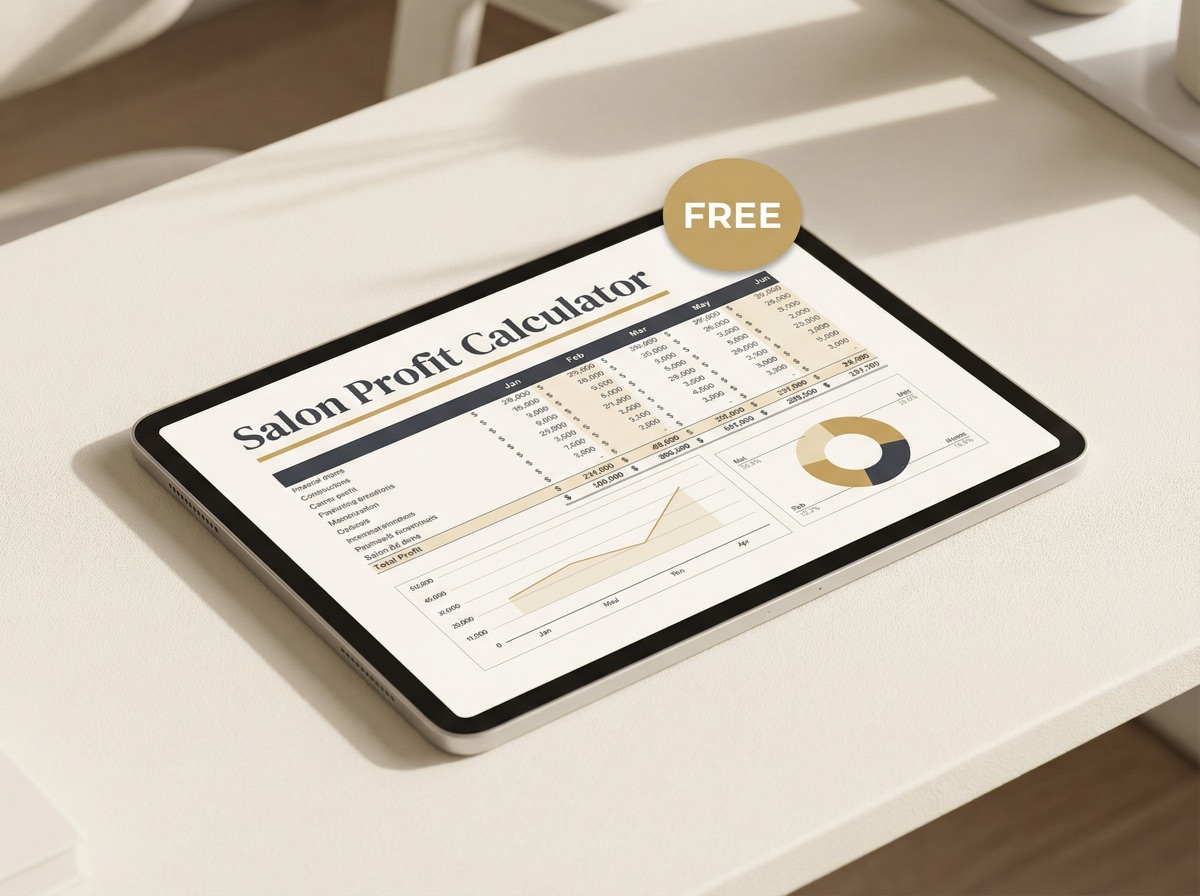
Written by Scott Farmer
Licensed Master Cosmetologist (GA & FL), former Toni & Guy Artistic Director, and founder of Hair Salon Pro. 30+ years behind the chair. 15,000+ clients. Building the business tools cosmetology school never taught. Currently behind the chair at scottfsalon.com in Venice, FL.