Double-Shifting Your Salon Chair: How One Chair and Two Stylists Can Add 80% More Revenue
 Scott Farmer
·
August 3, 2026
·
14 min read
Scott Farmer
·
August 3, 2026
·
14 min read
TL;DR

- Most salon chairs sit empty 40% to 60% of available hours. That is revenue evaporating from square footage you already pay rent on. A single chair generating $800 per week could generate $1,440 per week with a second stylist filling the dead hours. Same rent. Same utilities. Same lease.
- Double-shifting is not a new concept. Restaurants, medical offices, and barbershops have done it for decades. The beauty industry is one of the last to catch on because we have been trained to think of “my chair” as personal territory instead of a business asset.
- This article breaks down the exact math: how to calculate your chair utilization rate, what a second shift is worth in dollars, and how to structure the split so both stylists win. I ran chair-sharing at my own salon when I had more demand than stations. It added $2,100 per month in net revenue from one chair.
- The model works best for salon owners with high-traffic locations and unused evening or weekend hours, and for booth renters looking to cut their rent in half.
- Run your current numbers through the free Salon Profit Calculator to see how much idle chair time is costing you. Ready for the full Profit-First System? HSP Pro Membership walks you through it step by step.
Last updated: July 2026
$14 per square foot. That is what I was paying for my salon space when I ran my own salon. Seven stations. Two shampoo bowls. A small retail area. Every month, the rent check cleared whether those chairs had clients in them or not.
And most of them were empty more than I wanted to admit.
I tracked it for one month. I walked through the salon every two hours and counted occupied chairs versus empty chairs. The results were brutal. My seven-station salon was averaging 3.2 occupied chairs during operating hours. That means 54% of my square footage was collecting dust instead of collecting revenue.
I am Scott Farmer, Licensed Master Cosmetologist with over 30 years behind the chair and more than 15,000 clients served. I built and operated my own salon, worked as an independent stylist, and now run my practice in Venice, Florida. I have managed both commission-based teams and booth renters. And the single most underused asset in every salon I have worked in is the chair itself.
The BLS Occupational Employment and Wage Statistics survey puts the median hourly wage for hairdressers, hairstylists, and cosmetologists at $17.21 in May 2025 (SOC 39-5012), and barbers at $18.37 (SOC 39-5011). What they do not track is how many of those hours happen in a chair that sits empty the other half of the day. That gap is the opportunity I want to show you.
What Is Salon Chair Sharing (Double-Shifting)?
Chair sharing means two stylists use the same station at different times. One works mornings through early afternoon. The other works late afternoon through evening. Or one covers Tuesday through Thursday, and the other covers Friday through Sunday.
This is not co-working in the same chair at the same time. That would be chaos. This is scheduled, structured time-splitting where each stylist has exclusive use of the station during their block.
Restaurants do this with every table. A diner that seats 80 people runs a breakfast crew from 6 AM to 2 PM and a dinner crew from 4 PM to 10 PM. Same tables. Same kitchen. Double the revenue.
Barbershops have done this for years. In high-traffic shops in cities like Atlanta and New York, it is common for two barbers to split a single chair across morning and evening shifts. The rent cost per barber drops by 40% to 50%.
Salons have been slow to adopt this model because our industry treats “my chair” like personal real estate. I get it. I felt the same way for years. But when I ran the numbers at my own salon, the emotional attachment to an empty chair started to look expensive.
The Math: What an Idle Chair Costs You
Let me walk through this with real numbers.
Say your salon has 5 stations. Your rent is $3,500 per month. That breaks down to $700 per station per month in rent allocation alone. Add utilities, insurance, Wi-Fi, and cleaning, and each station costs $850 to $1,000 per month to keep available.
Now check your chair utilization rate. If a station is available for 50 hours per week (10 hours per day, 5 days) and a stylist books 28 hours of actual client time, that chair is running at 56% utilization.
That means for 22 hours per week, your station costs you money instead of making it.
At an average service ticket of $85, those 22 idle hours could theoretically generate $1,870 per week. You will not fill all of them. But even filling half of those empty hours with a second stylist adds $935 per week in gross revenue from one station.
That is $3,740 per month. From a chair that was otherwise empty.
Here is the comparison:
| Scenario | Weekly Revenue Per Station | Monthly Revenue Per Station | Monthly Station Cost | Net Contribution |
|---|---|---|---|---|
| Single stylist, 56% utilization | $800 | $3,200 | $950 | $2,250 |
| Double-shift, 80% utilization | $1,440 | $5,760 | $1,050 (slightly higher cleaning/supplies) | $4,710 |
| Gain from double-shifting | +$640/week | +$2,560/month | +$100 | +$2,460 |
That is a 109% increase in net station contribution from one operational change. No new clients needed for the first stylist. No rent renegotiation. No buildout.
If you run this across two or three stations, the numbers compound. Two double-shifted chairs add $4,920 per month. Three add $7,380. That is the difference between an 8% salon profit margin and a 20% margin.
Who Does Double-Shifting Work For?
This model is not for every salon. It works best in specific situations.
Salon owners with high-traffic locations and stylists who only work partial schedules. If you have a stylist who works Tuesday through Thursday and the chair sits empty Friday through Saturday, you are leaving the two busiest days of the week on the table.
Booth renters who want to cut their rent in half. If you are paying $1,200 per month for a station and you only need it 4 days per week, splitting it with another stylist who takes the other 3 days drops your cost to $600 to $700. That is $500 to $600 per month back in your pocket. Run that through the Booth Rent vs Commission Calculator and you will see how much it changes your take-home.
Suite owners with a second styling station they are not using. Many salon suites come with room for two chairs, but the second one stays empty because the owner treats it as overflow space. A part-time renter in that second chair brings in $800 to $1,500 per month with almost zero additional cost.
Commission salon owners looking to increase revenue per square foot without adding square footage. This is where I first tested the model. I had more stylists who wanted to work at my salon than I had stations. Instead of turning people away or signing a bigger lease, I tested chair sharing.
Where It Does NOT Work
If both stylists have overlapping peak hours. Double-shifting only works when the two schedules complement each other. If both stylists want Saturday morning, you have a conflict, not a system.
If the stylists cannot respect shared space. This requires clean station protocols, clear supply boundaries, and mutual respect. I will cover the agreement details below.
If your salon is already at 85%+ utilization. If your chairs are full most of the time, adding a second shift creates scheduling bottlenecks instead of revenue. Focus on raising your average ticket with your pricing formula instead.
How I Set Up Chair Sharing at My Own Salon
When I first tested this at my own salon, I started with one station. I had a stylist named Danielle who worked Tuesday through Thursday, 9 AM to 5 PM. Solid book. Consistent clients. But the chair sat empty Friday, Saturday, and Sunday.
I had a second stylist, Megan, who was looking for part-time weekend work. She had her own small clientele and wanted 3 days per week.
I offered Megan the station at a reduced booth rental rate. Instead of the full $1,100 per month, she paid $550 for Friday, Saturday, and Sunday access. Danielle’s rent dropped from $1,100 to $700 for her 3 days (Tuesday through Thursday).
Total station revenue before double-shifting: $1,100 per month.
Total station revenue after: $1,250 per month.
But the bigger win was utilization. That chair went from 3 days per week at 60% utilization to 6 days per week at 72% utilization. The station was producing $1,870 per week instead of $780.
My Toni and Guy training had taught me to think about every station as a profit center, not a workspace. That mindset is what made me try double-shifting in the first place. Most salon owners I know never even consider it because they have been conditioned to see one chair as one person’s territory.
The Chair-Sharing Agreement: What to Put in Writing
Never do a handshake deal. I learned this the hard way with booth rental contracts. You need a written agreement that covers:
1. Exact schedule blocks. Stylist A works Monday through Wednesday, 9 AM to 6 PM. Stylist B works Thursday through Saturday, 9 AM to 6 PM. No ambiguity. No “flexible” language that leads to fights.
2. Station condition rules. The station must be cleaned, sanitized, and cleared of personal tools at the end of each shift. No products left on the counter. No half-used color bowls in the shampoo sink. I had a 15-minute changeover window built into the schedule.
3. Supply boundaries. Each stylist provides and stores their own products, tools, and supplies. Shared items (like the blow dryer that stays at the station) need to be listed and maintained by both. Who replaces a broken flat iron? Write it down.
4. Rent split and payment terms. The split should reflect actual usage, not 50/50 by default. If Stylist A gets 4 prime days and Stylist B gets 2 days plus a slow day, the rent split should reflect that difference. For our arrangement, we used a 60/40 split weighted toward prime days (Friday and Saturday carried more value).
5. Client overlap policy. What happens if one stylist’s client calls and wants to book on the other stylist’s day? The answer needs to be clear before it happens. At my salon, we had a simple rule: the client books with their stylist on their stylist’s days. No exceptions. No poaching.
6. Termination clause. Either party can end the arrangement with 30 days written notice. This protects both stylists and the salon owner.
How to Calculate the Right Rent Split
The rent as a percentage of revenue rule I use is that station cost should not exceed 10% to 15% of the revenue that station generates. Use that as your check.
If the station generates $3,200 per month with one stylist and the full rent is $1,100, that stylist is paying 34% of revenue in rent. Too high.
With double-shifting, the station generates $5,760 per month combined. The total rent stays at $1,100 (or $1,250 if you adjust slightly for extra usage). Each stylist’s rent burden drops to 10% to 12% of their individual revenue.
Here is a formula for a fair split:
Each stylist’s rent share = (Their scheduled days / Total scheduled days) x Total station rent x Day-value weight
Day-value weight accounts for the fact that Friday and Saturday are worth more than Tuesday. A simple weight system:
- Monday: 0.7
- Tuesday: 0.8
- Wednesday: 0.9
- Thursday: 1.0
- Friday: 1.3
- Saturday: 1.3
- Sunday: 0.8
If Stylist A takes Tuesday through Thursday (weighted total: 2.7) and Stylist B takes Friday through Sunday (weighted total: 3.4), and total rent is $1,100:
- Stylist A’s share: (2.7 / 6.1) x $1,100 = $487
- Stylist B’s share: (3.4 / 6.1) x $1,100 = $613
Stylist B pays more because she gets the two highest-value days. Both stylists pay less than the $1,100 full-week rate. The salon owner still collects the full rent. Everyone wins.
5 Mistakes That Kill Chair-Sharing Arrangements
1. No written agreement. I cannot stress this enough. Verbal agreements between stylists always end badly. Write it down. Both parties sign.
2. Overlapping schedules. If both stylists want the same peak hours, the model collapses. The arrangement only works when the schedules are complementary, not competitive.
3. Messy changeovers. Nothing destroys a chair-sharing arrangement faster than Stylist B arriving at a station covered in foil scraps and color bowls. Build the 15-minute clean window into the schedule and enforce it.
4. Unclear client boundaries. If Stylist A starts booking Stylist B’s clients on her days, trust evaporates. Keep client lists separate. If a client wants a different day, they book with their stylist on their stylist’s available days.
5. Ignoring the commission vs booth rental implications. If one stylist is on commission and the other is a booth renter, the arrangement gets complicated from a tax and legal perspective. Both stylists should be on the same compensation model for the chair they share. The IRS classification rules for salon workers apply here. When in doubt, consult a tax professional.
What This Looks Like at Scale
One double-shifted chair adds $2,000 to $3,000 per month in additional revenue for the salon. Three double-shifted chairs in a 7-station salon can add $6,000 to $9,000 per month.
At my own salon, I ran chair sharing on 2 of my 7 stations for about 14 months. It added $4,200 per month in combined revenue. More importantly, it increased my revenue per square foot from $18 to $27. That number matters when your lease renewal comes up and the landlord wants to justify a rent increase.
If you are a booth renter paying $1,200 per month for a station you use 4 days per week, splitting it with a complementary stylist drops your cost to $650 to $700. That is $500 to $550 back in your take-home every month. Over a year, that is $6,000 to $6,600. That covers your entire product budget or puts a real dent in your quarterly taxes.
How to Find the Right Chair-Sharing Partner
The best chair-sharing partners are not your best friends. They are professionals with complementary schedules, similar cleanliness standards, and compatible client demographics.
Look for:
- Opposite peak days. If you are busiest Tuesday through Thursday, find someone who is busiest Friday through Saturday.
- Similar service level. If you charge $95 for a cut and your chair partner charges $35, the station sends mixed signals to clients. Aim for stylists within 20% of your pricing tier.
- Clean work habits. Spend one full day watching a prospective partner work before signing anything. How do they leave their station? How do they store tools? This is a compatibility question, not a skill question.
- Different client base. Ideally, you want zero overlap. If both stylists serve the same neighborhood and the same age demographic, you risk client confusion and competition at the same station.
The Bottom Line
Every hour your salon chair sits empty, you are paying rent on dead space. Double-shifting turns that dead space into revenue without adding square footage, signing a new lease, or hiring more employees.
The math is straightforward. A chair at 56% utilization produces $3,200 per month. The same chair at 80% utilization produces $5,760. The difference, $2,560 per month, comes from using an asset you already have.
I tested it. It worked. The setup takes one written agreement, one honest conversation about schedules, and one commitment to keeping the station clean between shifts.
Run your numbers. Check your chair utilization rate. Count the empty hours. Then decide if those hours are worth leaving on the table.
Your next step: Plug your current revenue, rent, and schedule into the free Salon Profit Calculator to see exactly how much idle chair time is costing you each month. Want the templates and scripts to set this up? Grab the $17 Salon Owner Starter Pack. Ready for the full Profit-First System? Join HSP Pro Membership.
What Salon Owners Ask Next About Chair Sharing
How do I bring up chair sharing without offending my current stylist? Start with the numbers. Show them the utilization data and explain that a second stylist during off-hours protects their prime-time schedule while lowering everyone’s cost. Frame it as a financial upgrade, not a space invasion.
What insurance do I need for a chair-sharing arrangement? Your existing salon liability policy should cover the physical space. Each stylist (especially booth renters) needs their own professional liability insurance. Contact your insurance provider to confirm your policy covers multiple operators using the same station at different times.
Can I double-shift in a salon suite I lease from a corporate suite company? Check your lease agreement for subletting or shared-use clauses. Some suite companies allow it with written approval. Others prohibit it. Get permission in writing before you sign a chair-sharing agreement with a second stylist.
Frequently Asked Questions
Is salon chair sharing legal?
Yes, in most states. Chair sharing is a scheduling arrangement between two stylists (or a salon owner and a stylist) for shared use of a physical station. The key legal consideration is the employment classification of the stylists involved. If both are independent contractors (1099), they each need their own cosmetology license displayed at the station during their shift. Check your state’s cosmetology board regulations for any specific rules about shared workstations.
How much can I save by sharing a salon chair?
The typical savings range from $400 to $600 per month for booth renters who split a $1,000 to $1,200 monthly station rental. Salon owners who implement double-shifting across multiple stations often see $2,000 to $5,000 per month in additional net revenue. The exact amount depends on your current utilization rate, the second stylist’s booking rate, and how you structure the rent split.
What if my client wants to come in on my chair partner’s day?
The simple rule is: clients book with their stylist on that stylist’s scheduled days. If your client wants Thursday but you only work Tuesday through Wednesday, you offer them your next available day. Do not swap days or bend the schedule. The structure is what makes the arrangement work. Flexibility on scheduling leads to scheduling conflicts within weeks.
Do I need a separate contract for chair sharing?
Yes. Even if you already have a booth rental agreement, the chair-sharing arrangement needs its own written addendum or standalone agreement covering the specific schedule, station condition rules, supply boundaries, rent split, and termination terms. A handshake deal between stylists will not hold up when disagreements happen.
Can I share a salon suite with another stylist?
Yes. Many salon suites are designed for two stations even though most renters only use one. If your suite has room for a second chair, bringing in a part-time renter for the days or hours you do not work is one of the fastest ways to reduce your net rent cost. Check your suite lease for any subletting restrictions first.
Found this useful? Tell Google you want to see more from Hair Salon Pro in your search results and AI answers.
Free Download
Get the Salon Profit Calculator
See exactly where your salon is losing money in under 5 minutes.
Download Free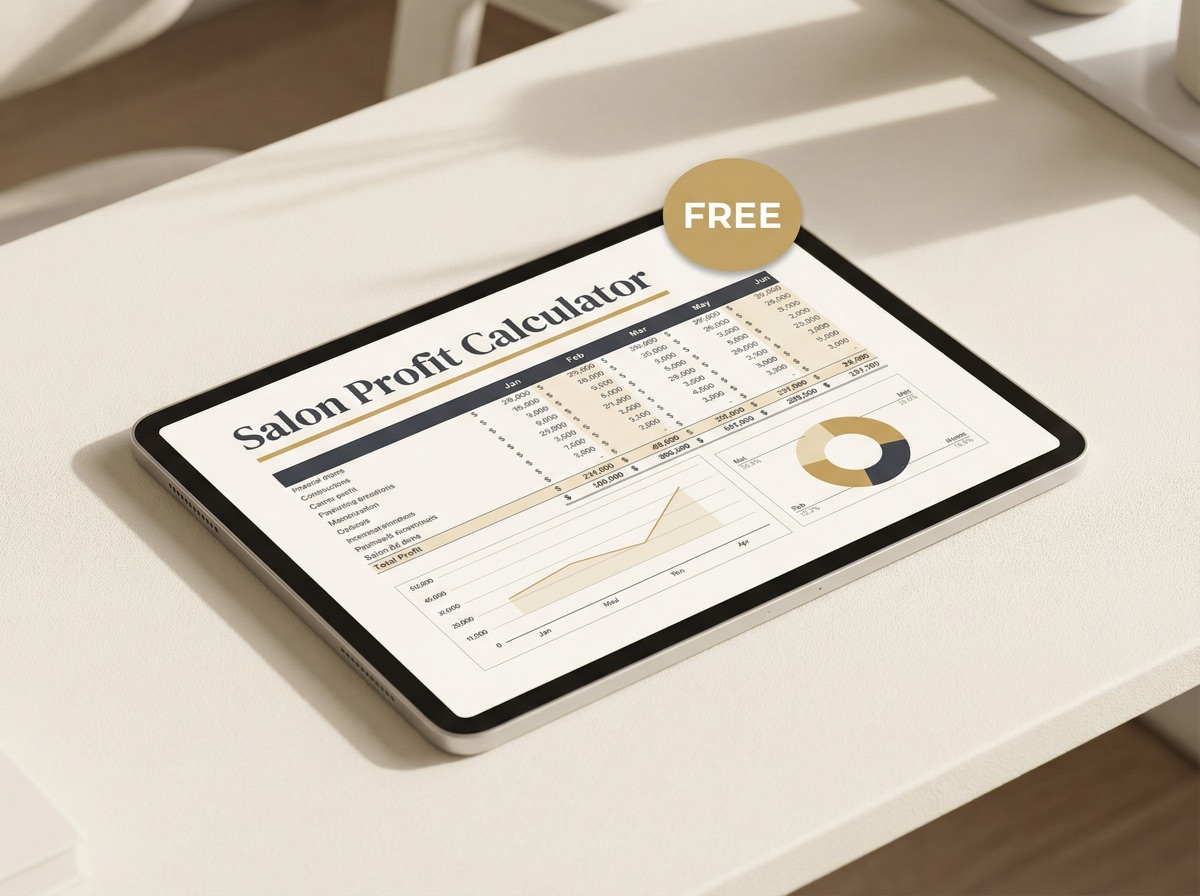
Written by Scott Farmer
Licensed Master Cosmetologist (GA & FL), former Toni & Guy Artistic Director, and founder of Hair Salon Pro. 30+ years behind the chair. 15,000+ clients. Building the business tools cosmetology school never taught. Currently behind the chair at scottfsalon.com in Venice, FL.