Salon Service Menu Pricing: Build Your Full Menu From Scratch in One Afternoon
 Scott Farmer
·
May 13, 2026
·
11 min read
Scott Farmer
·
May 13, 2026
·
11 min read
TL;DR

- The 4-component pricing formula: Every service price = time cost (hours x your target hourly rate) + product cost + overhead allocation + 15% to 20% profit margin. At an $80,000 income target, your minimum hourly floor is $63.66.
- Most salons leave 15% to 25% of revenue on the table every year because stylists price by gut or by competitor, not by their own cost structure. On a $96,000 gross book, that is $14,400 to $24,000 in annual revenue never collected.
- Real numbers from Venice, FL: My women’s cut is $75 (45 to 60 min, $63.66 time floor + $5 product + $6 overhead + margin). My balayage is $265 (3 hours, $190 time floor + $28 product + $25 overhead + margin). Both clear my cost floor with margin intact.
- According to the Bureau of Labor Statistics (SOC 39-5012), over 670,000 hairdressers and cosmetologists work in the U.S. The ones who build sustainable careers price color for profit, not volume.
- Scott Farmer, Licensed Master Cosmetologist, Gwinnett’s Best Hairstylist 2020, former Toni and Guy Artistic Director, founder of JScott Salon in Lawrenceville, GA. 30+ years behind the chair, 15,000+ clients served. Venice, FL.
Run your own numbers through the free salon profit calculator after you read this.
Last updated: May 2026
Most stylists build their salon service menu pricing backward.
They look at what the salon down the street charges. They knock off $5 to seem competitive. They add 10% when they finally feel brave enough. And then they wonder why a full book still does not feel like enough money.
I spent the first three years of my career doing exactly that. I charged what felt safe. What I thought clients would accept. What I hoped would keep the chair full.
I am Scott Farmer, Licensed Master Cosmetologist and founder of Hair Salon Pro. When I built the pricing structure for JScott Salon, I finally did it the right way. From the formula up, not from the competition down. The difference in revenue was immediate. The difference in how I felt about every service I performed was even bigger.
Here is the system I use to build a complete, profitable service menu from scratch. You can do this in one focused afternoon.
Why Do Most Salon Service Menus Undercharge?
Before the formula, understand the structural problem.
Most stylists look at three things when setting service prices: what they used to charge, what competitors charge, and what feels like “too much” in their gut.
None of those three inputs are wrong exactly. But none of them are based on your actual costs, your income target, or the math that tells you what sustainable profitability looks like.
The result is that most salons leave 15% to 25% of potential revenue on the table every year, not because clients would not pay it, but because the stylist never did the math that showed them what to charge.
At my Venice salon, a women’s cut is $75 and a balayage is $265. Those are not random numbers I picked to seem upscale. They come from the formula below, applied to my real costs and my real income target. When I charge $265 for a balayage, I know exactly what it costs me, what I keep, and why that number works.
Let me show you how to build that same certainty into every line of your menu.
What Are the 4 Cost Components of Every Salon Service?
Every service price has four parts: time cost, product cost, occupancy allocation, and profit margin. If you are guessing at any of them, your pricing is off.
I walk through the full income-goal math, billable-hours calculation, and a complete worked example in the salon pricing formula guide. For this menu build, use a stylist targeting $80,000 a year on 1,728 service hours. That works out to a $63.66 hourly floor, the number every price below is built from.
Add your real product cost for each service, your occupancy allocation (booth rent divided by service hours), and a 15% to 20% margin on top of that floor. Here is what that looks like across a real menu.
How Do You Price Haircuts on Your Menu?
This is where most stylists undercharge the most, because cuts feel simple and fast. But your time has the same value whether you are cutting or coloring.
Women’s cut (45-60 min): Floor price at $63.66 per hour = $47.75 to $63.66 in time cost alone. Add product ($3 to $5 for shampoo and style product) and overhead ($4 to $6). Before margin: $55 to $75. With 15% margin: $63 to $86 minimum.
Men’s cut (30-45 min): Same calculation. Floor: $32 to $48 in time. With product and occupancy cost: $38 to $58. With margin: $44 to $67 minimum.
At my salon in Venice, I charge $75 for women’s cuts and $45 for men’s. Both clear my floor with margin intact. I know that because I did this math.
For the full breakdown of haircut pricing tiers from $55 to $130, read How to Price a Haircut: The Math Behind Every Tier. That article covers the positioning behind different price points, not just the formula.
How Do You Price Color Services on Your Menu?
Hair color services should be your highest-margin category because product cost is real and your skill premium is significant. Do not let this become your lowest-margin category by underpricing. According to the Bureau of Labor Statistics, over 670,000 hairdressers work in the U.S., and the ones who build sustainable careers are the ones who price color for profit, not just volume.
Single process hair color (90 min): Time cost: $95.49. Product: $12 to $18 (depending on hair volume). Overhead: $12.50. Total floor: $120 to $126. With 15% margin: $138 to $145 minimum.
Balayage (2.5 to 3.5 hours): Time cost: $159 to $223. Product: $22 to $35. Overhead: $21 to $29. Floor: $202 to $287. With 15% margin: $232 to $330 minimum depending on hair length and service complexity.
A common industry mistake is pricing balayage based on what clients will “accept” rather than what it actually costs. If your balayage takes 3 hours and you are charging $150, you are losing money every single time you do one. When I was a Toni and Guy Artistic Director, we did these breakdowns for every service category and it changed how the entire team thought about pricing.
For the broader strategy of pricing your color services as a system, read How to Price Salon Services: The Strategy Behind the Numbers.
How Do You Price Treatments and Add-Ons?
Treatments are often priced too low because they feel like “extras.” They are not extras. They are services with real time, real product costs, and real skill involved.
Keratin/smoothing treatment (2 to 3 hours): Use the same formula. At a $63.66 hourly floor, a 2.5-hour service starts at $159 in time alone, before product (typically $15 to $25 for the treatment product) and occupancy cost. Floor: $190 to $210. With margin: $218 to $241 minimum.
Deep conditioning/bonding treatment add-on (20 to 30 min): Time cost: $21 to $32. Product: $3 to $8. Overhead: $2 to $3. Floor: $26 to $43. With margin: $30 to $50 minimum.
How Do You Price Styling Services on Your Menu?
Blowouts and styling services are where many stylists undercharge because they feel quick. But a 45-minute blowout at $25 is a net loss when you do the math.
Blowout (45 min): Time cost: $47.75. Product: $3 to $5. Overhead: $6. Floor: $57 to $59. With margin: $65 to $68 minimum.
Most markets bear $55 to $85 for a professional blowout. If yours is below $55, you are subsidizing your clients’ hair appointments with your own time.
How Do You Price Package and Bundle Deals?
A package is not a discount. It is a way to raise your average ticket while the client feels like they got more.
Bundle a color service with a treatment add-on and price the package 10% to 15% below what the two services would cost separately, not more. A single process hair color at $140 plus a bonding treatment at $40 totals $180 separately. Price the package at $160. The client sees savings. You still clear your floor on both services and add revenue you would not have booked otherwise, since most clients skip the add-on when it is offered alone.
Build 2 to 3 standing packages around your highest-margin services: a color and gloss package, a cut and deep-conditioning package, a bridal or event package that bundles styling with a trial run. Give each package a real name. “The Refresh Package” sells better than “Color Plus Treatment.”
Do not build a package around your lowest-margin service. Bundling a $45 blowout with a free product sample loses money twice.
What Pricing Strategy Fits Each Service Category?
Not every service on your menu needs the same pricing strategy. Volume services, profit-driver services, and add-ons behave differently, and your pricing should match.
For haircuts and basic color, use a floor-plus-margin pricing strategy. These are your volume services. Clients compare these prices against other salons, so price them close to your calculated floor with a modest margin and let volume carry the revenue.
For balayage, corrective color, and extensions, use a value-based pricing strategy instead. These services are harder to compare salon to salon because the outcome varies by stylist skill. Price 25% to 40% above your formula floor and let your portfolio, not your competitor’s menu, justify the number.
For add-ons and treatments, use a margin-first pricing strategy. These carry the lowest time cost and the highest margin percentage on your entire menu. Make them easy to say yes to at checkout, since the profit comes from the volume of add-ons sold, not the price of any single one.
How Should You Organize Your Salon Service Menu Structure?
Once you have your floor prices calculated, your menu structure affects how clients perceive your pricing and what they choose.
Lead with your mid-tier service. The first price clients see anchors everything else. If your least expensive cut is $35, your $75 cut feels expensive. If your women’s cut starts at $65 and you offer a signature experience at $95, both feel reasonable.
Use good-better-best tiers where they apply. For color especially, a three-tier structure (single process / balayage / full creative color) gives clients a choice and naturally moves them toward services with higher revenue per appointment.
Name your services specifically, not generically. “Women’s haircut” is less compelling than “Precision cut and style.” “Color touch-up” communicates less value than “Root refresh with gloss finish.” Names affect perceived value.
Show time, not complexity. Clients understand “90-minute balayage” better than “partial foil highlight.” Communicate what they are buying in terms they relate to.
When Should You Review and Update Your Salon Service Menu Pricing?
Your service menu is not a permanent document. Your costs change. Your skill level grows. Your target income grows.
Review your pricing once per year at minimum. Compare your current prices to the formula above using your current costs and current income goals. If your costs have risen 8% in a year, your prices need to reflect that.
The free Salon Profit Calculator is designed to show you exactly where your current service mix is profitable and where it is leaking. If you have not run a profit audit in the last 12 months, you do not actually know which services are making you money and which ones are keeping you busy without building your income.
For the complete approach to raising existing service prices with current clients, read The Salon Pricing Formula Every Owner Needs. That article covers the income goal math and how to calculate the gap between where you are and where you need to be.
How Do You Talk to Clients About Your Salon Service Prices?
Knowing your numbers is step one. Being able to talk about them clearly is step two.
When a client asks why a balayage is $265, you do not apologize. You explain:
“That service takes me 3 hours, and I use [specific product] that gives you [specific result]. The price reflects the time and the quality of what you are getting.”
That is the whole explanation. No discount offered. No justification required. Just the reason.
After 30 years, the clients who pushed back hardest on my prices were never the ones who stayed the longest. The ones who saw the value, who understood what they were getting, they booked 8 times a year and referred their friends.
Your pricing communicates your confidence in your work. Set it at a level you can explain without apologizing. The Professional Beauty Association recommends that salon professionals review their pricing at least annually, and the most profitable stylists do it more often than that.
Frequently Asked Questions
How do I calculate the right price for a new service I have never offered?
Use the four-component formula: time cost (hours times your target hourly rate) plus product cost plus occupancy allocation plus your margin percentage. If you are adding a service that takes 2 hours, start with your hourly floor rate times 2. Add your real product cost and occupancy cost. Add 15% to 20% margin. That is your starting price. You can adjust after your first few services once you have real data on actual product use and time.
Should my service menu show prices or say “prices vary”?
Show prices. Hidden pricing is a red flag for high-value clients and attracts people who want to negotiate. Transparent pricing filters for clients who value your work at your stated rate, which is who you want. If services genuinely vary, give a starting price range: “From $65.” But avoid “prices vary” with no range. It creates friction before the appointment starts.
How do I handle clients who say my prices are too high?
Do not discount. Explain the value: the time, the product quality, the experience level. If they still push, acknowledge the mismatch professionally: “I understand, this might not be the right fit.” Some clients will leave. The clients who stay and pay your real rate are worth far more over time than the ones who stay and constantly negotiate. Read more on how to price salon services and the right framing for these conversations.
How often should I raise my salon service prices?
At minimum, once per year to keep pace with rising product and occupancy costs. Raise prices when your books have been consistently full for 6 or more weeks, which signals demand exceeds supply. A price increase in that scenario is not just acceptable, it is financially necessary. The goal is not the highest price but the price that reflects the real cost of delivering your service plus a sustainable margin.
What is the difference between a service menu pricing review and a profit audit?
Your service menu review sets the right price for each service going forward. A profit audit tells you whether your current mix of services, at their current prices, is actually producing the income you need. Both matter. The menu sets the ceiling. The audit shows you whether you are hitting it and where the gaps are. They work together. Run the free Salon Profit Calculator to see where your current numbers stand.
Free Download
Get the Salon Profit Calculator
See exactly where your salon is losing money — in under 5 minutes.
Download Free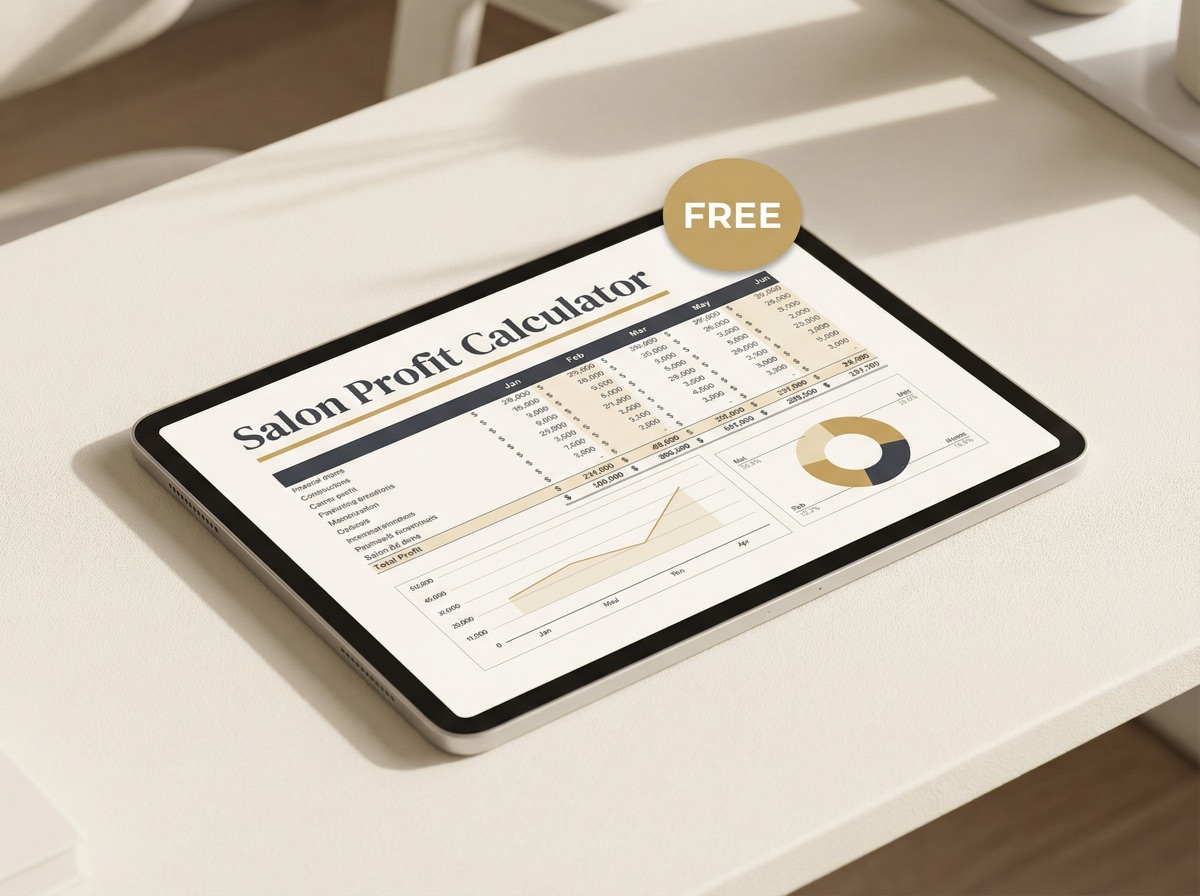
Written by Scott Farmer
Licensed Master Cosmetologist (GA & FL), former Toni & Guy Artistic Director, and founder of Hair Salon Pro. 30+ years behind the chair. 15,000+ clients. Building the business tools cosmetology school never taught. Currently behind the chair at scottfsalon.com in Venice, FL.