Vagaro vs Square Appointments (2026): A 30-Year Stylist’s Honest Take
 Scott Farmer
·
July 15, 2026
·
16 min read
Scott Farmer
·
July 15, 2026
·
16 min read
Quick Answer: Vagaro is the better salon-specific platform for most stylists. Square Appointments is the better starting point if you already run Square for retail. Vagaro wins on salon features (commission tracking, booth rent billing, no-show fees, automated reminders). Square wins on payment processing (2.6% + 10 cents vs Vagaro’s 2.75% + 25 cents) and has a free tier. Most salon owners who start on Square migrate to Vagaro within 12 to 18 months once they outgrow the generic toolset. The migration cost often exceeds a full year of the price difference.
Last updated: July 7, 2026.
I have watched four salon owners in my network switch from Square to Vagaro. Every single one said the same thing afterward: “I should have started here.”
That is not a knock on Square. Square is a great product. I used it myself for retail at my own salon before switching to a salon-specific platform. The problem is not that Square is bad. The problem is that Square was built for coffee shops, boutiques, and food trucks. Salons were an afterthought. And you feel that every time you try to set up commission splits, track retail by stylist, or charge a no-show fee without a workaround.
Vagaro was built for salons from day one. Over 200,000 salons, spas, and fitness businesses run on it. According to the Bureau of Labor Statistics, over 670,000 hairdressers, hairstylists, and cosmetologists work in the United States, and most of them rely on some form of scheduling software. That matters because bugs get caught faster, feature requests come from people like you and me, and the development roadmap is shaped by what happens behind the chair.
I am Scott Farmer, Licensed Master Cosmetologist with over 30 years behind the chair and more than 15,000 clients served. I owned and operated a multi-chair salon and worked as an independent stylist building my own book from zero, and now operate from my suite in Venice, FL. I have personally tested or demo’d both of these platforms.
Here is an honest comparison of both platforms in 2026. No affiliate bias. Here is what I have seen work and fail behind the chair.
At-a-Glance: Vagaro vs Square Appointments Comparison Table

| Feature | Vagaro | Square Appointments |
|---|---|---|
| Starting price | $30/month (1 staff) | Free (1 staff) |
| Price for teams | $30 + $10 per additional staff | $29/month Plus, $69/month Premium |
| Payment processing (in-person) | 2.75% + 25 cents | 2.6% + 10 cents |
| Payment processing (online) | 3.5% + 25 cents | 2.9% + 30 cents |
| Online booking | Yes, with Vagaro marketplace | Yes, via booking link |
| Client marketplace | Yes (Vagaro.com directory) | No |
| No-show fees | Built-in, automatic | Manual, requires card-on-file workaround |
| Commission tracking | Built-in, multiple structures | Not available |
| Booth rent billing | Built-in | Not available |
| Payroll | Add-on available | Via Square Payroll add-on |
| POS hardware | Vagaro Pay terminal | Square Reader, Square Stand, Square Terminal |
| Retail/inventory | Salon-focused | Robust, best-in-class for retail |
| Automated reminders | Email + SMS + push | Email + SMS (paid SMS on free plan) |
| Loyalty program | Built-in | Via Square Loyalty add-on |
| Mobile app | iOS + Android | iOS + Android |
| Website builder | Included | Via Square Online (separate product) |
| Integrations | Limited but salon-focused | Extensive (hundreds of apps) |
| Customer support | Phone + chat + email | Chat + email (phone on premium plans) |
| Free trial | Yes | Free tier available |
| Best for | Salon teams, commission salons, booth rent owners | Solo stylists, retail-heavy salons |
Pricing: What You Pay (Not the Sticker Price)
The sticker price comparison looks like a clear Square win. Free vs $30/month. But the real cost of salon software is never the monthly subscription. It is the total cost of ownership: subscription + payment processing fees + add-ons + the time you spend on workarounds.
Vagaro Pricing Breakdown
Vagaro charges $30/month for one staff member and $10/month for each additional staff. So a 4-chair salon pays $60/month.
That $30/month includes online booking, a marketplace listing, automated email and SMS reminders, loyalty program, forms, check-in app, a basic website, reporting, and the POS system. Commission tracking and booth rent billing are included.
Add-ons: payroll starts at $15/month plus $6 per employee. Vagaro Pay (their payment terminal) is $99 one-time or free with a 2-year contract.
Square Appointments Pricing Breakdown
Square Appointments has three tiers:
– Free: One staff, basic booking, Square POS, automated reminders (limited SMS)
– Plus ($29/month): Multiple staff, Google calendar sync, no-show protection via card-on-file
– Premium ($69/month): Team management, resource management, custom permissions
Payment processing: 2.6% + 10 cents for in-person card payments. 2.9% + 30 cents for online. These rates are the same across all tiers.
The Real Cost Comparison at $15,000/Month in Card Revenue
This is where it gets interesting. Most stylists look at the monthly fee and stop. But processing fees are the bigger number.
Vagaro at $15,000/month in card revenue:
– Subscription: $30/month
– Processing: $15,000 x 2.75% + $0.25 per transaction (assume 200 transactions) = $412.50 + $50 = $462.50
– Total monthly cost: $492.50
Square at $15,000/month in card revenue:
– Subscription: $29/month (Plus plan for team features)
– Processing: $15,000 x 2.6% + $0.10 per transaction (200 transactions) = $390 + $20 = $410
– Total monthly cost: $439
The difference: $53.50/month. That is $642 a year. Not nothing, but not a deciding factor either. And the moment you need commission tracking, booth rent billing, or no-show fees on Vagaro, that $642 vanishes because you would spend more than that in time doing workarounds on Square.
At $8,000/month in revenue (a typical solo stylist), the gap shrinks to about $28/month. At $25,000/month (a busy team salon), it widens to about $86/month.
The processing fee difference matters more at higher volumes. But the feature gap matters more than the processing fee at any volume above $5,000/month.
Online Booking and Client Experience
Both platforms let clients book online. The experience is different in ways that matter.
Vagaro’s Booking Experience
Vagaro gives you a booking page and also lists your salon on Vagaro.com, their consumer marketplace. This means potential clients searching Vagaro’s platform can discover you without knowing your salon name. It is a mini lead-generation channel.
The booking flow is clean: pick service, pick stylist, pick time, confirm. Clients can create a Vagaro account, which makes rebooking faster and enables push notifications for reminders.
The downside: Vagaro’s marketplace is a double-edged sword. Clients who find you on Vagaro are loyal to the platform, not to you. If you ever leave Vagaro, those marketplace-sourced clients may not follow. I have seen this happen twice in my network.
Square’s Booking Experience
Square gives you a booking link you can embed on your website or share directly. There is no marketplace. Clients book with you directly, which means every client relationship is yours.
The booking flow is simple and fast. Square’s checkout experience is one of the best in the industry because they have spent a decade perfecting it for millions of businesses.
The downside: no discovery channel. Every client has to find you on their own. If you are a new stylist building from zero, that matters. Vagaro’s marketplace adds 5 to 15 new client inquiries per month for well-optimized salon profiles in metro areas, based on what I have heard from owners who track this.
My take: If you have a full book and clients find you through referrals and Google, the marketplace does not matter. If you are still building clientele, Vagaro’s marketplace is a free lead channel worth testing.
No-Show Fees: Where Vagaro Pulls Ahead
No-shows cost the average salon $3,200 to $7,500 a year. That number comes from my own tracking over 30 years, and it lines up with industry data from the Professional Beauty Association.
Vagaro handles no-show fees natively. You set a no-show policy, clients agree to it at booking, their card is on file, and the fee is charged automatically if they do not show. You set the amount. You set the notice period. Done.
Square requires a workaround. On the Plus plan ($29/month), you can require a card on file at booking. But there is no automatic no-show charge. You have to manually process the charge after the fact, which means remembering to do it, which means most owners do not.
The difference between an automatic system and a manual one is the difference between recovering $4,000 a year and recovering $400.
If no-shows are killing your schedule, Vagaro’s built-in system alone is worth the platform switch. I wrote a full breakdown of how to build a salon cancellation policy that works with either platform, but the enforcement side is where Vagaro wins.
Commission Tracking and Team Management
This is where the comparison stops being close.
Vagaro Commission Features
Vagaro supports multiple commission structures: flat percentage, tiered (earn more as you hit targets), salary plus commission, and hybrid models. You can set different rates per stylist, per service category, and per retail product line.
Booth rent billing is built in. Vagaro invoices your renters, tracks payments, and reports the income separately. This saves 2 to 3 hours a month of manual bookkeeping for multi-chair owners.
Payroll is available as an add-on. Not amazing, but functional for small teams.
Square Appointments Commission Features
Square Appointments does not track commissions. At all.
If you run a commission-based salon on Square, you are tracking commissions in a spreadsheet, in QuickBooks, or in your head. None of those options scale. I ran commissions manually for two years at my own salon before switching to salon software that tracked it automatically. Those two years cost me more than $3,800 in calculation errors that I caught, and probably more that I did not. When I worked as a Toni and Guy Artistic Director, I saw the same problem at multi-location scale. Enterprise salons lose even more to manual commission math because the error compounds across stylists and locations.
Square does have team scheduling on the Plus plan, and permission controls on Premium. But the gap between “scheduling” and “full commission and payroll management” is the gap between booking software and salon software.
My take: If you have even one employee on commission, Square Appointments is not the right tool. Full stop. Vagaro, GlossGenius, or Boulevard is where you need to be.
POS, Payments, and Retail
Here is where Square fights back hard.
Square’s point of sale is one of the best in the world. Not for salons alone. For every business type. They process over $200 billion in payments annually. The hardware is sleek. The checkout experience is frictionless. The retail inventory system is robust, with barcode scanning, low-stock alerts, purchase orders, and vendor management.
If you sell a meaningful amount of retail product (shampoo, styling products, tools), Square’s retail engine is superior. I am Redken, Paul Mitchell, and Tigi certified. I have sold retail my entire career. A strong retail program adds $500 to $2,000/month for most salon owners, and the tool you use to manage it matters.
Vagaro has a POS system and retail tracking, but it is salon-first. The retail features are adequate, not excellent. Inventory tracking works. Barcode scanning works. But the depth of Square’s retail ecosystem (vendor catalogs, automatic reordering, retail analytics) is a tier above.
My take: If retail is more than 15% of your revenue, Square’s retail engine is worth serious consideration. If retail is under 10% (which is most salons), Vagaro’s retail features are fine.
Reporting and Analytics
Both platforms give you dashboards. The depth is different.
Vagaro’s reports are salon-specific: revenue by stylist, average ticket, retention rate, product cost per service, commission payouts, booth rent collected. These are the KPIs every salon owner should track, and they are built into the standard reporting.
Square’s reports are business-generic: total revenue, payment method breakdown, item-level sales, customer frequency, peak hours. Useful, but not calibrated to salon metrics. You will not find “average ticket per stylist” or “retention rate” without manual calculation.
If you want to know your salon profit margin at a glance, Vagaro’s reporting gets you closer without extra work.
Mobile App Quality
Both have mobile apps for iOS and Android. Both let you book, check schedules, and process payments from your phone.
Vagaro’s mobile app is functional but dated. The interface feels 2018. Navigation requires more taps than it should. But it does everything a salon needs on the go.
Square’s mobile app is beautiful. Fast, clean, intuitive. This is where their billion-dollar design budget shows. If you do most of your booking and checkout on a phone (common for suite renters and booth renters), the daily experience on Square is smoother.
Customer Support and Onboarding
Vagaro offers phone, chat, and email support. Phone support is available on business days. The knowledge base is deep and salon-specific. Onboarding includes data migration assistance if you are switching from another platform.
Square offers chat and email support on all plans. Phone support is limited to premium tiers. The knowledge base is massive but generic. You will find yourself searching “Square Appointments” to filter out the thousands of articles about Square POS for restaurants, retail, and other industries.
For salon-specific questions (“How do I set up tiered commission for color services?”), Vagaro support knows what you are talking about. Square support may need you to explain what commission in a salon even means.
The Migration Problem Nobody Talks About
Here is the real cost of choosing the wrong platform first.
Switching salon software costs $500 to $2,000 in hidden expenses:
– Data export: Client records, appointment history, and notes may not transfer cleanly
– Payment processor switch: New card reader hardware ($99 to $399), new processing agreement, potential gap in autopay recurring charges
– Client communication: You need to tell every active client that the booking link changed. Text, email, social post, updated Google Business Profile
– Lost automations: Every automated reminder, follow-up email, and text sequence has to be rebuilt from scratch
– Learning curve: Your team loses 5 to 10 hours learning the new system during the first month
That $500 to $2,000 almost always exceeds a full year of the price difference between the two platforms.
I am not saying never switch. I am saying pick the platform you will not outgrow in 18 months.
Who Should Pick Vagaro
Choose Vagaro if:
– You have one or more stylists on commission
– You manage booth renters and need automated rent billing
– You want built-in no-show fees that charge automatically
– You want salon-specific reporting (average ticket, retention rate, commission payouts)
– You are building clientele and want marketplace exposure
– You plan to grow beyond a solo chair within the next 2 years
Vagaro’s $30/month is not a cost. It is a tool that replaces 3 to 5 hours of manual admin per month. At $50/hour behind the chair, that is $150 to $250/month in time saved. The ROI is immediate.
Who Should Pick Square Appointments
Choose Square if:
– You are a solo stylist doing under $5,000/month in services
– You already use Square for retail and want one unified system
– You sell a high volume of retail product (15%+ of total revenue)
– You want the lowest possible payment processing rates
– You do not need commission tracking, booth rent billing, or automated no-show fees
– You are on a tight budget and need the free tier to start
Square’s free tier is a real free tier. No credit card required to start. That matters when you are launching a salon suite and watching every dollar.
Who Should Skip Both
Skip both Vagaro and Square if:
– You are a high-end, multi-location salon doing $50,000+ per location. Look at Boulevard or Mangomint instead
– You need deep marketing automation (email campaigns, loyalty tiers, review management). Look at Phorest
– You are a barbershop that needs walk-in queue management. Look at Booksy
Both Vagaro and Square are mid-market tools. They serve the $5,000 to $30,000/month solo or small-team salon well. Outside that range, there are better options.
Scott’s Verdict
If I were opening a solo suite tomorrow with $3,000/month in projected revenue, I would start on Square’s free tier. No question. Save every dollar until the book is full.
The moment I crossed $5,000/month, hired my first contractor, or needed commission tracking, I would switch to Vagaro and never look back. The $30/month buys me time, accuracy, and systems that pay for themselves ten times over.
The worst decision is starting on Square, building 18 months of client history and automations, then having to blow it all up when you outgrow it. If there is any chance you will need salon-specific features within the next year, start on Vagaro now.
Your software choice is a business decision. Run your actual numbers. See where your break-even point falls. Know your real take-home before you commit to any monthly cost. The $30/month matters a lot less than the $3,000/month you leave on the table by using a tool that was not built for your business.

Frequently Asked Questions
Is Vagaro better than Square for salons?
For most salons with employees or booth renters, yes. Vagaro was built for salons and includes commission tracking, booth rent billing, and automated no-show fees that Square lacks. Square wins for solo stylists on a budget who need a free booking tool and strong retail POS. The breakpoint is around $5,000/month in service revenue: below that, Square’s free tier is hard to beat. Above that, Vagaro’s salon features save more money than they cost.
Can I switch from Square to Vagaro easily?
You can switch, but “easily” is a stretch. Vagaro offers data migration assistance, so client records and appointment history can transfer. You will still need new payment hardware, your booking links will change (update your Google Business Profile and website), and every automated sequence will need to be rebuilt. Budget 2 to 4 hours for the switch and plan for a 1 to 2 week overlap period running both systems.
Does Square Appointments track commissions?
No. Square Appointments has no commission tracking feature. If you pay stylists on commission, you will need to track payouts manually in a spreadsheet or a separate payroll tool. This is the single biggest reason salon owners with teams outgrow Square and switch to Vagaro, GlossGenius, or Boulevard.
Is Vagaro’s payment processing more expensive than Square?
Yes, by a small margin. Vagaro charges 2.75% + 25 cents per in-person transaction vs Square’s 2.6% + 10 cents. On $10,000/month in card revenue, that difference is about $25 to $35/month. The gap is real but rarely the deciding factor. Vagaro’s built-in features (no-show fees, commission tracking) save more than the processing fee difference costs.
Does Vagaro have a free plan?
No. Vagaro’s lowest tier is $30/month for one staff member. There is a free trial available, but no permanent free tier. If budget is the primary concern and you are a solo stylist, Square’s free plan is a viable starting point. Factor in the potential migration cost when you eventually outgrow it.
Which salon software has better customer support?
Vagaro offers phone, chat, and email support with salon-industry knowledge. Square offers chat and email on most plans, with phone support limited to premium tiers. For salon-specific questions (commission structures, service categories, no-show policies), Vagaro support understands the context. Square support handles millions of business types and may need more explanation about salon-specific workflows.
What People Ask Next
Should I use GlossGenius instead of both of these?
GlossGenius is a strong alternative for solo stylists and small teams who want a modern, design-forward booking experience. It sits between Square (free but generic) and Vagaro (salon-built but more complex). GlossGenius charges a flat fee plus processing and includes a sleek client-facing booking page. It lacks Vagaro’s depth on commission and booth rent management. I compared it with Vagaro and Boulevard in my full software breakdown.
How Much Does Salon Software Cost Per Year?
Most salon owners spend $360 to $1,200/year on scheduling and POS software (subscription fees only). Add payment processing fees and the real cost is $4,000 to $8,000/year on a salon doing $10,000 to $20,000/month in card revenue. The software fee itself is the smallest piece. I covered the full cost picture in my salon KPIs breakdown.
What is the most important feature in salon booking software?
Automated no-show protection. A salon losing 3 to 5 no-shows per week at a $75 average ticket is losing $11,700 to $19,500 per year. Any software that charges no-show fees automatically (with card on file at booking) pays for itself in the first month. After that, the second most important feature is whatever matches your business model: commission tracking for team salons, or simple booking for solos.
Can I run two salon software platforms at the same time during a transition?
Yes, and you should. Run both platforms in parallel for 1 to 2 weeks during any switch. Book new appointments on the new platform. Let existing appointments complete on the old one. This prevents gaps in your schedule and gives you time to verify that client data migrated correctly before cutting off the old system.
Take the Next Step
Your salon software is one piece of the profit picture. If you are not sure whether your pricing, costs, and take-home numbers are where they should be, run a free Profit Calculator. It takes 5 minutes and shows you exactly where your money is going, so you can make decisions about software, pricing, and growth from real numbers instead of guesswork.
Already know you need to tighten up your business? The $17 Salon Owner Starter Pack includes a budget template, pricing guide, and price increase scripts that pair with whichever platform you choose.
Free Download
Get the Salon Profit Calculator
See exactly where your salon is losing money — in under 5 minutes.
Download Free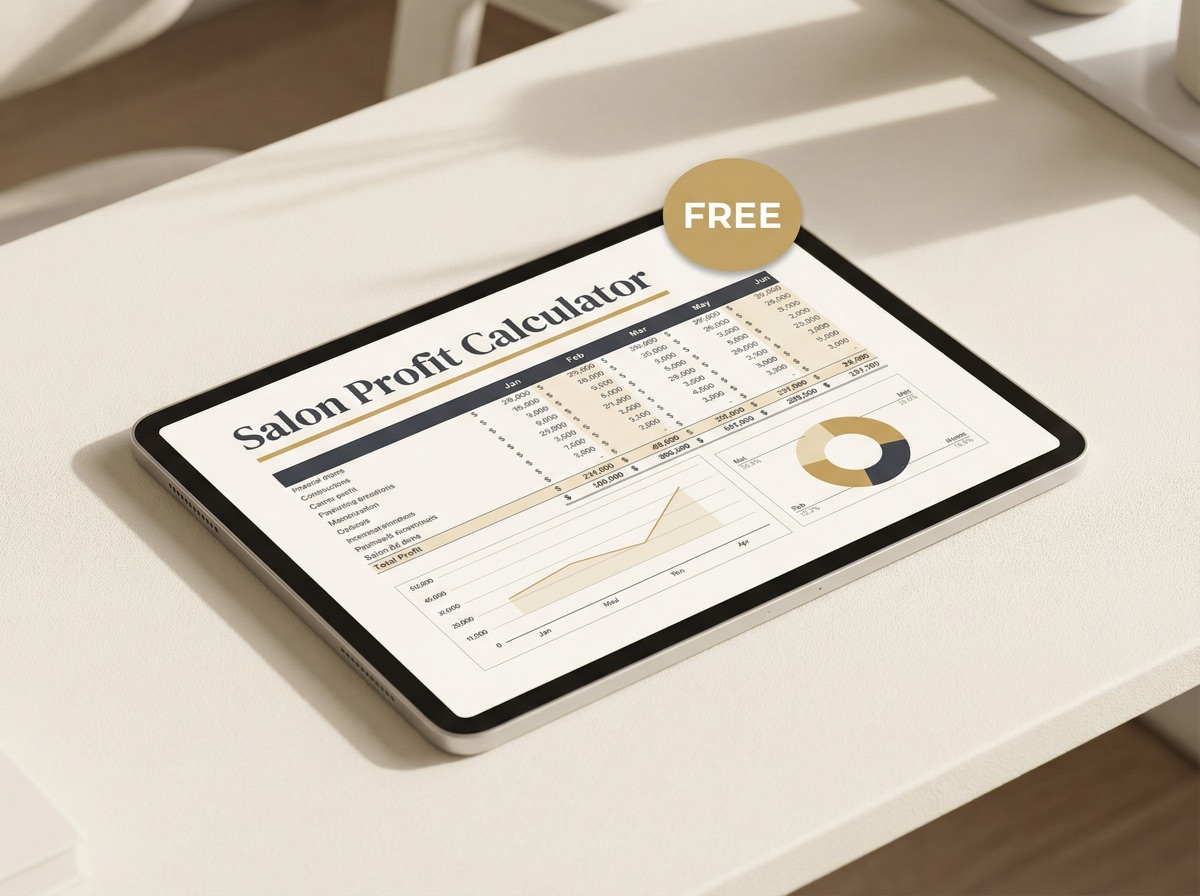
Written by Scott Farmer
Licensed Master Cosmetologist (GA & FL), former Toni & Guy Artistic Director, and founder of Hair Salon Pro. 30+ years behind the chair. 15,000+ clients. Building the business tools cosmetology school never taught. Currently behind the chair at scottfsalon.com in Venice, FL.